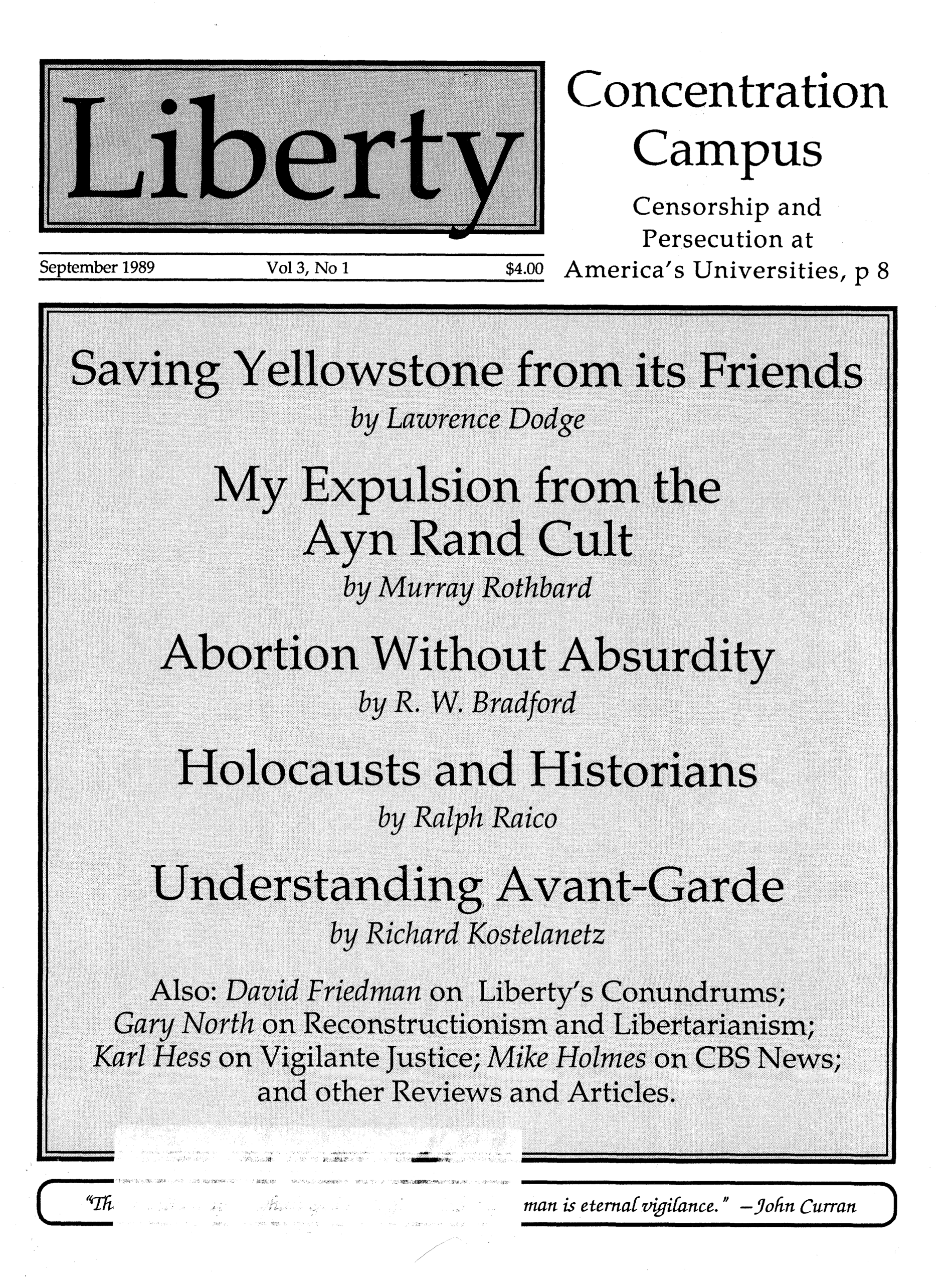
 From the vault: Murray N. Rothbard, “My Break With Branden and the Rand Cult,” Liberty (September 1988): 27–32. This issue also contains Rothbard’s entries in the Reflections section:
- “Her feet’s too big!”, p. 7: Rothbard mocks Eileen Ford (of the Ford Model Agency) for her lifelong personal hatred of Eleanor Roosevelt, which she attributes purely to Roosevelt’s appearance—calling her an “ugly old toad” with “awful size 50 feet”—rather than any political or ideological disagreement. He notes the absurdity of such superficial judgment and compares it to the Fats Waller lyric “Hate you cause your feet’s too big,” asking whether modern culture has become a living parody of that song.
- “Bennett’s Follies”, p. 11: Rothbard savages then–drug czar Bill Bennett’s proposals for “boot camps” (which Rothbard calls concentration camps) for drug dealers, mocking Bennett’s claims that they would be “spiritual-based rehabilitation centers” and “cost-effective.” He escalates the sarcasm by suggesting even cheaper alternatives such as mass execution, gas chambers, or Khmer Rouge-style clubbing, and notes Bennett’s enthusiastic agreement with a radio caller’s idea of beheading dealers. Rothbard then criticizes Bennett for “wimping out” by refusing to extend the same treatment to users, arguing that dealers merely serve consumers and that consistent logic would require torturing and executing millions of users on national television until America becomes a drug-free cemetery.
- “Sleaze!”, pp. 13–15: Rothbard analyzes the bipartisan “ethics” scandals of the late 1980s (involving figures such as Tower, Wright, Lukens, and Coelho) as a hypocritical and comic spectacle in which each party denounces the other’s corruption in high moral tones only to reverse positions when the charges are turned around. He argues that libertarians should play a “third-level” role—vindicating ordinary common sense against establishment sophistry—by treating the scandals the way Bastiat and Hazlitt treated the broken-window fallacy: the man-in-the-street correctly says “throw the rascals out,” while pundits urge everyone to ignore “trivia” and focus on the “real issues.” Since the major parties have already trivialized genuine debates (repeal of the income tax, abolition of the Fed, etc.), Rothbard concludes that the public should keep raising ethical standards higher and higher until only a saint would seek office, thereby achieving anarcho-capitalism “through the back door.”
Also in this issue:
- David Friedman, “Simple Principles vs the Real World” (September, 1989): see also “Hard Cases and Universal Principles” (July, 1990), p.39: Sheldon Richman, “How David Friedman Abuses ‘Rights’”; Friedman, “Law, Economics, and Liberty: Where Richman Goes Wrong”
- R.W. Bradford, “Bestschrift,” Liberty (September, 1989), p. 63, a review of Man, Economy, and Liberty: Essays in Honor of Murray N. Rothbard, Walter Block and Llewellyn H. Rockwell, Jr., eds. (Mises Institute, 1988)
See also—
- Rothbard, The Sociology of the Ayn Rand Cult (2), LewRockwell.com, September 12, 2002;
- Rothbard, Reflections on Mary McCarthy, the Ayn Rand Cult (Liberty, March 1989)
- Flynn, Daniel J. (2025). ”Murray Rothbard’s Lost Letters on Ayn Rand.” J. Libertarian Stud. 29, no. 2: 35–50
-
Kinsella, Rothbard’s Objectivist Influences
- Kinsella, Objectivism Schism Form Letter; I break for Randians; Breaking, Broken, Broke: Silly Objectivist Tendencies
- Ayn Rand to Mises: “You are treating me like a poor, ignorant little Jewish girl!”
- Alan Greenspan, RIP
Also: regarding the episode about Rothbard’s wife Joey refusing to convert to aheism: see this from Ayn Rand Answers: The Best of Her Q & A, ed. Robert Mayhew:
If religion is instrumental in spreading altruism, can we fight altruism in America without fighting religion?
In America, religion is relatively nonmystical. Religious teachers here are predominantly good, healthy materialists. They follow common sense. They would not stand in our way. The majority of religious people in this country do not accept on faith the idea of jumping into a cannibal’s pot and giving away their last shirt to the backward people of the world. Many religious leaders preach this today, because of their own leftist politics; it’s not inherent in being religious. There are many historical and philosophical connections between altruism and religion, but the function of religion in this country is not altruism. You would not find too much opposition to Objectivism among religious Americans. There are rational religious people. In fact, I was pleased and astonished to discover that some religious people support Objectivism. If you want to be a full Objectivist, you cannot reconcile that with religion; but that doesn’t mean religious people cannot be individualists and fight for freedom. They can, and this country is the best proof of it.
Of course, one should not forbid religion. Today’s culture is such that the moment you oppose something, people believe you want to forbid it by law. If we did that, we’d return to the Dark Ages. Leave people the right to be wrong in their own way. So long as they don’t force their ideas on you, you cannot forbid religion to anyone. Further, it’s not difficult to fight religion when you have a good philosophy.
In America, you would not find it difficult to divorce religion from altruism. After all, Christ said: “Love your neighbor as yourself.” So you must love yourself. After that, you can argue about your neighbors. [PVA 61]
Also, from the Ayn Rand Lexicon, “Religion” entry:
PLAYBOY
- Has no religion, in your estimation, ever offered anything of constructive value to human life?
- RAND
- Qua religion, no—in the sense of blind belief, belief unsupported by, or contrary to, the facts of reality and the conclusions of reason. Faith, as such, is extremely detrimental to human life: it is the negation of reason. But you must remember that religion is an early form of philosophy, that the first attempts to explain the universe, to give a coherent frame of reference to man’s life and a code of moral values, were made by religion, before men graduated or developed enough to have philosophy. And, as philosophies, some religions have very valuable moral points. They may have a good influence or proper principles to inculcate, but in a very contradictory context and, on a very—how should I say it?—dangerous or malevolent base: on the ground of faith.
***
Memoir
My Break With Branden and the Rand Cult
by Murray N. Rothbard
One of the most powerful means of controlling the members of a cult is the threat of expulsion. But this doesn’t always work.
Like thousands of other people, I have read Barbara Branden’s and Nathaniel Branden’s accounts1 of the Ayn Rand Cult. Unlike most others, I was there, and my memories diverge significantly from those of the Brandens, especially Nathaniel.
You may wonder how anyone could get involved in such a preposterous thing in the first place. I had been a libertarian since the late 1940s, and during the 1950s was lucky enough to find myself the center of a group of young, high-spirited libertarian thinkers and scholars who, if I may say so, have been unmatched anywhere. We called ourselves The Circle Bastiat,2 whose core, in addition to my wife Joey and myself, consisted of Ralph Raico, George Reisman, Ron Hamowy, Leonard Liggio, Bob Hessen, and Bruce Goldberg. There was a floating fringe of about eight or ten people. Our frequent informal gatherings combined learned discourse, high wit (most of it contributed by Raico and Hamowy), song composing, joint moviegoing, and fiercely competitive board games. It all added up to a helluva lot of fun.
Before the publication of Atlas Shrugged in 1957—that is, before Branden wove the seductive net of the Cult around her—Ayn Rand used to talk to, and even be friends with, other conservatives and libertarians. Sometime during the early 1950s I had been introduced to Rand by Herb Comuelle of the William Volker Fundan unsung and now-forgotten but marvelous organization that managed to sustain conservative and libertarian scholarship during those dark days. When Atlas was published in late 1957, I and most of the Circle admired it, and I wrote Ayn a fan letter telling her so. Then, at the importuning of the rest of the Circle who wanted to meet Ayn and the group, I agreed to renew my personal acquaintance, and there ensued about six months of (unfortunately) intense interaction between the two groups.
At the time, of course, we didn’t know that we were entering a totalitarian Cult; we naively thought we were meeting another group of libertarians or quasi-libertarians in New York. In fact, we were Present at the Creation of the organized RandCult (although we scarcely felt the thrill and pride that Dean Acheson did at the inception of the Cold War). We attended the very first series of Branden lectures on objectivism, and many of us (not me) attended a whole bunch of subsidiary lectures as well, including Nathan’s lectures on sex theory, Barbara’s on How to Think (!), and Ayn’s on fiction.
I. The First Deviation: Disobedience
The first Branden lectures began, as I recall, in January 1958; by the end of February, most of us were beginning to realize that the honeymoon was over, and that the marriage of the two groups was bound to collapse in not too long a time. The robotic, humorless posturing, the trumpeting by these ignoramuses of their own greatness, the personality cult being formed around Rand and Branden, the unrelieved nastiness toward one and all, the cigarette holders brandished by all the women, the monogrammed “dollar-sign” gold cigarette lighters everywhere, the NB monograms on every piece of Brandenian clothing, for all these and similar reasons we came to look at all these trumped-up jackasses as figures of ridicule. Rand herself was partially exempt, since she, after all, had created something.
These insights came to a head at a birthday party we held for me at our home on March 2. My wife and I had just bought ourselves a tape-recorder. Not only was it the kind you had to thread, it was one of those massive 50-pound jobs that could only sardonically be called “portable.” We proudly trotted it out to the entire Circle after the party got started. We started fooling around with the tape and the microphone, and what emerged was a true epiphany, a purely spontaneous, improvised skit satirizing the RandCult.
How could I do such a thing as imitate Rand and Branden? I tried the bromide about “imitation being the sincerest form of flattery,” but he was too shrewd to believe it. “After all,” he intoned, “you wouldn’t mock God.”
The day after this happy gathering,
one of the Circle Bastiat was out walking with one of the Randian females3 and told her about the fun he had had the day before, with various of us imitating the voices of Rand and Branden. I don’t believe he even told her about the subversive content of the skit; the very fact of such mimicry weighed on the poor girl. The awful knowledge caused her a sleepless night, after which she rushed to report this gross sin to Nathan the Great.
Blasphemy! Lèse majeste! Nathan called each of the ringleaders in turn on the carpet. Finally, I was called in. How could I do such a thing as imitate Rand and himself? I tried the bromide about “imitation being the sincerest form of flattery,” but he was too shrewd to believe it. “After all,” he intoned, “you wouldn’t mock God.” I looked at him, thinking, “Who’s God here, buster? You, Rand, or both?”
Branden then demanded that I turn the tape over to him. “Don’t tell me the tape doesn’t exist any more, because I wouldn’t believe it.” “No, it exists,” I said, “but you have no right to demand it.” Branden then conceded that he had no “right” to the tape, since, after all, it was my property, but he demanded that I give it to him anyway. I flatly refused, and that was that.
But I knew and Branden knew that from that point on my days in the Randian movement were numbered. I had flatly refused a direct order from the Fuhrer. From then on, it was just a question of what issue would constitute the official excuse for my expulsion. The crime of “disobeying a direct order from the greatest man of all time” would scarcely yield good public relations value.
II. The Gathering Storm
Deviations soon began to accumulate thick and fast; there was no shortage of critical issues. Many of us in the Circle Bastiat would fantasize about the taunts we would hurl at the Randians as we were being kicked out the door; heading the list was, inevitably, “What about Frank O’Connor?” For they all claimed to be perfect Randian heroes and heroines, whereas Frank, Mr. Rand, the only genuinely nice person in the Randian movement, clearly lacked the Randian virtues of philosophical acu-men, creativity, a driving sense of heroic purpose, and all the rest.
A. Anarchism
Most people assume that my split with the Randians must have come over anarchism vs. limited government, but the subject, though lurking in the wings, never came up. From my first meeting with Ayn, she decided to put off discussion of mere political questions until all the fundamental metaphysical issues had been hammered out. That was fine with me, since from my point of view, friendship (which is what I originally thought this was all about) should involve mutual learning and enjoyment, and not seeking out heresies for rapid conversion or excommunication. But the anarchist question was looming up, and by the end Nathan was already talking about arranging a full-scale “debate” over the issue. If for no other reason, the break/expulsion would have come shortly thereafter.
B. The Goldberg Expulsion
An ominous foreshadowing of the future came with the brusque expulsion from the RandCult of one of our leading Circle members, the budding philosopher Bruce Goldberg. The sticking point, however, was scarcely philosophical. A joint meeting of many of the Circle Bastiat and RandCult members (at which neither Rand nor I was present) turned into an orgy of Holy-Roller type testimonials in which each person, in turn, was expected to tell the assembled acolytes the answer to one crucial question: “Who has been the most intellectually important person in my life?” The answer, of course, was foreordained: The Rand. “Ayn Rand has changed my life;” “This greatest mind of all time has shown me that A is A, and that 2 and 2 make 4,” and on and on. Judgment hour hit, however, when it became Bruce Goldberg’s turn: the most intellectually important person in his life, it turned out, was Ralph Raico, who had converted him to libertarianism. “Ralph Raico!” Nathan leaped to the attack, and, in short order, Goldberg was shown the door for all time, a victim of premises that were clearly irredeemably evil. Raico, of course, departed with him.4
C. “Why Don’t You See Us More Often?”
In my last meeting with him before the break, on July 14, 1958, Branden, with elaborate casualness, asked me: “By the way, why is it you don’t see us more often?” (”Us,” of course, was the group.) I was a bit startled, since I was seeing these people twice a week, which I was coming to consider at least two times a week too many. More?
The reason I didn’t see this crew more often, and was more and more wishing I would see less, is I couldn’t stand these people. Any of them. Posturing, pretentious, humorless, robotic, nasty, simple-minded jackasses. I couldn’t very well say: “I don’t want to see more of you because I can’t stand you.” Not only would such a statement have been socially unacceptable, it would have been considered philosophically erroneous and evil. According to Randian doctrine, these were the most “rational” people in the country, if not the universe. If you wish to be rational yourself, (and if you don’t, buster, you’re in for instant excommunication or, at the very least, several grueling years of Randian brainwashing), it then follows ineluctably that you’d want to spend as much time as possible with these Most Rational People. I should be dying to spend eight days a week, if that were possible, with these super-men and super-women.
“Murray,” said Nathan,”you have plagiarized on every page from Atlas Shrugged and from Barbara’s unpublished Masters essay.” I told him that his statements were preposterous. “You will appear at your trial on Wednesday at 4,” he told me. I told him, in effect, what he could do with his trial, and hung up the phone.
I tried at first to say that I was very busy, but of course that was a feeble argument in the light of the imperious demands of Randian Reason. Branden let me off the hook for a while by concretizing his concern: “Why don’t you spend more time with Alan Greenspan?” Ahh, I was on safer ground. Greenspan was the Randian Economist, and since I too was an economist, and about the same age, we were supposed—if not required—to be simpatico. But I couldn’t stand Greenspan from our first—and fortunately only—meeting. In addition to being a Keynesian with no knowledge of or interest in Austrian economics, Greenspan was supercilious and monotonic; he had the sense of life of a dead mackerel.
“I don’t like Greenspan, Nathan.” “You don’t like Greenspan?” Clearly, a
sin that Branden had never before contemplated. “Why don’t you like Greenspan?”
“He’s a namedropper.” The understatement of the month.
“Alan—a namedropper?”
I was off the hook, for the moment. Not liking Greenspan was, I suppose, only a venial sin. But at our next meeting, the rest of the story would inevitably open up, and that would be that.
D. “The God Tape”
Whereas not liking any of this gang was going to come up at our next meeting, a less immediate but more serious reason for a break was also becoming clear and all too intense by mid-July. My wife Joey was and is a practicing Christian. I knew from the very beginning that the Randians were fanatically anti-religious, that Rand hated God far more than she ever hated the State. So I put it squarely to Branden at our very first meeting: “Is it your view that I should divorce Joey because she’s a Christian?” “Of course not,” Nathan replied, “how could you think we were such monsters?”
Branden’s answer lulled me into a false sense of security. As the months wore on, however, I came to realize that while Branden was technically telling the truth, the Randian attitude was, if possible, even worse. For no, I was not supposed to divorce Joey because she was a Christian; I was supposed to spend several months hectoring the poor girl to convert her to atheism; if that failed, I was supposed to divorce her.
Branden the Scholar! What a fearful power he thought he had loosed upon the world! Branden may have been good at winning by intimidation, and at tossing his forelock aloft and strutting up and down declaiming his greatness (what he calls being “serious about his values”). But when he started playing scholar, he was operating on my turf.
Branden’s campaign started casually. I was attending the first set of Branden’s Objectivist lectures. Nathan requested that Joey attend his refutation-of-God lecture, or, since she was going to be out of town that week, to listen to his God tape. Well, that sounded reasonable; why not? When I heard his anti-God lecture it struck me as one of the weakest of the lot. When coming to the argument from design—certainly the most powerful of theistic arguments—Branden set up an obvious straw man and proceeded to demolish it with easy ridicule. Branden’s “design-argument” was of the simpleton variety: “Isn’t it wonderful that God created oxygen since man needs it to breathe?”
When I heard Branden I was sure that Joey’s immortal soul was in no danger; it would be hard to underestimate the intelligence of any religious person who would be converted by Branden’s ploy. Sure enough, Joey heard Nathan’s God tape, and was singularly unimpressed. And that was that. Or so I thought.
At my last meeting with Nathan, the same where my Greenspan Deviation had emerged, he asked, with calculated casualness: “By the way, did Joey listen to my God tape?”
”Yes.”
“Well, what did she think of it?”
“She found it … interesting.”
“Well, was she converted by it?”
“No.”
Nathan was stunned. “But, but,” he sputtered, “don’t you care that Joey wasn’t converted by my God tape?”
“No.”
Nathan drew himself up. He couldn’t understand this clearly blase attitude on my part. “If Barbara should ever show any signs of religious leanings,” he emphasized sternly, “I would lock the door and sit her down and discuss the matter until we had come to a complete agreement.”
“I really did not know,” Mises wrote, ‘”that the concept that man has no automatic knowledge of how to survive and that the task of his reason is to discern the values and virtue needed to keep him alive’ was not known to mankind before the fall of 1957.”
As Nathan droned on, the Randian path blocked out for me became all too clear: I was to give Joey a reasonable amount of time to convert or else, subjecting her to intense pressure all the while. Nathan also made it clear that I was supposed to drop my other religious friends as well, such as Leonard Liggio. I never bothered to ask whether I was supposed to drop them immediately or pressure them to convert first. I’d had it with Branden and his whole bunch.
That day, I had given Branden as a courtesy a copy of a paper I had written for a conference to be held that fall by the William Volker Fund on Scientism and the Study of Man. The article, “The Mantle of Science,”5 was a Misesian critique of scientism—in particular behaviorism and organicism, expanded to be grounded in an Aristotelian-Thomist defense of free will. I had thought that Branden and Rand would be interested. Little did I realize just how interested they would be.
III. The Break: the Plagiarism Canard
The next day, July 15, 1958, as I sat down at my typewriter writing a letter to Branden kissing him and the whole bunch off, I received my final phone call from Branden. “Murray, you have plagiarized on every page from Atlas Shrugged and from Barbara’s unpublished Masters’ essay” (which he had urged me to read). I told him that his statements were preposterous. “You will appear at your trial on Wednesday at 4,” he told me. I told him, in effect, what he could do with his trial, and hung up.
The trial was held, in absentia of course, to the tune of general denunciations, reading from the Evil One’s works, etc. A few days later I received a letter from Branden dated July 16 reiterating the plagiarism charge, citing eleven specific instances to which I must answer, and issuing “a simple ultimatum”:
Unless, within a week, you present evidence that original authorship of all the above points will be acknowledged in your paper, Ayn’s and Barbara’s lawyer will send a letter to the head of the symposium, informing him of the issue in detail, and presenting quotations from the three works in question that will incontestably establish what you have done. The only other alternative is for you to withdraw your paper from the symposium altogether—and, frankly, this is what I would advise.
I did not respond, so Nathan sent a detailed list of charges (July 20) to me and, via the law firm, to Helmut Schoeck, the director of the conference.
Branden the Scholar! What a fearful power he thought he had loosed upon the world! It was clear that he was convinced that, once he laid out the detailed charges, aided by a bit of legal threat, then my iniquity would be exposed, I would be booted out of the Scientism conference, and I would lose my job as reviewer and analyst for the Volker Fund.
What a potz! Branden may have been good at winning by intimidation, and at tossing his forelock aloft and strutting up and down declaiming his greatness (what he calls being “serious about his values”). But when he started playing scholar, he was operating on my turf. And the problem with Rand, Branden, and the rest of the crew is that these were dazzlingly ignorant people. Rand was proud about never having read any philosophy except a third-rate history of philosophy by B.A.G. Fuller. She was convinced that any philosophical thought she ever had must have been original; no one could have anticipated her greatness. Her followers, from Branden on down, maintained this tradition.
Branden’s long letter began with the absurd statement that my “entire paper” had been written in Ayn Rand’s “philosophical framework”—absurd because to anyone with brains it was obvious that the paper was written in the Misesian framework, and that the entire disputed portion of my paper consisted of only five out of the twenty-five manuscript pages of the article.
And so Branden’s lengthy letter of July 20 listed ten charges of plagiarism against my article, demanding footnotes to Atlas and to Barbara’s masters’ essay on every point, else I would have to “take the consequences” of my action. (Ooh! Scary!) He graciously consented to letting me off the hook on Charges 2, 4, and 6. Interestingly, Branden quietly dropped an eleventh charge that he had made in his original letter of July 16: namely, that I had plagiarized Barbara’s great, original point that accepting other peoples’ judgments uncritically is not the same thing as being determined by them. Unfortunately, a mutual friend had leaked to Branden in the interim that I had indeed “plagiarized” this point—but from myself in an article I had submitted to an economic journal in 1954—three blessed years before encountering the RandCult!
He concluded by reiterating his threats and warning me that he really had the goods on me:
I might mention that there are several witnesses to the fact that, when reading “Human Freedom and Human Mechanism” [Barbara’s masters’ thesis], you took exceptionally detailed notes on it, which are still in your possession …
Needless to say, I shall certainly make it my business to learn whether or not a paper by you is presented at the symposium, and, if so, what is its content …
It is impossible for me to comply with your request that I return my copy of your essay. Under the circumstances, I have every rational right to keep the objective evidence of that of which I am accusing you.
The quintessence of my reply to the charges was contained in a short and not-sweet letter to Branden on August 16:
You are apparently laboring under several serious misapprenhensions. In the first place, it is not true that any idea that I write which is not footnoted is “passed off as my own.” Originality is not claimed for ideas in books or articles unless such originality is specifically proclaimed. If this were not true, very few books or articles would ever be written in philosophy or the social sciences, and those would be clogged by a vast morass of footnotes … Secondly, the ideas which you charge me with taking from Atlas Shrugged and Barbara Branden’s essay are neither theirs nor mine; on the contrary, they are a part of the philosophical heritage of Western civilization, and can be found in innumerable rationalist writers. Of the many people at all versed in philosophy who have read my paper, not one thought these ideas were original, and not one failed to state that these were ideas that he had encountered many times before.
Helmut Schoeck, the distinguished German sociologist and author of Envy, then teaching at Emory University, got the Branden-law firm missive on vacation in Austria. His reaction was even more caustic and horrified than my own. Writing to his colleague James Wiggins, chairman of the Scientism conference, Schoeck wrote (August 13):
This morning I did not quite believe my eyes … when the enclosed letter and material from the law firm of Ernst, Can & Berner arrived…. The apparatus [of legal threats] is so utterly out of proportion to what they seek (a few footnotes giving credit) that their primary aim seems to be the destruction of Dr Rothbard as a human being.
A study of Nathaniel Branden’s letter to Dr. Rothbard shows that a fantastically ludicrous claim of plagiarism is being made but none of the ideas [that] Rand and Brandens claim can any longer be considered private literary property. They are part and parcel of hundreds if not thousands of books and treatises which were published in the past sixty years, in some cases the past few hundred years. Item No. 6 [“consciousness is a primary”], for example here Rene Descartes, a few hundred years ago, has written as much.-The long item No. 7 of the complaint [showing that determinism is in self-contradiction]; all that has been rehashed in hundreds of arguments ever since Friedrich Nietzsche, the Marxists, and Sigmund Freud began to relativize intellectual positions. It is a well known argument taught in any introductory course in logic. Most ridiculous of all is item no. 10 on which the plaintiffs base most of their case: [a point supposedly original with Barbara] the example of the savage or child who does not respond to a gun [an argument I, along with dozens of authors, was making against behaviorism] can be found in every textbook on social psychology, social control and related subjects for the past sixty years or so. I have used this example spontaneously in many lectures. It is the most obvious one to come to the mind of anyone trying to make that point.
Schoeck added that my only error in all this was to get involved with these people in the first place, a point with which I, of course, heartily agreed.
The response to this affair I cherished the most was that of my dear mentor, Ludwig von Mises. I sent a copy of the Branden charges to him in New Hampshire, where he was vacationing. Mises replied promptly on July 22, employing a level of sarcasm that I had never seen him use: “I really did not know ‘that the concept that man has no automatic knowledge of how to survive and that the task of his reason is to discern the values and virtues (the ends and means) needed to keep him alive’ was not known to mankind before the fall of 1957.” Mises also dismissed Branden’s outrageous claim that Barbara had invented the crucial distinction between freedom and power: “Did Mrs. Branden, in pointing out that one must not confuse ‘freedom’ and ‘power,’ acknowledge Hayek’s Road to Serfdom?”6
A week later (July 30), Mises wrote me a follow-up letter after a further examination of Branden’s charges. He turned to No. 10, the “savage,” the “child,” and the “gun,” which had drawn the wrath of Helmut Schoeck.
It is true you used the example of the savage or the child in order to illustrate the proposition that the reaction depends on the meaning the actor ascribes to the stimulus. I pointed this out again and again in order to refute the crude behavioristic stimulus-response scheme, for the first time in an article “Begreifen und Verstehen,” published before 1933 and reprinted in “Grundprobleme” in 1933 … But I never claimed authorship of this fundamental idea. Neither did Max Weber (died 1920). Perhaps one has to credit Droysen or Dilthey.
Mises concluded sweetly by advising me to “be calm and wait,” adding that “it is useless to argue with B.”
Helmut Schoeck had concluded his letter to Wiggins:
I suggest that Dr. Rothbard ignore these crackpots and that he, with our help, get quotes for each of the disputed paragraphs of course preceding in time the publications of the plaintiffs. They can be found easily.
These were dazzlingly ignorant people. Rand was proud about never having read any philosophy except a third-rate history of philosophy by B.A.G. Fuller. She was convinced that any philosophical thought she ever had must have been original; no one could have anticipated her greatness. Her followers, from Branden on down, maintained this tradition.
Barbara had originated, and all were published from the 1930s to the 1950s—all before the publication of Atlas. I needed no more help than that. And most delicious of all, almost every one of these quotes was from a Dominican or Jesuit priest, exemplars of the Christianity that had been one of the major reasons for our break in the first place.
I sat down and wrote a detailed reply to all of the charges, incorporating the new quotes. I sent it to the Volker Fund. Justice triumphed. My paper, with the new citations, was published in the Scientism volume. The reader is invited to check all this for himself: Murray N. Rothbard, “The Mantle of Science,” in H. Schoeck and J.W. Wiggins, ed., Scientism and Values (Princeton, N.J.: D.Van Nostrand, 1960, pp. 159–180). The lovely sources, mainly Thomist, bolstering points allegedly stolen from Rand and Branden originals, can be found in footnotes 3–12. The article was well received, though every once in a while, someone would ask me, “it’s a good article, but why do you have all those footnotes to points that are a basic part of Western philosophy?” And then I tell the story.
For several months after the break, mutual acquaintances carried information back and forth between us. When the dust had settled, and the Volker Fund had in effect told Branden where to stuff his charges, Branden told a friend: ”Well, even if all of my charges are wrong, Murray’s greatest sin was to hang up on me”—thereby refusing to recognize the legitimacy of the Randian “judicial” process. I was greatly amused a decade later to read Barbara’s account that her greatest sin in Randian eyes was not showing up for her trial. Can you imagine the psyche of someone who would meekly respond and actually show up for his or her “trial”?
I had thought that publication of my article, cum footnotes, would finish the matter. But apparently Branden has forgotten. The old plagiarism baloney is trotted out as if this were still mid–1958, and Nathan were still the Enforcer.
Well, as far as I am concerned, he still is. Old Branden or New Branden, Randian shrink or Biocentric shrink, student or Ph.D., young or old, he’s still the same pompous ass, the same strutting poseur and mountebank, the same victim of his own enormously excessive self-esteem. Judgment Day confirms that assessment in spades. Certainly, in recounting my own case, Branden seems to forget the superficial recantation of his role as St. Paul and Grand High Inquisitor of the Randian movement, and slips easily back into the old loony prosecutorial role that he elsewhere claims to renounce. In my case at least, he seems to have forgotten much and learned nothing, dredging up the old “plagiarism” canard that I had stuffed down his gullet over thirty years ago. His copious sins of omission and commission make his account of our break simply not to be believed; it certainly does not inspire confidence in the veracity of the rest of his self-serving memoir.
There must be no more Rands, no more Brandens, no more tinpot enforcers and petty despots in our midst. We all need to realize that there will be no such Enforcers ever if we only deprive them of the Sanction of the Victim.
IV. Epilogue
I did not hear from Branden again for nearly thirty years. In July, 1986, I reviewed Barbara’s The Passion of Ayn Rand for American Libertarian (July 1986, p. 7). Then suddenly, a letter from Nate the Great! It almost achieved the status of being friendly. Of course, he wanted something from me.
I had referred in my review to the “numerous lives that the [Rand] cult wrecked or crippled.” Well, of all things, Branden wanted my help, in doing research for his book, in discovering the names of those whose lives he had wrecked.
What chutzpah!
Naturally, I did not reply.
- The Passion of Ayn Rand, by Barbara Branden (Garden City, N.Y.: Doubleday & Co, 1986); Judgment Day, by Nathaniel Branden (Boston: Houghton Mifflin, 1989). Cf. ‘Who is Nathaniel Branden?” Liberty, July 1989, pp.57–65. [↩]
- Named for Frederic Bastiat, noted 19th-century classical liberal. [↩]
- Vivian Greczka, who had followed Randian custom by changing her name to Grant. [↩]
- An imaginative reconstruction of the incident, as well as of my break with the RandCult, can be found in Jerome Tuccille’s hilarious It Usually Begins with Ayn Rand (New York: Stein and Day, 1971). While Tuccille’s account was not always historically accurate, he perceptively caught the spirit of the entire affair. [Ed. note: see also Hoppe, quoted in Ayn Rand to Mises: “You are treating me like a poor, ignorant little Jewish girl!”: “Among some followers of Austrianism, the Kant interpretation of Ayn Rand (see, for instance, her Introduction to Objectivist Epistemology [1979]; or For the New Intellectual [1961]) enjoys great popularity. Her interpretation, replete with sweeping denunciatory pronouncements, however, is characterized by a complete absence of any interpretive documentation whatsoever. On Rand’s arrogant ignorance regarding Kant, see B. Goldberg, “Ayn Rand’s ‘For the New Intellectual,’” New Individualist Rev., vol. 1, no. 3 (1961).” Hans-Hermann Hoppe, Praxeology and Economic Science (1988), later included in idem, Economic Science and the Austrian Method (Auburn, Ala.: Mises Institute, 1995), at 45 n.14. See also Stephan Kinsella, “The Undeniable Morality of Capitalism,” in Legal Foundations of a Free Society (Houston, Texas: Papinian Press, 2023), p. 604.] [↩]
- Rothbard, “The Mantle of Science,” in Economic Controversies (Auburn, Ala.: Mises Institute, 2011). —Ed. [↩]
- Chicago: University of Chicago Press, 1944. [↩]
Discover more from The Property and Freedom Society
Subscribe to get the latest posts sent to your email.


















 Alessandro Fusillo
 Andreas Tögel
 David Dürr
 Doug French
 Fernando Chiocca
 Greg Morin
 Hans-Hermann Hoppe
 Jay Baykal
 Jayant Bhandari
 Jeff Deist
 Jeffrey Barr
 Juan Fernando Carpio
 Ken Yamarashi
 León Isidoro
 Martin Cabrera
 Nick Hoppe
 Oscar Grau
 Peter Wong
 PFS
PFS scholarium
 Saifedean Ammous
 Sean Gabb
 Sean Ring
 Stephan Kinsella
 Stéphane Geyres
 Thomas Jacob
 Tom DiLorenzo