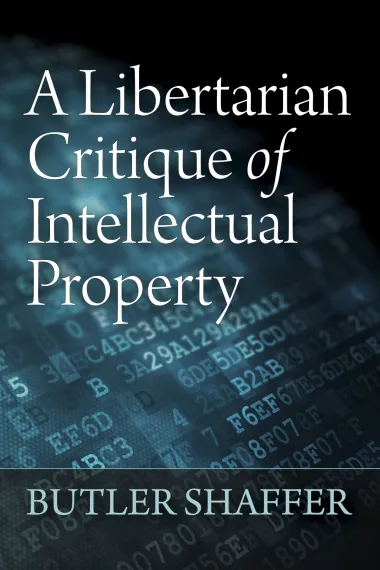
 On November 20, the Mises Institute’s Power & Market blog ran “Butler Shaffer’s ‘Libertarian Critique of Intellectual Property,’” bylined to Butler Shaffer, who died in 2019.1 It isn’t new. It’s the catalog blurb for Shaffer’s 2013 monograph, recycled as a blog post that invites readers to “Read Shaffer’s full book—first published in 2013—for free here on mises.org.” I liked Butler. Good guy. And to his credit, he opposed IP, even if his case was not as profound or important as David Gordon has hyperbolically claimed. MI’s choice of which anti-IP work to keep pushing is telling. So is the license it slapped on the post.
1. Promoting the Weakest Case
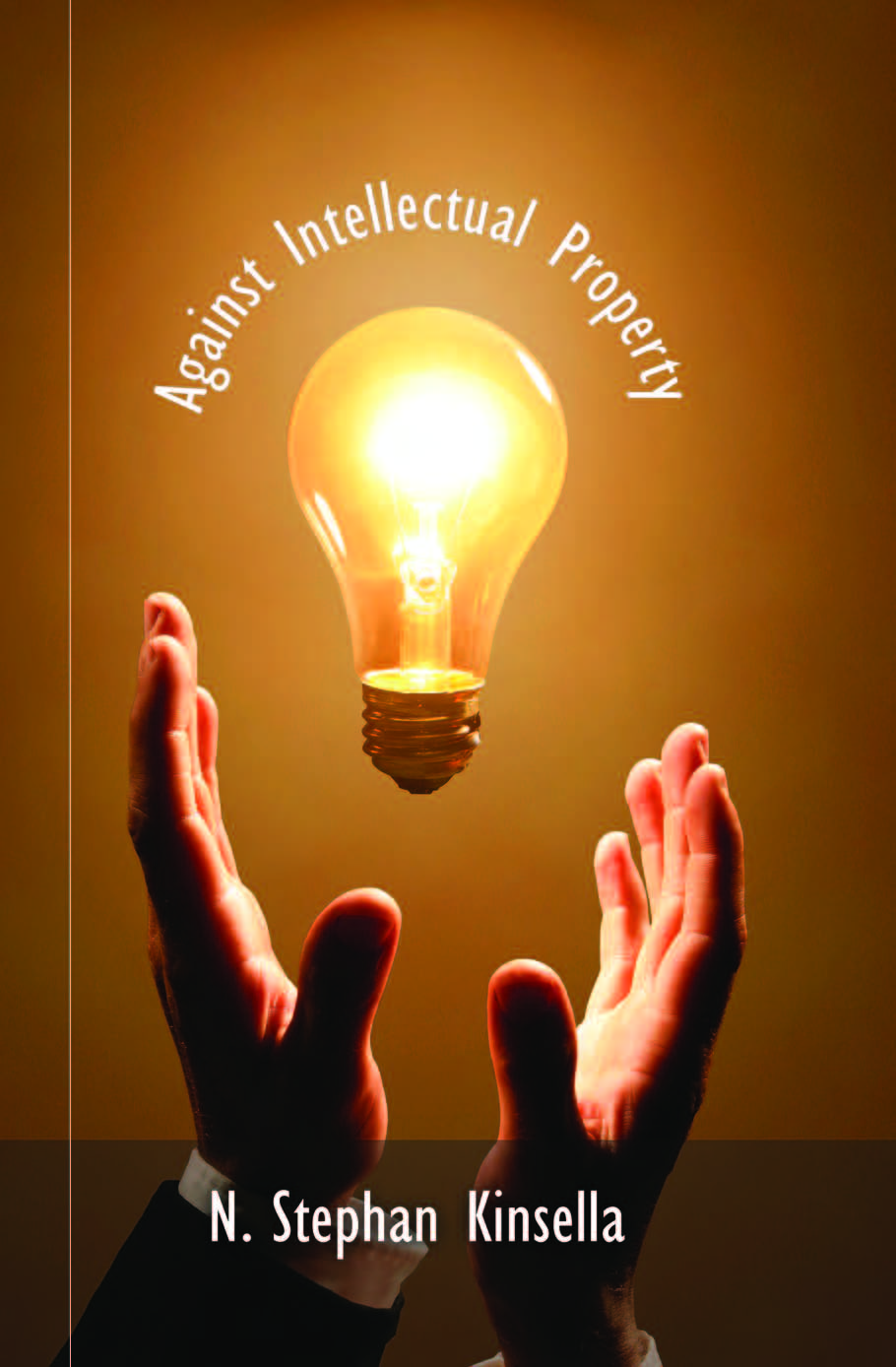
MI used to promote my work on IP. It published my Against Intellectual Property as a monograph in 2008, and the Mises Store still describes it this way:
This essay will change the way you think about patents and copyrights. Few essays written in the last decades have caused so much fundamental rethinking. It is essential that libertarians get this issue right and understand the arguments on all sides. Kinsella’s piece here is masterful in making a case against IP that turns out to be more rigorous and thorough than any written on the left, right, or anything in between.2
And not just in its catalog. MI gave that article, first published in its Journal of Libertarian Studies, its first O.P. Alford III Prize.3 It kept inviting me back to speak on IP: the 2008 Rothbard Memorial Lecture at the Austrian Scholars Conference, Mises University in 2009 and again in 2011, and online Mises Academy courses.4 I was a guest on MI’s podcasts and on The Lew Rockwell Show, where Rockwell introduced me by saying, “He’s really enacted a revolution in this area among libertarians.”5 After my 2009 Mises U talk, Lew emailed me: “You are an important and creative libertarian intellectual, so stay close to the Institute. It is an increasingly fruitful relationship.” A few weeks later Joe Salerno invited me to join MI’s Senior Faculty, citing my “long record of outstanding contributions to Misesian and Rothbardian political and economic thought.”6 And to this day, MI still asks me to referee submissions to the JLS.7
Then Lew Rockwell purged Jeff Tucker and Doug French, the architects of MI’s open publishing program, after telling Tucker that MI is “not the Kinsella Institute.”8 In a 2013 Oral History Project interview with Joe Salerno and Rockwell, David Gordon announced that “there isn’t, in my view, a Kinsella Revolution,” and that IP is “just a minor point that’s been blown up.”9 I keep finding occasions to quote that line. Gordon reviewed the Ayn Rand Institute’s collection on the First Amendment without once noticing that its authors champion free speech while supporting copyright, which is state censorship of thought. Not a surprise, as I noted in July, since for Gordon IP is “not one of the central issues of libertarianism.”10 Meanwhile copyright keeps old TV shows like Murphy Brown off streaming, and the EU’s “link tax” is now coming for AI chatbots.11 But sure, IP is “just a minor point that’s been blown up.” (Gee, one wonders why the Power & Market blog is bothering to promote even Shaffer’s inferior critique of IP, since it’s not a big deal. And even though it’s crippling AI.)12 And on the very day Power & Market ran the Shaffer blurb, LewRockwell.com, which once ran my “Go, Napster, Go!,” ran Charles Hugh Smith calling AI training the “theft of copyrighted content” and demanding that AI companies “Pay a 15% royalty of all revenues.”13
And that same year, 2013, MI found a safer anti-IP champion. As I recounted in “My Years with the Mises Institute”:
And then in 2013, Gordon started trying to promote a little pamphlet by Shaffer as “the” libertarian case against IP. His little barely 15 page essay was published as a “book,” stretched to 60 PDF pages by using small pages and large print and adding an index and introduction by Gordon. … Butler’s treatment of IP is a bit muddled, unsystematic and not comprehensive, and at most a minor complement to my own work on this topic. It does not even mention my work. And yet Gordon writes, in his “Introduction” (whoever heard of an “Introduction” to a “book” that is only 15 pages long?):
Intellectual Property is a difficult topic, and a lesser author could easily get bogged down in legal technicalities. Not so Shaffer. As always, he penetrates to the fundamentals.
Hmm: “a lesser author”? Gee, I wonder who he had in mind here.14
Or as I put it in “David Gordon on IP,” perhaps Gordon “preferred and praised Butler Shaffer’s short, non-systematic, non-comprehensive, nonrigorous, ad hoc and scattershot critique of IP–because it doesn’t get ‘bogged down’ in the details and thus doesn’t criticize Rothbard’s confused approach to IP.”15 That is the book MI keeps pushing: anti-IP enough to preserve MI’s anti-IP reputation, but not so systematic that anyone has to admit Rothbard got IP wrong.
Why trot it out again now? Maybe it’s a half-hearted, half-assed response to my criticisms this year of MI’s retreat from open publishing.16 Rather than reverse course and restore CC-BY, MI would rather give readers and supporters the impression that all is well and MI is as anti-IP as ever. In September, Power & Market ran Jacob D. Ott’s “The Austrian School Was Right Again: Abolish IP in the EU,” a decent anti-IP piece that opens by asserting that “The early Austrians such as F. A. Hayek and Ludwig von Mises were skeptical of intellectual property,” but never mentions my work, or Hoppe’s.17 Gee, I wonder why. In fact Mises and Hayek were not really that skeptical of IP, and neither was Rothbard; it’s modern Austro-libertarians like Hoppe and me who are.18 But as I noted at the time, “MI would probably not want me or Hans mentioned in such a piece; after all, David Gordon thinks Butler Shaffer’s 15 page unsystematic pamphlet is the real nail in the coffin of IP—and anyway, IP is ‘not a big deal.’” Ott’s piece, too, carried MI’s NC-ND badge. So don’t reprint it if you are “commercial,” whatever that means, or publish a translation! You don’t want to face years in prison or millions of dollars in fines!19
2. A CC-BY Book, Plugged Under NC-ND
 Now the irony. Shaffer’s book was licensed CC-BY. Its copyright page says it was “Published 2013 by the Mises Institute and published under the Creative Commons Attribution License 3.0.”20 That was the open publishing policy Tucker (and French) had established at MI (inspired by my anti-IP views), and it was still in place in 2013. It didn’t last. As MI haltingly crawfished away from open publishing,21 its books started carrying the far more restrictive CC-BY-NC-ND license: Walter Block’s Toward a Libertarian Society in 2014, for example, and Hoppe’s A Short History of Man in 2015. More recent books, like Ralph Raico’s The Struggle for Liberty (2025), are CC-BY-NC.22 Shaffer’s book escaped that, and it is still CC-BY. But MI’s new post promoting it, bylined to Shaffer, carries a CC BY-NC-ND 4.0 badge, the same license MI uses for Mises Wire: no commercial use, and no derivatives, which means no translations. So MI now plugs a CC-BY anti-IP book with a more restrictive notice than the book itself carries. And neither the book’s landing page nor its online HTML edition shows any license notice at all. A reader who clicks through from the post has no way of knowing the book is CC-BY unless he opens the PDF and finds the copyright page.
Nor could MI relabel the book itself NC-ND now, even if it wanted to. Not that this has stopped it from doing the same, and worse, to work it published under its old open policy. In April 2009 Tucker announced, “We put the whole of Mises.org on Creative Commons so that anybody can take anything without permission.”23 Yet articles mises.org published during those open years now carry “All Rights Reserved ©”—including Tucker’s own manifesto for open publishing, “A Theory of Open,” and several of my own IP articles.24 Mislabeling copyright isn’t just sloppy, either. As I noted in “My Years,” “it is actually potentially criminal, under 17 U.S.C. § 506(c), to put a ‘Fraudulent Copyright Notice’ on a work.”25 A Creative Commons grant is supposed to be irrevocable. The CC-BY 3.0 license is “perpetual (for the duration of the applicable copyright in the Work),” and while the licensor may later release the work under different terms, “any such election will not serve to withdraw this License.”26 As I wrote in “My Years with the Mises Institute,” about MI’s retreat from CC-BY generally:
I should note that once material is published under a permissive CC-BY license the publisher technically has no right to reverse this; but as I have noted, this is one problem of CC licenses in general; there is no bargained and signed license agreement so users have no easy way of proving they did have a license. …
[I]f I were publishing others’ work, I would be careful not to falsely put a copyright notice on it stating that I held the copyright instead of the author; nor would I change a previously granted CC-BY copyright notice to a more restrictive one, giving the false impression that the user is not free to copy under the initial CC-BY license. But hey, that’s just me.27
That proof problem is not hypothetical. A CC license is usually just a notice on a web page or a copyright page, with no signed agreement behind it, and notices can be changed or quietly dropped, just as MI quietly dropped its sitewide CC-BY footer after Tucker left. Back in 2012 I asked: “how does the random third party prove that he had permission?” And: “What if Kinsella has replaced it in the meantime with a CC-BY-NC license statement, meaning no commercial re-use is permitted?”28 So if you want to rely on the CC-BY grant for Shaffer’s book, save a copy of the PDF.
In practice, as I noted in “My Years,” the NC and NC-ND licenses are “almost the same as a standard, restrictive copyright, but unlike a normal copyright usage, which does not pretend to be open, gives the false impression that open publishing is being used, when it really is not.” After several complaints from me were ignored, I could only conclude that MI doesn’t care whether it has an open or even coherent copyright policy: “I guess noted IP expert Butler Shaffer was also not available.”27
MI’s own blurb says: “People may make contracts that limit the sale or transmission of ideas or books, but these bind only those who make them.” Exactly. But nobody signs a contract to read a blog post. As I noted years ago, “If you use a Creative Commons license, you are actually employing the copyright the state grants you–you are putting conditions or limitations on what others may do with your work.”29 The NC-ND badge’s “no commercial use” and “no derivatives” terms have teeth only because copyright law binds everyone, contract or no, which is just what Shaffer was objecting to. So MI promotes a libertarian critique of IP, one it published CC-BY, in a post wrapped in a narrower notice that depends on IP.
3. Conclusion
The fix is easy, and I proposed it in “My Years with the Mises Institute”: “The CC-BY policy previously used should be adopted again.”30
As for my own work, there is no ambiguity: anyone may use any of my work, past or future, without my permission (except for some older legal publications where the publisher, e.g. Oxford University Press, holds copyright). As my public domain dedication puts it:
In short: you may copy, publish, translate, adapt, sell, or otherwise use any of my published work, for any purpose, without asking me, paying me, or crediting me.
Saying so is harder than it should be, because copyright is very sticky. It attaches automatically the moment a work is written down, and if you want to get rid of it, “there is no clear and good way to do this.”31 As I put it in 2011, “if you don’t want copyright, you’re out of luck.” Indeed, “There is no way to make a copyright-protected work public domain. The closest thing to it is CC0, but this cannot ‘guarantee a complete relinquishment of all copyright and database rights in every jurisdiction’.”32 My websites have long carried a CC0 public domain dedication in their footers. But a footer notice covers only that site, and it’s not clear that CC0, or even CC-BY, is legally enforceable. So I have also signed a written public domain dedication (pdf) covering all my works, wherever published, including works I publish in the future.33 That includes this post. And it includes Against Intellectual Property, whatever MI’s 2008 edition says. As I have noted, “The copyright notice printed on this edition of my work is factually and legally incorrect”: MI only ever had a license to publish it, and “the copyright is held by me, not by the Mises Institute.”34 I have posted a PDF of MI’s edition with that notice struck out and a CC0 dedication added. So copy it, translate it, sell it. No need to ask.
Related
- Kinsella, “LewRockwell.com: Anti-War, Anti-State, Pro-Copyright?—From ‘Go, Napster, Go!’ to ‘Stop, AI IP Thief!’,” PFS Blog (Nov. 20, 2026)
- Kinsella, “Who Is Running LewRockwell.com? Hoppe and Others on LRC, Back When Rockwell Ran It,” PFS Blog (Nov. 1, 2026)
- Kinsella, “My Years with the Mises Institute,” Property and Freedom Journal (May 2, 2026)
- Kinsella, “David Gordon on IP,” C4SIF Blog (Jan. 8, 2025)
- Kinsella, “Mises Institute Oral History Project: The Lost Rothbard History (2013),” PFS Blog (April 17, 2026)
- Kinsella, “Objectivists Obscenely Pretend to Support the First Amendment,” PFS Blog (July 10, 2026)
- Kinsella, “The Austrian School Was Right Again: Abolish IP in the EU,” C4SIF Blog (Sept. 30, 2026)
- Kinsella, “Public Domain Dedication for Kinsella Works,” StephanKinsella.com (Nov. 14, 2026)
- Kinsella, “Copyright is very sticky!,” C4SIF Blog (Jan. 14, 2009)
- Kinsella, “Let’s Make Copyright Opt-OUT,” C4SIF Blog (April 12, 2011)
- Kinsella, “Are Creative Commons Licenses Even Enforceable?,” C4SIF Blog (Feb. 12, 2012)
- Kinsella, “Copyright is not a Verb; A Work is not “Copyrighted”,” C4SIF Blog (Jan. 28, 2026)
- KOL159 | Seminar: “Practical Solutions to the IP Trap”
- Kinsella, “On Leading by Example and the Power of Attraction (Open Source Publishing, Creative Commons, Public Domain Publishing),” C4SIF Blog (April 12, 2025)
- Kinsella, “The Influence and Significance of Human Action After 75 Years Finally in Print,” PFS Blog (May 9, 2026)
- Kinsella, “McMaken: Why Comments Sections Are Not Coming Back to Mises.org,” PFS Blog (Aug. 3, 2026)
- Kinsella, “Kinsella’s Mises Academy Courses: Libertarian Legal Theory, The Social Theory of Hoppe, Rethinking Intellectual Property,” PFS Blog (Aug. 17, 2026)
- Kinsella, “Rothbard on Intellectual Property,” C4SIF Blog (April 21, 2026)
- KOL238 | Libertopia 2012 IP Panel with Charles Johnson and Butler Shaffer (Feb. 14, 2018)
- “Butler Shaffer’s ‘Libertarian Critique of Intellectual Property’,” Power & Market (Nov. 20, 2026). [↩]
- Quoted in Kinsella, “My Years with the Mises Institute,” Property and Freedom Journal (May 2, 2026), section “Tucker and French v. Rockwell: Behind the Scenes, 2008–2012” (see the archived Mises Store page). [↩]
- “My Years with the Mises Institute,” section “Becoming ‘Mr. IP’”; see the archived awards page. [↩]
- Kinsella, KOL012 | “The Intellectual Property Quagmire, or, The Perils of Libertarian Creationism,” Austrian Scholars Conference 2008 (Rothbard Memorial Lecture, March 13, 2008); idem, KOL013 | “Intellectual Property and Libertarianism,” Mises University 2009 (July 30, 2009); idem, KOL126 | Intellectual Property and Economic Development (Mises University 2011) (July 27, 2011); idem, “Kinsella’s Mises Academy Courses: Libertarian Legal Theory, The Social Theory of Hoppe, Rethinking Intellectual Property,” PFS Blog (Aug. 17, 2026). [↩]
- Llewellyn H. Rockwell, Jr., “Intellectual ‘Property’” (interviewing Stephan Kinsella), The Lew Rockwell Show (Sept. 24, 2008); see also Jeffrey Tucker, “Rethinking Intellectual Property: History, Theory, and Economics” (interviewing Kinsella), Mises Institute (recorded Oct. 9, 2010); Kinsella, KOL302 | Human Action Podcast with Jeff Deist: Hoppe’s Democracy (Oct. 23, 2020). [↩]
- “My Years with the Mises Institute,” section “Honors, Invitations, and Senior Fellowship”; see the archived faculty page. [↩]
- “My Years with the Mises Institute,” section “Dipping One Toe Back In.” [↩]
- “My Years with the Mises Institute,” section “Tucker and French v. Rockwell: Behind the Scenes, 2008–2012.” [↩]
- “My Years with the Mises Institute,” section “Kinsella Out”; Kinsella, “David Gordon on IP,” C4SIF Blog (Jan. 8, 2025); idem, “Mises Institute Oral History Project: The Lost Rothbard History (2013),” PFS Blog (April 17, 2026). [↩]
- Kinsella, “Objectivists Obscenely Pretend to Support the First Amendment,” PFS Blog (July 10, 2026), discussing David Gordon, “How to Contradict Yourself about Rights,” Friday Philosophy, Mises Institute (Sept. 6, 2024), reviewing Tara Smith, Onkar Ghate, Gregory Salmieri, and Elan Journo, The First Amendment: Essays on the Imperative of Intellectual Freedom (Ayn Rand Institute Press, 2024). [↩]
- Kinsella, “Copyright: Why Murphy Brown is not on Streaming,” C4SIF Blog (Oct. 7, 2026); idem, “The EU’s Link Tax Comes for AI Chatbots: IP and ‘Press Publisher’s Right’,” C4SIF Blog (Nov. 6, 2026). [↩]
- Kinsella, “Libertarian and IP Answer Man: Artificial Intelligence and IP,” C4SIF Blog (Jan. 24, 2025); idem, “Whereupon Grok admits it (and AI) is severely gimped by copyright law,” C4SIF Blog (March 19, 2025); idem, “Copyright, AI, and the Great Illusion and Other AI & Intellectual Property Posts,” PFS Blog (Oct. 1, 2026). [↩]
- Charles Hugh Smith, “Wall Street and Anthropic Celebrate Looting the Creators Whose Work Trained AI,” LewRockwell.com (Nov. 20, 2026); see Kinsella, “LewRockwell.com: Anti-War, Anti-State, Pro-Copyright?—From ‘Go, Napster, Go!’ to ‘Stop, AI IP Thief!’,” PFS Blog (Nov. 20, 2026); idem, “In Defense of Napster and Against the Second Homesteading Rule,” LewRockwell.com (Sept. 4, 2000). [↩]
- “My Years with the Mises Institute,” section “Tucker and French v. Rockwell: Behind the Scenes, 2008–2012,” quoting David Gordon, “Introduction,” in Butler Shaffer, A Libertarian Critique of Intellectual Property (Auburn, Ala.: Mises Institute, 2013). [↩]
- Kinsella, “David Gordon on IP.” [↩]
- See “My Years with the Mises Institute,” section “Open Publishing Abandoned”; Kinsella, “The Influence and Significance of Human Action After 75 Years Finally in Print,” PFS Blog (May 9, 2026); idem, “McMaken: Why Comments Sections Are Not Coming Back to Mises.org,” PFS Blog (Aug. 3, 2026). [↩]
- Jacob D. Ott, “The Austrian School Was Right Again: Abolish IP in the EU,” Power & Market (Sept. 30, 2026), reposted with my comments in Kinsella, “The Austrian School Was Right Again: Abolish IP in the EU,” C4SIF Blog (Sept. 30, 2026). [↩]
- See Kinsella, “Mises on Intellectual Property,” C4SIF Blog (Sept. 22, 2012); idem, “Hayek on Intellectual Property,” C4SIF Blog (April 21, 2026); idem, “Rothbard on Intellectual Property,” C4SIF Blog (April 21, 2026). [↩]
- Willful infringement “for purposes of commercial advantage or private financial gain” is a federal crime: see 17 U.S.C. § 506(a)(1)(A). If it involves at least ten copies worth more than $2,500 in any 180-day period, it carries up to five years in prison, ten for a repeat offense: see 18 U.S.C. § 2319(b). Fines run up to $250,000 per felony count, or twice the gross gain or loss: see 18 U.S.C. § 3571. On the civil side, statutory damages run up to $150,000 per work for willful infringement: see 17 U.S.C. § 504(c). As law professor John Tehranian showed, a typical law professor’s ordinary day of emailing, teaching, and doodling could rack up “$12.45 million” in liability—“$4.544 billion in potential damages each year.” See Kinsella, “We are all copyright criminals: John Tehranian’s ‘Infringement Nation’,” C4SIF Blog (Aug. 22, 2011), discussing John Tehranian, “Infringement Nation: Copyright Reform and the Law/Norm Gap.” [↩]
- Shaffer, A Libertarian Critique of Intellectual Property (PDF), copyright page. [↩]
- Don’t try to stop me from my Louisianaisms, like “crawfishing”: “to retreat from a position: back out.” Merriam-Webster, s.v. “crawfish” (verb). Or, as I explained back in 2005, “crawfishing (how we Cajuns say backtracking).” Kinsella, “Lawyer apology,” StephanKinsella.com (March 4, 2005); see also idem, “Fun with Law Reviews: Coonass and so on,” StephanKinsella.com (Feb. 22, 2026). I have long used it for the way IP defenders backpedal: “when we point to many obvious problems with the patent system, libertarian patent advocates crawfish and say, well, I’m not in favor of that!” Kinsella, “Miracle–An Honest Patent Attorney!,” C4SIF Blog (Sept. 7, 2006); see also idem, comment (Dec. 16, 2010) on “Atlas Hefts: The Sequel!,” C4SIF Blog (Dec. 15, 2010) (“they always crawfish (retreat) when you point out these things”); idem, “Tabarrok’s Launching the Innovation Renaissance: Statism, not renaissance,” C4SIF Blog (Dec. 2, 2011) (“then he crawfishes in the very next sentence”). [↩]
- Walter E. Block, Toward a Libertarian Society (Auburn, Ala.: Mises Institute, 2014), copyright page (“licensed under a Creative Commons Attribution-NonCommercial-NoDerivs 4.0 International License”); Hans-Hermann Hoppe, A Short History of Man: Progress and Decline (Auburn, Ala.: Mises Institute, 2015), copyright page (PDF); Ralph Raico, The Struggle for Liberty: A Libertarian History of Political Thought (Auburn, Ala.: Mises Institute, 2025). See “My Years with the Mises Institute,” section “Open Publishing Abandoned.” [↩]
- “My Years with the Mises Institute,” section “The Mises Institute Goes Open Source,” quoting Tucker’s April 2009 talk “Dissident Publishing: Then and Now.” [↩]
- Jeffrey Tucker, “A Theory of Open,” Mises.org (Jan. 7, 2010); Kinsella, “The Case Against IP: A Concise Guide,” Mises Daily (Sept. 4, 2009); idem, “Intellectual Property and Libertarianism,” Mises Daily (Nov. 17, 2009); idem, “The Death Throes of Pro-IP Libertarianism,” Mises Daily (July 28, 2010); idem, “The Origins of Libertarian IP Abolitionism,” Mises.org (April 1, 2011). Each page now displays “All Rights Reserved ©.” For my own articles the notice is doubly false: MI never owned the copyright, which I have since dedicated to the public domain. [↩]
- “My Years with the Mises Institute,” section “Open Publishing Abandoned.” The statute reaches anyone who, “with fraudulent intent, places on any article a notice of copyright or words of the same purport that such person knows to be false,” and the penalty is a fine of “not more than $2,500”—no prison, unlike the infringement crimes that give MI’s NC-ND badge its teeth. 17 U.S.C. § 506(c). And MI could not own the copyright in an article its author never assigned to it: a transfer of copyright “is not valid unless an instrument of conveyance … is in writing and signed by the owner of the rights conveyed.” 17 U.S.C. § 204(a); see also 17 U.S.C. § 201. [↩]
- Creative Commons, Attribution 3.0 Unported Legal Code, §7(b); see also ibid. (“Our licenses are irrevocable.”). [↩]
- “My Years with the Mises Institute,” section “Open Publishing Abandoned.” [↩] [↩]
- Kinsella, “Are Creative Commons Licenses Even Enforceable?,” C4SIF Blog (Feb. 12, 2012). [↩]
- Kinsella, “Copyright is very sticky!,” C4SIF Blog (Jan. 14, 2009). [↩]
- “My Years with the Mises Institute,” section “Mises.org; Copyright and Open Publishing/Information.” [↩]
- Kinsella, “Copyright is very sticky!” [↩]
- Kinsella, “Let’s Make Copyright Opt-OUT,” C4SIF Blog (April 12, 2011). [↩]
- Kinsella, “Public Domain Dedication for Kinsella Works,” StephanKinsella.com (Nov. 14, 2026). The only exceptions are a few books whose copyright I assigned to publishers in the past. For practical advice on these issues, see Kinsella, KOL159 | Seminar: “Practical Solutions to the IP Trap”. [↩]
- Kinsella, “Copyright is not a Verb; A Work is not “Copyrighted”,” C4SIF Blog (Jan. 28, 2026); see also the AIP resources page. [↩]







 Alessandro Fusillo
 Andreas Tögel
 David Dürr
 Doug French
 Fernando Chiocca
 Greg Morin
 Hans-Hermann Hoppe
 Jay Baykal
 Jayant Bhandari
 Jeff Deist
 Jeffrey Barr
 Juan Fernando Carpio
 Ken Yamarashi
 León Isidoro
 Martin Cabrera
 Nick Hoppe
 Oscar Grau
 Peter Wong
 PFS
 scholarium
 Saifedean Ammous
 Sean Gabb
 Sean Ring
 Stephan Kinsella
 Stéphane Geyres
 Thomas Jacob
 Tom DiLorenzo

Follow Us!