 On the latest Law & Liberty podcast, economist Catherine Ruth Pakaluk of Catholic University of America, author of Hannah’s Children: The Women Quietly Defying the Birth Dearth, joins host James M. Patterson to talk about falling birth rates, why some educated women still choose big families, and why government baby bonuses don’t do much.
James M. Patterson and Catherine Ruth Pakaluk, “Signs of Life,” Law & Liberty Podcast (Nov. 17, 2026) (44 min.). Listen at Law & Liberty (with transcript) or on Overcast.
Summary
Method. For Hannah’s Children, Pakaluk interviewed college-educated mothers of five or more children. Her reason was that economists and political scientists rarely ask people why they do what they do. She focused on educated women because the fertility gap is widest at the top of the education distribution. Some of them work full time, some part time, and some stay home. One is “Hannah,” raised in a nominally Jewish family, who found her faith in Israel and came home with seven kids. Another is an LDS pediatrician who works two or three days a week while her husband stays home with the children.
Religion. The question isn’t whether religion matters but which kind. Most religious people don’t have big families, but most big families are religious. In Jewish, LDS, and Catholic communities alike, large families come from a committed minority, by her rough guess 10 to 20 percent of each group. What these families share is a view of marriage, of sex as tied to children, and of children as goods worth having for their own sake rather than as an add-on to an adult life. Pakaluk thinks that view appeals even to people who aren’t religious.
Education. She cites Bryan Caplan’s observation that each extra year of schooling a woman has is associated with fewer children. Her interviews were meant to test whether that comes from education itself or from the values that tend to come with it. Her answer points to the values, and she rejects the idea that the fix is less education for women.
Cost, fear, and support. Children cost money, but the usual cost-of-raising estimates are inflated, and earlier generations had more kids with less. What many women lacked was support, especially emotional and social support, and many felt isolated at home with small children. Stated money worries often mask deeper fears, and, as she puts it, “you don’t answer a fear that’s psychological with a better accounting sheet.” Besides, “having a child is what makes you ready to have a child.” The two also discuss how car-dependent suburbs make life with many kids harder; Pakaluk points to Ave Maria, Florida, where kids can get around by golf cart.
Policy. Patterson raises Hungary’s Orbán-style cash subsidies for married families, a version of which JD Vance has floated. Pakaluk’s view is that cash incentives can change the timing of births (a “tempo effect”) but, in most places they have been tried, have not raised the number of children couples have over their lifetimes. People have their own ideas about the family they want, and a few thousand dollars won’t talk a professional woman out of a career she enjoys.
Careers and timing. Women’s professional timelines are modeled on men’s, and they collide with the prime childbearing years. Men’s timelines don’t; men who marry young tend to earn more over their lifetimes. Pakaluk suggests thinking in “seasons of life”: time out for children, then a return to work, with employers valuing the management skills that running a large household builds. She herself didn’t work full time until her late thirties.
Marriageable men. One explanation for falling marriage rates is that men are deficient or the economy has failed them. The other, which she thinks gets too little attention, is that “what makes men marriageable is marriage. What makes men really employable is marriage.” She draws on George Gilder’s Men and Marriage, Steven Nock’s Marriage in Men’s Lives, Mark Regnerus’s Cheap Sex, and Kathryn Edin’s Doing the Best I Can, which shows how fragile fatherhood is outside of marriage. She also argues that lavish weddings have become status displays that delay marriage and should be scaled back. Her next book is about fathers; she has interviewed 53 of them so far.
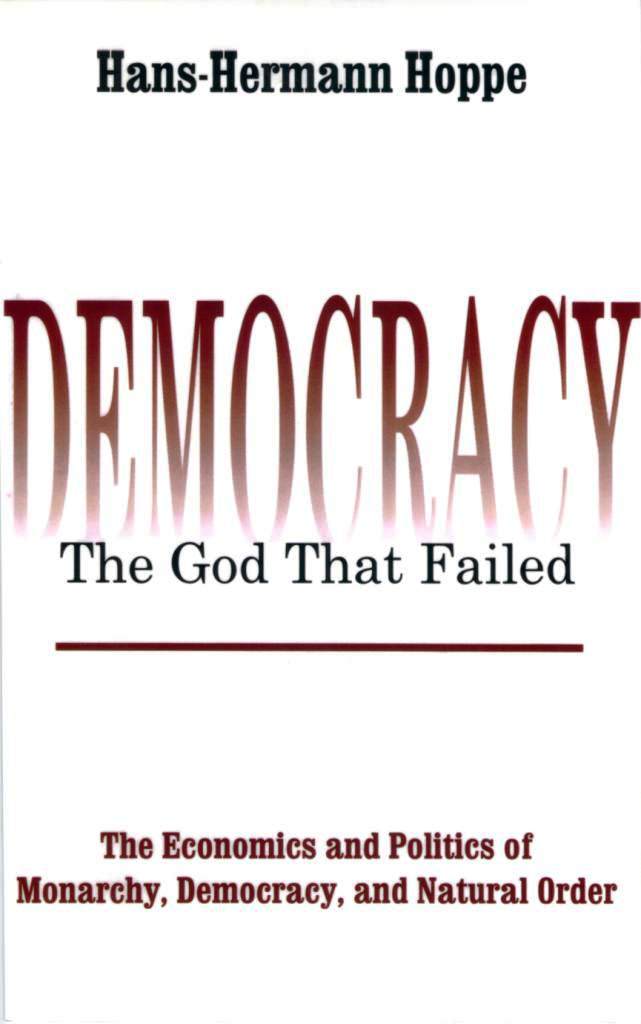
Comment. Pakaluk’s skepticism of baby bonuses is welcome: the state can’t buy a culture that values children. I’d add that the state is a big part of why that culture has eroded. Hoppe has long argued that the democratic welfare state, by socializing old-age security, health care, and education, raises time preference and lowers the value of marriage, family, and children.1 Hülsmann makes a similar case about fiat money: “Perennial inflation slowly but assuredly destroys the family.”2 And as Ryan McMaken notes, a shrinking population is a “crisis” mainly for pay-as-you-go state pension schemes.3
***
Related
- Catherine Ruth Pakaluk, Hannah’s Children: The Women Quietly Defying the Birth Dearth (Washington, D.C.: Regnery Gateway, 2024) — the book discussed in the episode, based on her interviews with college-educated mothers of five or more children
- Rachel Lu, “Breeding Immortal Beings,” Law & Liberty (Mar. 27, 2024) — a review of Hannah’s Children, arguing that these women have big families because they think children are worth the cost, so raising birth rates depends more on conveying that value than on cutting costs
- Steven J. Davis and Catherine Pakaluk, “Why Some Highly Educated Women Choose To Have Many Children,” Economics, Applied (Hoover Institution podcast) (Nov. 5, 2025) — an earlier interview with Pakaluk about the same research
- Hans-Hermann Hoppe, Democracy: The God That Failed (Transaction, 2001) — argues that the democratic welfare state raises time preference and weakens marriage, family, and the value of children
- Jörg Guido Hülsmann, “The Morality of Fiat Money,” excerpted from The Ethics of Money Production (Mises Institute, 2008), ch. 13 — argues that fiat inflation pushes people toward materialism and slowly undermines the family
- Ryan McMaken, “The ‘Fertility Crisis’ Is a Government-Caused Crisis,” Mises Wire (Mar. 15, 2019) — argues that a shrinking population is a problem mainly for state pay-as-you-go pension systems, not for a free economy
- Hans-Hermann Hoppe, Democracy: The God That Failed (New Brunswick, N.J.: Transaction, 2001), ch. 1. [↩]
- Jörg Guido Hülsmann, The Ethics of Money Production (Auburn, Ala.: Mises Institute, 2008), ch. 13, excerpted as “The Morality of Fiat Money,” Mises.org. [↩]
- Ryan McMaken, “The ‘Fertility Crisis’ Is a Government-Caused Crisis,” Mises Wire (Mar. 15, 2019). [↩]

















 Alessandro Fusillo
 Andreas Tögel
 David Dürr
 Doug French
 Fernando Chiocca
 Greg Morin
 Hans-Hermann Hoppe
 Jay Baykal
 Jayant Bhandari
 Jeff Deist
 Jeffrey Barr
 Juan Fernando Carpio
 Ken Yamarashi
 León Isidoro
 Martin Cabrera
 Nick Hoppe
 Oscar Grau
 Peter Wong
 PFS
 scholarium
 Saifedean Ammous
 Sean Gabb
 Sean Ring
 Stephan Kinsella
 Stéphane Geyres
 Thomas Jacob
 Tom DiLorenzo

Follow Us!