America’s Culture with Jeff Deist | Menger Institute Podcast #12
This is an interview of Jeff Deist by Matthew Geiger of the Carl Menger Institute for Menger Institute Podcast #12 (Aug. 1, 2026). Previous PFS-related Geiger interviews:
- Jörg Guido Hülsmann | Menger Institute Podcast #5
- KOL492 | Menger Institute Podcast #6 with Stephan Kinsella: Property Rights, Patents, Anarchy, Patents, Anarchy, Technology, Long-Term Hope for Freedom and the Technological Death of the State
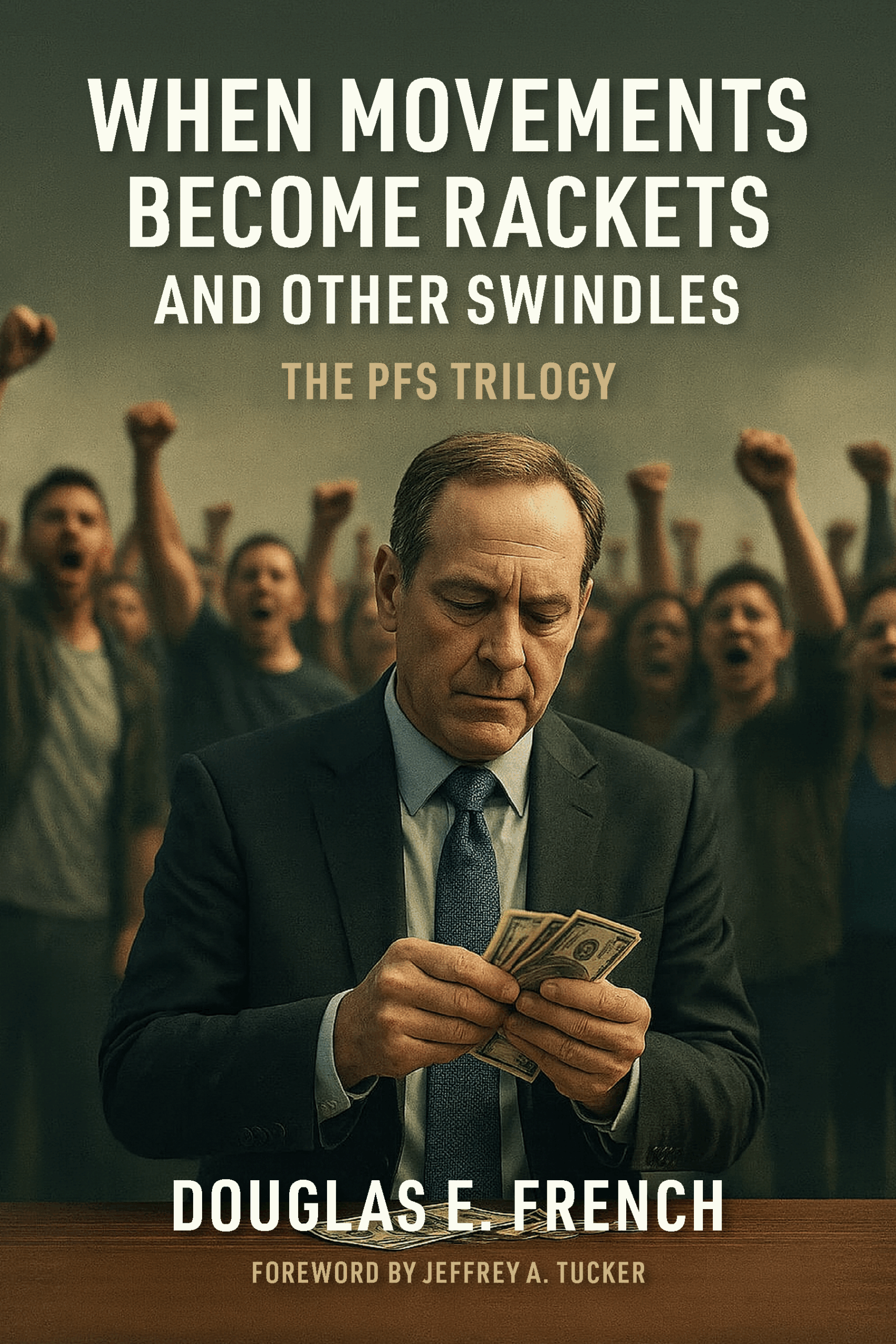
This interview contains some criticisms by Deist of Austrians for failing to read the populist room and not engaging the public on money even as inflation erodes everything. He also criticizes sinecurism/nonprofits. Related: Douglas E. French, When Movements Become Rackets and Other Swindles: The PFS Trilogy, Stephan Kinsella, ed. (Houston, Texas: Papinian Press and Property and Freedom Society, 2025). Summary and transcript below.
Summary (Grok)
Jeff Deist and Matthew Geiger discuss the deep connections between culture, economics, and politics from an Austrian and libertarian perspective. Deist argues that culture and economics cannot be separated: people’s political and economic views flow from culture, and the sociology of movements and institutions shapes ideas. He rejects the notion that libertarians should avoid “culture wars,” calling them essential. Figures like Zohran Mamdani are symptoms of a degraded culture rather than deep ideologues—products of acculturation rather than serious study.
A major theme is the cultural and moral damage caused by decades of inflationary monetary policy. From the Volcker era through the near-zero rates of the 2010s and COVID stimulus, incentives shifted decisively against saving and toward borrowing. Capital accumulation—the foundation of material progress—becomes extremely difficult when the currency steadily loses value. Deist places primary blame on older generations (Boomers and Gen X) for creating an environment in which younger people rationally respond with higher time preference, nihilism about homeownership, delayed family formation, and skepticism toward traditional saving. Objective conditions—student debt, housing costs, career entry, and family formation—are harder for Millennials and Zoomers than for previous cohorts.
The conversation turns to interventionism, war, and the entitlement state as pathways to socialism. Deist notes that “defense” spending is as socialistic as domestic welfare programs, and that Social Security and Medicare dwarf other entitlements. Both major U.S. parties (and their Western counterparts) share a statist mindset. Energy for any renaissance in foreign policy and economics, he argues, currently lies on the younger right, not among conventional libertarians who refuse to update their operating system.
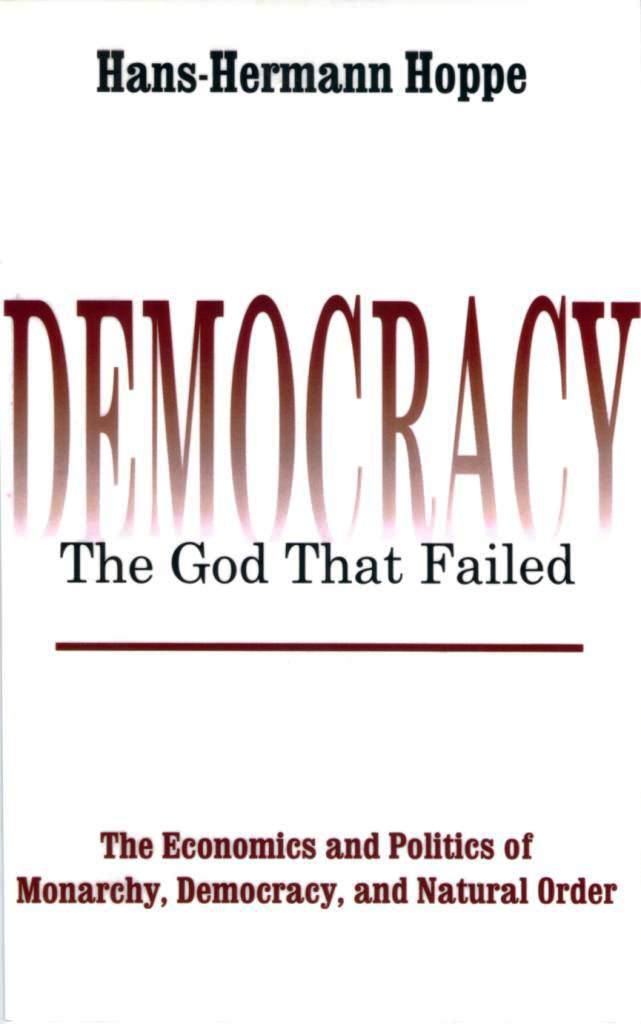
Deist praises Hans-Hermann Hoppe’s willingness to speak plainly on discrimination (in the older sense of high standards) and on the influence of powerful lobbies, including the Israeli lobby and endless Middle East wars. He sees neoconservative foreign policy as a persistent failure that has replaced the earlier Trump-era war-weariness.
Reflecting on his eleven years at the Mises Institute, Deist criticizes Austrian academics for remaining in theoretical cul-de-sacs instead of engaging the public. The 2008 crisis should have been a major teaching moment for Austrian business-cycle theory, yet Bitcoin—not Austrian outreach—brought many young people to the school. Economists’ proper job is to explain the “unseen” consequences of policy to ordinary people who feel prices rising faster than wages. Academia, he contends, is largely a system of sinecures captured by the state; tenure, hostile journals, and gatekeeping make it a lost cause. Libertarians should abandon the academic game, use the internet and popular media, and embrace justified populism given the comprehensive failure of current elites.
Higher education is portrayed as an expensive, debt-fueled extension of adolescence that fails both as liberal education and as technical training. Most of it produces little of value and responds mainly to incentives favoring job security and low accountability.
On practical organizational advice, Deist recommends that new nonprofits such as the Menger Institute pursue a laser-focused, narrow mission rather than a vague “promote Austrian economics” brief. Boards should be filled with accomplished business people who can actively help with strategy and fundraising, not academics. Organizations must guard against the natural drift into sinecure status once money arrives. He expresses interest in the institute’s emerging proprietary-governance / private-order program and notes the existing literature (Stringham, Friedman, Tannehills, Hans-Adam II, etc.), while remaining realistic about the durability of states.
Overall, the discussion is a call for cultural seriousness, public engagement, institutional realism, and a willingness to notice and name uncomfortable realities rather than remaining in comfortable theoretical or academic enclaves.
Transcript (Grok)
Introduction and the Importance of Culture 0:00
Matthew Geiger: Ladies and gentlemen, we have a very special guest. He is an author. He is the former president of the Mises Institute and he was the chief of staff for Ron Paul’s congressional office. If I could, I would give him an honorary doctorate degree in economics and he’s someone whose content I try to consume as much as I can. Jeff Deist, welcome to the Menger Institute podcast.
Jeff Deist: Thank you so much. I appreciate the invitation. I’m not producing much content these days. I’m lounging.
Matthew Geiger: Well, when you’re on other people’s shows, I try to listen.
Jeff Deist: Yes.
Matthew Geiger: So, I want to talk to you, I guess, a lot about culture and a couple different topics that I would like to discuss with you would be America’s gerontocracy and their cultural awakening, if you will. Even some of the more prevalent topics of the week are the whole Fauci hearings with Rand Paul. But yeah, where would you like to begin?
Jeff Deist: Well, the culture element is so incredibly broad and I think we have a little different understanding of culture or we ought to, people who were in Austrian and libertarian spaces, simply because people’s views on politics and economics I think flow very much from the culture.
Ideas matter but the people who promulgate ideas, the people who promote them matter just as much and the sociology surrounding those people surrounding movements surrounding institutions matters a lot. I mean if we go back and trace our own movement’s history from some of Menger’s experiences becoming a tutor to the prince and then some of von Wieser’s experiences, Mises’s experiences having to flee the pale of settlement what is now Ukraine, having to flee Vienna later, if we look at Rothbard’s let’s say shabby treatment from academia. And then you look at all the movements, the institutions around them, all of that had a tremendous amount to play with what ultimately became their ideas and their work.
So when we look at American culture today or Western culture today, there’s a lot of problems, a lot of big problems, and they’re very much related to, they’re not only tangential, but I would say they’re directly tied to economics in so many ways to what’s going on with our dollar, to what’s going on with the broader economy and inflationism as a mindset and as a policy. And you know, you mentioned off air earlier that the gerontocracy, boy oh boy, that is alive and well in the United States. And it’s a big problem. So I think that it’s a mistake to separate culture from economics.
Economics lives and breathes within culture. Culture matters. And when I was at the Mises Institute and even before, I very much disagree with the idea that well, you shouldn’t fight culture wars, that this is right-wing crankery. I don’t believe that at all. I think culture wars are very, very, very important. And you know Mamdani and people like him, they didn’t get their ideas through immersive reading and hard study and rational thought. They got them by being acculturated to them, right? So that’s a verb that uses the word culture. So acculturation is the battle we’re losing and we’re losing early and young and so that’s how we get what we get.
Mamdani as Symptom of Culture 4:00
Matthew Geiger: Speaking of Mamdani, this is something I heard from Curtis Yarvin who I like, I like his ideas but he said you know Mamdani is a symptom not the cause of democracy. And I have to agree that I think he’s kind of like a theater kid. I don’t think he’s sitting down and is serious about Marxism or socialism or communism. It’s just what’s popular and it got him elected and he’s in a big position. But yeah, he’s more of a symptom of the culture and the political system we live in.
Jeff Deist: Yeah, absolutely. I think that’s well said. He’s just a theater kid grown up. I mean, he’s not some Marx or Lenin ideologue. He’s just basically where social democracy 2026 takes you, which is nationalizing grocery stores apparently and instituting some weird tax on everyone’s second apartment in Manhattan or second home in Manhattan. But unfortunately, you got to sign some registry or be hit with a tax. So that’s going to cause some interesting let’s say collateral damage. But yeah, I think that’s just the world he grew up in.
I don’t think, you know, Murray Rothbard was born into a part of Brooklyn in the 1920s that was just full of literal Communist Party members and you know in his apartment his dad was the only Republican way back then. And it was a being a Republican was a different thing back then. But you know, so imagine growing up in that culture yet somehow he escaped it. But most didn’t. And so what we ought to do is try to get the odds more in our favor. And I think we do that by bringing back a more traditional culture and a more highbrow culture. I’m not afraid to use that term.
I think if look at the Vienna Mises loved I would say pre-war Vienna stands as almost a pinnacle of culture in terms of the learnedness and intelligence of the local population the music the art the opera. You think that you can’t, you know that you can have sound economics without all these other things, it’s some kind of stuffy. And I’m not sure that’s true to be frank. I think that a lot of what we call economics or government policy today is looting. It’s vandalism. And I think a lot of that flows from a mindset, a laxity of mind that has developed, I think, accelerated since the 1960s. And so we can’t separate I think sensible economics from the cultural malaise we’re in.
Inflationary Culture and High Time Preference 7:00
Matthew Geiger: Yeah. I want to ask you because you have been someone who’s influenced me to think more about this highbrow culture and how we represent ourselves in society. Especially for like in the younger generations I see the casualness in so many aspects. But what is kind of the cause and the effect of an inflationary culture and this high time preference society? Cuz I’m still trying to understand like well you know even if we become more highbrow and serious that’s not necessarily going to change monetary policy. But I want to see what you think about this.
Jeff Deist: Yeah, it’s true and I think you identify something important and as we know perhaps better than others, Austrian methodology looks to causal realism to understanding things deductively. Well, that means that you got to understand human action and a big part of that is understanding incentives. Incentives matter a lot. So if we look at how people arrange their economic lives in many ways they are just simply reacting rationally to inflation as a policy.
You know we go back and look at the big housing crisis of 2008. You were just very young at that time. But nonetheless the we say oh my gosh these mortgage lenders were doing crazy things. They were doing making loans without verifying income. They were loaning, you know, many, many, many times someone’s income so people could buy second and third houses. People who were just taxi cab drivers or strippers in some nightclub, you know what? How could they be so crazy? Well, they weren’t crazy. They were responding to incentives that were created by the financial monetary system, right?
So if you look at the period from around the early 1980s which was the end of Paul Volcker and the beginning of Alan Greenspan as the chairman of the Fed here in the US all the way till about 2022 at the height of COVID when the Biden and then Trump fiscal stimulus not monetary but fiscal direct stimulus occurred for that 40-year period interest rates more or less went down not straight down but in a downward trend, they went from basically a high during the Volcker era to, you know, not nominally zero, but almost effectively zero, real interest rates of zero here in the US and then of course actually nominally negative interest rates on some euro bonds.
So what that means is for 40-some years the increasingly saving money became saving was for chumps and increasingly borrowing money was a smart play. So over that 40-year period, it was rational and it made sense not to save and to, you know, spend beyond your means perhaps if you were dumb or to use a lot of credit wisely if you were smart like people in the financial class. So what do we expect? I mean, the whole idea of saving for a rainy day is awfully hard when your dollar is going to be worth, I don’t know, 90 cents in a year, 80 cents in a year. It depends on whose view of, you know, version of inflation numbers you want to believe.
But nonetheless, I mean, if you take that out across society, across the West, saving for a rainy day is just a euphemism for delayed gratification, for doing all the kinds of things, for living responsibly in ways that create more benefit tomorrow. And that tomorrow may even be beyond your lifetimes. I mean, let’s all be thankful. Let’s say our great-grandparents or our grandparents worked hard and lived in a manner that allowed us to come into this modern world without any, you know, great accomplishment on our part and have this incredible society and this incredible material wealth all around us and they would not have happened if generationally they had not, you know, collectively saved more than they spent. In effect, that’s what we call capital accumulation. That’s what initiates every step of material progress. And it becomes awfully hard to accumulate capital when the incentives are against it. It’s just that simple. And that’s both an economic and a moral ethical matter.
Advice for Younger Generations 11:40
Matthew Geiger: So, this is then a question I have for you for myself and on behalf of the younger generations. When we go to a cafe and we order a $7 latte and the older generations are like, “What are you doing? What are you thinking?” This is a different environment. It’s a different cultural environment. One where savings is almost like ludicrous. Why would you save? You have to invest. You have to gamble. I guess this is a question about advice for navigating for the younger generations this environment.
Jeff Deist: Yeah, it’s so true. You say, “Well, why should I save if the not only the down payment, but the price of, let’s say, the condo or the house I’d like to buy as a starter is radically outpacing my ability to save, right?” Why should I worry about getting a new car if it’s just going to cost me so much in gas and insurance and all these other things are going to go up and it’s going to depreciate. Maybe I should just, you know, have public transportation, not worry about it and use that money to take a trip that I wanted to take. And as for the $7 latte, well, you know, the Boomer the Boomer parent or grandparent in this scenario had a 50 cent cup of coffee at Denny’s, right? I mean, it was things were a lot cheaper.
So, I understand it. I mean, there’s a nihilism out there. There’s no question about it. But I don’t blame the younger generation for that. I blame the older generations. I’m Gen X, but I blame Gen X and boomers. And there’s still a few, you know, World War II’s greatest generations alive. They’re pretty much gone for the most part. People, let’s say over 90. But you know I think that younger people are simply reacting to the environment around them and that environment is I don’t care what baby boomers want to say. It is much harder for younger people today to a pay for college without a bunch of debt, b develop a career, c buy a house or a condo, and d have start marriage or families. All of those things, those four things are absolutely objectively and I could point to some facts about this, objectively harder for millennials and zoomers behind them than it was for Gen X and boomers in my opinion. My strong opinion.
War, Socialism, and the Entitlement State 14:30
Matthew Geiger: Okay, I kind of want to ask you this. Mises touching on Mises mentions that this interventionistic political society leads step by step to socialism and I just saw a recent article that Lockheed Martin is now employing GM to start building missiles and war as Randolph Bourne said is the health of the state and it’s a great means to create a socialized type of society the step-by-step process. So I think I want to kind of ask like how I mean it’s almost a frustration that I have that it’s like the boomers can’t realize that yeah you do have the leftist democratic socialist but there’s no one to the right of Trump there’s no one to the right of the neocons to really be like keeping America from going towards socialism in the welfare warfare type of dimension. And I just want them to recognize that that like war is a means to arriving at socialism. It doesn’t have to be through leftist egalitarianism.
Jeff Deist: No, it does not. The other thing is in the entitlement state where boomers have obviously a huge blind spot is Social Security and Medicare which are the two single biggest welfare programs in the United States. They vastly outpace the others. So, but yes, so-called defense spending is just as socialistic as any other. There’s no other term for it. So, and I mean, the one thing I will say for Trump is that he ran as a protectionist. He didn’t lie about that. He’s never called or tried to pretend he’s a free market guy. What he did try to pretend is that he’s more of a non-interventionist abroad in terms of foreign policy than he was. So that’s unfortunate to put it mildly.
But absolutely I mean the idea that the state needs to run X Y and Z is just as embedded on the right and the left. Now I think politically the GOP is just as bad as the Democrats in America. I think you could say that for most of the Western countries as well, their version, let’s say the social democrats or their version of the conservatives. But I do think that the action and the energy if there’s going to be some for a renaissance in foreign policy and in economics is on the right amongst young people. I think that’s just a fact. And I get very very tired of libertarians who deny this. You got to change your operating system when the world around you changes. I’m sorry.
Speaking Out and Hoppe on Discrimination 17:20
Matthew Geiger: Yeah. Okay. Speaking of the right, I don’t know if you had a chance to check out, but the I believe it was the Property and Freedom Society put together Rothbard at 100, a conference in Porto, Portugal with Hoppe, and Stephan Kinsella, and someone else I’m forgetting. But Hoppe gave a great talk and you know he was towards the end of it encouraging people to speak up but specifically when it comes to matters of what it means to be discriminating. And he gave the example that someone in decades prior when they were referred to as having a discriminatory taste meant that they had this type of they had like high quality standards in a sense. And not only this but he was also pointing out that the most powerful lobbies in the US are the Jewish elite. And I think I want to kind of ask you for libertarians and others how to navigate this type of courage to speak out and notice things that we’re not supposed to, you know, say or notice in polite society.
Jeff Deist: Well, I think Hoppe is mirroring Rothbard and others who have talked about the inordinate power of Israeli lobby in the US and in the West. I think that’s pretty much open knowledge. But, you know, we can’t kid ourselves about these endless Middle East wars and what they’re doing to us and how they’re draining not only our pocketbooks but also our I think our sense of morality. This war-weariness that helped get Trump elected has now been replaced by the neocon resurgence. We got to get Iran. We’ve been talking about Iran almost my whole life. My gosh, I was a kid when hostages taken by the Iranians and Jimmy Carter was president, I think, I guess, at the time. So, you know, Iran’s been this boogeyman forever and ever. And there’s always got to be a boogeyman. It’s just the neoconservative mantra. The Cold War had to be replaced by something. We can’t just have a Cold War dividend. My goodness. And we can’t just worry about America, so-called America first, you know, that it’s depressing to think about that we keep going back to the same old same old that we get at least in the second term what looks and feels like George W. Bush instead of Trump. I mean, he was a bull in a china shop. Now he’s a lap dog in, you know, in the beauty salon. But I think Hoppe’s right. Hoppe has always been intransigent and that’s our job is to not be afraid.
Time at the Mises Institute and Austrian Engagement 20:15
Matthew Geiger: Yeah. Can I ask how was your time at the Mises Institute and about this article that Hoppe wrote regarding the Mises Institute and the turnover of presidencies?
Jeff Deist: Yeah, I was there gosh 11 years. So it was a long time and I enjoyed it. I had been in private equity well I shouldn’t say in private equity had been in law and accounting settings private equity clients doing M&A work buy side acquisitions for a, you know, a fair time and almost inadvertently ended up reconnecting with Dr. Ron Paul whom I had known years and years and years earlier. Well, not really known but had known of I guess I should say and through that ended up you know I had intended for that to be sort of a short break a short deviation and then back to my previous career work but then that just not by planning led me to the Mises Institute for 11 years now that I think about it. So that was unexpected.
I think there are inherent problems and limitations with nonprofits and with NGOs and with some and you know all institutions you have to worry about two things you have to worry about the conquests you know law all you have to assume all institutions are run by a cabal of their enemies so to speak I mean I certainly wasn’t an enemy of the mission but I was very much looking to shake it up and make it more relevant and this is a broader topic I was hoping to touch on with you is I think Austrians have shirked their responsibility to be out there engaged with the public and I mean engaged I mean like getting on major media you know doing whatever you know through the way you attract people today you can’t just live in theory land however important theory is I mean what people are interested in is the applications and Mises certainly didn’t live in theory land he rolled up his sleeves and worked directly on policy in Vienna and certainly would have had you know given the chance in the US.
So the idea that you could sort of hang your hat on we were right that’s not enough. I really I really think academics I mean economists in general are letting us down the profession as a whole is in shambles it doesn’t explain anything it doesn’t help us understand the world it doesn’t even understand its role as a social science as a basically as logic as a branch of philosophy. I mean economics sees itself in the business department as crunching numbers and you know counting GDP and housing and this kind of thing and that’s not economics at all. And the Austrians have a better worldview. It’s based on how people really act and they ought to be out there. I mean look at people like Dave Smith. I mean, the guy’s a comedian who just somehow turned his platform into a big thing and he’s on all these big shows and there’s no excuses for Austrians to be hidden away in their little cul-de-sacs. No excuses.
The crisis of 2008 should have been a very serious teaching moment for the Austrian school to tell the world, “Hey guys, remember all that malinvestment business cycle stuff that Mises was talking about, Rothbard was talking about? Well, here you go.” Right? That should have brought huge interest. It took Bitcoin of all things to bring a lot of people to Austrianism, not the other way around. A lot of people got excited and engaged, especially younger people, by Bitcoin. And then through that, through Saifedean and others, found out that there was this philosophical underpinning to stateless money, to hard money, to money that, you know, was capped, you know, and so they started reading Austrian stuff as opposed to Austrian stuff leading people to Bitcoin.
So I do think that academics in general and I include Austrians in that camp, they’ve just they haven’t done their job. Their job is not to write academic papers for journals that 10 people read. Their job is to be out there in the public, sleeves rolled up, explaining to people the unseen. Right? That is the job of the economist. That’s the job of the economics profession to show us the unseen. Government takes your money in taxes and builds a, you know, gigantic housing project and you know the politician can point to that and say gee whiz look what I did here’s this housing project and all these poor people who used to not have house they live here now right that’s the seen of what you and I would consider a very foolish economic policy taxing people to build housing. But it’s the job of economists to say okay but there are opportunity costs. Here’s the unseen. You know, if people really valued this more than other things in their lives, they would voluntarily pay taxes to have you guys arrange this public housing, right? But they most assuredly do not voluntarily pay taxes. So, there’s just so many ways that econ could be presented better to people.
And all I can say to any academic econ or otherwise especially once you get tenure my god once you have tenure you have no excuse but even without tenure you if you really believe you need to be writing for lay audiences for popular audiences and not just writing coming up with you know there are lots of other formats today but how which people receive information a lot of times that’s goofy videos which aren’t my cup of tea but I still you know I understand the power of it. And that’s debates, that’s, you know, why are our leading stars of Austrian economics not on Fox News all the time? Why are they not on Piers Morgan? I don’t know what it is, but what, you know, I mean, why is it that that, you know, you and I can talk to just absolute normies around us and say, “Oh my god, you know, I went to Arby’s the other day and I got two, you know, big roast beefs and a large drink. Was 21 bucks.” You know, that’s there’s something rotten in the state of Denmark and everyone feels it. And so there’s this breach into which Austrians should be rushing, which is hey guys, I’m going to explain that to you. Inflationism, the idea that for most people is simply that the prices they actually have to pay on real things, not CPI or any of that. The prices they actually have to pay in their real life seem to be going up faster than their paycheck. That’s the real problem for most people. And Austrians ought to be rushing in there and saying, “Well, what how about if I explain to you that’s actually a policy. Governments, state treasuries, and central banks are actually doing that on purpose. It’s just a little higher than they profess to want. It’s only supposed to be 2%.” You know, I mean, that’s incredibly powerful. And academics seem to have an absolute allergy to populism.
And that’s such a mistake. Populism is absolutely justified when elites have failed as they have, right? Anti-elitism is absolutely justified at this juncture in the history of Western civilization because our elites are terrible elites. They need to be replaced. And they’ve done a terrible job with the economy, with banking, with education, with medicine, with war and peace. I mean, everything they touch is in shambles. And every institution they run needs to be upended. So, you know, in 2026, if you’re a professor or an academic, and god forbid, an Austrian, and you’re sniffing at sniffing your nose at populism, I just have no time for that.
Academia, Populism, and Higher Education 28:35
Matthew Geiger: Wow. Yeah. I mean, I love Dave Smith. He’s definitely a big inspiration for me and influence. And you’re making me realize that the academics, a lot of the Austrian economists that we have today do come from academic academia, but academia is sucking at the teat of the state and the politicians. And so, you’re absolutely right that there is a disdain from populism. And I think I don’t know the fear of being mixed in with academia but also being an Austrian economist, it taints your mission and your vision and what you’re trying to do. So I think you’re making me realize we need populist economists, populist Austrian economists.
Jeff Deist: Well, it is hard to get tenure oftentimes at major universities or even not so major universities without a pretty significant track record of publishing. Publishing needing certain kinds of journals. Those kind of journals are oftentimes hostile to Austrian viewpoints which makes your paper or whatever less likely to be approved. So the whole thing is just set to racket. I think we just need to abandon it. I mean we’re not going to win academic economics. We’re just, you know, it’s too far gone. The institute the AEA and all of these other various you know economic gatekeepers and then the publishing houses the big journals that’s just you know we went around all that the internet came along we don’t need you anymore we can publish whatever you want right here right now and if you work at it you can get a big audience without any gatekeeping. Right.
Matthew Geiger: Yeah, I absolutely agree. And I think that was part of the influence for me, Daron, Ethan, and Patil, our team to create the Menger Institute. And we’re also a nonprofit teaching Austrian economics. But we’re completely free for students. So we want to teach and we can self-publish now. We have the internet with through Amazon. We don’t need publishers. So I think in the long run these institutions will fall in on themselves and they’ll crumble. The Occidental where I went and where I met Professor Daron is now 85,000 a year. It’s like tied with SC as the most expensive.
Jeff Deist: Wow.
Matthew Geiger: And I heard from a former student that like the enrollment is down like they only had like 200 applicants last year.
Jeff Deist: That isn’t that Barack Obama’s alma mater?
Matthew Geiger: Yes. Yeah, he attended there for one or two years.
Jeff Deist: Attended? Jeez, another murky fact with this guy.
Matthew Geiger: Yeah, he didn’t graduate from there.
Jeff Deist: No, I think he transferred to Columbia and graduated from there. Oh, well, okay. Very well.
Matthew Geiger: Yeah. But Occidental I mean it’s become like apparently the library it’s just infected with horrible ideas. The first year I was there. They’re teaching obviously anti-capitalism and just like I don’t know if you’re familiar with Thad Russell but he also taught there so he’s familiar with some of the professors and he told me like yeah some of them were Maoist and I was just like oh that makes a lot of sense. So it’s ridiculous. They’re producing nothing of value. All studies of like, you know, producing nothing of real trades or skills, just like stupid, unimpressive studies that only require another academic job.
Jeff Deist: But more importantly, they’re responding to incentives, and the incentive is to create sinecures. That’s the incentive is to create a sinecure which is especially nice when you’re tenured and you have lots and lots of time off that you can just go right you can travel you can attend conferences and you can do all kinds of things like go on vacation or take sabbaticals. There’s no other industry that quite operates like this although there are some there are some good historical reasons for tenure to protect people’s line of research or that sort of thing but I think the point here is that there’s a difference between motion and action. And what academia does is mostly motion, very little action.
The left has had a lot more success in bringing their, you know, their, let’s say, stranger ideas from academia into corporate America, into mainstream media, into the schools, education, into mainline religious denominations, into popular culture. You know, I would say libertarians have not had nearly as much success with that. But I don’t see the university system as anything that is worth saving right now. When we look at you’ve got a 4-year model, you’ve got tremendous student debt for a lot of kids. You’ve got busy work classes oftentimes outside of one’s major. And you have graduates who coming in oftentimes are not particularly adept at basic reading, writing, mathematics because let’s say their high schools have failed them. And then you’ve got graduates exiting that don’t do much for employers. Employers still have to train them up. And so it just becomes almost a four-year diversion, an extension of teenagehood or something, which I think is pretty troubling.
I mean, I think education, higher education beyond high school, ought to be one of two things. It ought to be either very broad liberal education of the kind that let’s say really rich kids used to get, right? And it wasn’t so that they could get a job in 1900 if you went to Harvard or Yale. It was wasn’t so much necessarily because you needed a job. It may just be that you had a wealthy family or a wealthy family business that you could step into. So you got this sort of broadminded education. You got liberal arts and languages and humanities. So that I think a liberal education, the great books, the classics is absolutely worthy and we can all do that on our own. You know, we can all go read the classics on our own. We can do that without the aid of a professor necessarily. But the other is sort of technical training, right? in engineering, in medicine, in law, maybe in higher mathematics and certain types of science. But there’s an awful lot that’s neither of that. There’s an awful lot of kids going to school and they’re taking sociology or psychology or communications or business. And you can’t teach business in my jaded opinion. So man we’ve created this racket called higher education and it is in big trouble. The COVID years were a baby bust which means there’s a ticking time bomb for enrollment and we’ve already got that because these generation the current generation is a lot smaller than the millennials. So you know I think a lot of smaller schools are just going to go kaput the Occidentals of the world unless they have big endowments which unfortunately some of them do and the big schools the state schools like where I live which is Auburn Alabama has a big SEC state school in my backyard and I think they’re going to have to adjust to put it to put it mildly.
Populism, Milei, and Political Earthquakes 36:15
Matthew Geiger: Yeah. I mean, you’re definitely right that it’s like a high school extension period, which is tragic. Because, yeah, we’re not actually getting educated. It’s for indoctrination. I mean, the more the state funds it, I think that’s what it turns into is this form of statism. Let me ask you this because you got me really thinking about culture and influence and I think of Argentina and President Javier Milei being so popular. Set aside what you will about his devout Zionism, but Argentina was a country that suffered massive inflation and he really spoke to that. I hope. I don’t know. But since the relatively cushioned years of the decades from the ’60s up to now, it hasn’t been this troubling with inflation. Maybe in the ’70s, I’m not so sure. But maybe that’s what it takes for some strong willed Austrians to step in and discuss this with people and develop this populist movement. What do you think?
Jeff Deist: Well, I don’t know a lot about him. But he’s certainly a skilled populist and he was able to use dissatisfaction with the status quo to elevate, at least in campaign rhetoric some of the ideas of our greatest thinkers. So, I mean, that’s a great thing. And I think people should take his approach. Look at Brexit. Look at Meloni in Italy. Look at AfD in Germany. Look at the Trump phenomenon. I mean, people still don’t know because we’re still in it. We don’t have the benefit of hindsight, but 20 years from now, 50 years from now, people are going to look back on the Trump phenomena and they’re going to write books about it because it really I mean to think that this guy is president of the United States is really remarkable. It’s really and truly remarkable. It’s way beyond I don’t know you think of populist figures from the past like a like a George Wallace or a you know maybe a Teddy Roosevelt was kind of a populist figure. But man oh man, this is quite a thing. And the fact that he beat both the Clinton and Bush crime families in his rise to the presidency is really really remarkable.
So we still don’t quite grasp how, you know, apart from Trump and his policies and the terrible personnel and all that, we still don’t grasp the degree to which his being elected, the populist push back, the great push back. We still don’t how profound it was. In other words, people were so unhappy on some level. And that’s odd if you think about it because most of the world would love to live in America. We’re relatively prosperous and wealthy compared to the rest of the world. A lot of them think, well, why are we so unhappy? But yet, there’s this deep sort of cultural malaise that Trump tapped into. And that many Americans were willing to say, you know what, I know Hillary Clinton has been senator and secretary of state and Bill Clinton’s wife, first lady and this and that, but I’m going to vote for the orange TV reality guy, New York hustler guy just because why not? I can’t take any more this inevitable Hillary, you know? I mean, that’s really remarkable. And these are these are earthquakes that were they’re just slow motion earthquakes. So we’re not as aware of them. And I think I think they I think you know it’s easy to say well Jeff these are all sort of steered fake astroturf revolutions. I I’m not so sure about that. I think I think the last 10 or 15 years poses a challenge a factual challenge to elite theory. And you know, we ought to be studying it and learning from it and emulating the successful tactics of people around us, whether they’re friend or enemy.
Advice on Building a Nonprofit and Board 40:40
Matthew Geiger: Yeah. Okay. Switching a little bit of gears here. Because I would not forgive myself if I didn’t ask you this, but for our institute, we are a nonprofit and we’re looking for donors, even a board of trustees. If you have advice, if you have insights, if you’re also interested, how did you go about this when you’re with the Mises Institute?
Jeff Deist: Well, we had a for a period we had a very fine board of trustees that we had expanded to go out and get successful people in the business world. So, that I think would be job one. I very much think academics don’t belong on boards. It’s just not their nature. No offense, but it’s the truth. So, I think you want to think of a board that is going to understand your mission and keep you in line with your mission, but also assist your mission. You know, a board of directors should not just be an honorarium or a title. It should be people who can actively help, right? Like, hey, I’ve been in business for 40 years and I’ve seen X, Y, and Z, and here’s how here’s what you ought to do. Who are people who can help with fundraising, you know, prominent people.
I’ve really come to reject this this logical fallacy about about the, you know who the identity of an argument of the person who makes an argument shouldn’t matter and all that. You know, we should judge every argument whether it’s by some anon on Twitter with five followers and a, you know an avatar like the tattoo of that guy from Maine or a totem pole or something like that or you know we should take his or her or its spot just as seriously as Mises’s right because it’s not we just misjudge the argument on its own merits. I think that’s just bunk. I think that’s not part of human nature. I think the people’s personal lives, how they conduct themselves, their character and especially their achievements in the world matter a lot. And there are natural elites. Hoppe talks about this. We got unnatural elites surrounding us at the moment, but there are natural elites. And so I think if you’re going to start an organization and you want to make it effective, you shouldn’t be afraid to seek them out. You know, my goodness, you’re in California, you got the Bay Area, you got just incredible bunch of talent talented, smart, wealthy people out there. And just be very very truthful.
But also I would say if I were starting an organization like yours and you’ve got a good great name, Menger’s underappreciated, underappreciated and I think understudied, but is just don’t mirror other organizations. Find a totally different niche and just say we’re going to find a very small very small place to push our index finger and apply a lot of force to a very small place instead of a very, you know, large wall and really get specific. That’s what happens to nonprofits at first. They don’t have any money and they work really really hard until they get some money and start to hold events and start to do things and gain some traction and then lo and behold 10 20 30 years goes by they’ve got lots of money and the incentives we talked about earlier go out the window and it becomes a sinecure. So, you know, you I would guard against that and I would I would find a really really really laser focused narrow mission, not a broad mission like well we want to promote Austrian economics too broad right because you wake up in the morning what does that mean? You want to be very very very narrow and I think start with thinking hard about that and get some other people’s input and then maybe figure out who you want on your board and go from there. You’re a young guy. You got time and energy and you can do it.
Private Governance and Closing 45:05
Matthew Geiger: You know, I think our niche we’re actually after a year and a half, almost two years discovering and we’re launching it tomorrow, our brand new anarchic order program teaching the science of proprietary governance, the alternative to democracies and statism and we’re very excited about this. So maybe this will become our flagship program. I hope it does. We have Edward Stringham. He’s going to come out tomorrow and lecture for us. So I’m very excited.
Jeff Deist: Yeah his book on for listeners I mean he has a book on private governance that’s with Oxford I think Oxford University Press if I recall it’s a beautiful cover if you want the copy I have but it’s you know there’s a literature in that area of truly private governance you know David Friedman Morris and Linda Tannehill there’s Ed Stringham’s book there’s Prince Hans-Adam has the state in the third millennium which is about state craft as you know basically responding to consumers and competing with other states. I mean it I hope that’s not a pipe dream but it whether we like it or not I mean states appear to be pretty stubborn and durable things in society. People seem to want them now. Would a private mechanism begin to look like a state? Would it begin to feel like a state with an enforcement monopoly like your HOA? I don’t know. But as long as you have exit and as long as you have contracts that are respected, I think it’s a great idea. And there’s a lot of groups working on that. But I mean I think your mission is a little different.
Matthew Geiger: Yeah. Or I mean we’re more in the academic sphere. So, I’m optimistic and I would love to have you on the board if that’s…
Jeff Deist: I’ll give that some due consideration. Thank you.
Matthew Geiger: Okay. Excellent. I know you’re you got to run to your next interview, but Jeff, thank you very much. This was a pleasure and I hope we can do it again.
Jeff Deist: Absolutely. I appreciate the invite.
Matthew Geiger: Okay. Thank you, Jeff. Thank you.



















 Alessandro Fusillo
 Andreas Tögel
 David Dürr
 Doug French
 Fernando Chiocca
 Greg Morin
 Hans-Hermann Hoppe
 Jay Baykal
 Jayant Bhandari
 Jeff Deist
 Jeffrey Barr
 Juan Fernando Carpio
 Ken Yamarashi
 León Isidoro
 Martin Cabrera
 Nick Hoppe
 Oscar Grau
 Peter Wong
 PFS
PFS scholarium
 Saifedean Ammous
 Sean Gabb
 Sean Ring
 Stephan Kinsella
 Stéphane Geyres
 Thomas Jacob
 Tom DiLorenzo