The historian Quinn Slobodian has built a career out of discovering that libertarians are secretly what his colleagues already assumed they were. His 2023 book Crack-Up Capitalism: Market Radicals and the Dream of a World Without Democracy is ostensibly about “zones”: free ports, charter cities, tax havens, Liechtenstein, Dubai, Honduras, the metaverse. Their sin, he says, is that they are part of “a decades-long effort to pierce holes in the social fabric, to opt out, secede, and defect from the collective.”1 Defecting from the collective. The horror.
Chapter 5, “The Wonderful Death of a State,” is mostly about Rothbardian ancaps and the PFS orbit: Murray Rothbard, Hans-Hermann Hoppe, the Mises Institute, and the Property and Freedom Society. Jeff Deist, Daniel Model, Titus Gebel, and Patrik Schumacher, all PFS speakers, turn up elsewhere in the book.2 Slobodian made his name with Globalists (2018), a history of Hayek, Mises, and the other founding “neoliberals,” and has since worked his way down the family tree to their supposedly illegitimate heirs: us.3 His follow-up to Crack-Up Capitalism, Hayek’s Bastards: Race, Gold, IQ, and the Capitalism of the Far Right (2025), went on to win a National Book Critics Circle Award, because of course it did.4
Since the PFS features so prominently in his story, a few corrections and observations are in order.
1. Guilt by Association, by Calendar, and by Zip Code
Here is how Slobodian introduces the PFS:
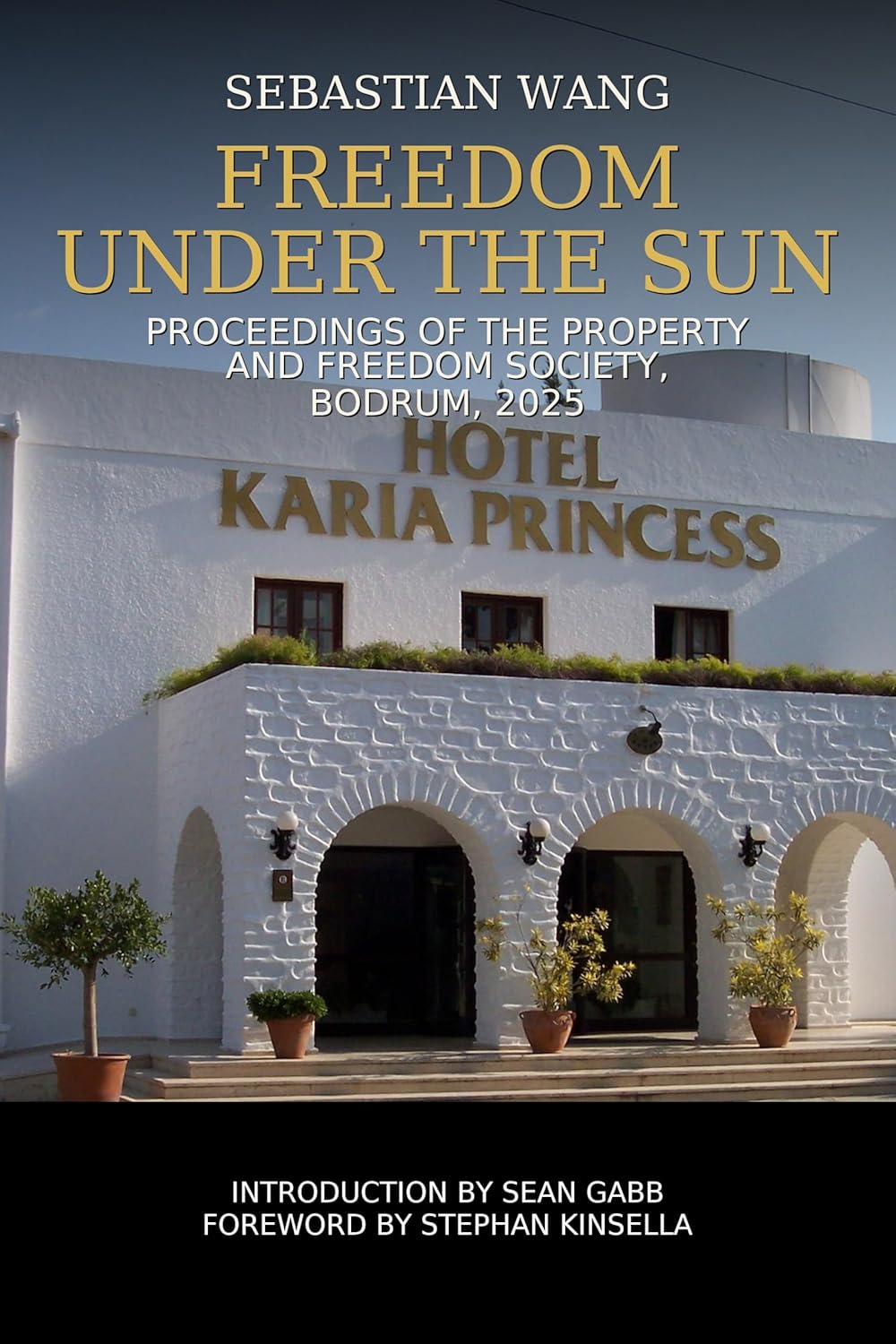
In 2005, Hoppe held the first meeting of the Property and Freedom Society in the gilded ballroom of a hotel on the Turkish Riviera owned by his wife. In its annual gatherings, the PFS unites former members of the John Randolph Club (which dissolved in 1996) with new advocates of stateless libertarianism and racial secession. Prophets of racial and social breakdown share the stage with investment advisors and financial consultants.5
“Gilded ballroom” is the kind of detail you add when you want readers to picture a Bond villain stroking a white cat. And he can’t even get the year right. The first PFS meeting was held in Bodrum in May 2006, not 2005.6 His own source for the claim is Hoppe’s “The Property and Freedom Society—Reflections After Five Years,” which Hoppe delivered at the fifth annual meeting, in 2010.7 The maths isn’t that hard, as my English PFS friends might say.
As for the “prophets” sharing the stage with “investment advisors,” Slobodian’s evidence is the 2010 program. He mentions Richard Lynn’s talk on The Global Bell Curve, plus three others with sinister-sounding titles: “Public Health as a Lever for Tyranny,” “How to Enrich Yourself at Others’ Expense Without Anyone Noticing It,” and “The Mirage of Cheap Credit.”8 The first of those was Theodore Dalrymple, a retired prison doctor, on public-health authoritarianism (which, after 2020, sounds less like crankery and more like prophecy). The second was Olivier Richard on the Cantillon effect: how monetary inflation transfers wealth to those closest to the spigot. The third was the economist Guido Hülsmann on credit expansion. Racial secession, all.
Here is what he left off the same program: Mustafa Akyol, “Are Islam and Capitalism Compatible?”; Paul Gottfried, “Encountering the Left: My Meetings with Herbert Marcuse”; the historian Norman Stone on the Eastern Front in World War I; Frank van Dun on restitution and retribution; Terence Kealey on why government science is wasteful; and me, on “Ideas are Free: The Case Against Intellectual Property Rights.”9 Evidently patent abolition was insufficiently racial to make the cut.
The rest of the section is guilt by calendar and guilt by cancellation. The South African free-marketeer Leon Louw “spoke the same year as” Carel Boshoff IV, who talked about Orania.10 “One of the organizers praised Orania as a ‘rare example’ of peaceful secession.” The “organizer” turns out to be Robert Grözinger, a German writer who has spoken at a couple of PFS meetings, writing in the German magazine eigentümlich frei, not for the PFS.11 Peter Thiel “was scheduled to speak at one of the PFS meetings as well, but canceled at the last minute.”5 Guilt by non-attendance.
Then there’s guilt by zip code: “Rothbard and Hoppe’s home of Las Vegas was the fastest-growing city in the United States that decade, and the gated community was its favored form.”12 And guilt by meme. After describing an online cartoon of Rothbard, Hoppe, and Mises drawn as Pepe the Frog, Slobodian concludes: “In the end, he would seem to have no quarrel with an image that appeared on message boards.”13 Would seem. By this standard Slobodian has no quarrel with anything on the internet he hasn’t personally denounced.
2. Hoppe and the Missing Context
“Hoppe became an icon for the Far Right,” Slobodian tells us, and the proof is the passage from Democracy: The God That Failed that every Hoppe critic quotes and no Hoppe critic reads:
“There can be no tolerance toward democrats and communists in a libertarian social order,” Hoppe wrote. “They will have to be physically separated and expelled from society.”14
Here are the sentences Slobodian lopped off the front:
In a covenant concluded among proprietor and community tenants for the purpose of protecting their private property, no such thing as a right to free (unlimited) speech exists, not even to unlimited speech on one’s own tenant-property. One may say innumerable things and promote almost any idea under the sun, but naturally no one is permitted to advocate ideas contrary to the very purpose of the covenant of preserving and protecting private property, such as democracy and communism.15
Hoppe is talking about private covenant communities: voluntary, contractual arrangements among property owners, formed for a stated purpose. If you join a community whose founding covenant exists to protect private property, and you agitate to abolish private property, you can expect to be asked to leave. That’s it. It is the logic of every homeowners’ association, monastery, and kibbutz on earth. Hoppe himself clarified this years ago, and I’ve explained it before as well.16 Slobodian quotes the punchline, skips the setup, and then moves on to the helicopter memes, as if Hoppe drew them.
He also says Hoppe “drew on racial scientists” to support his case for smaller communities. His own endnote offers exactly one example: a citation of J. Philippe Rushton on page 141 of Democracy.17 A footnote is not a worldview.
The most brazen claim is this one: “Rather than disavow such support, Hoppe praised the insights.”13 For this Slobodian cites Hoppe’s 2017 PFS speech, “Libertarianism and the Alt-Right.”18 Did he read it? In that speech Hoppe says it would be “a serious strategic error to make ‘whiteness’ the exclusive criterion on which to base one’s strategic decisions, as some strands of the Alt-Right have suggested to do.” He calls the Alt-Right’s protectionism “antithetical to libertarianism and inimical to human prosperity.” And he notes that Richard Spencer, whom Slobodian features as the PFS’s 2010 guest of dishonor, “now denounces, without any qualification whatsoever, all libertarians and everything libertarian,” and has “gone so far as to even put up with socialism, as long as it is socialism of and for only white people.”19 That’s a funny kind of praise.
(Slobodian also notes that Hoppe wrote a foreword for someone else’s self-published book whose cover featured a helicopter. In my experience, authors of forewords do not design other people’s covers. And he fails to mention Hoppe withdrew his permission to include the Foreword after seeing the completed book.20 I guess he’s to blame for not being a copyright nazi.)
Slobodian’s framing of the PFS as the reunion tour of the John Randolph Club gets the history backwards, too. The 1990s paleo alliance fell apart because, as Hoppe put it, the libertarians were willing to learn the conservatives’ cultural lessons but “the conservatives did not want to learn their economics.”21 The PFS was Hoppe’s answer to that failure: a forum for intellectual radicals of many stripes, anchored in libertarian principle. I’ve called it a “cautious fusionism,” one that is willing to learn from conservatives but rejects their unlibertarian positions, and that is especially wary of the Alt-Right.22
Finally, Slobodian’s summary of Hoppe’s political vision: “Rothbard had said: repeal the twentieth century. Hoppe’s message was more extreme: repeal the millennium.”5 Clever line. It’s Slobodian’s, not Hoppe’s. What Hoppe actually called for was “a world of tens of thousands of free countries, regions, and cantons, of hundreds of thousands of free cities,” on the grounds, which Slobodian himself quotes, that “the smaller the country, the greater pressure to opt for free trade rather than protectionism.”23 Smaller polities, freer trade, more exit options. Truly the stuff of nightmares.
3. Rothbard, Neoliberal Settler
Slobodian calls Rothbard “the most important figure in the secessionist alliance” and says he “came up through the world of neoliberal think tanks.”24 Calling Rothbard a neoliberal is like calling Trotsky a Menshevik. In Slobodian’s taxonomy, “neoliberal” evidently means “anyone to the right of Thomas Piketty.”
Then there’s Rothbard on the Indians. According to Slobodian, Rothbard held that North America’s natives, “even if they did have a right to the land they cultivated under natural law, had lost this right through their failure to hold it as individuals.… Because they were proto-communists, their claim to the land was moot.”25 Notice that Slobodian concedes, mid-sentence, that Rothbard thought Indians had a right to the land they cultivated. David Gordon checked Slobodian’s own source and found that it shows the opposite of what Slobodian claims: Rothbard affirmed that individual Indians owned the land they cultivated, and what he criticized was collective tribal land tenure.26 The homesteading principle Slobodian sneers at gives title to the first user, which is to say, to the Indians who actually worked the land.
Gordon also points out that Slobodian’s portrait of Rothbard as a neo-Confederate omits a rather important detail: “Slobodian also does not tell his readers that Rothbard strongly opposed slavery.”27 And “Disintegrate and segregate was the program” is, again, Slobodian’s slogan, not Rothbard’s.28 Rothbard’s own title for the idea was “nations by consent.”
4. Deist and the Sinister Sanctuary City
Jeff Deist, former president of the Mises Institute and a PFS speaker, appears throughout the book, usually unnamed, as “one market radical” or “the president of the Mises Institute.” In the introduction Slobodian credits him with the idea of “soft secession,” which he describes this way: “We can secede by removing children from state-run schools, converting currency into gold or cryptocurrency, relocating to states with lower taxes, obtaining a second passport, or expatriating to a tax haven.” Each such act, he warns, is “another small victory for the zone, another pinhole in the collective.”29 So if you homeschool your kids and move to Texas, you are poking holes in the collective. Noted.
The funny thing is that the Deist article Slobodian cites gives, as its examples of soft secession, nullification and state policies on “immigration sanctuaries and marijuana laws.”30 By Slobodian’s logic, San Francisco’s sanctuary ordinance is a market-radical plot to shatter the map.
He also writes that “the president of the Mises Institute wrote that Trump had shown ‘the cracks in the globalist narrative’ of one-world government and that libertarians should capitalize by supporting all forms of secession.”31 “All forms”? What Deist actually wrote was that “We should support breakaway movements in places like Catalonia and Scotland (provided they are organic and not engineered by states and their spy agencies).”32 His framework there is Mises’s, who wrote that if it were possible to grant the right of self-determination to every individual person, “it would have to be done.”33 Last I checked, Mises was not a neo-Confederate.
In chapter 7, Slobodian quotes Deist, at PFS 2018, praising “breakaway movements of the kind that Prince Hans of Liechtenstein is writing about, that government be rethought of as more of a service provider and subjects being thought of, or citizens being thought of, as customers.”34 I was on that panel. I can confirm that no one was harmed by the suggestion that governments should treat people like customers rather than livestock.
And in the conclusion, Slobodian says Deist “applauded the efficiency of places like the Emirates and Singapore” in a podcast with Stephan Livera, quoting him: “In Singapore, things work. In Dubai, things work.… If we’re increasingly becoming authoritarian in the West, you can be authoritarian and nothing works or you can be authoritarian and things work.”35 Read his own quote. It’s a lament about the West getting the authoritarianism without even getting the trains to run on time, not a love letter to the Emir.
5. Model, Gebel, Schumacher, and the Horror of Opting Out
Daniel Model, the Swiss industrialist and longtime PFS member, gets the full Slobodian treatment: “a corrugated packaging mogul and former curling champion” who “took the rhetoric literally,” issued a “declaration of sovereignty” that “condemned democracy as a system of organized theft,” and named his private state Avalon after a feminist Arthurian fantasy novel.36 Cardboard and curling. The man is clearly a menace. What Slobodian doesn’t mention is that Model spoke at PFS 2021 on “An Entrepreneur’s Bureaucratic Encounters” and on a Q&A panel along with David Dürr, Hoppe, and me.37 A businessman who has dealt with bureaucrats concluding that he’d rather not be ruled by them is not exactly a shocking development.
At a 2021 conference Slobodian says Model hosted, the speaker he quotes, Titus Gebel (who spoke at PFS 2017 on “Creating Free Private Cities”), sums up the attendees’ motivation with this chilling question: “Are there possibilities to opt out?”38 That, in a sentence, is the entire indictment.
Then there’s Patrik Schumacher, the principal of Zaha Hadid Architects, who also spoke at PFS 2017. Slobodian quotes him predicting that Scotland might secede and fail as a socialist project, at which point right-libertarians would come in, “who have been predicting this.” For this Slobodian cites “Hoppe, Stone, Kinsella, Dürr: Discussion, Q&A (PFS 2017).”39 But Schumacher wasn’t on that panel. He was on a different one, with Taghizadegan, Hülsmann, Stone, Korwin-Mikke, and Gebel.40 Maybe he spoke from the floor during ours. Maybe Slobodian grabbed the wrong YouTube link. Either way, it’s not a confidence-builder from a man whose book rests on stitching together quotes from other people’s videos.
6. Others Have Noticed
I’m not the first to notice Slobodian’s methods. David Gordon has reviewed Crack-Up Capitalism three times and came away unimpressed every time. In the Quarterly Journal of Austrian Economics he writes that “Slobodian’s obsession with the evils of competition is so great that it leads him to dismiss commonplace observations.”41 In The Austrian: “Although Slobodian teaches the history of ideas, his own ideas lack analytical sharpness,” and the book “isn’t what it is cracked up to be.”42 And on Mises Wire: “An eminent historian has called Crack-Up Capitalism a ‘head spinner of a book,’ and with this sentiment I heartily agree.”43 Gordon took on Hayek’s Bastards too: “To be blunt, he has a slapdash approach to ideas.”44
Phillip Magness, who is no member of the Hoppe fan club (see my “Magness on Hoppe; the Kochtopus and the Mises Caucus”), has documented what he calls Slobodian’s “pattern of contextomy: selectively edited quotations,” including Mises quotes trimmed and spliced to imply the opposite of what Mises said.45 In Reason he writes that Slobodian “is blind to any evidence that confounds his story” and that he extracts links “through textual divinations that only appear in works by Quinn Slobodian.” Years earlier, in an exchange with me, Magness called Slobodian’s work “basically conspiracy theorizing writ large.”46 When Hoppe’s critics and Hoppe’s defenders agree that you’re making things up, it may be time to reconsider your method. Andy Lamey, reviewing Hayek’s Bastards in Quillette, calls it “a shabby and polemical work” and concludes that “Slobodian ultimately has the historical story backwards.”47 None of this is merely academic. In August 2026, Munich’s Bayerischer Hof stopped hosting the annual conferences of the Ludwig von Mises Institute Germany after a local newspaper attacked the institute’s views on the state and democracy. Among the paper’s “crown witnesses from the left political spectrum”: “Canadian historian Quinn Slobodian.”48 Footnotes have consequences.
Conclusion
Strip away the helicopter memes and the gilded ballrooms and what’s left of Slobodian’s case against us is this: we think people should be free to leave. We favor secession, decentralization, competition among jurisdictions, and smaller political units, for the same reason Mises did: the more exits there are, the less any ruler can get away with. Slobodian treats this as sinister because, for him, the collective, which is to say the state, is the default, and anyone who opts out is a defector. His introduction is titled “Shatter the Map.” He means it as a warning. Some of us read it as a to-do list.
Notice, too, who gets off lightly. In Crack-Up Capitalism, Hayek rates only a handful of passing mentions: founder of the Mont Pelerin Society, inviter of Leon Louw, theorist of competing currencies. Even Mises is introduced as “Hayek’s mentor.”49 Rothbard, by my count, comes up about forty times, and Hoppe more than twenty. Slobodian does go after Hayek elsewhere; that’s what Magness’s and Lamey’s reviews of Hayek’s Bastards are about. But the title gives away the pecking order. Hayek, the Nobel laureate, is the legitimate father. We’re the bastards. Perhaps that’s because portraying a Nobel laureate as a crank would make Slobodian look like the crank. The guilt-by-meme treatment is reserved for the rest of us.
He also concludes that “undemocratic capitalism is the winning brand.”50 But nobody at the PFS is pining for Dubai. The alternative to democracy we defend is not an emirate or even a monarchy51 but a private-law society, which is the argument of Hoppe’s Democracy: The God That Failed, the book Slobodian quote-mines but never engages. Rothbard diagnosed this condition back in 1990. He called it “Hoppephobia.”52 Thirty-odd years later, Hayek’s Bastards won a National Book Critics Circle Award for it. Not bad for the poster boy of tendentious “scholarship” and bizarre conspiracy theorizing.
Related
From StephanKinsella.com and PropertyandFreedom.org
- Kinsella, “Hoppe vs. the Alt-Right” (Aug. 5, 2025)
- Kinsella, “The Three Fusionisms: Old, New, and Cautious” (Jan. 16, 2022)
- Kinsella, “Hoppe on Covenant Communities and Advocates of Alternative Lifestyles” (May 26, 2010)
- Kinsella, “Magness on Hoppe; the Kochtopus and the Mises Caucus” (Sept. 7, 2022)
- “KOL396 | Decentralized Revolution #87: The Attacks on Hoppe,” Kinsella on Liberty Podcast (Sept. 22, 2022)
- Kinsella, “Hoppe and Kinsella on Immigration”
- Kinsella, “Private Discrimination, Rand Paul, and the Civil Rights Act of 1964” (May 25, 2010)
- Kinsella, “Memories of the First Property and Freedom Society Meeting, May 2026” (May 10, 2026)
- Kinsella, “Bodrum Days and Nights: The Fifth Annual Meeting of the Property and Freedom Society: A Partial Report” (June 16, 2010)
- “Jeff Tucker on PFS 2012: The Center of the Conspiracy” (Sept. 30, 2012)
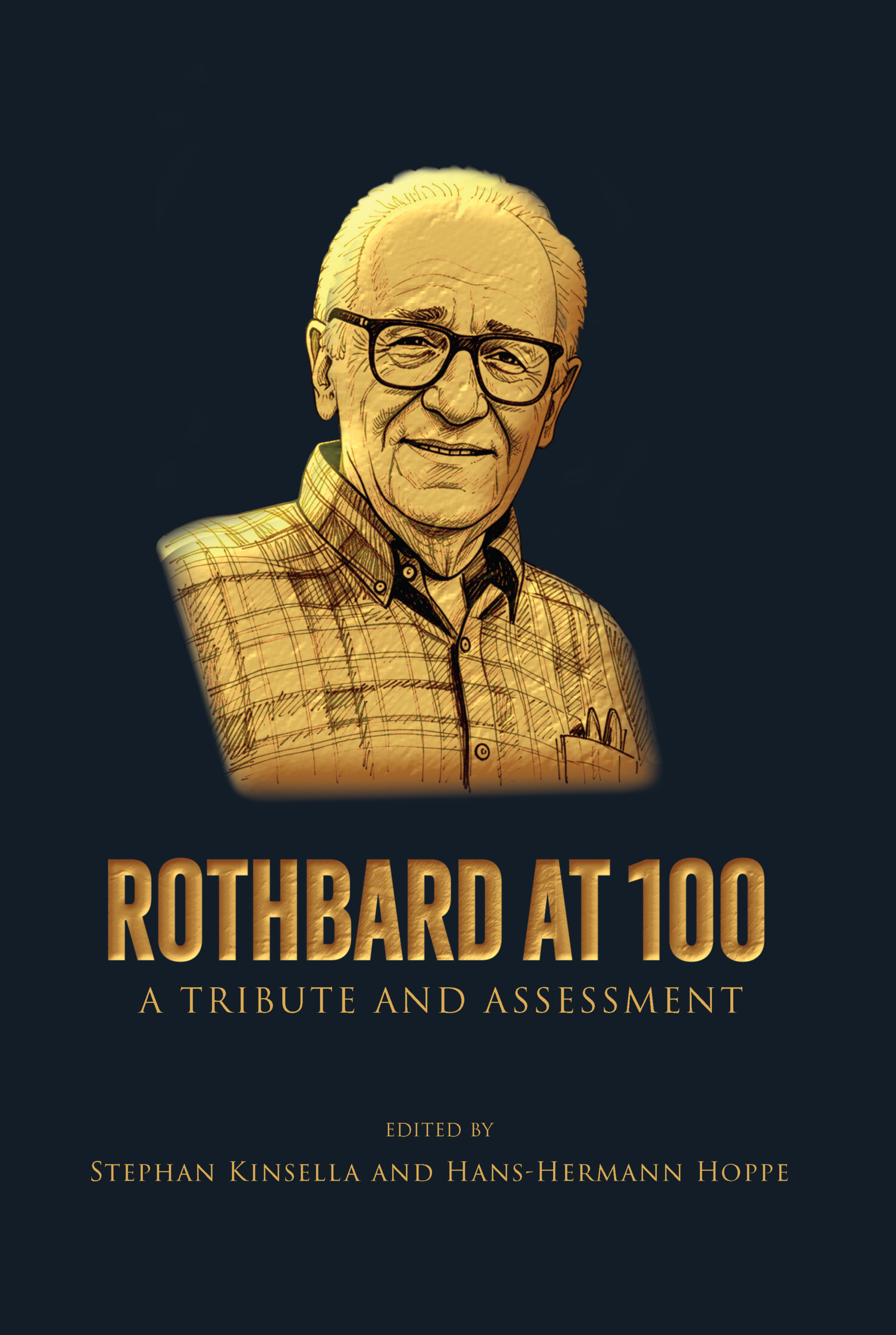
- Stephan Kinsella and Hans-Hermann Hoppe, eds., Rothbard at 100: A Tribute and Assessment (Papinian Press and The Saif House, 2026)
- Kinsella, “Hoppe Is Not A Monarchist” (Sept. 15, 2009)
- Kinsella, “Was Mises an Anarchist?” (Aug. 7, 2009)
From HansHoppe.com and Hoppe on PFS
- Hoppe, “Libertarianism and the Alt-Right: In Search of a Libertarian Strategy for Social Change” (PFS 2017), reprinted in Getting Libertarianism Right
- Hoppe, “The Property and Freedom Society—Reflections After Five Years” (PFS 2010), reprinted in The Great Fiction
- Hoppe, “From Nation to Household: The Middle American Illusions of Sam Francis (and Pat Buchanan)” (1996)
- Hoppe, “Where the Right Goes Wrong” (1997)
- Rothbard, “Hoppephobia,” Liberty (March 1990)
- Hoppe, “A Note on Chase Rachels’s Book” (Jan. 29, 2018)
The PFS Meetings and Panels Slobodian Cites (or Doesn’t)
- PFS 2006 Annual Meeting—Speakers and Presentations
- PFS 2010 Annual Meeting—Speakers and Presentations
- PFS 2014 Annual Meeting—Speakers and Schedule
- PFS 2017 Annual Meeting; Hoppe, Stone, Kinsella, Dürr: Discussion, Q&A (PFS 2017)
- PFS 2018 Annual Meeting; Jeff Deist, The Zeitgeist Libertarians (PFS 2018)
- Daniel Model, An Entrepreneur’s Bureaucratic Encounters (PFS 2021); Model, Kinsella, Dürr, Hoppe, Discussion, Q&A (PFS 2021)
Other Critiques of Slobodian
- David Gordon, “Book Review: Crack-Up Capitalism,” Quarterly Journal of Austrian Economics 26, no. 2 (2023)
- David Gordon, “Slobodian contra Rothbard,” The Austrian (July–Aug. 2023)
- David Gordon, “Cracked-Up Slobodian,” Mises Wire (July 7, 2023)
- David Gordon, “The Goldbug Variations,” Friday Philosophy (April 25, 2025)
- Jesse Russell, “Slobodian’s Bastard Caricatures: Smearing Austrian Economists,” Mises Wire (Aug. 4, 2026)
- Phillip W. Magness, “Quinn Slobodian Bastardizes Hayek and Mises,” Reason (April 16, 2025)
- Phillip W. Magness, “Prominent Historian Misrepresents Mises,” Independent Institute (July 23, 2026)
- Andy Lamey, “A Baseless Attack on Friedrich Hayek’s Intellectual Legacy,” Quillette (June 5, 2026)
- Malte Fischer, “Banished from the Hall of Freedom: The Ludwig von Mises Institute in the Crosshairs of Conformity,” Neue Zürcher Zeitung (Aug. 24, 2026), trans. Nick Hoppe, Property and Freedom Society (Aug. 25, 2026)
- Quinn Slobodian, Crack-Up Capitalism: Market Radicals and the Dream of a World Without Democracy (New York: Metropolitan Books, 2023), Introduction, pp. 5–6. [↩]
- Slobodian, Crack-Up Capitalism, Introduction, pp. 5, 9; ch. 5, p. 112; ch. 7, p. 147; Conclusion, p. 232 [Deist]; ch. 7, p. 147 [Model, Gebel]; Conclusion, pp. 225–28 [Schumacher]. [↩]
- Quinn Slobodian, Globalists: The End of Empire and the Birth of Neoliberalism (Cambridge, Mass.: Harvard University Press, 2018). [↩]
- “Hayek’s Bastards wins the National Book Critics Circle Award for Criticism,” Princeton University Press (March 27, 2026). [↩]
- Slobodian, Crack-Up Capitalism, ch. 5, p. 111. [↩] [↩] [↩]
- See Kinsella, “Memories of the First Property and Freedom Society Meeting, May 2026,” Property and Freedom Society (May 10, 2026); “PFS 2006 Annual Meeting—Speakers and Presentations,” Property and Freedom Society. [↩]
- Slobodian, Crack-Up Capitalism, ch. 5 n.63; Hans-Hermann Hoppe, “The Property and Freedom Society—Reflections After Five Years” (delivered June 4, 2010, at the Fifth Annual Meeting of the PFS), reprinted as ch. 24 of Hoppe, The Great Fiction: Property, Economy, Society, and the Politics of Decline. [↩]
- Slobodian, Crack-Up Capitalism, ch. 5, p. 111 & n.65, citing “PFS 2010 Annual Meeting—Speakers and Presentations,” Property and Freedom Society. [↩]
- “PFS 2010 Annual Meeting—Speakers and Presentations.” [↩]
- Slobodian, Crack-Up Capitalism, ch. 5, p. 111 & n.66; “PFS 2014 Annual Meeting—Speakers and Schedule,” Property and Freedom Society. [↩]
- Slobodian, Crack-Up Capitalism, ch. 5, p. 111 & n.67; see “PFS 2006 Annual Meeting—Speakers and Presentations” [Groezinger on the political correctness panel]; “PFP238 | Robert Groezinger, Gary North’s Covenantalism as a Contribution to Political Economy (PFS 2022),” Property and Freedom Podcast (July 3, 2023). [↩]
- Ibid., p. 114. [↩]
- Ibid., p. 113. [↩] [↩]
- Slobodian, Crack-Up Capitalism, ch. 5, p. 112, quoting Hans-Hermann Hoppe, Democracy: The God That Failed (New Brunswick, NJ: Transaction, 2001), p. 218. [↩]
- Hoppe, Democracy: The God That Failed, p. 218. [↩]
- See Kinsella, “Hoppe on Covenant Communities and Advocates of Alternative Lifestyles,” StephanKinsella.com (May 26, 2010), quoting Hoppe’s “My Battle with the Thought Police” (2005): the passage concerns a covenant “concluded among proprietors and community tenants for the purpose of protecting their private property.” [↩]
- Slobodian, Crack-Up Capitalism, ch. 5, p. 112 & n.74. [↩]
- Ibid., ch. 5 n.80. [↩]
- Hans-Hermann Hoppe, “Libertarianism and the Alt-Right: In Search of a Libertarian Strategy for Social Change” (speech at the Twelfth Annual Meeting of the PFS, Bodrum, Sept. 17, 2017), HansHoppe.com (Oct. 12, 2017), reprinted as ch. 3 of Hoppe, Getting Libertarianism Right (Auburn, Ala.: Mises Institute, 2018). See also Kinsella, “Hoppe vs. the Alt-Right,” StephanKinsella.com (Aug. 5, 2025). [↩]
- Hoppe, A Note on Chase Rachels’s Book. [↩]
- Hoppe, “Reflections After Five Years,” as quoted in Kinsella, “Hoppe vs. the Alt-Right.” [↩]
- Kinsella, “The Three Fusionisms: Old, New, and Cautious,” StephanKinsella.com (Jan. 16, 2022). [↩]
- Ibid., pp. 110–11. [↩]
- Ibid., p. 101. [↩]
- Ibid., p. 107. [↩]
- David Gordon, “Slobodian contra Rothbard,” The Austrian 9, no. 4 (July–Aug. 2023). [↩]
- Ibid. [↩]
- Slobodian, Crack-Up Capitalism, ch. 5, p. 108. [↩]
- Slobodian, Crack-Up Capitalism, Introduction, p. 5 & nn.21–22, citing Jeff Deist, “The Prospects for Soft Secession in America,” Mises Wire (Sept. 21, 2021), and Deist, “Secession Begins at Home,” LewRockwell.com (Jan. 31, 2015). [↩]
- Deist, “The Prospects for Soft Secession in America.” [↩]
- Slobodian, Crack-Up Capitalism, ch. 5, p. 112 & n.71. [↩]
- Jeff Deist, “Self-Determination, Not Universalism, Is the Goal,” Mises Wire (May 29, 2017). [↩]
- See also Kinsella, “Was Mises an Anarchist?,” StephanKinsella.com (Aug. 7, 2009). [↩]
- Slobodian, Crack-Up Capitalism, ch. 7, p. 147 & n.85, citing “Discussion Q&A—Salin, Stone, Malice, Kinsella, Deist (PFS 2018).” See “PFP197 | Salin et al., Discussion, Q&A (PFS 2018),” Property and Freedom Podcast; “PFS 2018 Annual Meeting,” Property and Freedom Society; Jeff Deist, “The Zeitgeist Libertarians (PFS 2018),” Property and Freedom Society. [↩]
- Slobodian, Crack-Up Capitalism, Conclusion, p. 232 & n.41, citing Jeff Deist and Stephan Livera, “Economic Freedom vs. Personal Freedom,” The Human Action Podcast (May 13, 2022). [↩]
- Slobodian, Crack-Up Capitalism, ch. 7, p. 147. [↩]
- “PFP230 | Daniel Model, An Entrepreneur’s Bureaucratic Encounters (PFS 2021),” Property and Freedom Podcast (May 8, 2023); “PFP234 | Model, Kinsella, Dürr, Hoppe, Discussion, Q&A (PFS 2021),” Property and Freedom Podcast (June 5, 2023). [↩]
- Slobodian, Crack-Up Capitalism, ch. 7, p. 147 & n.88; “PFS 2017 Annual Meeting,” Property and Freedom Society. [↩]
- Slobodian, Crack-Up Capitalism, Conclusion, p. 228 & n.15; see “Hoppe, Stone, Kinsella, Dürr: Discussion, Q&A (PFS 2017),” Property and Freedom Society (Nov. 2, 2017). [↩]
- “PFS 2017 Annual Meeting.” [↩]
- David Gordon, “Book Review: Crack-Up Capitalism: Market Radicals and the Dream of a World Without Democracy,” Quarterly Journal of Austrian Economics 26, no. 2 (2023): 325–28. [↩]
- Gordon, “Slobodian contra Rothbard.” [↩]
- Gordon, “Cracked-Up Slobodian,” Mises Wire (July 7, 2023). [↩]
- Gordon, “The Goldbug Variations,” Friday Philosophy, Mises Institute (April 25, 2025). See also Jesse Russell, “Slobodian’s Bastard Caricatures: Smearing Austrian Economists,” Mises Wire (Aug. 4, 2026). [↩]
- Phillip W. Magness, “Prominent Historian Misrepresents Mises,” Independent Institute (July 23, 2026) (originally published in City Journal, June 23, 2026); Magness, “Quinn Slobodian Bastardizes Hayek and Mises,” Reason (April 16, 2025). [↩]
- Kinsella, “Magness on Hoppe; the Kochtopus and the Mises Caucus,” StephanKinsella.com (Sept. 7, 2022) [appendix]. My own contribution to that exchange was, “who is ‘Slobodian’? I have never heard of this guy.” Times change. [↩]
- Andy Lamey, “A Baseless Attack on Friedrich Hayek’s Intellectual Legacy,” Quillette (June 5, 2026). [↩]
- Malte Fischer, “Banished from the Hall of Freedom: The Ludwig von Mises Institute in the Crosshairs of Conformity,” Neue Zürcher Zeitung (Aug. 24, 2026), trans. Nick Hoppe, Property and Freedom Society (Aug. 25, 2026). [↩]
- Slobodian, Crack-Up Capitalism, ch. 1, p. 20; ch. 4, p. 85; ch. 5, p. 103; ch. 11, p. 214. [↩]
- Slobodian, Crack-Up Capitalism, Conclusion, p. 232. [↩]
- Kinsella, “Hoppe Is Not A Monarchist,” StephanKinsella.com (Sept. 15, 2009). [↩]
- Murray N. Rothbard, “Hoppephobia,” Liberty 3, no. 4 (March 1990): 11–12, responding to Loren Lomasky’s review of Hoppe’s A Theory of Socialism and Capitalism. See also Hoppe’s response, “Intimidation by Argument—Once Again” (Liberty, Nov. 1989; also in EEPP, Appendix); and Kinsella, “KOL302 | Human Action Podcast with Jeff Deist: Hoppe’s Democracy” (Oct. 23, 2020). [↩]









 Alessandro Fusillo
 Andreas Tögel
 David Dürr
 Doug French
 Fernando Chiocca
 Greg Morin
 Hans-Hermann Hoppe
 Jay Baykal
 Jayant Bhandari
 Jeff Deist
 Jeffrey Barr
 Juan Fernando Carpio
 Ken Yamarashi
 León Isidoro
 Martin Cabrera
 Nick Hoppe
 Oscar Grau
 Peter Wong
 PFS
 scholarium
 Saifedean Ammous
 Sean Gabb
 Sean Ring
 Stephan Kinsella
 Stéphane Geyres
 Thomas Jacob
 Tom DiLorenzo

Follow Us!