From the Swiss NZZ (leading Swiss daily): Malte Fischer (Wirtschaftsredaktor der NZZ Deutschland, Düsseldorf), “Linke werfen Liberalen und Libertären eine Nähe zum Rechtsextremismus vor. Dahinter steckt blinder Antikapitalismus,” Neue Zürcher Zeitung (Der andere Blick) (24 August 2026) (published as part of the “Der andere Blick am Abend” newsletter).
English translation below (translated by Nick Hoppe).
Note that the Bayrische Hof is host to the annual International Security Conference that regularly features multitudes of war criminals.
Update [SK]: See also Rothbard Takes Portugal: 100 Years with Rothbard: A Personal Account:
Manuel had originally intended a smaller, local event, but we ended up needing a larger space for the almost 400 attendees, which were about 80% Portuguese but many others from Spain, Europe, and elsewhere. The first venue booked ended up canceling the booking, due to local political concerns over our libertarian views. A second venue was booked. They also backed out. Finally, a third venue was booked, which thankfully did not end up backing out.
Related:
- Hoppe, Resignation from the Scientific Advisory Board of the Ludwig von Mises Institute Germany (Aug. 18, 2025).
Banished from the Hall of Freedom: The Ludwig von Mises Institute in the Crosshairs of Conformity

The Munich luxury hotel Bayerischer Hof will no longer be available for conferences of the liberal Ludwig von Mises Institute. Liesa Johannssen / REUTERS
Now it has caught the Ludwig von Mises Institute Germany (MID). The institute, named after the liberal Austrian economist and state philosopher Ludwig von Mises, will no longer be allowed to hold its annual conferences at the “Bayerischer Hof” luxury hotel in Munich.
The management of the five-star luxury hotel justified its decision last week by stating that the public statements made by representatives of the Mises Institute were incompatible with the values of “open-mindedness, tolerance, diversity, and the core values of a free and democratic society” for which the “Bayerischer Hof” stands.
The background to the hotel’s decision was a report by the Munich local newspaper “Abendzeitung”. In it, the newspaper accuses the institute of questioning the state and democracy under the guise of scientific expertise. With this stance, the Mises Institute—which was funded until a few years ago by the billionaire August von Finck Jr., who died in 2021—shows a dangerous proximity to the AfD and right-wing extremism.
State-Critical School of Thought
To lend gravitas to the accusation of the Mises Institute’s right-wing leanings, the Abendzeitung cites crown witnesses from the left political spectrum who are well known for their anti-capitalist stance. These include sociologist Andreas Kemper, who works for the left-wing campaigning organization Campact, and Canadian historian Quinn Slobodian. This suggests the presumption that behind the media attack against the Mises Institute lies an attempt to socially discredit the market economy and capitalism, which liberals and libertarians advocate.
Such accusations are not new. For years, representatives from the left political spectrum have been trying to prove a proximity to right-wing ideas in the liberal Friedrich August von Hayek Society.
Ludwig von Mises and his student Friedrich August von Hayek were prominent representatives of the Austrian School of economics. It is a state-critical, liberal school of thought founded in the 19th century by Carl Menger.
In his works, Mises pleads for a minimal state that confines itself to protecting the property and freedom of citizens as well as peace. He sharply opposed state intervention in the economy, warning that this triggers an interventionist spiral and drives the economy into socialism.
Plea for a Private-Law Society
Liberals and libertarians standing in the tradition of the Austrian School advocate for the exact opposite of what the dominant political forces in Germany have been doing for years. They do not want to fatten the state, but rather slim it down; they want to expand the freedom of citizens, not restrict it. Therefore, it is hardly surprising that the Mises Institute is now in the crosshairs of social state apologists.
This is all the more true because representatives of the institute also draw on the ideas of economists such as Murray Rothbard and Hans-Hermann Hoppe in their publications. Rothbard and Hoppe blended Mises’s state-critical doctrine with American libertarianism and advocate for an anarcho-capitalist private-law society. In this society, private-law contractual relationships replace the state. Infrastructure, education, internal and external security—everything is privatized. Voluntary contracts take the place of state coercion.
One may view this idea as a utopia, as a forward-looking innovative social design, or even as foolishness. But one thing the ideas of libertarians certainly are not: right-wing radical.
On the contrary. While forces on the left and right fringes of the political spectrum long for an omnipotent state—the ones to expropriate the rich, the others to monitor uncompliant citizens—liberals and libertarians advocate for the freedom of the individual.
Democracy is Not a God
Unlike the right and the left, liberals and libertarians do not focus on the collective, but on the individual. For the collectivists of the right and left, liberals and libertarians are therefore enemy number one. Against this background, it is quite absurd to lump them together with right-wing extremism.
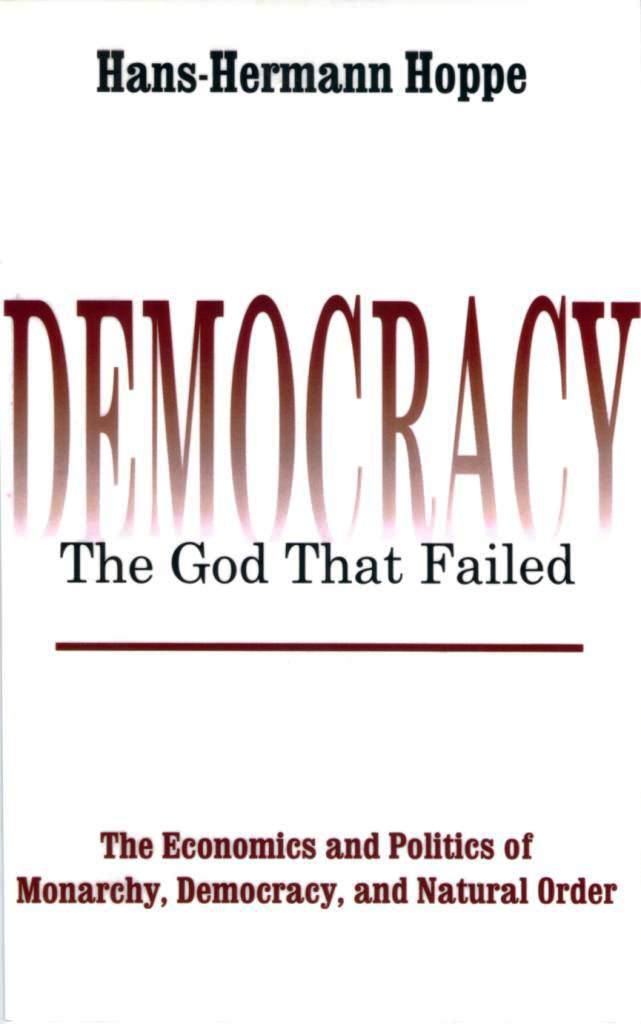
Nor does this change the fact that in liberal-libertarian circles, democracy is reflected upon critically. Democracy is not a god, as Hans-Hermann Hoppe correctly noted in his works. Democracy is a form of government with advantages and disadvantages. Discussing these critically does not demonstrate hostility to the constitution, but rather civic maturity.
Not without reason did Nobel Prize-winning economist Hayek warn “that a democratic government under the rule of a very homogeneous and doctrinaire majority could subjugate people just as easily as the worst dictatorship.”
The State Must Also Endure Polemical Criticism
In its landmark ruling of 1958, the German Federal Constitutional Court broke a wide path for freedom of speech in Germany. Freedom of speech is “constitutive” for a free and democratic constitutional order, the ruling stated.
That freedom of speech also includes the right to critically question the state and democracy was affirmed by the constitutional judges in another ruling from 2024. The state is “not entitled to a constitutional basis for protection of honor,” it states. As a rule, it “must also endure sharp and polemical criticism.” The admissibility of criticism of the system, according to the judges, “is part of the constitutional state.”
Thus, anyone who accuses liberals of their state-critical stance being an expression of a right-wing radical mindset with which they move outside the constitutionally permissible spectrum must be asked what form of society they themselves prefer. A free one it certainly cannot be.


















 Alessandro Fusillo
 Andreas Tögel
 David Dürr
 Doug French
 Fernando Chiocca
 Greg Morin
 Hans-Hermann Hoppe
 Jay Baykal
 Jayant Bhandari
 Jeff Deist
 Jeffrey Barr
 Juan Fernando Carpio
 Ken Yamarashi
 León Isidoro
 Martin Cabrera
 Nick Hoppe
 Oscar Grau
 Peter Wong
 PFS
PFS scholarium
 Saifedean Ammous
 Sean Gabb
 Sean Ring
 Stephan Kinsella
 Stéphane Geyres
 Thomas Jacob
 Tom DiLorenzo
Follow Us!