Earlier this month Ryan McMaken published “Jefferson, Secession, and ‘All Men Are Created Equal’,” Mises Wire (Nov. 3, 2026), which doubles as a hit piece on John C. Calhoun. Calhoun, we learn, “was an anti-Jeffersonian who disliked the Declaration of Independence,” whose chief concern besides the presidency was “crafting defenses for slavery and the planter class.” McMaken then serves up Calhoun’s most politically incorrect remarks on race, such as blacks being “utterly unqualified to possess liberty.” Shocking stuff, if you’ve never read Lincoln: “I am not, nor ever have been, in favor of bringing about in any way the social and political equality of the white and black races.”1 Somehow that never seems to disqualify the Great Emancipator, as Tom DiLorenzo has been pointing out for over twenty years.
For authority, McMaken leans on the author of Cronyism, Patrick Newton—I mean, Newman.2 According to Newman, Calhoun’s primary lifelong goal was to be president of the United States. Well. An American politician wanted to be president. Big surprise. (McMaken and Newman previously explained, in a Radio Rothbard episode, “A Closer Look at John C. Calhoun,” in January, why Calhoun was “never a true Jeffersonian.” On a show named after Rothbard, no less. Say, didn’t Jefferson also want to be president?)
But Rothbard called Calhoun “one of America’s most brilliant political theorists”3 and, of his Disquisition on Government, said it was “one of the most brilliant essays on political philosophy ever written.”4 DiLorenzo reminded us of this just this June, at the PFS Blog: “Rothbard’s Favorite American Political Philosopher” (June 29, 2026). McMaken quotes Rothbard several times, but only as a witness against Calhoun. You’d never guess Rothbard, or any libertarian, was a fan. (McMaken himself once quoted Rothbard calling Calhoun’s theory “pathbreaking.” See McMaken, “Rothbard and Mises vs. Calhoun on the Natural Right to Secede,” Mises Wire [Dec. 20, 2023].)
Now, nine days later, the Institute’s David Gordon and Wanjiru Njoya have offered a corrective in “Murray Rothbard on John C. Calhoun,” Mises Wire (Nov. 12, 2026).5 They show Rothbard praising Calhoun’s “profound analysis of the constitutional problem”: a Supreme Court with the final say over the Constitution’s meaning will inevitably expand federal power. “In his Disquisition, Calhoun demonstrated the inherent tendency of the State to break through the limits of such a constitution,” Rothbard wrote.6
Calhoun’s remedy was his doctrine of the “concurrent majority.” Instead of leaving the Supreme Court as final judge of the federal government’s powers, any “substantial minority interest in the country, specifically a state government,” would have “the right to veto” federal action it deemed unconstitutional. Applied to the states, as Rothbard noted, this “implied the right of ‘nullification’ of a Federal law or ruling within a state’s jurisdiction.” Rothbard endorsed the idea, with one complaint: Calhoun didn’t push it “down to the individual himself.” A consistent theory of concurrence, Rothbard argued, “would imply veto power by every individual.”7
All of this is similar to ideas I’ve long advocated. One is concurrent review: the Jeffersonian view that each branch of government has an equal and independent duty to refuse to enact or enforce what it believes is unconstitutional. Another is its vertical counterpart, state nullification, as asserted in Jefferson’s Kentucky and Madison’s Virginia Resolutions of 1798. Neither gives the Supreme Court the final say. And the only remedy the feds should have against a nullifying state is to eject it from the Union.8
Gordon and Njoya also show Rothbard admiring Calhoun’s division of society into “tax-payers and tax-consumers.” DiLorenzo was already applying that theme to the 2000 election map in “Calhoun Foresaw This,” Mises Daily (Nov. 13, 2000). They remind us, too, that Rothbard was a Youth for Thurmond man in 1948 who counted the South’s cause as one of America’s two just wars. Their Calhoun is no anti-Jeffersonian but an heir to Jefferson’s Kentucky Resolutions. DiLorenzo made the same point on the same site two years ago (when he was still President, ‘natch): “Calhoun was a Jeffersonian philosophically.”9 See DiLorenzo, “Can John C. Calhoun Save America?,” Mises Wire (Apr. 17, 2024). And Njoya had already given Calhoun a fairer hearing back in June: “Calhoun’s Answer to the Abolition Petitions,” Mises Wire (June 30, 2026). So it’s Mises Wire contra Mises Wire.
For a decentralist—anyone who favors nullification, interposition, and some check on judicial supremacy—Calhoun is an obvious resource. Publicly condemning him is about the most gratuitously PC move available to an American intellectual. As Tom Woods puts it, Calhoun has been “sufficiently demonized” that anything associated with him becomes “automatically suspect.”10 The Straussians can’t stop condemning him. Back in 2008 DiLorenzo was already warning readers to disregard “the lies about Calhoun that have been invented by Harry Jaffa” and repeated by his followers.11 Cato, FEE, and the rest condemn Calhoun too, trying to win the respect of people who despise them and everything they supposedly stand for. It’s a neocon-ish reflex, and an odd one to find at the Mises Institute, especially in what it has proclaimed “2026: The Year of Rothbard.” Happy centennial, Murray.12
Related
-
- Kinsella, “Noted Rothbard ‘Expert’ Shelton at the Mises Institute Supporters’ Summit” (Nov. 12, 2026)
- Kinsella, “Akhil Amar on Jury Nullification and State Nullification (Converse-§1983 Laws)” (Oct. 31, 2026)
- Tom DiLorenzo, “Rothbard’s Favorite American Political Philosopher” (June 29, 2026)
- Kinsella, “My Years with the Mises Institute,” Property and Freedom Journal (May 2, 2026)
- “Hoppe: Mises Institute: Quo Vadis?” (Mar. 25, 2026)
- “Mises Institute email: ‘Rothbard’s Ideas Live On: Three Books That Defend Liberty’” (Mar. 17, 2026)
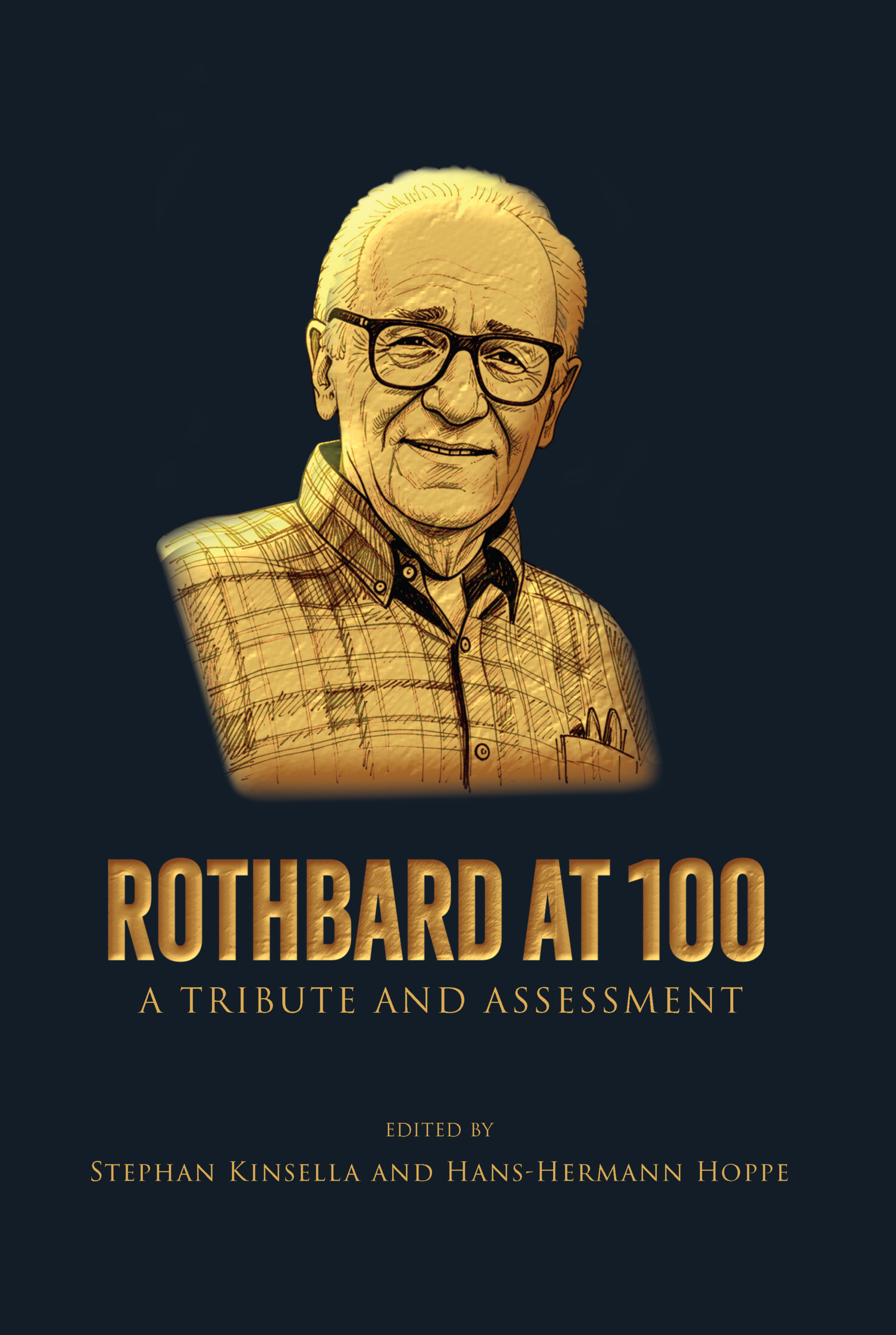
- Kinsella & Hoppe, eds., Rothbard at 100: A Tribute and Assessment (Papinian Press/The Saif House, 2026)
- Kinsella, “Concurrent Review and Judicial Supremacy” (Mar. 14, 2025)
- “PFP231 | Stephan Kinsella, State Constitutions vs. the Libertarian Private Law Code (PFS 2021)” (May 15, 2023)
- Kinsella, “Cato on Drug Reimportation; Cato Tugs Stray Back Onto the Reservation; and Other Posts” (Dec. 23, 2009)
- Kinsella, “Sobran on Sandefur” (Oct. 23, 2003)
- Abraham Lincoln, Fourth Lincoln-Douglas Debate, Charleston, Illinois, Sept. 18, 1858, in National Park Service, “Fourth Debate: Charleston, Illinois.” [↩]
- Judy Shelton twice called him “Patrick Newton” in her keynote at this year’s Mises Institute Supporters Summit, “100 Years of Rothbard: His Bequest for the Future.” See Kinsella, “Noted Rothbard ‘Expert’ Shelton at the Mises Institute Supporters’ Summit,” PFS Blog, Nov. 12, 2026. [↩]
- Murray N. Rothbard, For a New Liberty: The Libertarian Manifesto, p. 58, as quoted in Thomas DiLorenzo, “Happy Birthday, John C. Calhoun,” LRC Blog, Mar. 18, 2008. [↩]
- Murray N. Rothbard, “A Strategy for the Right,” Rothbard-Rockwell Report, 1992, reprinted in Mises Daily, Mar. 9, 2010. [↩]
- This reminds me of the time Cato had to correct the anti-trade errors of some of its own pro-IP people—Doug Bandow, Michael Krauss, and Richard Epstein—who, in defense of patent-inflated prices, had come out against free trade in pharmaceuticals, aka drug reimportation. Ed Crane and Roger Pilon then had to explain, at length, that “Reimportation is right and good.” See Kinsella, “Cato Tugs Stray Back Onto the Reservation; Epstein on reimportation,” LRC Blog, July 29, 2003, reprinted at C4SIF; idem, “Cato on Drug Reimportation; Cato Tugs Stray Back Onto the Reservation; and Other Posts,” StephanKinsella.com, Dec. 23, 2009; Edward H. Crane and Roger Pilon, “Conservative Drug Split,” National Review, July 29, 2003. [↩]
- Murray N. Rothbard, Anatomy of the State, “How the State Transcends Its Limits”; see also Gordon and Njoya, “Murray Rothbard on John C. Calhoun.” [↩]
- Id. [↩]
- On concurrent review, see David N. Mayer, The Constitutional Thought of Thomas Jefferson (Charlottesville: University Press of Virginia, 1995), 131, 259, 263, 269–72; and William J. Quirk & R. Randall Bridwell, Judicial Dictatorship (New Brunswick, N.J.: Transaction, 1995), xiv, 10–11, 13, reviewed by none other than David Gordon, “How High the Court?,” The Mises Review 2, no. 2 (Summer 1996). On nullification, see Thomas E. Woods Jr., Nullification: How to Resist Federal Tyranny in the 21st Century (Washington, D.C.: Regnery, 2010), which reprints the Virginia and Kentucky Resolutions, Calhoun’s Fort Hill Address, and Littleton W. Tazewell’s review of Jackson’s 1832 proclamation against nullification; and idem, “Nullification and Liberty,” LewRockwell.com, Dec. 9, 2002, rejecting the idea that the Supreme Court, “itself a branch of the federal government,” could serve as the “common umpire” between the federal government and the states. See also Kinsella, “Concurrent Review and Judicial Supremacy,” StephanKinsella.com, Mar. 14, 2025; idem, “State Constitutions vs. the Libertarian Private Law Code,” talk at the 2021 PFS annual meeting, Property and Freedom Podcast, ep. 231, May 15, 2023. In that talk I propose, among other structural limits, giving states the power to “nullify unconstitutional acts of the feds,” a right of secession, and supermajority requirements and sunset provisions for legislation. I also endorse Marshall DeRosa’s amendment letting “a national majority of each State’s chief judicial official” negate a Supreme Court decision, a close cousin of Calhoun’s state veto. See also idem, “Akhil Amar on Jury Nullification and State Nullification (Converse-§1983 Laws),” PFS Blog, Oct. 31, 2026, on jury nullification, state nullification, and Amar’s “Converse 1983” idea of state laws letting people sue federal officials who violate their constitutional rights. [↩]
- In the late summer of 2025, DiLorenzo and CFO Karen De Coster were put on “administrative leave” and then dismissed, while donors were told, “deceivingly and untruthfully,” that both had resigned. See Hans-Hermann Hoppe, “Mises Institute: Quo Vadis?,” HansHoppe.com, Mar. 25, 2026, also posted at PFS Blog. [↩]
- Thomas E. Woods Jr., “Nullification,” LewRockwell.com, Mar. 9, 2018. Woods adds that nullification’s critics “never used Thomas Jefferson’s name,” though the idea, “including the very word itself, came from his pen.” [↩]
- Jaffa’s influence reaches even some libertarians. Tom DiLorenzo once remarked that the pro-Lincoln libertarian Timothy Sandefur was “merely repeating what Harry Jaffa taught him when he was a Lincoln Fellow at Claremont.” See Kinsella, “Sobran on Sandefur,” LRC Blog, Oct. 23, 2003; idem, “Rand, Objectivism, and One-World Government,” StephanKinsella.com, Sept. 17, 2009, on “Sandefur’s Jaffaism” and his “Jaffa-ite construction of our founding and the Fourteenth Amendment.” For my earlier exchanges with Sandefur on Lincoln and secession, see idem, “Pro-Lincoln Libertarians,” StephanKinsella.com, July 7, 2002; idem, “Of Legal Fictions and Pro-Lincoln Libertarians: Reply to Sandefur,” LewRockwell.com, Dec. 31, 2002; idem, “Sandefur and Federal Supremacy,” LewRockwell.com, July 5, 2003; and idem, “Down with the Bill of Rights: Heller and the Central States Cheerleaders (2008),” StephanKinsella.com, June 25, 2021. [↩]
- My title is a nod to Louis Torres’s review of Barbara Branden’s excellent biography, “Boswell’s Johnson, Branden’s Rand: The Passion of Ayn Rand in Historical Perspective,” Aristos 3, no. 5, May 1987. As the Aristos editors later recalled, Torres concluded that Branden’s book “is likely to remain the definitive biography of Ayn Rand.” See The Editors, “Barbara Branden, 1929–2013: Boswellian Biographer of Ayn Rand,” Aristos, Dec. 2013. Rothbard reviewed Branden’s book too, for American Libertarian, July 1986; see “Rothbard, My Break With Branden and the Rand Cult,” PFS Blog, July 25, 2026. [↩]










 Alessandro Fusillo
 Andreas Tögel
 David Dürr
 Doug French
 Fernando Chiocca
 Greg Morin
 Hans-Hermann Hoppe
 Jay Baykal
 Jayant Bhandari
 Jeff Deist
 Jeffrey Barr
 Juan Fernando Carpio
 Ken Yamarashi
 León Isidoro
 Martin Cabrera
 Nick Hoppe
 Oscar Grau
 Peter Wong
 PFS
 scholarium
 Saifedean Ammous
 Sean Gabb
 Sean Ring
 Stephan Kinsella
 Stéphane Geyres
 Thomas Jacob
 Tom DiLorenzo

Follow Us!