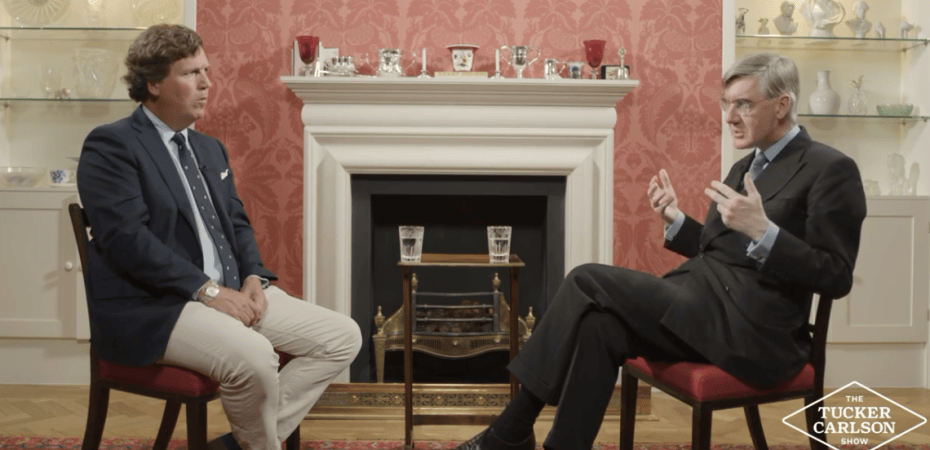
 Marian Halcombe, “Jacob Rees-Mogg: Conservatism as a Costume,” Libertarian Alliance (3 October, 2026).
I have no time for watching videos. But I will read their transcripts when made available. Therefore, if I did not watch it, I have read Tucker Carlson’s interview with Jacob Rees-Mogg, published on the 2nd October 2026. The most revealing part of the interview with comes towards the end. After nearly an hour discussing Russia, deterrence, the world wars and the international order, the conversation reaches the freedom of British people to speak in their own country. Rees-Mogg supplies this extraordinary reassurance:
“They’re not oppressing anything that I’ve tried to say…” — 58:04
He immediately seeks to qualify it. Nevertheless, the instinct is revealing. Here is a former senior minister, confronted with the suppression of other people’s opinions, reaching first for the fact that his own opinions remain comfortably expressible.
Carlson interrupts:
“That’s not how free speech works.”
Quite. A political order cannot be judged by how pleasantly it treats Jacob Rees-Mogg.
The interview ranges widely. Rees-Mogg argues that military preparedness deters Russia, that the integrity of nation states is essential to international order, and that Britain has an interest in supporting Ukraine. Carlson repeatedly asks what these commitments cost, how they benefit British people, and whether Britain’s rulers are more attentive to distant frontiers than to the condition of their own country. They dispute the justification for the world wars, the bombing of Hiroshima and Nagasaki, immigration, sovereignty and the policing of speech.
But the central political revelation is much simpler. Rees-Mogg can recognise failure. He can describe it. He can occasionally deplore it in language strong enough to satisfy a conservative audience. What he does not provide is a convincing account of why anyone should entrust the remedy to the political class that presided over it.
That is what makes him, in my judgment, a City spiv masquerading as a gentleman. The phrase describes a political performance: the cultivation of reassuring manners and traditional associations while selling another instalment of the same exhausted Conservative promise. His career in finance and his role in establishing Somerset Capital Management are matters of public record. So are his appointments as Leader of the Commons, minister for government efficiency and Business Secretary. This was a man inside government, with access and influence, not an eccentric spectator watching events from a country drawing room.












 Alessandro Fusillo
 Andreas Tögel
 David Dürr
 Doug French
 Fernando Chiocca
 Greg Morin
 Hans-Hermann Hoppe
 Jay Baykal
 Jayant Bhandari
 Jeff Deist
 Jeffrey Barr
 Juan Fernando Carpio
 Ken Yamarashi
 León Isidoro
 Martin Cabrera
 Nick Hoppe
 Oscar Grau
 Peter Wong
 PFS
PFS scholarium
 Saifedean Ammous
 Sean Gabb
 Sean Ring
 Stephan Kinsella
 Stéphane Geyres
 Thomas Jacob
 Tom DiLorenzo
Follow Us!