[StephanKinsella.com cross-post]
From Public Domain Dedication for Kinsella Works:
I want it to be as clear as possible that anyone may use my work, past or future, without my permission. In short: you may copy, publish, translate, adapt, sell, or otherwise use any of my published work, for any purpose, without asking me, paying me, or crediting me.1
This site’s footer has long stated that its content is dedicated to the public domain under the Creative Commons CC0 1.0 Universal Public Domain Dedication. But a footer notice covers only this site, and as I’ve noted before, it’s not clear that CC0, or even CC-BY, is legally enforceable (see the posts listed below). So, out of an abundance of caution, I have also signed a written public domain dedication (pdf) covering all my works, wherever published, including works I publish in the future.
The only exceptions are a few books whose copyright I assigned to publishers in the past. I now try to avoid doing that, but academic publishers often demand that authors assign their copyright, so it sometimes takes a fight. When Lexington Books’ form for my chapter “Dialogical Arguments for Libertarian Rights” in The Dialectics of Liberty (2019) offered a choice between assigning copyright and obtaining permission to reprint previously published material, I refused to assign and found a way around it. And for my chapters in Palgrave’s Handbook of Misesian Austrian Economics and Springer’s Handbook of the Philosophical Foundations of Business Ethics, I first published the texts myself as Papinian Press working papers under Creative Commons licenses, so the publishers could have the work without my assigning copyright. They can have my work for free, but not my copyright; if they won’t publish it on those terms, I can publish it myself.2
Too many academics, as I noted in my tribute to Tibor Machan, “sign away their copyrights, or leave the status vague and murky.”3 Some libertarian academics even seem to assume it’s impossible to persuade a publisher to allow a free online version, so they don’t even try. But it can be done: Michele Boldrin and David K. Levine published Against Intellectual Monopoly with Cambridge University Press in 2008 and negotiated the right to post a free version online.4
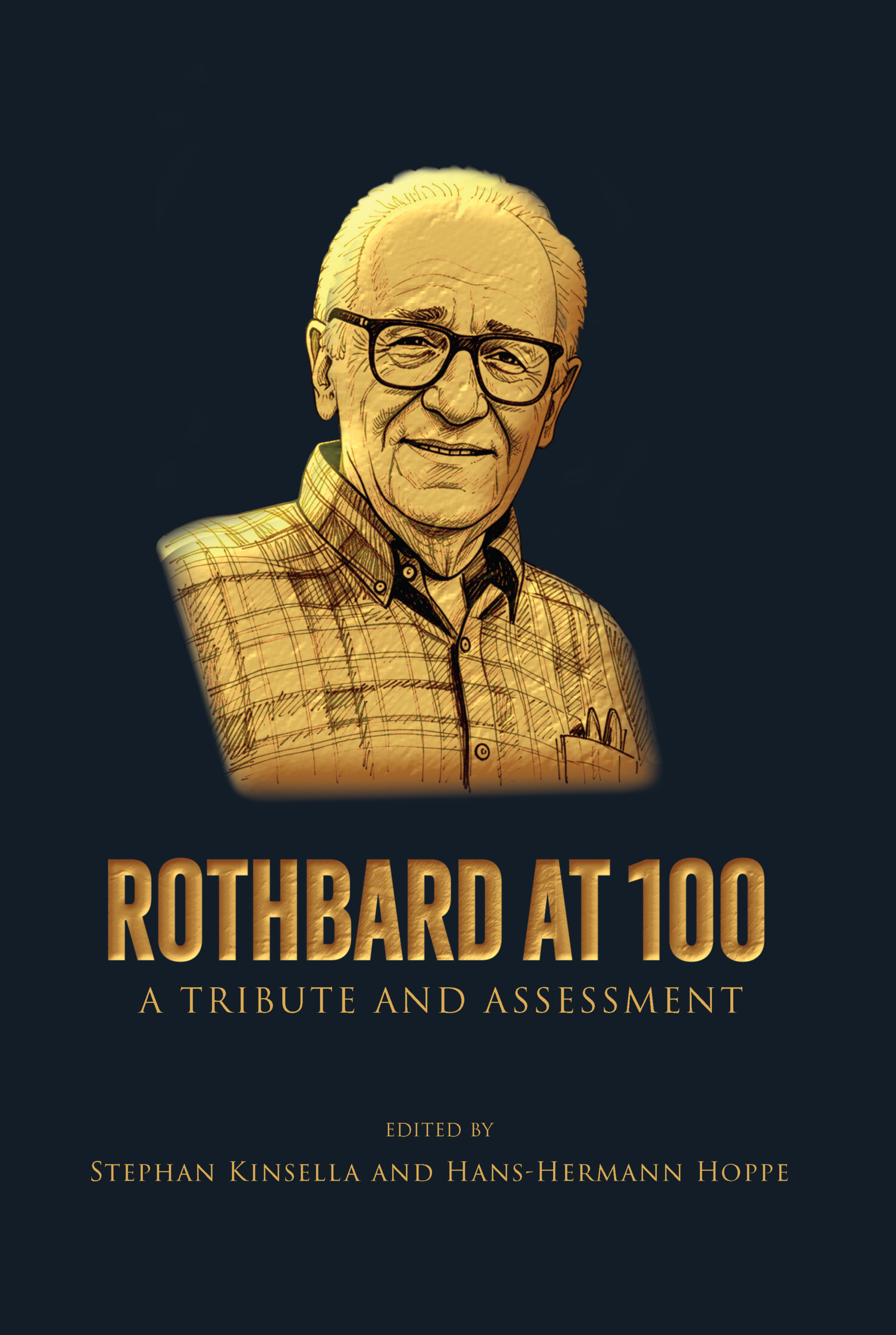
- On attribution as a matter of social convention rather than justice, see Kinsella, “Mises, Rothbard, Hoppe: An Indispensable Framework,” in Stephan Kinsella & Hans-Hermann Hoppe, eds., Rothbard at 100: A Tribute and Assessment (Houston: Papinian Press and Property and Freedom Society, 2026), “Excursus: The Role of Ideas in Human Action.” See also David Koepsell, “A Question of Authorship? (attribution),” C4SIF Blog (Oct. 3, 2012). [↩]
- See Kinsella, “On Leading by Example and the Power of Attraction (Open Source Publishing, Creative Commons, Public Domain Publishing),” C4SIF Blog (Apr. 12, 2025); idem, “The Title-Transfer Theory of Contract,” Papinian Press Working Paper #1 (Sept. 7, 2024); idem, “The Problem with Intellectual Property,” Papinian Press working paper (May 15, 2025), published as “The Problem with Intellectual Property,” in Christoph Luetge & Marianne Thejls Ziegler, eds., Handbook of the Philosophical Foundations of Business Ethics (Dordrecht: Springer, 2026). [↩]
- Kinsella, “Remembering Tibor Machan, Libertarian Mentor and Friend: Reflections on a Giant,” StephanKinsella.com (Apr. 19, 2016). [↩]
- See Kinsella, “The Academic Publishing Paywall Copyright Subsidized Racket,” C4SIF Blog (Nov. 9, 2025). [↩]







 Alessandro Fusillo
 Andreas Tögel
 David Dürr
 Doug French
 Fernando Chiocca
 Greg Morin
 Hans-Hermann Hoppe
 Jay Baykal
 Jayant Bhandari
 Jeff Deist
 Jeffrey Barr
 Juan Fernando Carpio
 Ken Yamarashi
 León Isidoro
 Martin Cabrera
 Nick Hoppe
 Oscar Grau
 Peter Wong
 PFS
 scholarium
 Saifedean Ammous
 Sean Gabb
 Sean Ring
 Stephan Kinsella
 Stéphane Geyres
 Thomas Jacob
 Tom DiLorenzo

Follow Us!