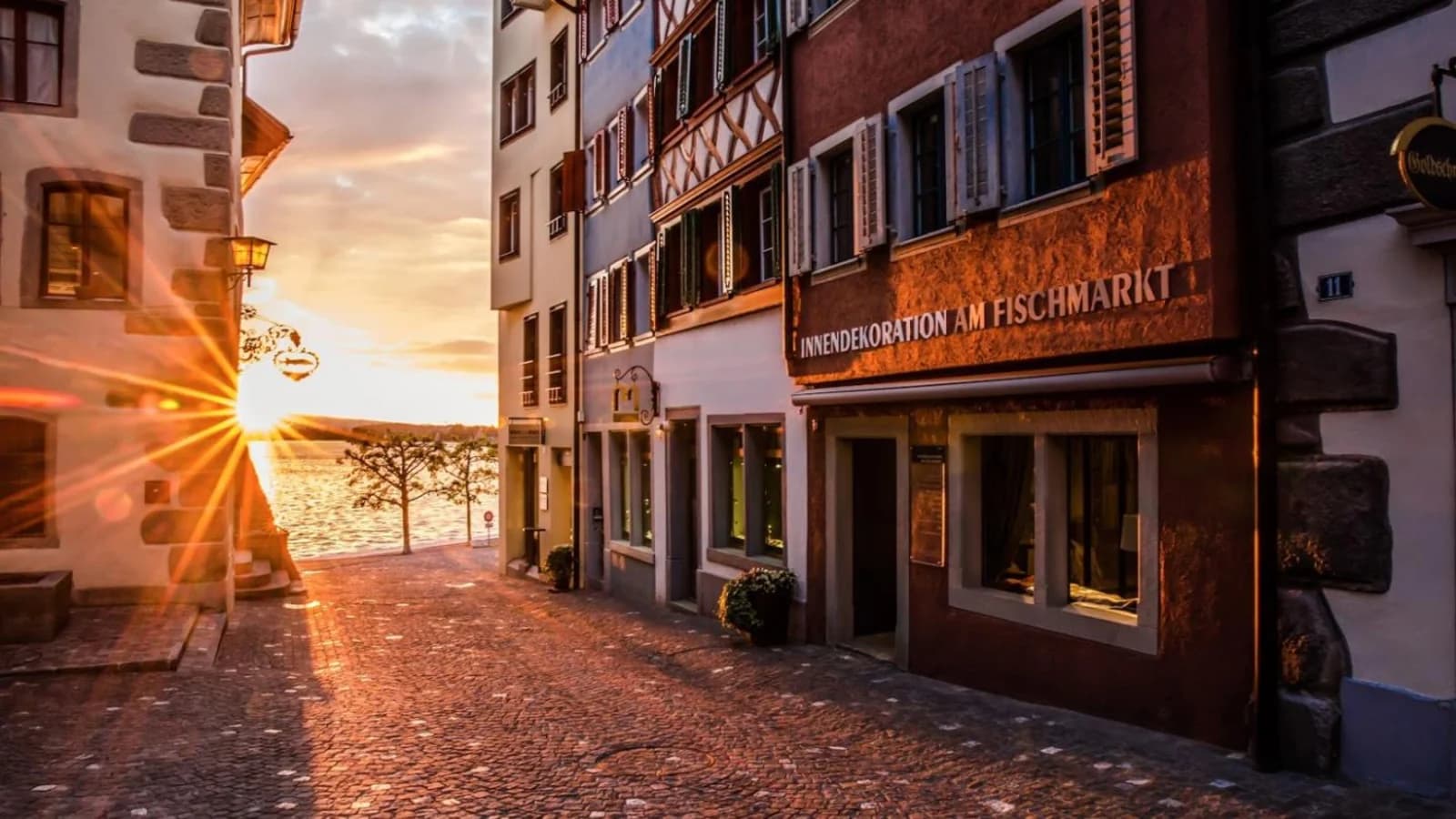
Evening light in Zug’s old town. © Daniel Hegglin / Zug Tourism
Rahim Taghizadegan, “Zug: A Trading House for the World: How a poor little canton learned to connect capital and strangers productively,” scholarium (19 August 2026)
In July 2024 I closed my Vienna base and moved to Zug with my family. Choosing Switzerland still felt like a vote for Austria and the Alpine region: close enough not to sever the old links. A short thread on what Zug gets right—and what it risks losing. 1/5 pic.twitter.com/fGz4RBxE2P
— Rahim Taghizadegan (scholarium.at) (@scholarium_at) August 20, 2026
Zug: A Trading House for the World
How a poor little canton learned to connect capital and strangers productively
When I moved with my family from Vienna to the canton of Zug in 2024, I arrived in a place whose everyday achievement becomes fully apparent only through living there: safety and reliability, short distances, an astonishing proximity of global business and nature, authorities who answer, and a landscape that is not merely admired but inhabited. A newcomer has, at first, nothing to explain about this. He has to notice what generations before him built and to be grateful for it.
Zug is neither a libertarian Arcadia nor merely a tax dodge. That is precisely what makes the canton so remarkable. Its success story is real because it requires no miracle. It rests on long prior investment, institutional capacity to learn, and the rare art of receiving foreign capital and foreign people without wholly losing its own measure. The legends about Zug fall short; the actual achievement is greater.













 Alessandro Fusillo
 Andreas Tögel
 David Dürr
 Doug French
 Fernando Chiocca
 Greg Morin
 Hans-Hermann Hoppe
 Jay Baykal
 Jayant Bhandari
 Jeff Deist
 Jeffrey Barr
 Juan Fernando Carpio
 Ken Yamarashi
 León Isidoro
 Martin Cabrera
 Nick Hoppe
 Oscar Grau
 Peter Wong
 PFS
PFS scholarium
 Saifedean Ammous
 Sean Gabb
 Sean Ring
 Stephan Kinsella
 Stéphane Geyres
 Thomas Jacob
 Tom DiLorenzo
Follow Us!