According to Thomas Hobbes, life in the state of nature was “solitary, poor, nasty, brutish, and short”: a permanent war of all against all, ended only by the emergence of a sovereign power. Libertarians have spent three centuries answering him with an optimistic rebuttal: the natural condition of humanity is cooperation, exchange, and division of labor rather than the gloomy homo homini lupus that Hobbes imagined. Strangers trade instead of killing each other because trade pays better than plunder. Progress is the story of win-win contracts, of a society based on trust, not the story of Leviathan imposing peace from above.
But suppose that Hobbes had been right?
What if life genuinely was nasty, brutish, and short because in the state of nature (by this expression we refer to the greater part of human history before the emergence of governments and states), given the alternative between “economic means” (homesteading, production and voluntary exchange) and “political means” (fraudulent or violent appropriation of other people’s wealth),1
many or most chose the shortcut of violence and fraud in order to deal with a world of scarce resources? Now, what would a brute do in order to make his criminal activities more effective and secure? The first answer is that he would resort to a network of alliances and build an organization of criminals. The lone primitive robber who hit his fellow human beings on the head to steal their mammoth bones could only count on a limited effectiveness. Age, encountering stronger brutes, and simple bad luck could make his criminal venture far too risky. That’s why the first response to the conditions imagined by Hobbes would have been an alliance between brutes.
Division of labor is morally neutral. It is an efficiency multiplier whatever you apply it to—the production of shoes, or the production of crime. A single bandit is a nuisance. A hierarchy of bandits, with scouts, enforcers, accountants, and a chain of command, is an economy of predation, and economies of predation, like economies of production, benefit from specialization. Hence, if we accept the premise that human beings left to themselves and their natural inclinations would resort to violence and fraud, then the first step after the beginning of the war of all against all is the incorporation of criminal organizations. Under their cover the nasty individuals who make up Hobbes’ gloomy picture of primitive humanity would have enjoyed the protection of the group and the higher efficiency of organized crime, which wins for the same reason that organized industry wins. Hobbes saw the war; he missed that its worst practitioners were never chaotic individuals but standing institutions.
Organization alone explains a gang. But sooner or later the gangsters would try to make their lives even easier and better than the simple use of a complex organization would allow. They would decide to turn their gangs into permanent institutions that rested not on the brutal principle that might is right but on a much more refined and shrewd method.2 What allows a criminal organization to tax rather than merely rob, conscript rather than merely kidnap, execute rather than merely murder—is a further, and stranger, achievement: the conviction, lodged in the minds of the victims themselves, that the gang has a right to do these things. Not that it can. That it may. This is the real paradigm shift, and it costs the ruling organization almost nothing to produce, because once installed it runs on the labor of the ruled. A tax collector who is believed to be legitimate needs no bodyguard. A law that is believed to be just enforces itself, through the ordinary shame and civic conscience of people who would never dream of resisting it. Legitimacy is predation on credit: the victims finance both the theft and the policing of their own compliance. Moreover, by relying on the herd instinct, which naturally leads individuals to identify with the group,3 the embryonic state organizations needed only two elements to secure obedience: to convince the members of the group that the organization was identical with the group itself (that is, the identification of State and civil society), and to play on fear as a primordial instinct that would lead the States’ victims to join with others in a strategy of collective defence under the banner of the organization. To do this they needed to tell a story.
Rothbard saw this clearly: since the state’s rule is exploitative, it must purchase the alliance of “Court Intellectuals”, whose task is to bamboozle the public into accepting and celebrating its rule, molding opinion toward the necessity, validity, and benevolence of the existing order.4 Legitimacy is the sole load-bearing element, stripped of everything else: neither a gang nor a cooperative can ever become a “government” unless the people believe that someone among them has the right to rule; without that belief, brute force alone provides no lasting power, and with it, the politicians and their enforcers become “indistinguishable from a giant organized crime syndicate” in everything but the public’s opinion of them.5 Hence, even if Hobbes was right about the evil tendencies that arise in the state of nature, he failed to see that States and governments, far from being a solution to the problem of crime and violence, are the perfection and completion of these tendencies. There is no mythical state of nature where human beings thrived happily because they chose to cooperate. There was indeed the nasty, brutish, and short life of primitive human beings, but it was made much worse by the emergence of States and governments.
Hence, the solution to the problem of crime lies in the future, hopefully, and not in the distant past.
If organization, herd instinct, and legitimacy are the two pillars of violence and fraud, resistance has two matching tasks. The first is old and unglamorous: counter-organize (build an alternative herd), and refuse. The Roman plebeians did not petition the patricians for better treatment. They walked out to the Aventine as a community and simply stopped participating—no army, no negotiation, just the withdrawal of the cooperation the whole system depended on. Étienne de La Boétie gave this refusal its first and still its sharpest theoretical statement: the tyrant has no power but what his subjects lend him through their own consent and habituated obedience; resolve to serve no more, and, like a colossus whose base has been pulled away, he collapses of his own weight.6
Every serious historical check on power has looked more like this than like a battle: strikes, tax revolts, jury nullification, quiet noncompliance multiplied across thousands of ordinary refusals. Organization without our participation crumbles, because, unlike voluntary enterprises, it produces nothing on its own.
The second task is harder, and more important: attack legitimacy directly. This is where conspiracy theories and revisionist history—categories polite society is trained to sneer at reflexively—do their real work. Every official history is a legitimacy narrative: the state’s founding was necessary, its wars were just, its laws reflect the general will. Revisionism’s task is not to indulge in fantasy but to do what any honest historian should do anyway—reopen the founding myths and show the coercion, the self-interest, and the arbitrary violence underneath the ceremony. Every myth stripped away is a brick pulled from a wall that was never held up by force alone.
Baudelaire wrote that the devil’s greatest trick was convincing the world he doesn’t exist.7 The state pulled off a more audacious stunt: convincing the world that it is necessary and good, or at least inevitable, given the alternatives. The reply is symmetrical to Baudelaire’s insight. To defeat the States, you must prove that the permanent gang of robbers has no power beyond what you lend it. Hobbes thought Leviathan was the cure for the war of all against all. He never considered that Leviathan might be its most successful practitioner — organized, and, worse, believed.
Downgrade the brutes. They will not go away, but they will lose their greatest and most dangerous power: the belief that they are the solution to the problems and dangers they create themselves.
- Franz Oppenheimer, The State (1908), on the distinction between the “economic means” and the “political means” of acquisition. [↩]
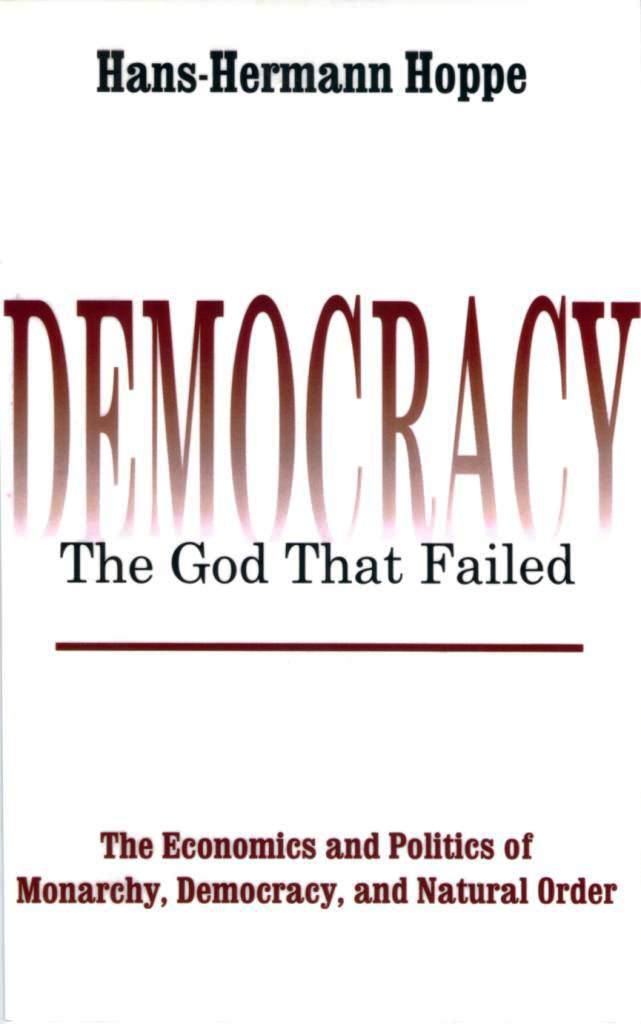
- Hans-Hermann Hoppe, Democracy: The God That Failed (2001), and The Economics and Ethics of Private Property (1993), on the state as the monopolist of final decision-making and compulsory jurisdiction — the ultimate judge in all conflicts, including those to which it is itself a party. [↩]
- Wilfred Trotter, Instincts of the Herd in Peace and War, 1916. [↩]
- Murray N. Rothbard, Anatomy of the State (Auburn, Ala.: Mises Institute, 2000; pdf); on the role of “Court Intellectuals” p. 20 ff. Also included in Rothbard, Egalitarianism as a Revolt Against Nature and Other Essays (2000). Originally published in Rampart Journal of Individualist Thought, vol. 1, no. 2 (Summer 1965): 1–24. [↩]
- Larken Rose, The Most Dangerous Superstition (2011). [↩]
- Étienne de La Boétie, Discourse on Voluntary Servitude (c. 1548/1576). [↩]
- Charles Baudelaire, Le Joueur généreux, Petits Poèmes en prose, Michel Lévy Frères, 1869, IV. Petits Poèmes en prose, Les Paradis artificiels (pp. 87–91). [↩]
Discover more from The Property and Freedom Society
Subscribe to get the latest posts sent to your email.

















 Alessandro Fusillo
 Andreas Tögel
 David Dürr
 Doug French
 Fernando Chiocca
 Greg Morin
 Hans-Hermann Hoppe
 Jay Baykal
 Jayant Bhandari
 Jeff Deist
 Jeffrey Barr
 Juan Fernando Carpio
 Ken Yamarashi
 León Isidoro
 Martin Cabrera
 Nick Hoppe
 Oscar Grau
 Peter Wong
 PFS
PFS scholarium
 Saifedean Ammous
 Sean Gabb
 Sean Ring
 Stephan Kinsella
 Stéphane Geyres
 Thomas Jacob
 Tom DiLorenzo