Hans-Hermann Hoppe (Germany/Turkey), StephanKinsella (USA), and Alessandro Fusillo (Italy) were guests and speakers at the Liberland Christmas Party and Constitution Celebration held in Prague at the elegant Le Palais Art Hotel in Prague on 19 Dec. 2025. Invited by long-time PFS member and Liberland President and Founder Vít Jedlička, the gathering featured speeches, presentations, a press conference, and various awards, presentations, and announcements. President Jedlička awarded the Liberland Award of Merit to Professor Hoppe and Mr. Kinsella, and citizenship and passports to Mr. Kinsella and Mr. Fusillo. Photographs from the event may be be found at Prague 2025: Liberland Constitution Celebration: Photos; also Vit’s post at Facebook, my facebook post, and online at google drive (full set) and here (Kinsella set). [continue reading…]
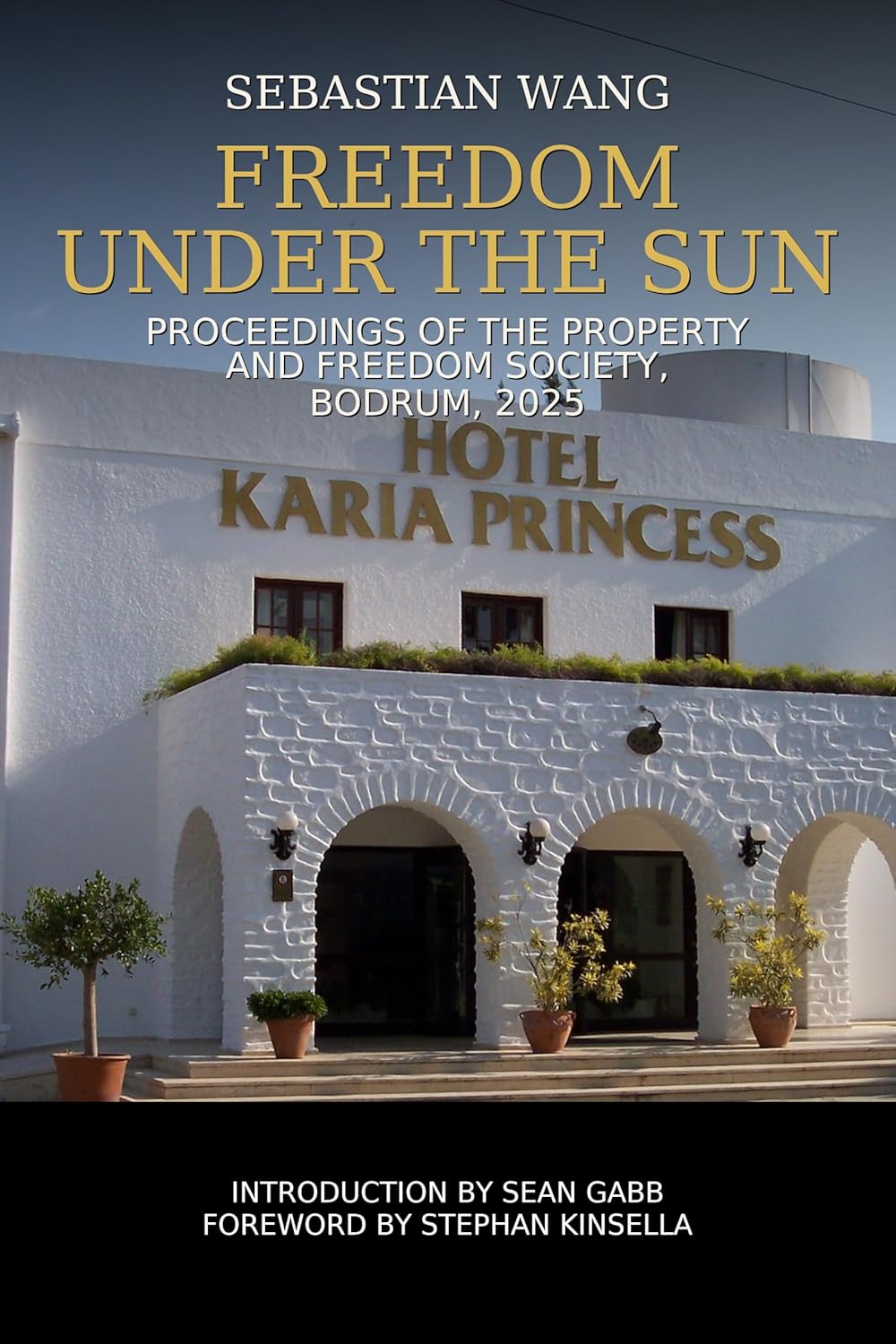
The latest PFS book has just been published by Sebastian Wang and his Hampden Press, co-published with the Property and Freedom Society.
Sebastian Wang, Freedom Under the Sun: Proceedings of the Property and Freedom Society, Bodrum, 2025, edited and with an introduction by Sean Gabb (Hampden Press and Property and Freedom Society, 2025). It also includes a Foreword by Stephan Kinsella. It is available in paper, Kindle, and audiobook (Amazon.com). All PFS members should be grateful to Dr. Gabb for producing this work.
Grok analysis of this clever novel (with some spoilers so beware). The book reminds me of Henry Hazlitt’s underappreciated but great novel Time Will Run Back, which uses a future dystopia to illustrate the calculation problem.[continue reading…]
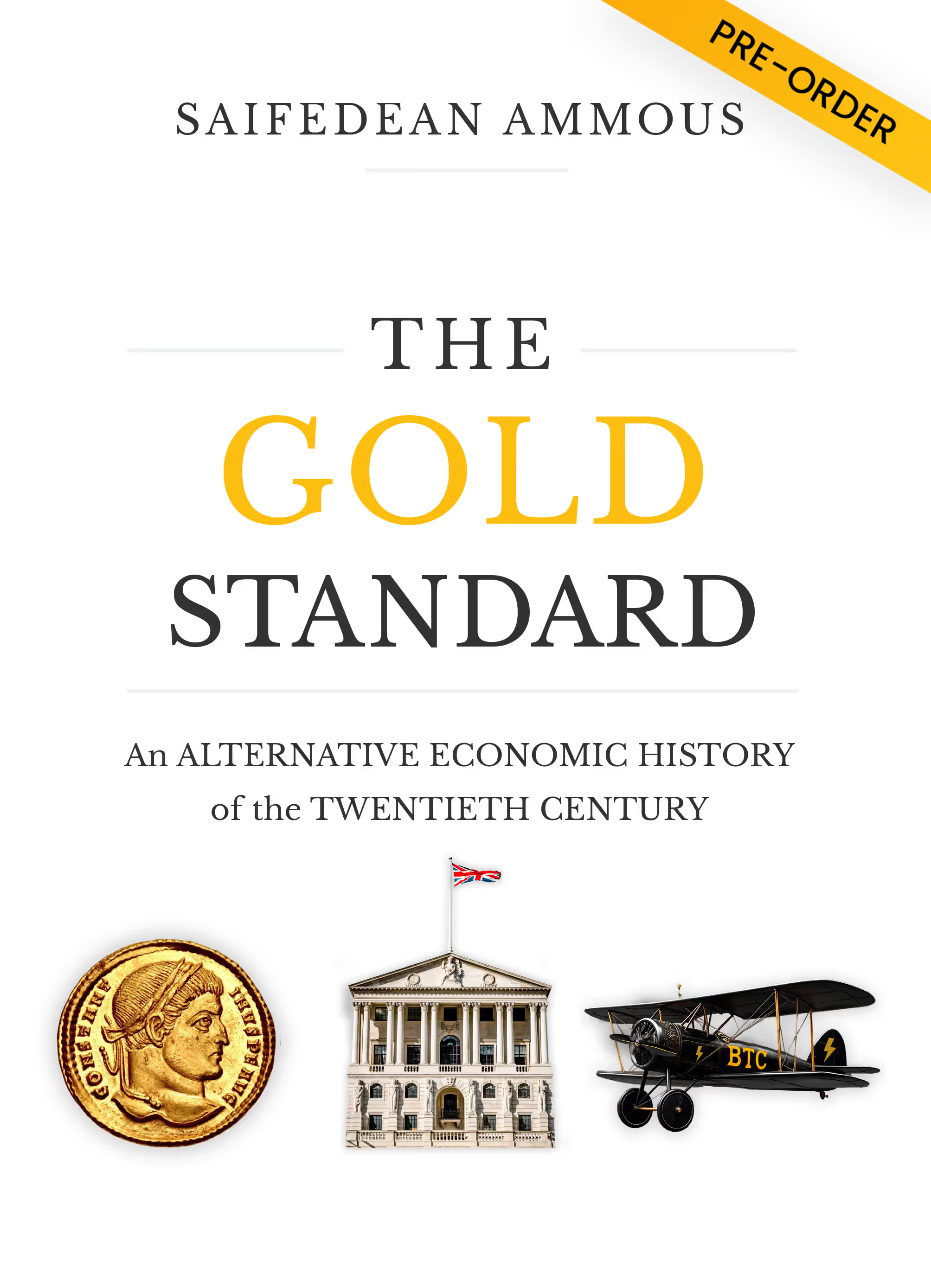
Another recent publication by long-time PFS member Saifedean Ammous, Property Rights: The Root Cause of the Palestinian-Israeli Conflict, Saifedean Substack (Nov 10, 2025). This paper was the basis of his talk of the same name presented at the PFS 2025 Annual Meeting (Sep. 18–23, 2025, Bodrum, Turkey). It will be podcast later on the Property and Freedom Podcast; the Youtube video is below, along with the slides. It was also podcast at The Bitcoin Standard Podcast, Ep. 299: “In this lecture delivered at the Property and Freedom Society, Saifedean explains why the root cause of the Palestinian-Israeli conflict is the denial of property rights. Religious and racial conflict are not destined in Palestine; they are historically rare occurrences, but this system of property rights would create violent conflict anywhere.”
It was also discussed in the panel “Fusillo, Ammous, Hoppe, Gabb, DiLorenzo, Open Discussion, Q&A,” also to be podcast later; video below.
DeLiecht envisions a decentralized governance model inspired by economist Hans-Hermann Hoppe’s praise for micro-states like Liechtenstein, where self-governing administrative units emerge spontaneously through Bitcoin-funded contributions linked to geographic residency, sidestepping rigid national borders to achieve optimal scales of neutrality and minimize war risks. Participants generate open-source wallets using SHA-256 hashes of city names and GPS coordinates (e.g., New York’s yielding a specific address), funding them with location-verified satoshi payments that build value amid fiat currency collapse; spending requires multisig consensus with 51% approval, enhanced by tenure-based voting power, reputation incentives, family continuity, and neighbor approvals to promote cooperation and deter disputes. The system unfolds in phases—from early adopters in unstable regions to institutional involvement—potentially enabling a city like New York, with 4.5 million residents contributing 1,000 sats monthly, to fully transition by 2040 as Bitcoin appreciates and fiat taxes wane. Ultimately, DeLiecht leverages Bitcoin’s bottom-up ethos via the “location principle,” rendering invasions obsolete since value is blockchain-secured, fostering peaceful self-rule for minorities, and allowing consensual expansions or mergers to create a network of resilient, Liechtenstein-like enclaves.
As noted here, the 2025 Annual Meeting of the Property and Freedom Society was held from Thursday, September 18, 2025 to Tuesday, September 23, 2025, in Bodrum, Turkey, at the Hotel Karia Princess.
Those interested in attending future meetings should contact Mr. Thomas Jacob ([email protected]) (Administrative Secretary/Membership), regarding conditions, availability, and requirements.
Speakers and topics for previous Annual Meetings may be found here.
To donate with BITCOIN please use the address below. If you would like us to credit your payment (for dues, conference fees, etc.) please email Stephan Kinsella ([email protected]) when you make the bitcoin payment.
17M9V6m5X5Da4vNM5wWLjzcHz9qF36FPk6
“Property does not exist because there are laws, but laws exist because there is property.” — FrédéricBastiat
“Because the concept of property, for instance, is so basic that everyone seems to have some immediate understanding of it, most people never think about it carefully and can, as a consequence, produce at best a very vague definition. But starting from imprecisely stated or assumed definitions and building a complex network of thought upon them can lead only to intellectual disaster. For the original imprecisions and loopholes will then pervade and distort everything derived from them. To avoid this, the concept of property must first be clarified.” —Hans-Hermann Hoppe, TSC, ch. 2
The Property and Freedom Society (PFS; Facebook) stands for an uncompromising intellectual radicalism: for justly acquired private property, freedom of contract, freedom of association—which logically implies the right to not associate with, or to discriminate against—anyone in one's personal and business relations—and unconditional free trade. It condemns imperialism and militarism and their fomenters, and champions peace. It rejects positivism, relativism, and egalitarianism in any form, whether of "outcome" or "opportunity," and it has an outspoken distaste for politics and politicians. As such it seeks to avoid any association with the policies and proponents of interventionism, which Ludwig von Mises identified in 1946 as the fatal flaw in the plan of the many earlier and contemporary attempts by intellectuals alarmed by the rising tide of socialism and totalitarianism to found an anti-socialist ideological movement. Mises wrote: "What these frightened intellectuals did not comprehend was that all those measures of government interference with business which they advocated are abortive. ... There is no middle way. Either the consumers are supreme or the government."
(A more complete statement of our Principles can be found here.)









Follow Us!