Originally published at The Rude Awakening.
The Straits Strangle
The Rude Awakening (Sept. 23, 2026)
By Sean Ring
The Straits Strangle
It takes only 32 minutes to get from the Pizza Hut on Camp Lemmonier in Djibouti City to China’s only overseas military base on the northeast side of town. A mere 10 miles separate 4,000 US personnel from the People’s Liberation Army Navy (PLAN).
On a clear day, they can probably see each other’s flags without the spy tech.
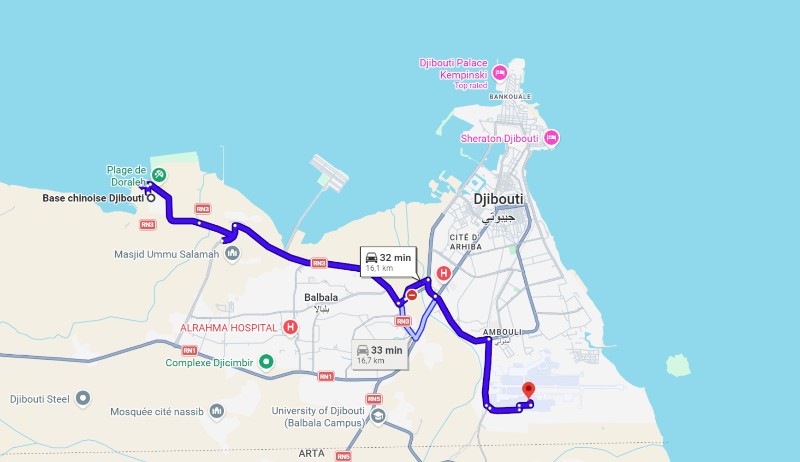 I wonder if the Chinese Navy ever orders from Pizza Hut. Credit: Google Maps.
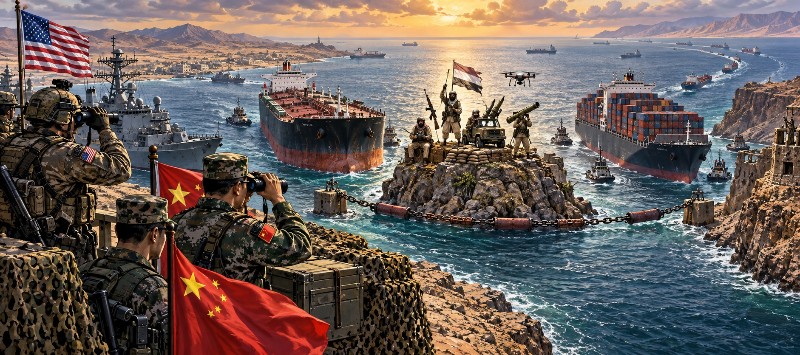
Both militaries are parked here for the same reason, and it ain’t the Hut Crust. They’re watching the same gateway: the Bab al-Mandab Strait, the southern door of the Red Sea, about 20 miles wide at its mouth.
And get this: “Bab al-Mandab” is Arabic for “Gate of Grief.”
Who says the Arabs don’t have a sense of humor?
The only thing funnier is the Houthis taking the strait right out from under the noses of the world’s two largest militaries.
Good Grief!
Before The Donald started this unforced error of a war, about 12.5% of world trade and 33% of global container traffic squeezed through Grief’s own gateway. Then, to the shock of America’s best and brightest, Iran shut the Strait of Hormuz, and the Grief Gateway became the escape hatch. Saudi Arabia has – or had – been moving millions of barrels a day through the east-west Petroline to the Red Sea and out through the strait.
Two superpowers. One throat. Yet neither of them controls it.
The Militia at the Gate
On September 10th, Houthi forces swept down Yemen’s Red Sea coast. They took Hays. They took Al Khawkhah. They took the old coffee port of Mocha. Over the weekend, they overran Mayyun Island, better known as Perim, the rock in the middle of the strait that splits it into two shipping channels.
Now, the Houthis control Yemen’s entire Red Sea coastline. Their fighters stand about 12 miles from Africa.
Armed with Iranian drones and anti-ship missiles, the sandal-clad militia holds the gate that the world’s two most expensive navies built bases to guard.
The shipping press has noted tanker owners now demand war risk premiums that have pushed daily charter rates past $1 million. Shippers who can’t bear that cost are sailing around the Cape of Good Hope, adding 2 weeks and a small fortune in fuel to each voyage.
Either way, they pay, as do we. The chokepoint tax lands on every container of shoes, barrel of crude, and bag of fertilizer.
The Strait Jacket
Both hands are wrapped around the same throat, yet neither can squeeze.
America needs the strait open, as does China. Their interests converge, but their commands don’t speak. Any strike near the gate risks hitting the other’s ships, or worse, the other’s base.
Beijing won’t shoot at Iran’s proxies while it buys Iran’s oil. DC is already stretched across a 7th month of war with Tehran. So each giant waits, watches, and hopes the other blinks first.
Just the way the landlord likes it!
Djibouti’s government collects rent from everyone.
The Americans alone pay about $60 million a year for Camp Lemonnier. France, Japan, and Italy pay, too.
China paid differently: it built the port, financed the railway, and, after Djibouti expelled Dubai’s DP World from the main container terminal, a Chinese state firm moved in.
Djibouti’s president couldn’t give a flying fig if the strait is secured. He wants – needs, really – his tenants paying because his survival depends on rent. So the president’s best move is to host everyone and commit to no one.
How would the kids say it? “Chillin’ like a villain,” I think. Djibouti’s president is incentivized to throw the biggest beach party he can… for as many guests as he can, while keeping them happy and in neutral corners.
On the Far Bank
So it’s not at all surprising that on September 18th, the Treasury lifted sanctions on Eritrea’s ruling party, its army, and the Red Sea Trading Corporation, the firm that controls most of the country’s trade. Those measures dated back to the 2021 Tigray war and expired 8 days after the Houthis took the strait.
Let’s zoom in on the map.
Eritrea owns more than 600 miles of Red Sea coastline. Its southern port, Assab, sits just up the coast from the strait’s mouth (circled in red on the left bank on the map). The UAE ran an airbase there during the last Yemen war before packing it up.
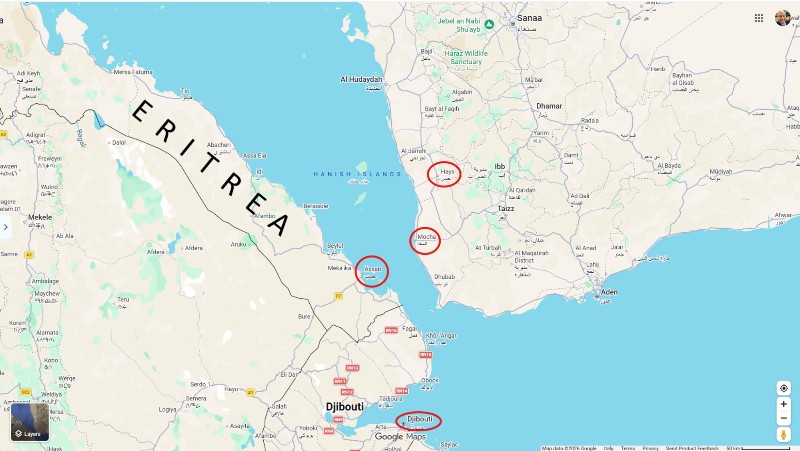 Eritrea is Djibouti’s northern neighbor. Credit: Google Maps
One more piece. Haaretz reported this weekend that Eritrea’s diaspora opposition, hundreds of thousands strong across Israel, Europe, and America, is organizing openly from a warehouse in south Tel Aviv. They promise a revolution against Isaias Afwerki, the man who has ruled Eritrea since 1991.
I can’t tell you whether that movement is organic or assisted (but I can surely guess which). Nobody outside a few rooms in DC, Abu Dhabi, and Tel Aviv knows.
But I can tell you this: When a dictator’s army comes off the sanctions list the same week his coastline becomes the most valuable real estate on Earth, that’s a bid.
The Swamp & Co. want a position on the African bank of the strait. It will get one through Isaias, or through whoever replaces him. The 80-year-old dictator knows it, which is why he’s suddenly the most courted pariah in Africa.
Wrap Up
Governments can print money, but they can’t print a strait. Real estate is the hardest asset there is, and right now the world’s hardest geographical asset is 20 miles wide and on fire.
A few things follow.
Energy will stay bid. WTI is up over 80% this year, and every Houthi attack raises the floor. The boring, profitable, asset-heavy energy names we’ve favored all year long will keep working.
Shippers will continue to get paid. Scarce tankers, war premiums, and Cape routings make for fat rates.
The chokepoint tax will hit your grocery bill with a lag, though I’m not sure the lag’s not already over. Either way, the experts will call it “inflation,” and politicians will demand more government to fight it.
But rising prices from a strangled strait aren’t a monetary event. They’re a supply event wearing inflation’s mask, and no committee in The Swamp can print it away.
Gold remains your insurance against all of the above.
While the herd sees Houthi headlines, you see the strangle: two superpowers standing at the gate, a not-so-ragtag militia holding it, and a quiet American bid for the far bank.
Watch Assab. If Emirati transport planes or American engineers show up there, you’ll know the next phase has begun.
Have a great day ahead.
Discover more from The Property and Freedom Society
Subscribe to get the latest posts sent to your email.









 Alessandro Fusillo
 Andreas Tögel
 David Dürr
 Doug French
 Fernando Chiocca
 Greg Morin
 Hans-Hermann Hoppe
 Jay Baykal
 Jayant Bhandari
 Jeff Deist
 Jeffrey Barr
 Juan Fernando Carpio
 Ken Yamarashi
 León Isidoro
 Martin Cabrera
 Nick Hoppe
 Oscar Grau
 Peter Wong
 PFS
PFS scholarium
 Saifedean Ammous
 Sean Gabb
 Sean Ring
 Stephan Kinsella
 Stéphane Geyres
 Thomas Jacob
 Tom DiLorenzo