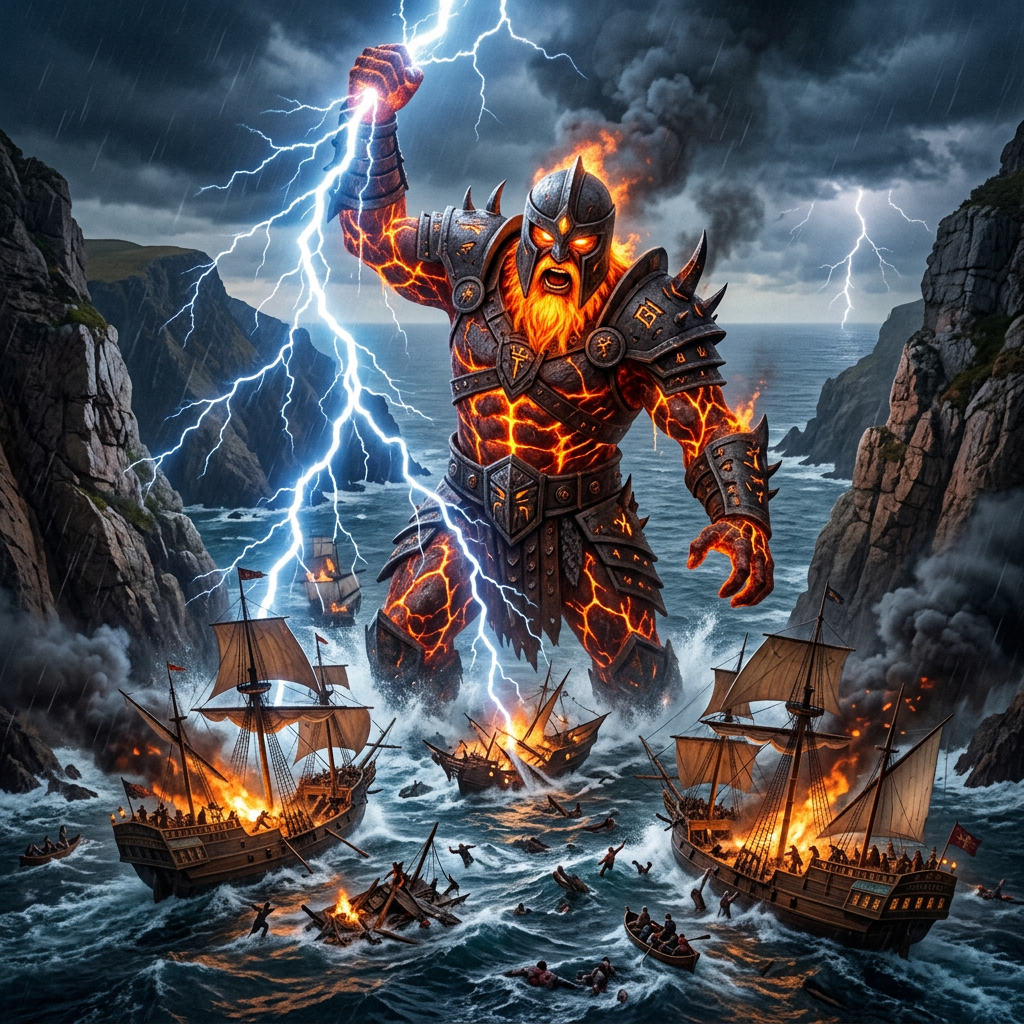
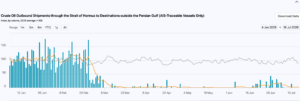
After nearly five months since the start of the U.S. initiated 2026 Straight of Hormuz Crisis it should be clear that bombing, blockades, and rhetorical bluster cannot compel the flow of commerce through the region. Since February 28, 2026, the movement of crude oil and other commodities remains at a standstill.
Former Navy SEAL, apocalyptic novelist, and social commentator, Matt Bracken highlights the impossibility U.S. forces controlling Iran’s coastal islands, Kharg and Qeshm. His X, Gab and Substack accounts are worth following. Aside from the World Trade Organization data on crude oil movement, all of the graphics in this post are Bracken’s creations.
Queshm is larger than Japan’s Okinawa island where it took 180,000 troops with 30,000 casualties and 12,000 American death over 82 days to defeat an enemy already on the verge of collapse. Kharg island is roughly the same size as Iwo Jima where, during World War II, 70,000 Marines fought for 36 days and lost 19,000 wounded and 7,000 killed despite having relatively uncontested supply lines.
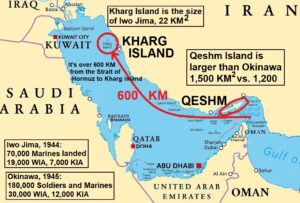
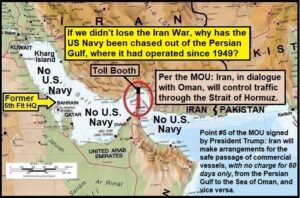
Both Kharg and Qeshm exist behind the range rings of Iranian missiles and other aymmetric threats where the U.S. Navy does not enjoy freedom of movement. Delivering supplies and combat power to Kharg island, deep within Persian Gulf, means contending with the tyrrany of distance, moving under fire, and surrounded by unreliable Arab allies. Moreover the U.S. Navy has largely remained east of Hormuz with the aircraft carriers and cruiser escorts floating in safer waters in the Gulf of Oman. The carrier airwing jets have reduced loiter time and heavier reliance on midair refueling. The 5th Fleet Headquarters in Bahrain was crippled by Iranian strikes and is functionally inoperable. Sure, the U.S. can use smaller, faster combat ships, unmanned vessels, and airpower to conduct limited attacks but they cannot force the Straight of Hormuz open or ensure safe travel for commercial traffic.
If taking just two islands off the coast of Iran appears daunting, then consider escalating into a fight for the whole territory. Overlaying the 174,000 square kilometers of South Vietnam on a roughly equivalent patch at the south end of Iran’s 1,650,000 square kilometers provides a striking juxtaposition. Since the United States could not secure South Vietnam, a country one tenth the size and with two tenths the population, with an allied, albeit puppet, friendly government in place over eight years of sustained combat operations and a surge force of over 500,000 troops, what conceivable chance is there in a country like Iran?
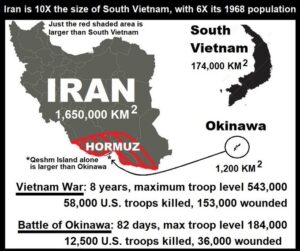
During Vietnam, despite congestion and primitive in-country distribution systems, the United States enjoyed unchallenged command of the high seas and relatively unfettered access to seaports from which to deliver troops and supplies. Not so with Iran. Mines, unmanned vessels, aerial drones, fast attack ships, missiles, mortars, sabateurs, and snipers would plague all waterborne supply runs. Attacking Iran’s eastern and western flanks means contending with inhospitable regimes in Iraq and Afghanistan, scenes of recent U.S. military humiliations.
While Turkiye remains a NATO member and an ostensible U.S. ally, penetrating Iran from the northwest sliver implies negotiating arduous terrain at a point furthest from the primary conflict zone in the Straight of Hormuz. Unless the plan was to topple the regime in Tehran and occupy the entire country, attacking Iran from Turkiye makes little strategic sense, and such a scheme appears logistically infeasible given the lack of political support for such an enormous undertaking.
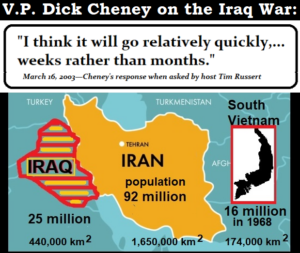
Since the strategic defeats in Iraq and Afghanistan proved the folly of applying military force in hopes of overcoming intractable cultural and political problems, the Iran quagmire willl persist until public officials are compelled into adopting policies of restraint. Economic and geopolitical reality cannot be glossed over with demagoguery and propaganda. The ramifications of inhibited trade from the region, particularly with hydrocarbons and their derivative products, will reverberate around the globe in the form of higher prices, shortages, substitutions, and disrupted product lines.
As largely export-driven, industrialized economies with virtually no domestic hydrocarbon resources, U.S. allies Japan and South Korea are particularly vulnerable to a closure of the Strait of Hormuz. Unlike the United States, which has buffered its energy security through domestic production and advanced shale processing technologies, these two East Asian allies rely on imported hydrocarbons for the vast majority of their primary energy needs—roughly 87% for Japan and 81% for South Korea. Because of these dependencies, a disproportionate amount of their crude oil supply is anchored to the Middle East, with Japan at 90% and South Korea routing approximately 70% of its crude imports directly through the narrow Persian Gulf chokepoint. A prolonged blockade not only triggers an immediate domestic energy crisis and soaring freight insurance rates, but also starves their massive, energy-intensive manufacturing sectors with downstream affects in semiconductors, automobiles, and petrochemicals, leading to cascading economic shocks that directly compromises both nations’ domestic sufficiency and security capacity.
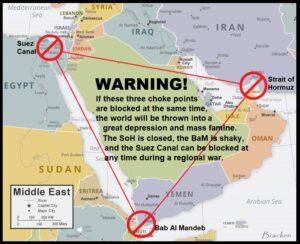
Along with the Strait of Hormuz, the Bab al Mandeb, between southwest Yemen and Djibouti in northeast Africa, compose twin maritime gatekeepers to the Arabian Peninsula. They form a sequential trade corridor for energy resources heading to Europe.
A ships bound for Europe from the Persian Gulf via the Strait of Hormuz must travel around the southern tip of Oman and pass directly through the Bab al-Mandeb to enter the Red Sea and access the Suez Canal. If any of these chokepoints are closed, it effectively severs the shortest maritime route to the Mediterranean Sea, forcing ships to bypass the region entirely and take a lengthy detour around Africa’s Cape of Good Hope.
The Houthis in Yeman are a Shia Islamic group ideologically aligned with Iran in an Axis of Resistance network to oppose U.S. hegemony in the region and Israeli treatment of the Palestinians. Applying decentralized coordination structures and insurgent tactics, the network uses Iranian-supplied anti-ship ballistic missiles, one-way attack drones, and uncrewed surface vessels (USVs) to target commercial shipping.
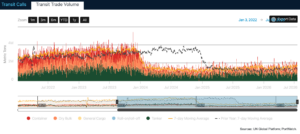
Due to its dependence on transit fees, Egypt maintains tight security on the Suez Canal and overland smuggling routes to Resistance proxies in Lebanon and Palestine are heavily surveilled by U.S. and allied forces. However, even without direct attacks on the Suez, according to the Internation Monetary Fund’s Portwatch, traffic volume is down approximately 60% since late 2023 when the Houthis started firing on ships transiting the Red Sea. Just imagine what would happen to global trade and downstream manufacturing if all three chokepoints around the Arabian Peninsula were restricted.
In Chapter 8 of the 1949 economics treatise, Human Action, Ludwig Von Mises has a section entitled The Instinct of Aggression and Destruction. In it, Mises recognizes that human beings possess a propensity toward aggression and brutality, but civilization progresses precisely when people realize that voluntary cooperation and trade yield greater material prosperity than violent plunder. Lasting peace is required for increasing living standards and this must be preceded by a widespread, rational recognition of global economic interdependence, understanding that when people and nations participate in a global market, war transitions from a tool of one-sided enrichment into an act of mutual economic suicide. “Wars, civil wars, and revolutions are detrimental to man’s success in the struggle for existence because they disintegrate the apparatus of social cooperation.”
Let’s hope that people of reason overtake the impulses of public officials currently indulging in foolish brinksmanship that threaten global catastrophe.
Discover more from The Property and Freedom Society
Subscribe to get the latest posts sent to your email.





















 Alessandro Fusillo
 Andreas Tögel
 David Dürr
 Doug French
 Fernando Chiocca
 Greg Morin
 Hans-Hermann Hoppe
 Jay Baykal
 Jayant Bhandari
 Jeff Deist
 Jeffrey Barr
 Juan Fernando Carpio
 Ken Yamarashi
 León Isidoro
 Martin Cabrera
 Nick Hoppe
 Oscar Grau
 Peter Wong
 PFS
PFS scholarium
 Saifedean Ammous
 Sean Gabb
 Sean Ring
 Stephan Kinsella
 Stéphane Geyres
 Thomas Jacob
 Tom DiLorenzo