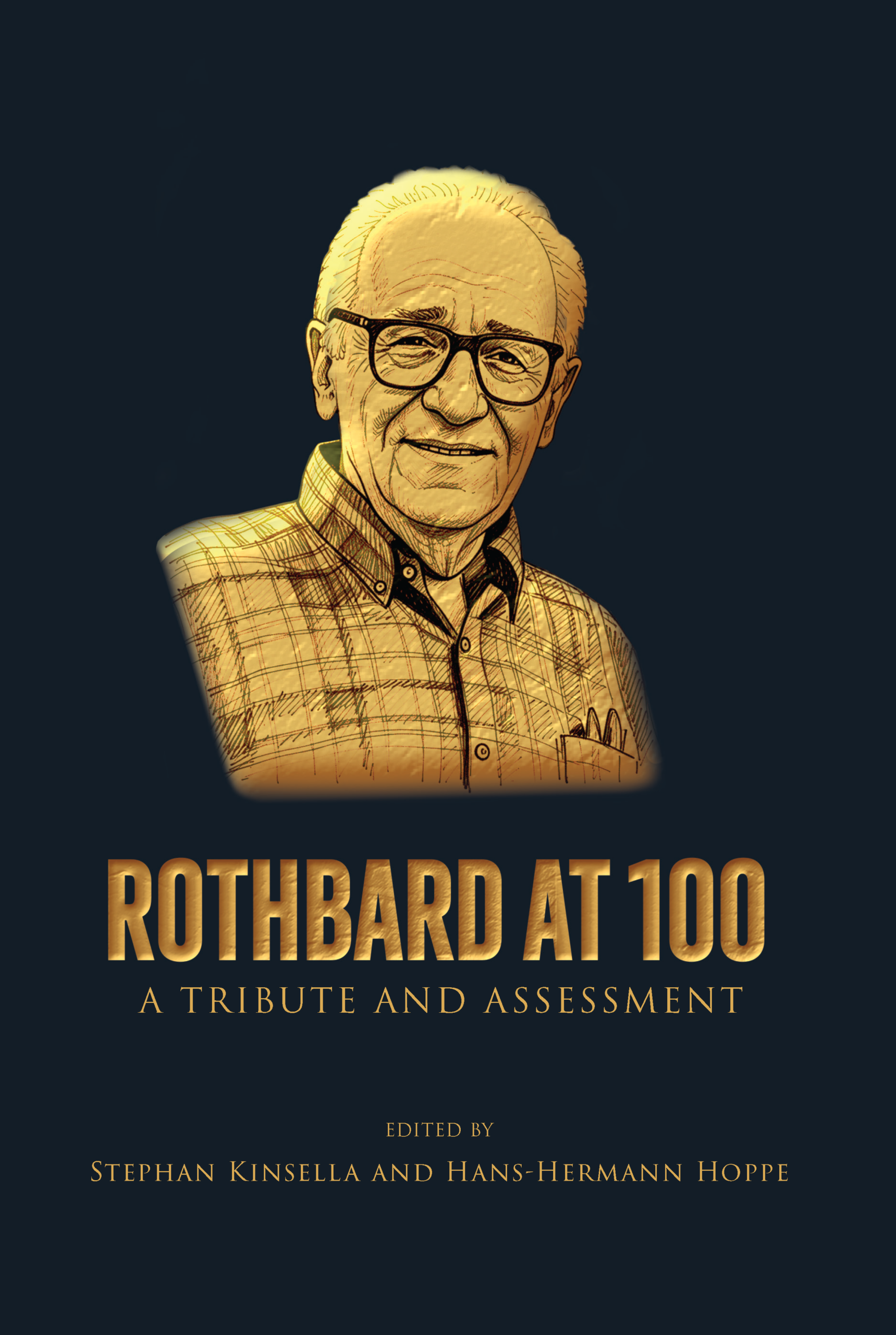
Many students of Murray Rothbard’s writings will be greatly disappointed by the new book by Joe Salerno and Patrick Newman—Murray N. Rothbard: The Making of an Economist. It is not an intellectual biography as the authors claim. Eighty-five percent of it is essentially a detailed book review of Man, Economy and State, published in 1962. There is no mention of any of Rothbard’s works after that date, which is why it is actually insulting to Rothbard’s legacy to call it an intellectual biography. It is Rothbard’s brilliant interdisciplinary writings in the subsequent thirty-three years (and beyond, since he has posthumous publications) that created what is known as Rothbardianism.
“Rothbardianism” is not a mere “branch” of Austrian economics as some critics have said. It is based on myriad brilliant applications of Austrian economics to the study of economic and political institutions by Murray Rothbard. As one example, as Mises wrote in Human Action, everyone who writes about history does so through some kind of intellectual lens—Marxism, institutionalism, etc. Murray did so—as did Mises himself—through the lens of the praxeological approach of Austrian economics and the deep study of history, philosophy, and other fields. This type of scholarship is what first impressed me during my own education, and not just the pure economic theory of Austrian treatises. Mises and Hayek did not write only on pure economic theory themselves, after all.
The authors say they spent six years writing the 169-page book, two years longer than it took Rothbard to write Man, Economy and State (1,441 pages in the version including Power and Market; 987 pages otherwise). It reads like typed out lecture notes from the annual week-long Mises Institute “Rothbard Graduate School” where Salerno and Newman lecture, and which is devoted to a study of Man, Economy and State about every other year. The narrative in the book is a step by step account of the contents of each chapter of Man, Economy and State along with occasional references to communications with various individuals, including Mises himself, who had great praise for the book and its author. They cite some of Rothbard’s journal articles and working papers along the way, but then serious students of Austrian economics, the intended audience for the book, are probably already familiar with them—and with Man, Economy and State for that matter.
A big part of the story of the book is how Rothbard had a similar educational experience to what all of us experienced who are interested in and study Austrian economics. He was educated in the economics of the mainstream, institutionalism and positivism in his case at Columbia University, and then discovered Human Action. (It’s not as though it’s 50/50, half of all economics departments are Austrian and the other half “mainstream”!) Thank God that Murray discovered Mises in the way that he did, and no one has made more of it by applying and extending the teachings of Mises.
The authors explain the importance of this in the context of Man, Economy and State but nothing else, unfortunately. They have written an account of four years of Rothbard’s 53-year academic/intellectual life (he enrolled at Columbia University in 1942 at the age of 16).
The authors apparently chose to write such a narrowly focused book because of their obsession with a few comments made by George Mason economists like Larry White, Pete Boettke, and Karen Vaughn, who they cite on page 3. They then declare on the next page that their goal in the book is to show that the GMU economists’ comments “inadequately convey the scope and originality” of Rothbard’s contributions . . .” Can you spell “inside baseball”?
Discover more from The Property and Freedom Society
Subscribe to get the latest posts sent to your email.












 Alessandro Fusillo
 Andreas Tögel
 David Dürr
 Doug French
 Fernando Chiocca
 Greg Morin
 Hans-Hermann Hoppe
 Jay Baykal
 Jayant Bhandari
 Jeff Deist
 Jeffrey Barr
 Juan Fernando Carpio
 Ken Yamarashi
 León Isidoro
 Martin Cabrera
 Nick Hoppe
 Oscar Grau
 Peter Wong
 PFS
PFS scholarium
 Saifedean Ammous
 Sean Gabb
 Sean Ring
 Stephan Kinsella
 Stéphane Geyres
 Thomas Jacob
 Tom DiLorenzo