On “Are Minarchists Even Libertarian?,” a new crossover episode of Adam Haman’s Haman Nature (Hn 293) and The Bob Murphy Show, Haman lays down a “Liberty Challenge” for economist Bob Murphy: minarchism is incoherent, so can minarchists and anarchists both be called libertarians?
Haman’s challenge: most of us were brought into the movement by minarchists, such as Ayn Rand, Ron Paul, Mises, Hayek, Friedman, Nozick and Sowell, or by Reason, Cato and FEE. (I was a Randian minarchist myself once.) Yet, as the joke goes, the difference between a minarchist and an anarchist is about six months. Haman argues there is no libertarian answer to how a territorial monopolist should fund and supply “security” or run “public” property. If the state may tax us for defense, what stops it from taking 75% of everything, or 99%?
I’ve been making this point for years. If, as Randians, Nozick, and other minarchists insist, the state may legitimately monopolize a useful service, why shouldn’t it charge whatever the market will bear, the way a mall owner takes a cut of his tenants’ sales? On those premises the only limit is a practical one: maybe a 70% rate is fine, but 99% would kill the goose that lays the golden egg.1 And the Randians admit they are not even for “small” government: a “limited government,” says one, might “absorb 50 percent or more of the nation’s product” for defense.2
Notice, too, the loose language. Most libertarians, and minarchists and Objectivists especially, are not careful to distinguish the state from government. Anarchism is anti-state, not anti-government. We do not oppose law and order or the institutions of governance; we oppose the state, the agency that taxes and outlaws competition, and thus commits institutionalized aggression.3 So when minarchists talk about “limited government,” they really mean a limited state, which is to say limited aggression. That is why I call them what they are: mini-statists.4 And when we say we oppose the state, they hear us saying we oppose law and order. Objectivist William Thomas, for example, writes that “we all need government to set us free from force.”5 But if someone favors “government” without a state, with no taxation and no compelled monopoly, he is an anarchist, whether he knows it or not.
The Objectivists are in an even tighter spot. They claim to oppose taxation, yet they believe in IP and revere the Constitution the Founders “created” as a great achievement of the intellect. So just as you can charge a royalty for someone “using” your idea, why shouldn’t the Founders’ successor, the state, charge us for using theirs—as much as the market will bear? Don’t call it a tax—call it a royalty!6
Murphy splits the question in two. Is minarchism coherent? No, he agrees. If 99% is too much, why isn’t 1% too much for the same reason? Pooling resources for defense doesn’t explain how a holdout’s neighbors may force him to join. We can’t build cars on our own either, but no one concludes that we should vote on car production every two years. Haman adds Spooner’s point that a constitution either authorizes the government we have or is powerless to prevent it. He also says Rand’s “voluntary” fees for monopoly courts are taxation by another name. He’s right: the power to outlaw competition implies monopoly prices, which is functionally equivalent to taxation.7
But should minarchists be denied the label “libertarian”? Here Murphy says no. A libertarian, in his view, is someone who first asks whether the state has the right to do X, based on property rights, rather than whether he likes the outcome. Follow that consistently and you end up an anarcho-capitalist. That is why minarchism, from Bastiat’s The Law to Thomas Paine, works as a “gateway drug.”
Along the way, Haman says I would insist that not just any conception of property rights will do.8 And Murphy recalls being an anarcho-capitalist who still believed in patents and copyright until “Stephan just walked through” the issue with him.9 For dealing with minarchists, they suggest asking whether they would privatize the roads and the post office, and whether people may secede. If the answer is yes, says Murphy, “you and I are pretty close, my friend.” He recommends Michael Huemer’s The Problem of Political Authority and his own Chaos Theory: “read it and then check with me in six months.”
Related
- Robert P. Murphy, Common Sense: The Case for an Independent Texas (Sept. 2021). The pamphlet Murphy plugs; secession is the test he and Haman put to minarchists.
- idem, Chaos Theory: Two Essays on Market Anarchy (2002). Murphy’s essays on private law and private defense, which he urges minarchists to read “and then check with me in six months.”
- Kinsella, “An Objectivist IP Argument for Taxation,” StephanKinsella.com (Feb. 24, 2010). On why minarchists really can’t object to high taxation. If IP is legitimate and the Constitution is a great intellectual creation, then the Founders’ successor, the state, may charge us a royalty for using it: “Don’t call it a tax—call it a royalty.”
- idem, “Why Should the Government Be Limited?,” Mises Economics Blog (Sept. 28, 2011). If the state, even the minarchist state, provides an invaluable service, why shouldn’t it charge what the market will bear, like a mall owner? The only limit is practical: “maybe 70% marginal rate is fine, but 99% would kill the goose that lays the golden egg.” This is Haman’s 75%-or-99% question.
- idem, “The Power to Tax and the Power to Outlaw Competition Imply Each Other,” StephanKinsella.com (July 12, 2025). The power to outlaw competition “implies monopoly prices and thus is functionally equivalent to taxation,” which is why “voluntary” and tax-free minarchism “is a chimera.”
- idem, “Libertarian Answer Man: Is Libertarianism Synonymous with Anarchism?,” StephanKinsella.com (July 9, 2024). “Libertarian” is broad enough to cover both minarchists and anarchists, though minarchists are not fully consistent libertarians. This is essentially Murphy’s answer to the second half of Haman’s challenge.
- idem, “Consistency: Point/Counterpoint: Emerson, Rand, Kinsella,” StephanKinsella.com (Oct. 1, 2026). What sets libertarians apart is that they are “consistently opposed to aggression,” so “the consistent libertarian, in opposing aggression, is also an anarchist.” That is the core of Haman’s charge that minarchism is incoherent.
- idem, “Zwolinski on Rothbard: ‘Libertarianism, Oversimplified’,” StephanKinsella.com (Jan. 9, 2026). Ranks the camps by consistency: anarchists fully consistent, minarchists “not fully consistent,” classical liberals “even less consistent than minarchists,” and Hayek “hardly even a classical liberal.”
- idem, KOL492 | Menger Institute Podcast #6: Property Rights, Patents, Anarchy, Technology, Long-Term Hope for Freedom and the Technological Death of the State (June 13, 2026). Minarchists are “libertarians but they’re not fully consistent libertarians,” while classical liberals are predecessors rather than libertarians.
- idem, “A Note to Randians, Minarchists, and other Mini-Statists: Mind Your Manners, Know Your Place,” StephanKinsella.com (Nov. 21, 2025). Written after an Objectivist insulted Per Bylund and me over Bylund’s piece. Minarchists back the state’s right “to tax us, or to outlaw competition (usually both),” which is aggression. Yet anarchists are “generous enough” to count them, Objectivists included, as libertarians, if inconsistent ones. The note even tells the “about 6 months” joke Haman opens with.
- Kinsella, “Friedman and Socialism,” Mises Economics Blog (June 10, 2005). Ranks the camps by degree of socialism: anarchists at zero, minarchists with “a small degree of socialism,” then classical liberals and Friedmanesque free-marketers further along.
- idem, “Jesus Christ, stop whining about ‘libertarian purity tests’,” StephanKinsella.com (Nov. 21, 2023). Minarchists are “partly libertarian and partly statist,” inside the libertarian tent but less libertarian than anarchists; classical liberals are allies, not libertarians.
- idem, “Attention Minarchists: Mind Your Manners” (draft, July 2008), StephanKinsella.com (Aug. 2, 2026). Minarchists and other fellow travelers (classical liberals, constitutionalists, paleoconservatives) call anarchists unrealistic and not “real libertarians.” In fact “libertarianism is anarcho-libertarianism.” Minarchists are “quasi-libertarians,” tactical allies whom anarchists host graciously, so they should mind their manners.
- Murray N. Rothbard, “Do You Hate the State?,” The Libertarian Forum 10, no. 7 (July 1977). The essay Murphy recalls: what matters is whether one hates the state, and Rothbard would rather ally with a radical minarchist than with a coolly utilitarian anarchist.
- Kinsella, “The Nature of the State and Why Libertarians Hate It,” StephanKinsella.com (May 3, 2010). The state as “the agency that commits institutionalized aggression,” defined by the territorial monopoly and taxation Murphy uses to define it. Since libertarians oppose aggression, “it is quite clear why libertarians hate the state.” See the section “Libertarians, ‘Government,’ and the State.”
- Kinsella, “Is Albert Jay Nock a Statist Too?,” StephanKinsella.com (June 24, 2009). Invoking Nock for a rights-protecting “government” makes you a statist if you advocate a state, and an anarchist if you don’t.
- idem, “Machanarchy,” Mises Economics Blog (Mar. 29, 2010). On Tibor Machan’s government/state distinction: “anarchism is anti-state, not anti-government,” so advocating only government, and not the state, makes you an anarchist.
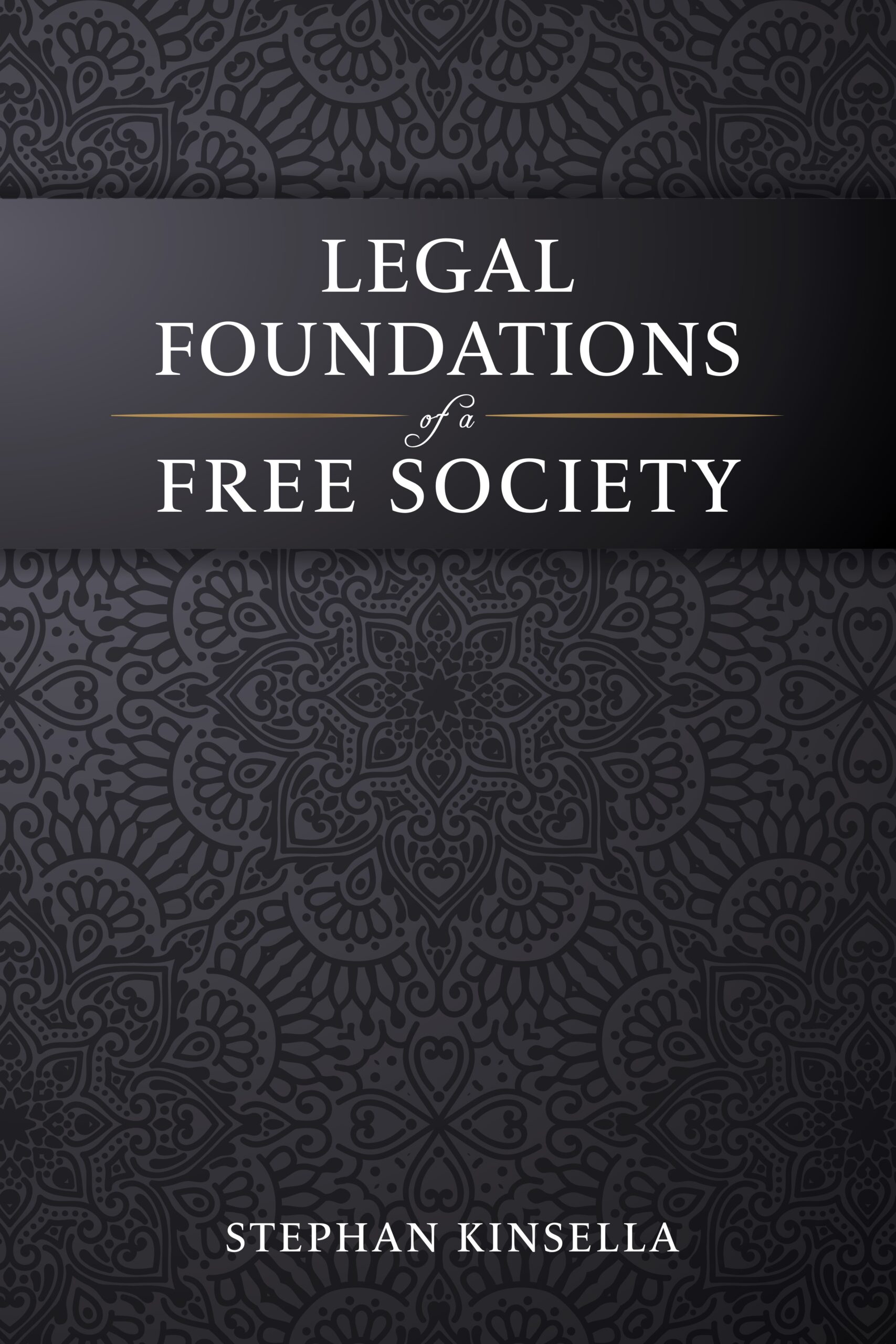
- idem, “Libertarianism After Fifty Years: What Have We Learned?” (NYC LibertyFest, Oct. 11, 2014), included as ch. 25 of Legal Foundations of a Free Society (2023). “Even the word ‘government’ … is a dangerous word to use”; say “state,” or the minarchist (“which we can call a mini-statist”) “will take you to mean you’re against law and order.”
- idem, “The State is not the government; we don’t own property; scarcity doesn’t mean rare; coercion is not aggression,” StephanKinsella.com (Dec. 19, 2022). “Just as roads are not inherently statist, neither is government”: anarcho-libertarians oppose state control of law and order, not governance.
- Roderick T. Long, “Why Objective Law Requires Anarchy,” Formulations 6, no. 1 (1998) (PDF; Philpapers; Panarchy). Long answers Hinton and the Objectivist demand for “objective law,” the premise behind the Randian monopoly courts Haman criticizes.
- See Adrian Hinton, “The Importance of Objective Law: Why I Support Limited Government,” Formulations 6, no. 1 (1998) (PDF)
- Hans-Hermann Hoppe, “Anarcho-Capitalism: An Annotated Bibliography,” LewRockwell.com (Dec. 31, 2001). Reading for minarchists starting their “six months.” I recommended it in my 2008 “Mind Your Manners” draft.
- Kinsella, “What It Means To Be an Anarcho-Capitalist,” LewRockwell.com (Jan. 20, 2004). Anarchism is not a prediction about what “works” but consistent opposition to aggression, including the state’s taxation and monopoly.
- Roderick T. Long, “Libertarian Anarchism: Responses to Ten Objections” (Mises University talk, 2004). Long answers the standard minarchist objections to anarchy. Also on my 2008 reading list.
- Kinsella, “Randanarchists,” LewRockwell.com Blog (Oct. 18, 2005), reposted as “Before Vandanarchists, There Were … Randanarchists!,” StephanKinsella.com (July 17, 2009). Objectivists “cannot be principled opponents of aggression while opposing anarchy,” because “to seriously oppose anarchy they have to favor some aggression.” Unless they are one-worlders, their world of multiple states has the same “warring gangs” problem they attribute to anarchy.
- idem, “Minarchists as Statist-Aggressors,” StephanKinsella.com (Dec. 8, 2005). To favor a state, “even a minarchy,” is to favor “some aggression committed by the state.” That position is flawed, but it is “respectable, and honest, and sincere.”
- Hoppe, PFP020 | Hans-Hermann Hoppe, Reflections on the Origin of the State (PFS 2008). Hoppe on what makes an agency a state and how states arise, published in print as “Reflections on the Origin and the Stability of the State,” LewRockwell.com (June 23, 2008). Cited in my 2008 draft.
- idem, “On the Impossibility of Limited Government and the Prospects for a Second American Revolution,” Mises Daily (June 28, 2008). Why a “limited” state cannot stay limited, the point Haman presses with Spooner and Lord Acton.
- Kinsella, “Ayn Rand Endorses Big Government,” LewRockwell.com Blog (May 31, 2009). Objectivists admit they are not for small government or low taxes. Roger Donway says a “limited government” might “absorb 50 percent or more of the nation’s product” for defense. Eric Daniels says “size is not an essential aspect of government’s propriety or impropriety.” And Rand reportedly said 80% taxation was justified “if you need it for defense.” This is the Objectivist answer to Haman’s 75%-or-99% question.
- See Roger Donway, “Government, Yes! Leviathan, No!,” The Atlas Society (Oct. 5, 2001)
- idem, “Why Objectivists Hate Anarchy (Hint: IP),” Mises Economics Blog (Aug. 17, 2009). Objectivists cling to the state partly because “you can’t have IP without a state,” which bears on Murphy’s own former belief in IP.
- idem, “The Irrelevance of the Impossibility of Anarcho-Libertarianism,” Mises Economics Blog (Aug. 20, 2009). Answers the objection that anarchy is “impractical,” the magic word Haman and Murphy warn against.
- idem, “Objectivism, Bidinotto, and Anarchy,” StephanKinsella.com (Sept. 17, 2009). My debate with Robert Bidinotto over anarchy versus minarchy. Whoever advocates a state “cannot avoid advocating taxation,” since all states tax. And nothing guarantees that a “final” (read: one-world state) decision maker will produce just results.
- Kinsella, “Libertarian Centralists,” Mises Economics Blog (June 7, 2005). See the section “Randians and One-World Government.” Bidinotto says a legitimate one-world government would require a global Enlightenment culture, so for now the “final arbiter” must stay at the federal level. Rand opposed world government, but her followers’ arguments against anarchy “would seem to support increasing centralization wherever possible.”
- See also Roderick T. Long, “Anarchism as Constitutionalism: A Reply to Bidinotto,” In a Blog’s Stead (Dec. 7, 2003); idem, “Anarchism as Constitutionalism, Part 2,” In a Blog’s Stead (Dec. 26, 2003)
- Kinsella, “David Kelley on the Necessity of Government,” StephanKinsella.com (May 2016). Objectivist David Kelley says we need a state because competing defense agencies might go to war, which would imply we need a one-world government. Minarchists blur “government” and “the state,” but the real dispute is whether order is possible without the state’s monopoly on force.
- idem, “Rand, Objectivism, and One-World Government,” StephanKinsella.com (Sept. 17, 2009). Randians reject anarchy because they want a single “final arbiter,” but that logic points to one-world government, which Rand herself opposed. Some Objectivists even admit they favor it.
- idem, “Then and Now: From Randian Minarchist to Austro-Anarcho-Libertarian,” StephanKinsella.com (Feb. 6, 2010). My own version of Haman’s “six months.”
- idem, “Afterword,” in Hans-Hermann Hoppe, The Great Fiction: Property, Economy, Society, and the Politics of Decline (Laissez Faire Books, 2012; 2d rev. ed., Mises Institute, 2021). “The state is always socialistic, and socialism always implies a state,” so even a minimal state is partly socialist. Quoted in my 2025 “Mind Your Manners” note.
- KOL123 | Debate with Jan Helfeld on Anarchy vs. Limited Government (Apr. 28, 2014). My debate with a limited-government advocate on the same anarchy-versus-minarchy question.
- See Kinsella, “Why Should the Government Be Limited?,” Mises Economics Blog (Sept. 28, 2011); idem, “The Power to Tax and the Power to Outlaw Competition Imply Each Other,” StephanKinsella.com (July 12, 2025). [↩]
- See Kinsella, “Ayn Rand Endorses Big Government,” LewRockwell.com Blog (May 31, 2009), quoting Roger Donway, “Government, Yes! Leviathan, No!,” The Atlas Society (Oct. 5, 2001), Eric Daniels’s claim that “size is not an essential aspect of government’s propriety or impropriety,” and Rand’s reported 1962 remark that 80% taxation was justified “if you need it for defense.” [↩]
- See Kinsella, “The Nature of the State and Why Libertarians Hate It,” StephanKinsella.com (May 3, 2010); idem, “Machanarchy,” Mises Economics Blog (Mar. 29, 2010); idem, “The State is not the government; we don’t own property; scarcity doesn’t mean rare; coercion is not aggression,” StephanKinsella.com (Dec. 19, 2022). [↩]
- See Kinsella, “Libertarianism After Fifty Years: What Have We Learned?” (NYC LibertyFest, Oct. 11, 2014), included as ch. 25 of Legal Foundations of a Free Society (Houston: Papinian Press, 2023) (“either a minarchist, which we can call a mini-statist, or a regular statist”); idem, “Libertarian Answer Man: Is Libertarianism Synonymous with Anarchism?,” StephanKinsella.com (July 9, 2024) (“minarchists (mini-state-ists)”); idem, “A Note to Randians, Minarchists, and other Mini-Statists: Mind Your Manners, Know Your Place,” StephanKinsella.com (Nov. 21, 2025). [↩]
- William Thomas, “Libertarianism and Objectivism: Compatible?,” The Atlas Society (June 29, 2010), quoted in Kinsella, “The State is not the government…,” StephanKinsella.com (Dec. 19, 2022); see also idem, “David Kelley on the Necessity of Government,” StephanKinsella.com (May 2016) (anarchists should make clear “they oppose the state not ‘government,’ to keep the mini-statist from falsely accusing us of opposing ‘government’ i.e. law and order”). [↩]
- See Kinsella, “An Objectivist IP Argument for Taxation,” StephanKinsella.com (Feb. 24, 2010); idem, “Why Objectivists Hate Anarchy (Hint: IP),” Mises Economics Blog (Aug. 17, 2009). [↩]
- See Kinsella, “The Power to Tax and the Power to Outlaw Competition Imply Each Other,” StephanKinsella.com (July 12, 2025); idem, “Objectivism, Bidinotto, and Anarchy,” StephanKinsella.com (Sept. 17, 2009). [↩]
- See Kinsella, “What Libertarianism Is,” Mises Daily (Aug. 21, 2009), included as ch. 2 of Legal Foundations of a Free Society (Houston: Papinian Press, 2023). [↩]
- On IP as one reason Objectivists cling to the state, see Kinsella, “Why Objectivists Hate Anarchy (Hint: IP),” Mises Economics Blog (Aug. 17, 2009). [↩]











 Alessandro Fusillo
 Andreas Tögel
 David Dürr
 Doug French
 Fernando Chiocca
 Greg Morin
 Hans-Hermann Hoppe
 Jay Baykal
 Jayant Bhandari
 Jeff Deist
 Jeffrey Barr
 Juan Fernando Carpio
 Ken Yamarashi
 León Isidoro
 Martin Cabrera
 Nick Hoppe
 Oscar Grau
 Peter Wong
 PFS
 scholarium
 Saifedean Ammous
 Sean Gabb
 Sean Ring
 Stephan Kinsella
 Stéphane Geyres
 Thomas Jacob
 Tom DiLorenzo

Follow Us!