Attorney Steve Lehto has a new video on a property-rights nightmare in Washington state, based on Chris Bennett’s report for AgWeb/Farm Journal.
In 2021, Tyler and Wendy Chambers bought 66 acres at the end of Number 1 Canyon Road outside Wenatchee, in Chelan County. The land was three tax parcels, zoned residential. They wanted to build a home and a pole barn and plant a few acres of orchard. They did their homework: a 30-day feasibility period, meetings with county planners, a surveyor, an engineer, a geologic hazard assessment, and soil and perc tests. The county gave them the green light. Then, as they began moving dirt, a neighbor showed up and told Chambers, “Good luck getting a permit.” The neighbor turned out to be a county commissioner and a former land-trust director.
Complaints followed. The county prosecutor’s office found the first one “unfounded.” But the development director who had approved the project resigned, and in 2022 the county issued a stop-work order and sued. Then came the studies: stormwater, geotechnical, spotted owl, golden eagle, deer, shrub-steppe, even a study to prove no fish lived in a drainage ditch. They cost $5,000 to $20,000 apiece, nearly $300,000 in all, while the couple pays about $3,000 a month on a loan for land they can’t touch. Finally, as “mitigation” under the State Environmental Policy Act (SEPA), the county demanded that they permanently set aside 44.2 acres, two-thirds of their land, under a deed restriction. That was the price of building their home on the rest. Meanwhile, about ten miles away, Microsoft has moved some 500,000 cubic yards of dirt for a data center. That is roughly 500 times the 1,000 cubic yards Chambers is accused of moving, a figure the county never even measured.
The neighbors and a local land trust tell a different story. They accuse Chambers of grading without the required critical-areas review, causing erosion, and trespassing, all of which he denies. The dispute has produced lawsuits on several sides and appeals to the county hearing examiner (see the sources below). But even on the county’s version, look at the remedy: you may build your home, but only if you give the state a permanent veto over two-thirds of your land.1 That is the same kind of land-for-a-permit “exaction” at issue in Koontz v. St. Johns River Water Management District, 570 U.S. 595 (2013). There, a Florida water district told a landowner he could build on 3.7 acres only if he gave up the rest of his land to conservation. Libertarian law professor and takings scholar Richard Epstein would say that a restriction like this is a partial taking: his Takings argues that regulations, like outright seizures, presumptively require compensation. But his framework also blesses state takings so long as they supposedly enlarge the social pie and the losers receive “just compensation,” explicit or implicit. I’ve long criticized that utilitarian standard, as it would apply to his justification for intellectual property.2
As Lehto notes, some will say the Chamberses would still “own” the 44 acres. But what good is land you can never build on? Try selling it. I posted this comment on the video:
Many years ago, I met this doctor who told me he lived for a year in China back in the early 1990s. He said, “In fact, I bought house there.” I said, really? What happened to it? “Oh, I still own it.” I said… what? You still own a house in China? Do you ever go there or rent it? Is it just sitting there empty? “No, the government let some family move into it.” I said, well then in what sense do you own it? He said, I don’t know, maybe if I ever visit the family would let me stay in it a couple nights.
The doctor had “title” (or said he did; he was probably wrong about this too). What he didn’t have was the right to use (or exclude). As I’ve put it, “a property right is not a right to control a resource but a right to exclude others.”3 And normally the right to exclude gives the owner the right to use (but not the right to use the owned resource as a means to invade others’ property, that is, to commit aggression).4 In short, whoever decides who may use a thing (or not use it) is its real owner.5 In the doctor’s case, that was the Chinese state, or the family it installed.
Likewise, once the county holds a permanent deed restriction over the Chambers acreage, the county, not the Chamberses, decides whether anything is ever built there. They would keep the title (and no doubt the tax bill); the state would get the control. Mises called this the “German pattern” of socialism, which “nominally and seemingly preserves private ownership of the means of production.” Under it, the former entrepreneurs become mere “shop managers” who “are bound to obey unconditionally the orders issued by the government’s supreme office of production management.”6 (This is why IP rights are a form of fascism.)7 Nor would paying the Chamberses for the 44 acres cure the problem, whatever Epstein’s framework says. Compensation set by the taker does not turn a taking into a trade, and since value is subjective, there is no way to know it is “just.”8
References
The Chambers Case: Reports and Commentary
- Steve Lehto, “Couple Must Give Up 44 Acres to be Allowed to Build Their Home,” YouTube (Nov. 16, 2026). Lehto’s video on the case, which prompted this post.
- Chris Bennett, “Property Shock: State Demands Couple Surrender 44 Acres to Build Home,” AgWeb/Farm Journal (Sept. 15, 2026). The original report Lehto relies on: the Chamberses’ account, the required studies, and the 44.2-acre demand.
- Jason Taylor, “No. 1 Canyon Property Owner Denies Wrongdoing in Lawsuit,” KPQ News Radio 560, Wenatchee (Oct. 5, 2022). Covers the county’s and the land trust’s lawsuits against Chambers and his denial.
- Jason Taylor, “Neighbors Complain About Land Owner’s Project on No. 1 Canyon Rd.,” KPQ News Radio 560, Wenatchee (May 20, 2024). The neighbors’ objections to Chambers’s SEPA filings and earthmoving.
- Jason Taylor, “No. 1 Canyon Property Owner Speaks Out Against Neighbors, Process,” KPQ News Radio 560, Wenatchee (June 1, 2024). Chambers’s side: repeated geohazard and wildlife studies, and the county’s reclassification of his land as a critical area.
- Dominick Bonny, “Property Rights and Ecological Stewardship Clash Up Wenatchee’s Number 1 Canyon,” Dominick Bonny Reports (June 5, 2022). An early account from the neighbors’ and land trust’s side, including the 2022 stop-work order and the county’s suit.
- Dominick Bonny, “Number One Canyon Property Owners Plan to Retain Legal Counsel in Hopes of Spurring Action From Chelan County,” Dominick Bonny Reports (June 3, 2024). The neighbors’ allegations, the competing lawsuits, and the county’s May 2024 SEPA determination.
- Dominick Bonny, “Superior Court Judge Lifts Contempt of Court Order on Chelan County Developer,” Dominick Bonny Reports (May 13, 2025). The judge lifted a contempt order against Chambers but left the stop-work order in place.
The Chambers Case: County Proceedings
- Chelan County Hearing Examiner, Final Decision, File No. AA 24-408 (Chambers) (Aug. 8, 2025); and Decision on Request for Limited Reconsideration, File Nos. AA 24-408 & AA 24-409 (Aug. 27, 2025). Rulings on the appeals of the county’s SEPA mitigated determination of nonsignificance issued to Chambers.
Cases and Statutes
- Koontz v. St. Johns River Water Management District, 570 U.S. 595 (2013); see also Paul J. Beard II, “A Summary of the Koontz Decision,” Pacific Legal Foundation (June 25, 2013). Holds that permit conditions demanding land or money must meet the Nollan/Dolan nexus and proportionality tests, even when the permit is denied.
- Cedar Point Nursery v. Hassid, 594 U.S. 139 (2021). Holds that a regulation giving union organizers access to farms was a per se taking because it took the owners’ right to exclude, “one of the most essential sticks in the bundle of rights that are commonly characterized as property.”
- La. Civ. Code art. 707. Gives the prohibition of building on an estate as its example of a nonapparent servitude.
Kinsella on Property, Ownership, and the Right to Exclude
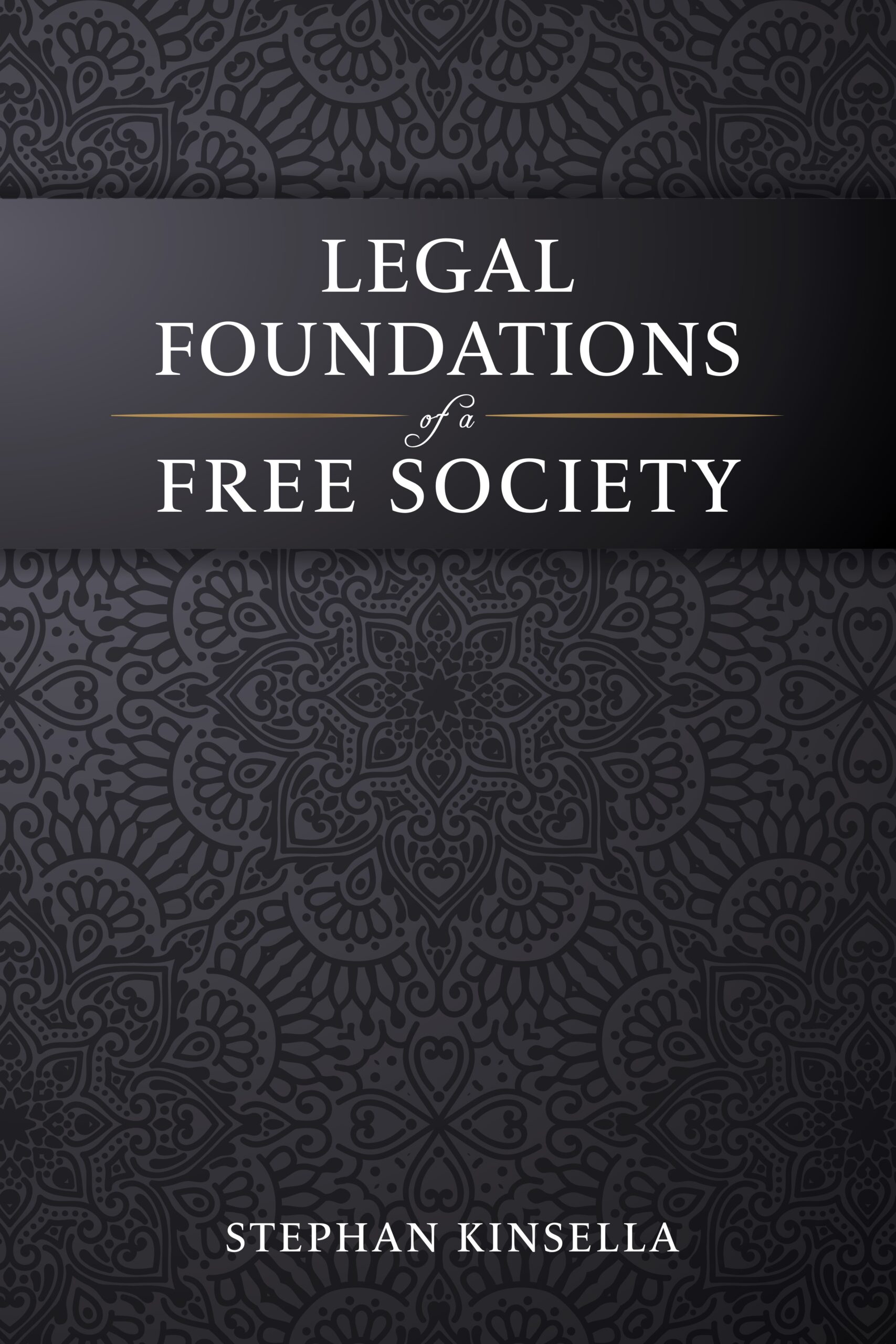
- Stephan Kinsella, Legal Foundations of a Free Society (Houston: Papinian Press, 2023), ch. 2, “What Libertarianism Is,” pp. 13–14 & n.5; p. 32. Every legal system has some property rights; libertarianism is distinguished by its property assignment rules; and, technically, a property right is a right to exclude others.
- Idem, “What Libertarianism Is,” in Jörg Guido Hülsmann & Stephan Kinsella, eds., Property, Freedom, and Society: Essays in Honor of Hans-Hermann Hoppe (Auburn, Ala.: Mises Institute, 2009); also Mises Daily (Aug. 21, 2009). The original version of LFFS ch. 2, on libertarianism’s distinctive property allocation rules.
- Idem, “The Non-Aggression Principle as a Limit on Action, Not on Property Rights; Individuals are Responsible for Actions, not ‘for Their Property’; Property rights are not obligations or responsibilities,” StephanKinsella.com (Jan. 22, 2010). Property rights are not limited by other property rights; the non-aggression principle limits action.
- Idem, “How To Think About Property (2019),” StephanKinsella.com (Apr. 25, 2021). My New Hampshire Liberty Forum speech (Feb. 8, 2019): every political system has property rights, so what matters is who is assigned ownership.
- Idem, “KOL395 | Selling Does Not Imply Ownership, and Vice-Versa: A Dissection (PFS 2022),” Kinsella on Liberty (Sept. 17, 2022); Substack version, Substack (Nov. 1, 2022). My PFS 2022 talk: the essence of a property right is the right to exclude, not the right to use or sell.
- Idem, “Libertarian Answer Man: Easements and Rights of Way,” StephanKinsella.com (Mar. 7, 2024). Ownership as the right to exclude, applied to easements and other partial interests in land, like the deed restriction here.
- Idem, “KOL471 | What Is Property? And What Is Not? — Part 1,” Kinsella on Liberty (Aug. 23, 2025). My Capitalism & Morality 2025 talk (Vancouver): property rights are rights to exclude others from scarce resources, not the resources themselves.
- Idem, “Owning and possessing money, keys, knowledge, bitcoin,” StephanKinsella.com (Apr. 1, 2026). Distinguishes possession, a matter of fact, from ownership, the normative right that supports it.
Kinsella on IP, Negative Servitudes, and Socialism
- Stephan Kinsella, “IP and Aggression as Limits on Property Rights: How They Differ,” StephanKinsella.com (Jan. 22, 2010). The ban on aggression limits only invasions of others’ property; IP gives a non-owner a veto over an owner’s use of his own things.
- Idem, “Intellectual Property Rights as Negative Servitudes,” C4SIF.org (June 23, 2011), also published at Mises Wire (June 23, 2011). Argues that patents and copyrights are nonconsensual negative servitudes granted by state fiat, giving IP holders a veto over how others use their own property. The county’s no-build deed restriction is another such servitude.
- Idem, “Twitter Rant about IP and Socialism,” C4SIF.org (May 27, 2025). Every legal system has some property rights scheme; systems that depart from libertarian assignment rules, IP among them, are socialist.
Kinsella on Epstein, Takings, and Remedies
- Stephan Kinsella, “Book Review of Rosalyn Higgins, Problems and Process: International Law and How We Use It,” Reason Papers No. 20 (Fall 1995): 147–153 (PDF). Observes, following Higgins, that “a right without a remedy is hollow indeed.” Since an “illegal” expropriation has little practical remedy beyond compensation, the legal/illegal distinction seems meaningless.
- Idem, “Richard Epstein’s Takings Political Theory versus Epstein’s Intellectual Property Views,” C4SIF.org (Nov. 4, 2011). Criticizes Epstein’s utilitarian, public-goods case for the takings power, and his failure to apply his own test to IP.
- Idem, “KOL364 | Soho Forum Debate vs. Richard Epstein: Patent and Copyright Law Should Be Abolished,” Kinsella on Liberty (Nov. 24, 2021). My debate with Epstein; the notes trace his case for IP to the logic of Takings.
- Idem, “Richard Epstein’s Takings Theory of the State,” StephanKinsella.com (July 6, 2025). Argues that Epstein’s theory fails because it is utilitarian and ignores subjective value, and that regulatory-takings victims get only fictional “in-kind” compensation.
- Idem, “Email to Richard Epstein: Tension Between Takings Framework and IP Views,” C4SIF.org (Mar. 28, 2026). Presses Epstein on whether patent and copyright can pass his own Takings test, given the lack of evidence that they produce net benefits.
- Idem, “Libertarianism, Minarchists, International Law, and Eminent Domain,” StephanKinsella.com (July 27, 2026), cross-posted from the PFS Blog. Argues that minarchists have no principled objection to eminent domain, and that Epstein bases his theory of the semi-minimal state on the takings power. Also notes that a right without a remedy is hollow, i.e., not a real right (text at n.22).
Other Works on Takings and Remedies
- Richard A. Epstein, Takings: Private Property and the Power of Eminent Domain (Cambridge, Mass.: Harvard University Press, 1985). Epstein’s classic argument that regulations, like outright seizures, are takings that presumptively require compensation.
- Jeffrey Rogers Hummel, “Epstein’s Takings Doctrine and the Public-Goods Problem,” Texas Law Review 65 (1987): 1233. A libertarian critique of Epstein’s reliance on public-goods theory to justify the takings power.
- Rosalyn Higgins, Problems and Process: International Law and How We Use It (Oxford: Clarendon Press, 1994), p. 16 n.42, pp. 53, 99. The future President of the International Court of Justice on why a right without a remedy is hollow.
Other Works on Property, Ownership, and Socialism
- Ludwig von Mises, Human Action: A Treatise on Economics (New Haven: Yale University Press, 1949), excerpted as “Is There Room for Compromise with Socialism?,” Mises Daily (Dec. 27, 2018). The “German pattern” of socialism, which keeps private ownership in name while the state controls its use.
- Hans-Hermann Hoppe, A Theory of Socialism and Capitalism (Boston: Kluwer Academic Publishers, 1989; Auburn, Ala.: Mises Institute, 2010), ch. 5, “The Socialism of Conservatism.” Hoppe treats regulation as a form of socialism: partial expropriation that leaves owners with title but not control.
- Thomas W. Merrill, “Property and the Right to Exclude,” Nebraska Law Review 77 (1998): 730. The classic law-review argument that the right to exclude is the sine qua non of property.
- Cf. Ilya Somin, “The Right to Use Private Property,” The Volokh Conspiracy (Mar. 31, 2026). A different emphasis: argues that the right to use property deserves stronger Takings Clause protection.
- A deed restriction barring construction is a textbook negative servitude: it obliges the owner of the burdened land to refrain from doing something on his own property. Louisiana’s Civil Code even gives “the prohibition of building on an estate” as its example of a nonapparent servitude. See La. Civ. Code art. 707. Ordinarily a servitude binds an owner only if he grants it. But “consent” extracted as the price of a building permit is not real consent. This is thus another nonconsensual negative servitude imposed by the state, like the ones patents and copyrights impose on everyone else’s property by giving IP holders a veto over how others use their own things. See Stephan Kinsella, “Intellectual Property Rights as Negative Servitudes,” C4SIF.org (June 23, 2011). There I also note that zoning and similar regulations are “forms of negative servitudes, if not outright transfers of property rights.” [↩]
- See Richard A. Epstein, Takings: Private Property and the Power of Eminent Domain (Cambridge, Mass.: Harvard University Press, 1985); Kinsella, “Richard Epstein’s Takings Political Theory versus Epstein’s Intellectual Property Views,” C4SIF.org (Nov. 4, 2011); idem, “Richard Epstein’s Takings Theory of the State,” StephanKinsella.com (July 6, 2025). [↩]
- Kinsella, Legal Foundations of a Free Society (Houston: Papinian Press, 2023), p. 32; see also idem, “Libertarian Answer Man: Easements and Rights of Way,” StephanKinsella.com (Mar. 7, 2024). Just as a right to “own” something you have no right to exclude others from is meaningless, a right without a remedy is not a real right. As I have previously pointed out, “it is a common legal observation that a right without a remedy is hollow—i.e., not a real right at all.” Idem, “Libertarianism, Minarchists, International Law, and Eminent Domain,” StephanKinsella.com (July 27, 2026), text at n.22, cross-posted from the PFS Blog. Rosalyn Higgins, later President of the International Court of Justice, makes the same point; as I put it in my review of her book, “as Higgins observes, a right without a remedy is hollow indeed.” Kinsella, “Book Review of Rosalyn Higgins, Problems and Process: International Law and How We Use It,” Reason Papers No. 20 (Fall 1995): 147–153, citing Rosalyn Higgins, Problems and Process: International Law and How We Use It (Oxford: Clarendon Press, 1994), p. 16 n.42, pp. 53, 99. [↩]
- But as I have pointed out, this is not a limitation on property rights, but a limit on action. See Kinsella, “The Non-Aggression Principle as a Limit on Action, Not on Property Rights; Individuals are Responsible for Actions, not ‘for Their Property’; Property rights are not obligations or responsibilities,” StephanKinsella.com (Jan. 22, 2010) (“property rights are not limits on or limited by other property rights; property rights are limits on action”); idem, “IP and Aggression as Limits on Property Rights: How They Differ,” StephanKinsella.com (Jan. 22, 2010); idem, “Libertarian Answer Man: Easements and Rights of Way,” StephanKinsella.com (Mar. 7, 2024) (“property rights do not limit other property rights, they limit actions”). [↩]
- This is why I argue that what distinguishes libertarianism is not that we believe in property rights; all systems have some system of property rights. What distinguishes libertarianism is our particular property allocation rules. See Kinsella, LFFS, ch. 2, pp. 13–14 & n.5 (“Every legal system defines and enforces some property rights system. … What is distinctive about libertarianism is its particular property assignment rules”); idem, “What Libertarianism Is,” in Jörg Guido Hülsmann & Stephan Kinsella, eds., Property, Freedom, and Society: Essays in Honor of Hans-Hermann Hoppe (Auburn, Ala.: Mises Institute, 2009); idem, “How To Think About Property (2019),” StephanKinsella.com (Apr. 25, 2021) (“every political system believes in property rights, that is, the right to control resources as assigned by their legal system to some owners”); idem, “Twitter Rant about IP and Socialism,” C4SIF.org (May 27, 2025) (“Socialist systems are those that assign property rights in other ways”). [↩]
- Ludwig von Mises, Human Action: A Treatise on Economics (New Haven: Yale University Press, 1949), excerpted as “Is There Room for Compromise with Socialism?,” Mises Daily (Dec. 27, 2018). [↩]
- Patents and copyrights give the IP holder a veto over how others use their own property. The owner of a printer or a factory keeps nominal title, but the state and the IP holder dictate what he may do with it: Mises’s German pattern in miniature. See Kinsella, “Intellectual Property Rights as Negative Servitudes,” C4SIF.org (June 23, 2011); idem, “IP and Aggression as Limits on Property Rights: How They Differ,” StephanKinsella.com (Jan. 22, 2010) (the IP advocate “wants A to have a veto over B’s use of B’s own disk”); idem, “Twitter Rant about IP and Socialism,” C4SIF.org (May 27, 2025). [↩]
- See Kinsella, “Libertarianism, Minarchists, International Law, and Eminent Domain,” StephanKinsella.com (July 27, 2026); idem, “Email to Richard Epstein: Tension Between Takings Framework and IP Views,” C4SIF.org (Mar. 28, 2026); see also Jeffrey Rogers Hummel, “Epstein’s Takings Doctrine and the Public-Goods Problem,” Texas Law Review 65 (1987): 1233. [↩]








 Alessandro Fusillo
 Andreas Tögel
 David Dürr
 Doug French
 Fernando Chiocca
 Greg Morin
 Hans-Hermann Hoppe
 Jay Baykal
 Jayant Bhandari
 Jeff Deist
 Jeffrey Barr
 Juan Fernando Carpio
 Ken Yamarashi
 León Isidoro
 Martin Cabrera
 Nick Hoppe
 Oscar Grau
 Peter Wong
 PFS
 scholarium
 Saifedean Ammous
 Sean Gabb
 Sean Ring
 Stephan Kinsella
 Stéphane Geyres
 Thomas Jacob
 Tom DiLorenzo

Follow Us!