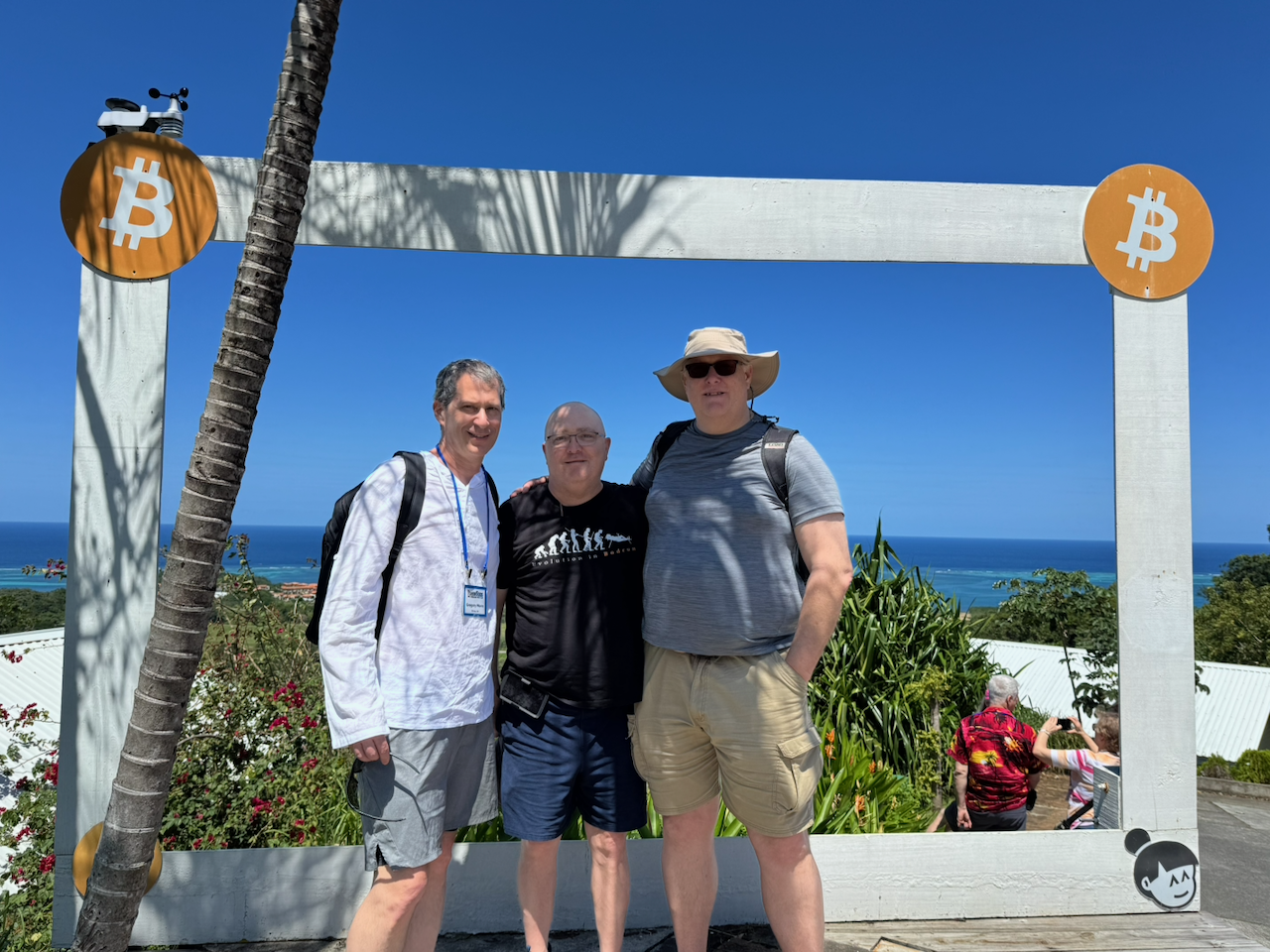
Greg Morin, Kinsella, Adam Haman, Prospera, Roatan, Honduras, Feb. 2025, Tom Woods Cruise
The Free Cities Foundation’s latest email newsletter reports that Honduras has escalated its long-running war on Próspera, the charter city on the island of Roatán (I’ve visited twice).1 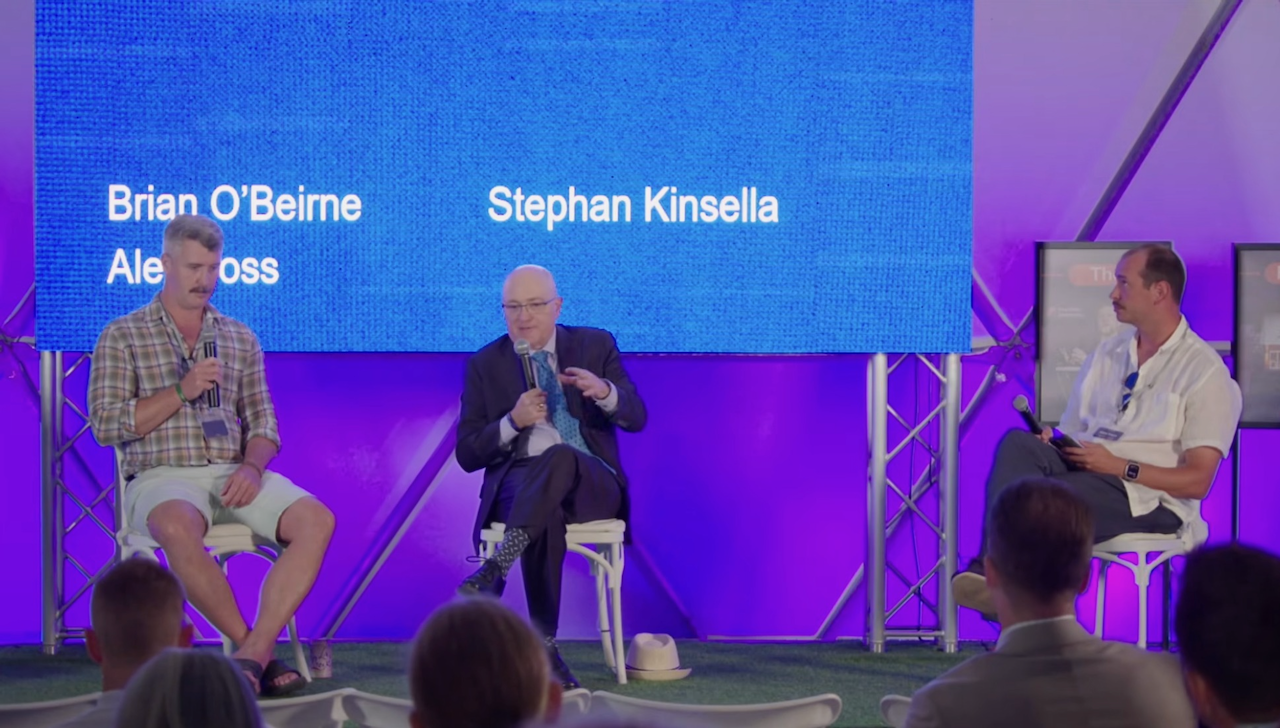 The government’s Attorney General, the Procuraduría General de la República (PGR), has filed a criminal complaint accusing Próspera’s top official, and the lawyer he swore in, of treason.2 Treason, for swearing in a civil prosecutor. I was just there in September for the Foundation’s annual conference, and I’ve written before about how international investment law may yet save the project, so a few comments.
1. What Happened
On September 15, Jorge Colindres, the technical secretary of Próspera ZEDE (basically the zone’s mayor), swore in lawyer Alberto Hernández Franks as Próspera’s “Fiscal Civil,” a post Próspera describes as handling civil and administrative matters. Six days later the PGR filed a criminal complaint with the public prosecutors (the Ministerio Público) accusing both men of “traición a la patria” (treason against the fatherland) and “usurpación de funciones” (usurpation of public functions). The PGR claims the Fiscal Civil post carries jurisdictional, tax-collection, and public-order powers that the Honduran Constitution reserves to the state.3
The PGR’s theory is that the Honduran Supreme Court’s September 20, 2024 ruling declared the ZEDE constitutional amendments and the ZEDE organic law unconstitutional ex tunc, void from the beginning, so that no appointment made under the ZEDE regime has any legal validity.4 So: Honduras amended its own constitution to invite investors to build Próspera, gave them a legal stability agreement, and now says anyone who acted under that regime is a traitor. As the PGR put it, “No private structure may set itself up as a public authority within Honduran territory.”5 One is tempted to ask how the Honduran state came to be a public authority in the first place, but never mind.
Próspera disputes all this. In its updated legal stability disclosure, it argues that the 2024 ruling “contains no mandate against any person”; that under Article 94 of Honduras’s Law on Constitutional Justice the ruling cannot reach legal situations already resolved and executed, such as Próspera’s creation, the appointment of its authorities, and its legal stability agreements; that Article 96 of the Constitution protects acquired rights; that the 2022 repeal decree never took effect because it was never ratified; and that Próspera was not even a party to the case.6 Colindres also says the ZEDE law authorized appointing a civil prosecutor to handle tax procedures.7
Nobody has been arrested or charged. A complaint only asks for an investigation, and the prosecutors, not the PGR, decide whether to act. The case has reportedly been assigned to prosecutors, who asked the national criminal investigation agency (ATIC) to gather documents from Próspera-linked offices.8 Meanwhile, Attorney General Dagoberto Aspra now says his office is open to a settlement: “we are open, with one hand applying the law, and with the other extended.”9 The carrot and the stick, in a single sentence.
2. Why “Void from the Beginning” Doesn’t Get Honduras Off the Hook
As I explained last year in a long blog post, Próspera’s protection does not depend on Honduran domestic law alone. The combination of Honduras’s (former) membership in ICSID, the investment chapter of CAFTA-DR, and Próspera’s Agreement for Legal Stability and Investor Protection with Honduras appears to be enough to “internationalize” the stability agreement, so that Honduras cannot change its terms by domestic legislation without incurring liability under international law.10 That is the whole point of stabilization clauses and investment treaties, something I have been writing about since the 1990s.11
The doctrine of parliamentary or legislative sovereignty lets a state change its own law,12 and a state’s high court can declare a statute void ab initio if it likes. But none of that changes the state’s obligations under international law. As the Vienna Convention on the Law of Treaties puts it, “A party may not invoke the provisions of its internal law as justification for its failure to perform a treaty.”13 And under the International Law Commission’s Articles on State Responsibility, whether a state’s act is internationally wrongful “is governed by international law,” not by the state’s own law, and the conduct of any state organ, whether legislative, executive, or judicial, is attributable to the state.14 So the Supreme Court’s “void from the origin” ruling is no defense to Próspera’s claim; if anything, it is part of what the claim is about. And opening a treason investigation into the zone’s officials for exercising powers they say the ZEDE regime gave them is not the sort of thing that helps a respondent state in front of an investment tribunal.
Próspera is also pressing a clever treaty argument. Honduras’s 2013 investment agreement with Kuwait provides that guarantees for ZEDE investments “shall remain as a guarantee to Kuwaiti investments and investors for not less than fifty (50) years,” and Próspera argues that CAFTA-DR’s most-favored-nation clause extends that protection to it as well.15 Whether that MFN argument flies remains to be seen, but it is a good example of how the web of investment treaties can be used to lock in protections that a later government can’t simply legislate away.16
The arbitration itself grinds on. Próspera and its affiliates filed their ICSID claim in December 2022, initially seeking about $10.8 billion, roughly a third of Honduras’s GDP, though the claim has reportedly since been cut to about $1.6 billion.17 In February 2025 the tribunal rejected Honduras’s attempt to condition its CAFTA-DR consent on exhaustion of local remedies, and in April 2026 it denied Honduras’s request to bifurcate the proceedings, so Honduras’s remaining objections will be heard together with the merits.18
3. Mixed Signals from Tegucigalpa
What makes the treason complaint so odd is its timing. Xiomara Castro’s leftist government, which pushed the 2022 repeal and pulled Honduras out of ICSID in 2024, is gone. President Nasry Asfura took office in January 2026 and promptly began the process of bringing Honduras back into ICSID. According to a State Department report to Congress, he signed the ICSID Convention in March 2026, Honduras will rejoin upon ratification, and his government aims to “strengthen legal certainty for investors.”19 Yet the same government’s Attorney General is accusing Próspera’s officials of treason with one hand while extending the other for a settlement. Maybe the complaint is just leverage for settlement talks. Or maybe it’s simply the Honduran state being the Honduran state. Meanwhile, Fernando García, who led the Castro government’s ZEDE commission, is already warning that settlement talks would weaken Honduras’s hand in the arbitration.20
Either way, this is a textbook illustration of political risk. When people think of political risk they think of outright expropriation: the government seizes the oil field. But the subtler forms, such as “creeping” expropriation, regulatory harassment, and threatening local managers with prison, can be just as destructive. This is exactly why investors in developing countries seek stabilization agreements, treaty protection, and political risk insurance, rather than relying on the goodwill of the host state’s next government.21
4. International Law Cuts Both Ways
There’s an irony here. At the Free Cities conference at Próspera in September, I debated IP attorney Brian O’Beirne on whether free cities should protect intellectual property.22 One of O’Beirne’s main arguments was that Próspera can’t just ignore IP, because “Honduras is a signatory to the CAFTA-DR treaty, which binds them to TRIPS or even a higher level than TRIPS.”23 Fair enough. As I pointed out in the debate, patent law is “municipal and national only,” so whether Próspera has a patent law of its own is mostly irrelevant anyway. But if CAFTA-DR’s IP chapter constrains what Próspera can do, then CAFTA-DR’s investment chapter constrains what Honduras can do to Próspera. Treaties are not a one-way ratchet that binds free cities and liberates states.
As for Próspera’s prospects, I remain a friendly skeptic. I first visited in February 2025 on the Tom Woods Cruise, enjoyed the people there this year, made some friends, and might go back.24 But as I told Mark Maresca on his show The White Pillbox, I’m not sure Honduras is the place for it: “the location is just not a place where you can build a thriving modern tech metropolis,” and the country “goes back on their word.” Still, “it’s limping along. It may make it in the end.”25 Projects in places like Brunei or the UAE, with its common-law Dubai International Financial Centre, may have better odds.26 But if Próspera does survive, it will be in no small part because of the international-law protections the Honduran state signed up for and now wishes it hadn’t.
Conclusion
Honduras invited investors in, amended its constitution to do it, and, Próspera says, promised them decades of legal stability. Now it calls the people who took it at its word traitors. If anyone has betrayed anyone here, it is the Honduran state. The best outcome for everyone, including ordinary Hondurans, who need investment far more than they need treason prosecutions, is for prosecutors to drop the complaint, for the Asfura government to finish rejoining ICSID, and for the parties to settle. Otherwise Honduras may find that “void from the beginning” turns out to be very expensive.
One can only admire the various attempts to find or found oases of liberty in an unfree world, from seasteading to the Free State Project to Liberland and Próspera and others.27 Fingers crossed that some of them work.
Related
- Noah D. Rubins, Thomas N. Papanastasiou and N. Stephan Kinsella, International Investment, Political Risk, and Dispute Resolution: A Practitioner’s Guide, 2d ed. (Oxford: Oxford University Press, 2020) — my co-authored treatise on political risk, investment treaties, stabilization clauses, and investor-state arbitration such as ICSID, the legal framework behind Próspera’s claim.
- Paul E. Comeaux and N. Stephan Kinsella, “Reducing Political Risk in Developing Countries: Bilateral Investment Treaties, Stabilization Clauses, and MIGA & OPIC Investment Insurance,” New York Law School Journal of International and Comparative Law 15 (1994): 1 — an early article on the same tools Próspera is relying on, namely investment treaties, stabilization clauses, and political risk insurance. This served as the basis for the two predecessor books to Rubins, Papanastasiou and Kinsella treatise, International Investment, Political Risk, and Dispute Resolution (2020)
- Kinsella, “Using International Law to Protect Property Rights and International Investment,” StephanKinsella.com (Nov. 24, 2025) — explaining that investment treaties, ICSID, and stability agreements can “internationalize” a state’s promises to investors, with a note on Próspera’s ICSID claim against Honduras.
- Kinsella, “Libertarian Nation and Related Projects,” StephanKinsella.com (Sept. 14, 2025) — a survey of free-city, charter-city, and libertarian-nation efforts, including Próspera, Tipolis, Dubai’s common-law DIFC, and Liberland, and a note on my first visit to Próspera.
- Kinsella, “My Failed Libertarian Speaking Hiatus; Memories of Mises Institute and Other Events, 1988–2025,” StephanKinsella.com (Feb. 2016, regularly updated) — my running log of talks and events, including the February 2025 Tom Woods Cruise visit to Próspera and the 2026 Free Cities conference there.
- Kinsella, “Free Cities Foundation Annual Conference — Próspera 2026,” PFS Blog (Sept. 4, 2026) — my report from the September 2026 conference held at Próspera, with the livestream and photos.
- Kinsella, “Kinsella vs. O’Beirne Debate: ‘Should Free Cities Protect Intellectual Property?’” PFS Blog (Sept. 6, 2026) — a summary of my debate at the conference, where both sides agreed Próspera should not pick a treaty fight with Honduras.
- Kinsella, “KOL497 | Debate: ‘Should Free Cities Protect Intellectual Property?’ Free Cities Foundation Annual Conference — Próspera, Honduras 2026,” Kinsella on Liberty Podcast (Sept. 6, 2026) — audio, video, and transcript of the debate, including O’Beirne’s argument that CAFTA-DR binds Honduras to TRIPS-level IP protection (discussed in section 4 above).
- Kinsella, “KOL501 | Stephan Kinsella (The Kinsellanator) returns to dispense some White Pills, with Mark Maresca of The White Pillbox: Próspera and Free Cities, PFS, Helsinki, Bitcoin, Why the State Is Fragile, Way-Station Libertarians, Anarchism, and IP,” Kinsella on Liberty Podcast (Oct. 7, 2026) — my take on Próspera’s prospects, Honduras’s habit of going back on its word, and more promising free-city projects in places like Brunei and the UAE.
- Kinsella, “KOL250 | International Law Through a Libertarian Lens (PFS 2018),” Kinsella on Liberty Podcast (Sept. 26, 2018) — my 2018 PFS talk on how libertarians should view international law, drawing on Rothbard’s case for reviving classical international law.
- Kinsella, “International Law, Libertarian Principles, and the Russia-Ukraine War,” StephanKinsella.com (Apr. 18, 2022) — why international law is real law even without a world sovereign, resting like domestic law on widespread voluntary compliance, and why treaty obligations bind (pacta sunt servanda).
- Kinsella, “On the UN, the Birchers, and International Law,” StephanKinsella.com (Mar. 29, 2022) — a reply to conspiratorial libertarian hostility toward the UN and international law, noting that the UN cannot tax or legislate and that international law is a real body of law.
- Kinsella, “Legislation and the Discovery of Law in a Free Society,” StephanKinsella.com (Jan. 8, 2021), also in Kinsella, Legal Foundations of a Free Society (Houston: Papinian Press, 2023), ch. 13 — my critique of legislation and legislative supremacy, and the legal uncertainty it creates.
- I first visited Próspera in February 2025, on the Tom Woods Cruise, and returned in September 2026 to speak at the Free Cities Foundation’s annual conference, held at Próspera, where I debated IP attorney Brian O’Beirne. While there I also recorded an interview with Timothy Allen for the Free Cities Podcast, not yet released. On the first visit, see Kinsella, “My Failed Libertarian Speaking Hiatus; Memories of Mises Institute and Other Events, 1988–2025,” StephanKinsella.com, entry for “Tom Woods Cruise (Feb. 23, 2025–March 2, 2025)”; idem, “Libertarian Nation and Related Projects,” StephanKinsella.com (Sept. 14, 2025); idem, “Using International Law to Protect Property Rights and International Investment,” StephanKinsella.com (Nov. 24, 2025), under “A note on Próspera.” On the second, see idem, “Free Cities Foundation Annual Conference — Próspera 2026,” PFS Blog (Sept. 4, 2026); idem, “Kinsella vs. O’Beirne Debate: ‘Should Free Cities Protect Intellectual Property?’” PFS Blog (Sept. 6, 2026); idem, “KOL497 | Debate: ‘Should Free Cities Protect Intellectual Property?’ Free Cities Foundation Annual Conference — Próspera, Honduras 2026,” Kinsella on Liberty Podcast (Sept. 6, 2026); idem, “KOL501 | Stephan Kinsella (The Kinsellanator) returns to dispense some White Pills, with Mark Maresca of The White Pillbox,” Kinsella on Liberty Podcast (Oct. 7, 2026). [↩]
- Free Cities Foundation, “Honduras Escalates Its Dispute with Próspera,” Free Cities Foundation Newsletter No. 54 (Nov. 16, 2026). The newsletter has not yet been posted online; the Foundation’s Managing Director, Peter Young, tells me it will be uploaded to the Foundation’s website soon, and the Foundation says it will publish more on the story at its Substack. [↩]
- “PGR acusa a dos figuras de ZEDE Próspera por traición a la patria y usurpación de funciones” [PGR accuses two ZEDE Próspera figures of treason and usurpation of functions], El Heraldo (Sept. 21, 2026); “PGR interpone denuncia por traición a la patria y usurpación en caso ZEDE Próspera” [PGR files complaint for treason and usurpation in ZEDE Próspera case], Hondudiario (Sept. 21, 2026). [↩]
- El Heraldo, “PGR acusa,” supra; “La PGR espera que Próspera busque conciliación con el Estado de Honduras” [The PGR expects Próspera to seek conciliation with the State of Honduras], El Heraldo (Oct. 13, 2026). The court was unanimous that Decree 236-2012, which amended Articles 294, 303, and 329 of the Constitution, and Decree 120-2013, the ZEDE organic law, were unconstitutional, but split 8–7 on giving the ruling effect from the origin. [↩]
- Hondudiario, supra: “Ninguna estructura privada puede erigirse como autoridad pública dentro del territorio hondureño.” [↩]
- Próspera ZEDE, “Legal Stability Disclosure and Disclaimer” [Divulgación y Descargo de Estabilidad Jurídica] (updated Sept. 29, 2026), § 5. [↩]
- Sharon Ardon, “¿Por qué sigue operando Próspera en Honduras?” [Why is Próspera still operating in Honduras?], Expediente Público (Oct. 21, 2026). [↩]
- Free Cities Foundation, supra; Ardon, supra. [↩]
- El Heraldo, “La PGR espera,” supra: “estamos abiertos con una mano aplicando la ley, y con otra mano extendida.” Próspera had proposed a two-stage dialogue with the PGR on September 22. Ibid. [↩]
- Kinsella, “Using International Law,” supra, under “A note on Próspera.” See also Alan Bickley, “The Nature of International Law: Response to Kinsella,” Libertarian Alliance (Jan. 17, 2026). [↩]
- Paul E. Comeaux and N. Stephan Kinsella, “Reducing Political Risk in Developing Countries: Bilateral Investment Treaties, Stabilization Clauses, and MIGA & OPIC Investment Insurance,” New York Law School Journal of International and Comparative Law 15 (1994): 1; Noah D. Rubins, Thomas N. Papanastasiou and N. Stephan Kinsella, International Investment, Political Risk, and Dispute Resolution: A Practitioner’s Guide, 2d ed. (Oxford: Oxford University Press, 2020), ¶¶ 2.29, 2.53, 5.109, et pass. [↩]
- As I noted in “Using International Law,” supra, under “A note on Próspera,” “The doctrine of parliamentary or legislative sovereignty permits states to change their law,” but a properly “internationalized” agreement can still give rise to liability under international law. See also Comeaux and Kinsella, “Reducing Political Risk in Developing Countries,” supra, explaining that the key element of a stabilization clause is the “removal of the government’s right to unilaterally alter the investor’s rights by changing its municipal law”; Rubins, Papanastasiou and Kinsella, supra, ¶¶ 2.29, 2.53, 5.109. On the uncertainty that legislative supremacy creates, see Kinsella, “Legislation and the Discovery of Law in a Free Society,” StephanKinsella.com (Jan. 8, 2021); idem, Legal Foundations of a Free Society (Houston: Papinian Press, 2023), ch. 13, quoting Bruno Leoni’s point that under legislative supremacy “nobody can tell whether a rule may be only one year or one month or one day old when it will be abrogated by a new rule.” [↩]
- Vienna Convention on the Law of Treaties, art. 27, May 23, 1969, 1155 U.N.T.S. 331. [↩]
- International Law Commission, Articles on Responsibility of States for Internationally Wrongful Acts, arts. 3, 4(1), in Report of the International Law Commission on the Work of its Fifty-third Session, U.N. Doc. A/56/10 (2001). [↩]
- Próspera ZEDE, “Legal Stability Disclosure,” supra, § 5(d), citing Article 16.4 of the Honduras–Kuwait agreement, approved by Decree 367-2013; Ardon, supra. [↩]
- See Kinsella, “Using International Law,” supra, on how investment treaties, ICSID, and stability agreements can “internationalize” a state’s commitments to investors; idem, “KOL250 | International Law Through a Libertarian Lens (PFS 2018),” Kinsella on Liberty Podcast (Sept. 26, 2018); idem, “International Law, Libertarian Principles, and the Russia-Ukraine War,” StephanKinsella.com (Apr. 18, 2022), arguing that international law is real law, resting like domestic law on widespread voluntary compliance, and that treaty obligations bind under the principle of pacta sunt servanda. [↩]
- Ardon, supra (citing PGR figures that the claim fell from US$10,775 million to US$1,630 million); “Honduras’ Bid To Bifurcate $1.6B Island City Arbitration Denied By Tribunal,” Mealey’s (Apr. 15, 2026). The case is Honduras Próspera Inc. v. Republic of Honduras, ICSID Case No. ARB/23/2. [↩]
- “A Local Remedies Pitfall Avoided—for Now: Key Takeaways from Honduras Próspera Inc. v. Honduras,” Kluwer Arbitration Blog (Apr. 21, 2025); Mealey’s, supra. [↩]
- Pamela Bustillo, “Nasry Asfura inicia proceso para reincorporar Honduras al CIADI” [Nasry Asfura begins process to bring Honduras back into ICSID], Infobae (Jan. 28, 2026); U.S. Department of State, “Report to Congress on United States Investment in Próspera ZEDE” (2026). [↩]
- Ardon, supra. [↩]
- See Comeaux and Kinsella, “Reducing Political Risk in Developing Countries,” supra; Rubins, Papanastasiou and Kinsella, supra. [↩]
- Kinsella, “Free Cities Foundation Annual Conference — Próspera 2026,” supra; idem, “Kinsella vs. O’Beirne Debate,” supra; idem, “Debate: ‘Should Free Cities Protect Intellectual Property?’ Free Cities Foundation Annual Conference — Próspera, Honduras 2026,” C4SIF Blog (Sept. 5, 2026). [↩]
- Kinsella, “KOL497,” supra. [↩]
- Kinsella, “Libertarian Nation and Related Projects,” supra; idem, “Using International Law,” supra; idem, “My Failed Libertarian Speaking Hiatus,” supra. [↩]
- Kinsella, “KOL501,” supra. [↩]
- See Kinsella, “Libertarian Nation and Related Projects,” supra, surveying Próspera, Tipolis, the Free Cities Foundation, the DIFC, Liberland, seasteading, and other such projects. [↩]
- Kinsella, “Libertarian Nation and Related Projects,” supra. [↩]












 Alessandro Fusillo
 Andreas Tögel
 David Dürr
 Doug French
 Fernando Chiocca
 Greg Morin
 Hans-Hermann Hoppe
 Jay Baykal
 Jayant Bhandari
 Jeff Deist
 Jeffrey Barr
 Juan Fernando Carpio
 Ken Yamarashi
 León Isidoro
 Martin Cabrera
 Nick Hoppe
 Oscar Grau
 Peter Wong
 PFS
 scholarium
 Saifedean Ammous
 Sean Gabb
 Sean Ring
 Stephan Kinsella
 Stéphane Geyres
 Thomas Jacob
 Tom DiLorenzo

Follow Us!