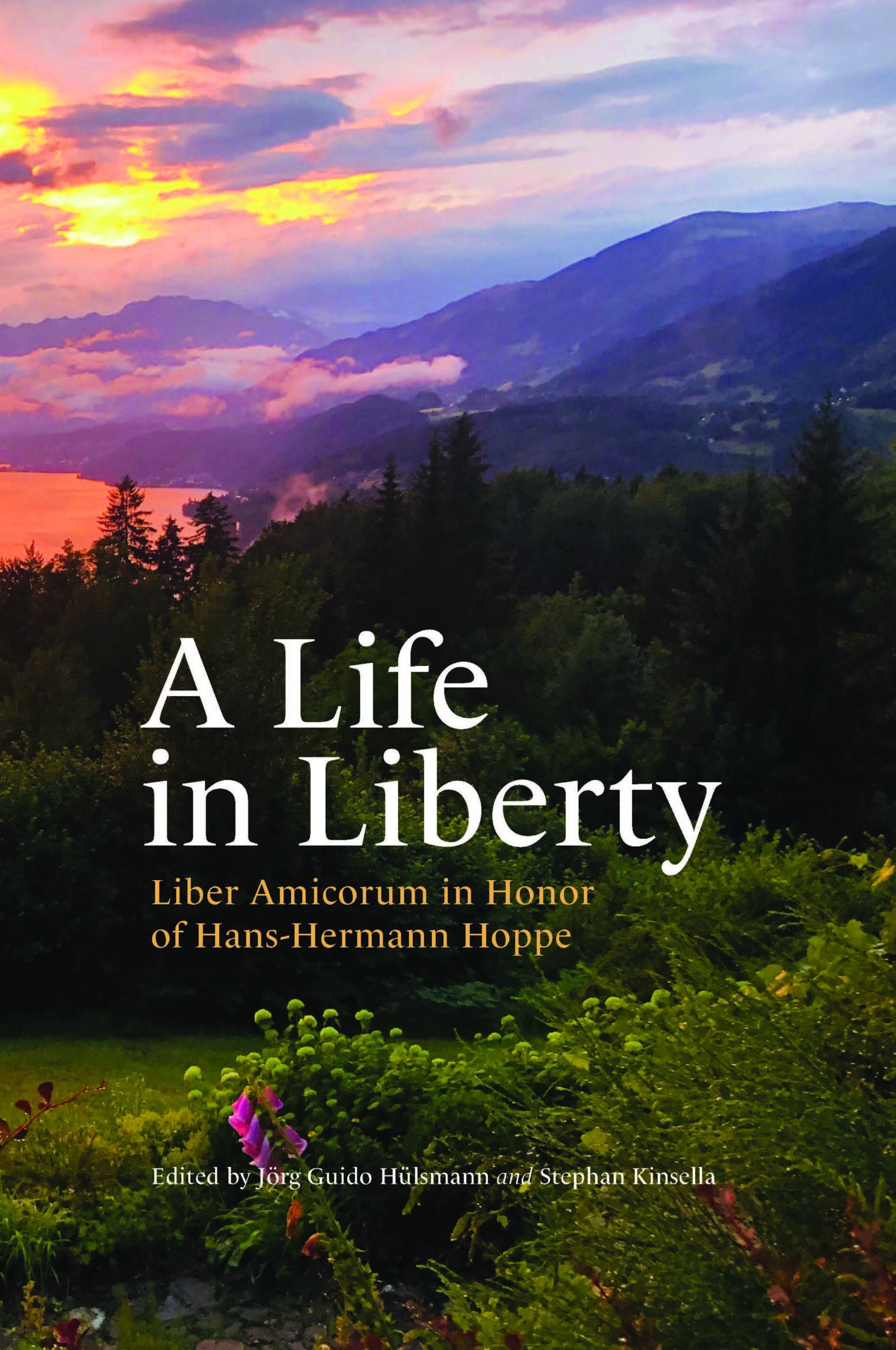
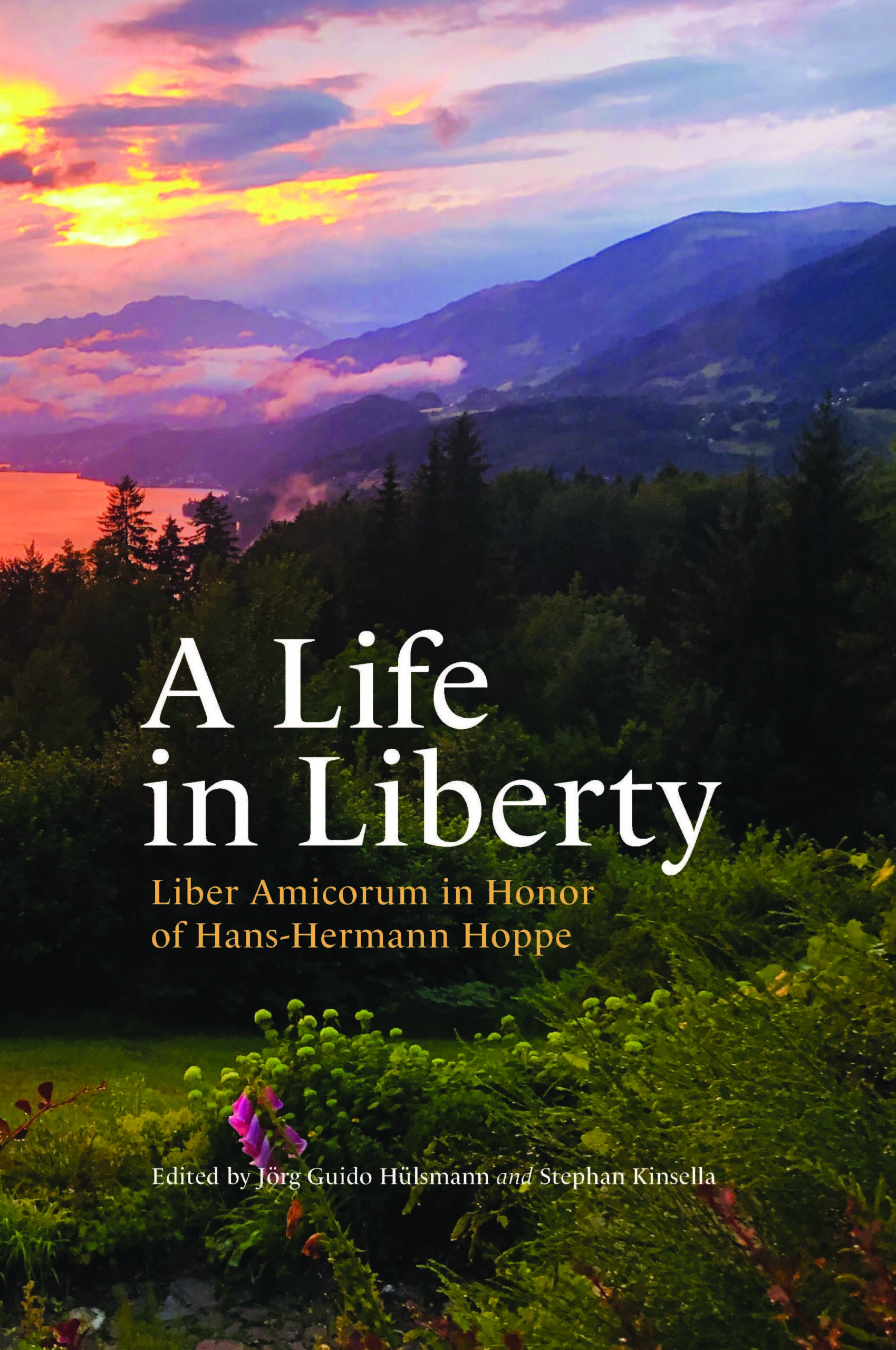
 In 2024, the Property and Freedom Society published A Life in Liberty: Liber Amicorum in Honor of Hans-Hermann Hoppe, Jörg Guido Hülsmann and Stephan Kinsella, eds. (Houston, Texas: Papinian Press, 2024), on the occasion of Professor Hoppe’s 75th birthday on Sept. 2, 2024.
Most of the the pieces were not published in HTML text form as separate articles; we will be posting them in this Bookstream. The Preface was republished in the inaugural post in this Bookstream: A Life in Liberty Bookstream: Preface — Hülsmann and Kinsella. Links to the remaining chapters may be found at the book’s landing page here.
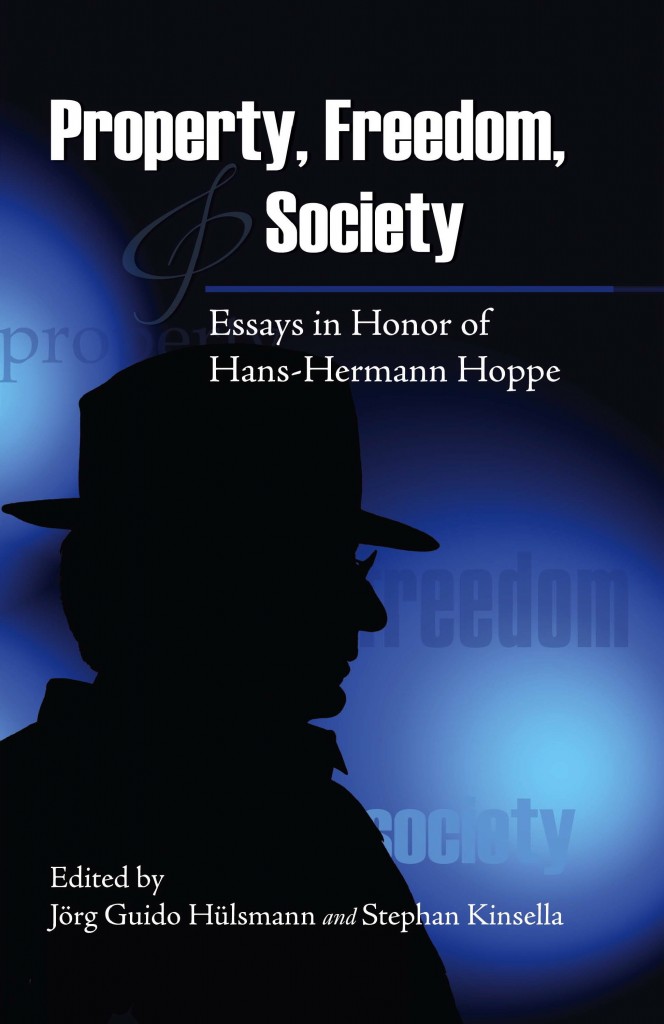
Here’s the next entry: “In Honor of Hans Hoppe,” by Llewellyn H. Rockwell, Jr. Regarding this piece, see also Stephan Kinsella, “My Years with the Mises Institute,” Property and Freedom Journal (May 2, 2026), regarding the odd reference to Salerno at the end of this piece. See also Rockwell’s contribution to the previous Hoppe Festschrift, “A Life of Ideas,” in Property, Freedom, and Society: Essays in Honor of Hans-Hermann Hoppe, Jörg Guido Hülsmann and Stephan Kinsella, eds. (Auburn, Ala.: Mises Institute, 2009).
4
In Honor of Hans Hoppe
Llewellyn H. Rockwell, Jr.*
Ifirst heard of Hans Hoppe from Murray Rothbard in the early 1980s. Bubbling over with enthusiasm, Murray told me that a brilliant young German graduate student had become his disciple. Hans had been a prize pupil of the famous Frankfurt School Marxist Jürgen Habermas. He wasn’t satisfied with the socialist views of his teacher and converted to the free market and, later, anarcho-capitalism after reading first Hayek, then Mises and Rothbard. By doing so, he gave up the chance for a major academic chair in Germany, because Habermas hated supporters of the free market and would do nothing to help Hans. But Hans has exemplary courage. He never bends or bows in the wind.
Hans showed his courage once more after he received a prestigious fellowship from the Humboldt Foundation to study in the United States. James Buchanan offered Hans a chance to study public choice economics, with a generous financial stipend, but Hans turned it down. He preferred to study with Murray, who had been marginalized by the mainstream, even though Buchanan, a Nobel Prize winner, could have done much more to help his career.
When he came to New York, Hans attended all of Murray’s classes, took careful notes, and had innumerable long conversations with Murray. He soon became one of the world’s most knowledgeable Rothbardians and one of Murray’s closest friends.
When I met Hans, I was impressed right away by his devotion to Murray, his knowledge, and his friendly personality. He and I soon became fast friends.
One thing that especially impressed Murray was that Hans had developed a new argument for libertarian rights. Hans used the “argumentation ethics” he had learned from Habermas and Karl-Otto Apel in a way that reversed the conclusions they drew from it. Argumentation ethics does not, as they thought, support socialism. To the contrary, if you deny the self-ownership principle, you are contradicting yourself. You couldn’t deny self-ownership unless you in fact owned your body. Murray thought this was a brilliant contribution to libertarian theory. As he wrote at the time:
In a dazzling breakthrough for political philosophy in general and for libertarianism in particular, he [Hoppe] has managed to transcend the famous is/ought, fact/value dichotomy that has plagued philosophy since the days of the scholastics, and that had brought modern libertarianism into a tiresome deadlock. Not only that: Hans Hoppe has managed to establish the case for anarcho-capitalist, Lockean rights in an unprecedentedly hard-core manner, one that makes my own natural law/natural rights position seem almost wimpy in comparison.1
A memory that stands out in my mind is seeing Hans at a Mises Institute Conference held in Manhattan in 1989. Hans presented his argumentation ethics and more than held his own when the utilitarian economist Leland Yeager objected to it.2
In the nearly 45 years since then, Hans has become, along with Joe Salerno, the greatest living Rothbardian. It is an honor to salute him on his 75th birthday.
Endnotes
*Llewellyn H. Rockwell, Jr., is founder and chairman of the board of the Ludwig von Mises Institute in Auburn, Alabama, and editor of LewRockwell.com.
- Murray N. Rothbard, “Beyond Is and Ought,” Liberty 2, no. 2 (Nov. 1988): 44–45, at 44. For more on argumentation ethics, see Stephan Kinsella, “Argumentation Ethics and Liberty: A Concise Guide,” StephanKinsella.com (May 27, 2011). Despite his many contributions to austro-libertarian theory, Hans himself views argumentations ethics as his most important contribution. See Hans-Hermann Hoppe, “PFP163 | Hans Hermann Hoppe, ‘On The Ethics of Argumentation’ (PFS 2016),” Property and Freedom Podcast (June 30, 2022). [↩]
- Yeager later claimed that Murray, who died in January 1995, had changed his mind before his death regarding the validity of Hoppe’s argument, even after endorsing it in 1988. See Leland B. Yeager, “Book Review,” Rev. Austrian Econ. 9, no. 1 (1996; https://perma.cc/UDC3-UQ3Z): 181–88 (reviewing Murray N. Rothbard, Economic Thought Before Adam Smith and Classical Economics, vols. 1 and 2 of An Austrian Perspective on the History of Economic Thought (Aldershot, England and Brookfield, Vt.: Edward Elgar, 1995; https://perma.cc/3ABN-9FD2) ). Yeager asserts that, based on language in this posthumously-published treatise:
Rothbard no longer endorses Hans-Hermann Hoppe’s claim to derive libertarian policy positions purely from the circumstances of discussion itself, without any appeal to value judgments.… On the contrary, and as he had done earlier, Rothbard now correctly observes that policy recommendations and decisions presuppose value judgments as well as positive analysis. (p. 185)
It is true that Yeager himself disagreed with argumentation ethics. See Leland B. Yeager, “Raw Assertions,” Liberty 2, no. 2 (Nov. 1988): 45–46. However, Yeager provided no evidence for his contention about Murray’s change of mind. Murray was a fan and friend of Hans until the end, and never disavowed his support for Hans’s argumentation ethics. [↩]
Discover more from The Property and Freedom Society
Subscribe to get the latest posts sent to your email.











 Alessandro Fusillo
 Andreas Tögel
 David Dürr
 Doug French
 Fernando Chiocca
 Greg Morin
 Hans-Hermann Hoppe
 Jay Baykal
 Jayant Bhandari
 Jeff Deist
 Jeffrey Barr
 Juan Fernando Carpio
 Ken Yamarashi
 León Isidoro
 Martin Cabrera
 Nick Hoppe
 Oscar Grau
 Peter Wong
 PFS
PFS scholarium
 Saifedean Ammous
 Sean Gabb
 Sean Ring
 Stephan Kinsella
 Stéphane Geyres
 Thomas Jacob
 Tom DiLorenzo