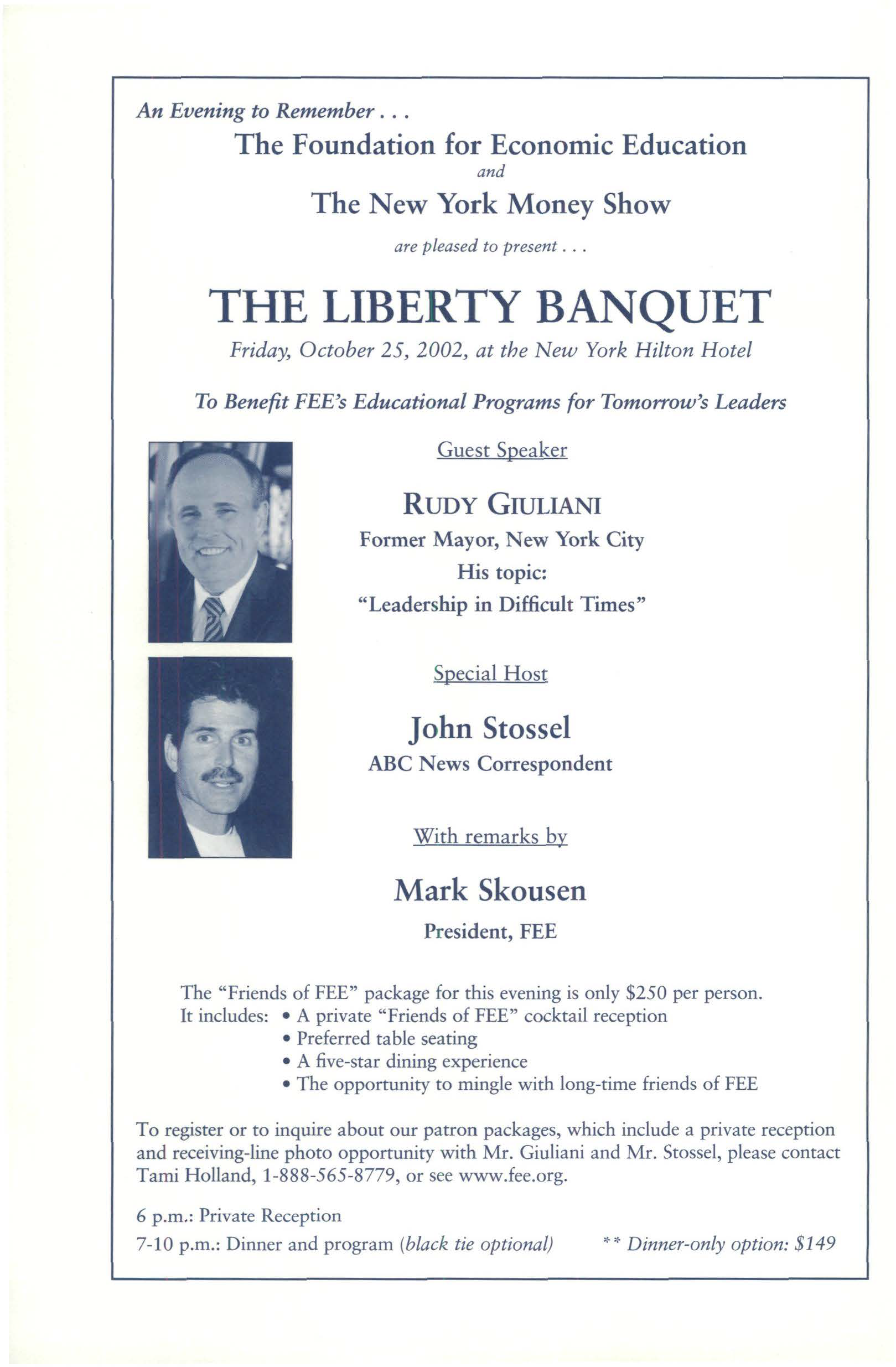
 Longtime libertarians may remember the flap at FEE back in 2002, when its then-president, Mark Skousen, invited Rudy Giuliani—prosecutor, big-government mayor, war-on-terror cheerleader, and “America’s Mayor”—to headline FEE’s Liberty Banquet (sic) at the New York Hilton, with John Stossel as host.1 Skousen’s idea was to put FEE on the map: “I invited the #1 speaker in America.”2 After much hue and cry, the trustees eventually pulled the plug on the event and on Skousen, who resigned at the board’s request. One account says FEE was going to pay Giuliani a $30,000 honorarium.3
More recently, in March of this year, Jesús Huerta de Soto, one of Javier Milei’s leading intellectual cheerleaders, gave the Mises Memorial Lecture in Auburn—at Joe Salerno’s invitation, according to Hans-Hermann Hoppe—and closed with his standard praise of Milei, who, as Hoppe notes, is a self-professed Zionist and a supporter of Netanyahu’s war in Gaza, of Trump, and of the US-Israeli war on Iran. The audience applauded. As Hoppe put it, “And, sadly, there is applause instead of boos.”4 When Hoppe then criticized the Institute’s direction, he was stripped of his Distinguished Senior Fellow title.5

Judy T. Shelton, profile pic at the Independent Institute
And now comes the noted Austrian economist and Rothbard expert Judy Shelton (sarcasm intended; she’s no Austrian; see below), keynoting this year’s Mises Institute Supporters Summit, held in San Antonio on October 22–24 to celebrate the centennial of Rothbard’s birth.6 Her title: “100 Years of Rothbard: His Bequest for the Future.” A few weeks earlier, Shelton had become a Counselor in the Office of the Secretary of the Treasury.7 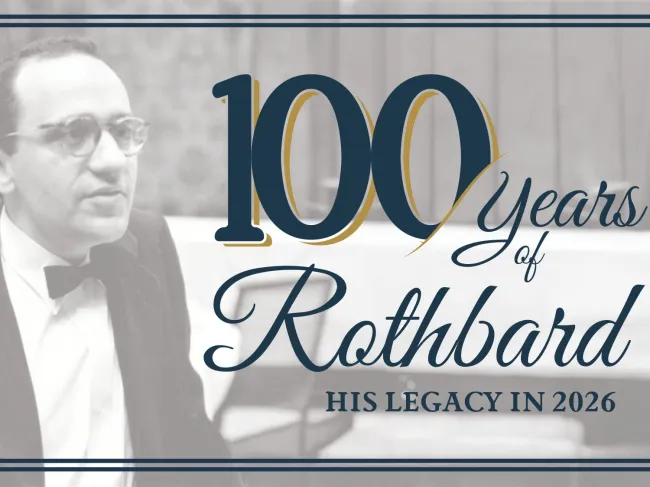 A Supporters Summit at the Institute named after leading Austrian Mises and devoted to spreading his ideas and those of Rothbard (it should really be called the Rothbard Institute)8 in the year of Rothbard’s hundredth birthday, keynoted by a Trump administration Treasury Department bureaucrat and Republican establishment economist. It’s a bit cringe. And unlike in the case of FEE there is no threat of the board firing the president for “celebrating the year of Rothbard” by highlighting a Zionist warmongering statist from Argentina and a Republican regime economist who is barely familiar with Rothbard because there is no president to fire—after DiLorenzo was fired in August 2025 by the Mises Institute knaves, there is still no President; as I noted recently, “the institute is actually run by Judy Thommesen and Chad Parish, the two low-level, subaltern functionaries”).9
See 100 Years of Rothbard: His Bequest for the Future (Mises.org):
I watched the talk and read the transcript. It was empty, self-congratulatory, and pompous. She knows the names and titles—she correctly cited Rothbard’s 100 percent gold dollar essay and the Yeager volume it first appeared in—but showed no serious grasp of Mises or Rothbard. Details below.
Related
- Hans-Hermann Hoppe, “Javier Milei” (PFS 2024) (Oct. 1, 2024)
- Kinsella, “Lowering Taxes Without Spending Cuts” (Nov. 8, 2024)
- “PFP290 | Hoppe: Considerations and Reflections of a Veteran Reactionary Libertarian (AERC 2025)” (March 23, 2025)
- Kinsella, “Money Prices Not a Measure of Value” (July 21, 2025)
- Kinsella, “IP Proponents Do Not Even Know the Difference Between Patent, Copyright, Trademark …” (Dec. 11, 2025)
- Kinsella, “Unlike Milei, and per Rothbard, Repudiate the Debt!” (Feb. 8, 2026)
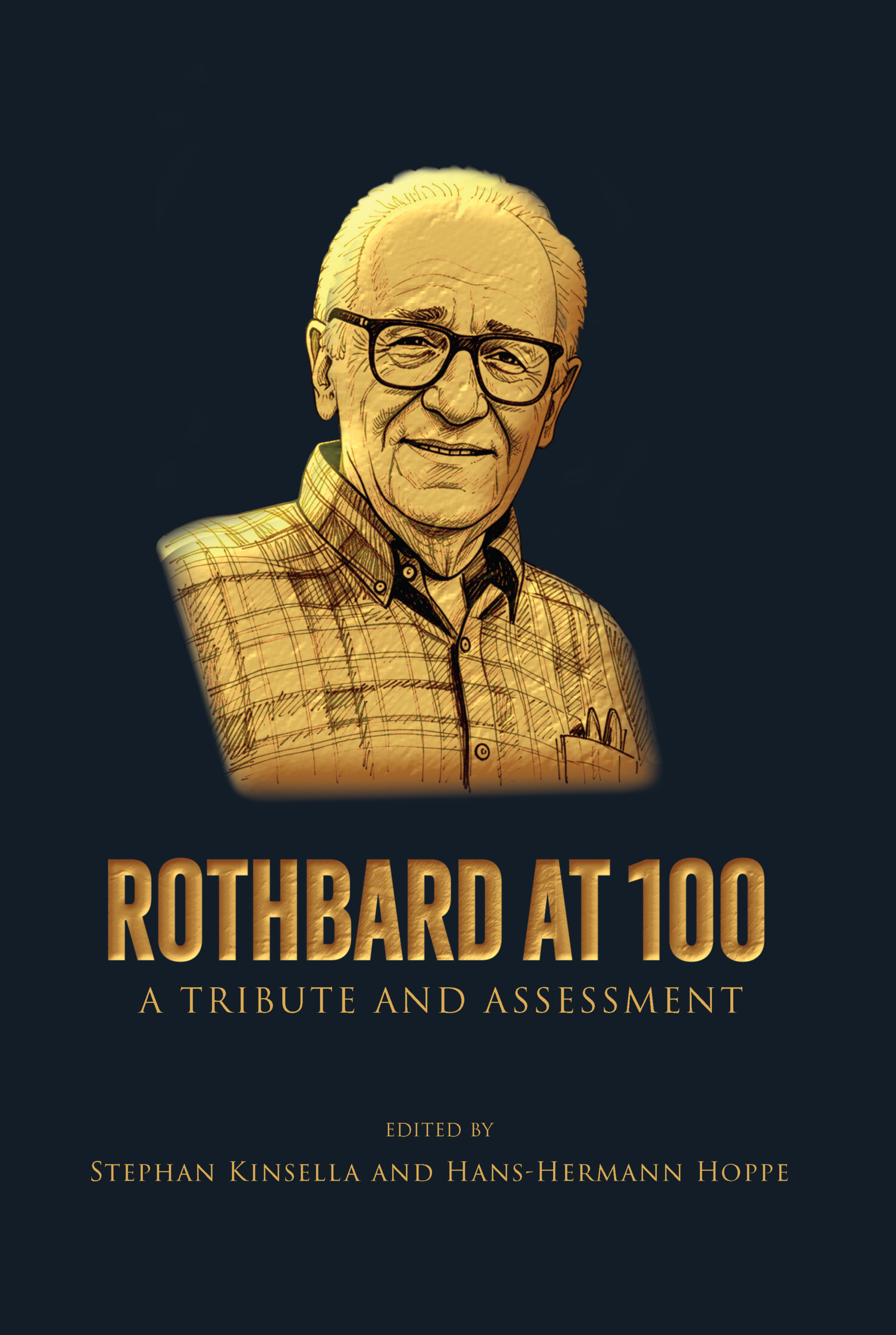
- Kinsella, “Preface,” in Rothbard at 100: A Tribute and Assessment (2026)
- Hans-Hermann Hoppe, “Introduction,” in Rothbard at 100: A Tribute and Assessment (2026)
- Kinsella, “Milei, “libertarian” IP fascist?” (March 18, 2026)
- Hans-Hermann Hoppe, “Milei Praised instead of Booed at Mises Institute” (March 21, 2026)
- Fernando Chiocca, “The most Zionist president in the world is now the greatest Austro-libertarian hero of all time” (March 24, 2026)
- Hans-Hermann Hoppe, “Mises Institute: Quo Vadis?,” Property and Freedom Journal (March 25, 2026)
- Hans-Hermann Hoppe, “On Intellectual Integrity and What a Difference one Crook can Make” (March 29, 2026)
- Kinsella, “Hoppe Removed as Mises Institute Senior Distinguished Fellow” (April 1, 2026)
- León Isidoro, “The Writing on the Wall with Milei” (April 16, 2026)
- Hans-Hermann Hoppe, “Mises Institute: Quo Vadis?: Postscript,” Property and Freedom Journal (April 17, 2026)
- Kinsella, “My Years with the Mises Institute,” Property and Freedom Journal (May 2, 2026)
- Saifedean Ammous, “Javier Milei’s Austrian Scam By the Numbers” (May 18, 2026)
- Oscar Grau, “The Downfall of the Spanish Armada of Austro-Libertarianism” (May 26, 2026)
- Kinsella, “Classic Hoppe on the Realistic Right vs. the Egalitarian Left” (June 9, 2026)
- Kinsella, “Lew Rockwell Festschrift in the Works—Sans Hoppe, French, Deist, DiLorenzo …” (June 12, 2026)
- Kinsella, “Alan Greenspan, RIP” (June 22, 2026)
- Fernando Chiocca, “Rothbardianism at Rothbard’s Centenary” (July 1, 2026)
- Kinsella, “Day of the Long Knives” (July 14, 2026; originally 2009)
- Hans-Hermann Hoppe, “Where the Right Goes Wrong” (1997) (July 17, 2026)
- Kinsella, “Argentina: 2.1% monthly CPI rise after 3 years of “Misesian” economics” (Aug. 13, 2026)
- Tom DiLorenzo, “‘The Making of an Austrian Economist’” (Sept. 2, 2026)
- Hans-Hermann Hoppe, “Milei in Madrid – Again, Messing up….” (Oct. 25, 2026)
- Kinsella, “Hoppe, Book Review, The Failure of America’s Foreign Wars (1996); and Day of the Long Knives (FEE)” (Oct. 28, 2026)
- Tom DiLorenzo, “Milei “hearts” the IMF and embraces Keynesian Demand Management” (Nov. 5, 2026)
- Milei-related posts at PFS, HansHoppe.com, and StephanKinsella.com
1. The Billing vs. the Record
By her own account, Salerno—who also invited Huerta de Soto—emailed her in March to invite her to keynote.10 The Institute billed her as a gold-standard proponent and Fed critic “whose opposition to easy money likely prevented her appointment” to the Fed’s Board of Governors. That would surprise the Institute’s own writers, who covered her nomination in 2019 and 2020.
To be sure, they liked her as a Fed critic, and with some reason. She compared the Fed to Soviet central planners, opposes deposit insurance and interest on excess reserves, and once called Bernard von NotHaus, arrested for minting silver “Liberty Dollars,” the “Rosa Parks of monetary policy.”11 But none of them mistook her for an Austrian. Salerno called her supply-side position “deeply flawed on monetary policy” and noted that she confused the classical gold standard with Bretton Woods.12 Former Mises Institute President Jeff Deist wrote, bluntly, that she is “not an Austrian,” put her in the supply-side camp of her friend and mentor Larry Kudlow, and pointed out that she doesn’t want to end the Fed.13 She herself confirms it: she’s “not part of #EndTheFed.”14 Even Bob Murphy, her most enthusiastic defender, said her view “seems more supply-side” than Austrian and balked at her call to get tough with China on trade.15 Fittingly, her Treasury job is to evaluate “financial conditions in China.”16 She’s also a former Senior Fellow with the Independent Institute,17 and past chairman of the National Endowment for Democracy, long a neocon foreign policy money pit.18 And Tho Bishop reported that at her confirmation hearing she said she would answer a crisis by cutting rates to zero and expanding QE, and that she later came around to the rate cuts Trump wanted.19 Some opponent of easy money.
The talk itself confirmed all of this. Here is some of what grated.
2. Money as a “Measure”
Shelton told the audience that “money was always meant to be a measure,” and praised Jefferson’s quest for a “dependable and unchanging measure of value” and an “invariable measure” for the money unit. At the Mises Institute. Mises spent his career demolishing this. In The Theory of Money and Credit he wrote that although people commonly speak of money as a measure of value and prices, “the notion is entirely fallacious”; under the subjective theory of value, the question of measurement cannot even arise. In Socialism he put it even more simply: “Money does not measure value.” Prices are not measured in money; they are amounts of money. Value is ordinal: we rank, we don’t measure. I have harped on this for years, in the IP context and elsewhere.20 A keynote on Rothbard’s monetary legacy that gets the most basic point of Misesian monetary theory wrong.
3. Rothbard Is “Confusing”
Near the end, Shelton confessed that Rothbard’s positions are hard to classify as left or right, and that “for me it can be confusing.” Then: “Rothbard argued that the state is illegitimate, that taxation is theft. That sounds a bit leftist to my ears.” Private law, security, and infrastructure, on the other hand, sound “more rightest to me, or maybe libertarian.” And then: “I bow to the true experts in this room.” This was the keynote address of the Rothbard centennial. Taxation is theft sounds leftist? Rothbard wrote an entire manifesto on where libertarianism sits relative to left and right.21
Earlier, she read the Mises Institute’s boilerplate to the audience: that it seeks a private property order that “rejects taxation, monetary debasement, and a coercive state monopoly of protective services,” and that it opposes “all efforts at compromise, sellout, and amalgamation.” She called that conviction the “gold standard” for anyone trying to stay true to their beliefs while serving in government, and told the audience: “In a way, you are my conscience.” She said this as Counselor to the Secretary of the Treasury, the department that houses the IRS. She even joked that she keeps the Rothbard volume containing What Has Government Done to Our Money? and The Case for a 100% Gold Dollar “locked away in my cabinet.” Just kidding, she said. “Well, sort of.”22
4. Gold as a Leash, Not as Money
Shelton told the audience she doesn’t see a 100 percent gold dollar “happening soon,” because there is $2.4 trillion of Federal Reserve notes outstanding and only about $1 trillion worth of Treasury gold (261 million ounces at roughly $4,000 an ounce). But the dollar “price” of gold is just the definition of the dollar. That was Rothbard’s whole point in the very essay she keeps locked in her cabinet: the dollar was never an independent thing but a name for a weight of gold. Rothbard’s remedy was to redefine the dollar so that the gold covers it. In The Case Against the Fed he calculated that revaluing the Fed’s 260 million ounces at $1,555 an ounce would cover its $404 billion of liabilities in 1994. Run the same arithmetic on Shelton’s own numbers and you get about $9,200 an ounce, just to cover the currency. Shelton herself described an economist on a panel of AfD-linked advisers in Germany proposing exactly this move, at 35,000 per ounce.23 The obstacle is not arithmetic. It’s that the people who run the Treasury and the Fed have no intention of giving up the printing press.
And whose gold is it, anyway? Shelton calls it “our nation’s official gold reserves.” Rothbardians remember how the Treasury got it: FDR seized it from Americans in 1933, and the Gold Reserve Act of 1934 moved it to the Treasury.24 It’s loot, not a national heirloom.
What Shelton offers instead is gold as a leash on the state’s paper: a “monetary anchor” exerting “monetary discipline” through a gold-convertible Treasury security, her “Treasury Trust Bonds,” which she was careful to call her personal proposal and not Treasury policy.25 Note what this is: a way to make federal debt more attractive to lenders. Rothbard wanted to abolish the Fed and separate money from the state.26 Shelton wants to help the Treasury borrow. And we have seen this movie. The federal government sold Liberty Bonds payable in gold coin, then repudiated the gold clauses in 1933. In Perry v. United States, the Supreme Court held the repudiation unconstitutional—and then held that the bondholder had shown no loss he could recover.27 Even Jeffrey Hummel, in a mostly respectful review of her book, doubts such bonds would be issued or honored.28 Gold clause, meet the state.
Her larger vision has always been Bretton Woods redux—the very system Salerno says she confuses with the classical gold standard. Her “big dream,” she told the Financial Times in 2019, is a new Bretton Woods–style conference: “if it takes place at Mar-a-Lago, that would be great.” Rothbard, as Murphy reminds us, thought a world of fiat currencies at fixed exchange rates was even worse than one at floating rates.29
The same Cato Journal article that introduced Treasury Trust Bonds also floated a “Universal Gold Reserve Bank” with “the potential to become a sort of global monetary authority.”30 A world central bank, but with gold. Just what Rothbard always wanted.
5. Milei, Again
Shelton celebrated Milei’s election, his claim that Rothbard shaped his thinking, his cloned dog named Murray, and his April 2024 boast: “We are fulfilling Rothbard’s dream.”31 Rothbard’s dream apparently includes a central bank that is still in business and a bailout from the U.S. Treasury. In October 2025, the Treasury—Scott Bessent’s Treasury, Shelton’s current employer—finalized a $20 billion currency swap line with Argentina’s central bank and bought pesos directly, ahead of Argentina’s midterm elections, after Bessent had pledged the Exchange Stabilization Fund to the cause.32 PFS writers have been documenting the gap between Milei’s Rothbardian rhetoric and his record for some time: a central bank preserved and strengthened, more IMF borrowing, stubborn inflation, and more.33 After Huerta de Soto in March, that makes two Milei boosters at Mises Institute podiums in Rothbard’s centennial year.
6. The Greenspan Tease
Early on, Shelton mentioned an old interview in which Salerno expressed his shock at Greenspan’s sellout once he became Fed chairman, and promised to tell us about “my personal experience confronting Dr. Greenspan about just that issue.” I perked up. Here comes the tea. The payoff: when Greenspan refused to let her quote his 1966 essay “Gold and Economic Freedom” in her book, they had an “animated discussion” in his office. He assured her he still held those views, but pointed to his big leather chair and the screens full of bond and currency rates and explained that, now that he ran the central bank, his old writings could have financial implications. “He hoped I would understand,” she said, “and I kind of did.” He asked her to deliver the book wrapped in brown paper. Then he smiled.34 That isn’t a confrontation. It’s an apologia. It also sounds like a preview: Shelton now sits in a big chair of her own, her speech vetted by Treasury ethics lawyers, forbidden to discuss her work. Writing at mises.org in 2024, George Ford Smith compared her to Greenspan and concluded that she “should have stayed far away from the Fed.”35 She went to the Treasury instead.
Contrast Rothbard, who saw in 1987 that Greenspan’s real qualification was that he “can be trusted never to rock the establishment’s boat,” as David Gordon reminded mises.org readers just this June.36
7. “Trademark”?
Shelton said Greenspan “personally held the trademark” for “Gold and Economic Freedom.” She meant copyright.37 And she didn’t need his permission: quoting a published essay to discuss or criticize it is textbook fair use. As a published author, she knows this. Indeed, she quoted it at some length in this very speech.38 She refrained from quoting him at his behest, to please him. What the episode does show is copyright working as a censorship tool, here used by a powerful man to keep his own inconvenient words out of a gold advocate’s book. One more reason to abolish IP.39 No doubt mainstream Shelton is no more an opponent of copyright than she is of inflation, money manipulation, and the Fed.
8. Name-Dropping and Other Grating Bits
- The humble-brags. The only other woman in her Hoover fellowship cohort was Condoleezza Rice. She had the same title as Milton Friedman, whose office was “just a few steps away,” and Friedman wrote her single-spaced letters. Pentagon war games. Greenspan sought her out after The Coming Soviet Crash. Some 80 Wall Street Journal op-eds. “Just over a 100,000 followers on X.” Book blurbs from Laffer, Forbes, Hanke, and Grant.40
- The Soviet “prediction.” She told the audience that her Hoover research for The Coming Soviet Crash led her to “the rather startling conclusion at the time” that the Soviet Union was going bankrupt.41 Startling to whom? Not to anyone who has read Mises, who explained in 1920 why socialism cannot calculate.42 Hoppe’s A Theory of Socialism and Capitalism came out the same year as her book.43 To be fair, she was ahead of the mainstream: that same year, the Samuelson–Nordhaus textbook told students that the Soviet economy showed a socialist command economy “can function and even thrive.”44 But even FEE’s reviewer noted that the book hints at a Soviet collapse but “never comes right out and predicts it.”45 Her real point was that the West should not lend money to prop up a bankrupt state; asked on C-SPAN whether the U.S. should help finance the Soviet economy, she answered, “I think not.”46 Good advice. Now she designs bonds to make it easier for the U.S. Treasury to borrow.
- She twice called Patrick Newman, Salerno’s coauthor on the new Rothbard book she says she displays in her Treasury office, “Patrick Newton.”47 Sounds like she’s really familiar with it.
- She said “plenty of people” are already disappointed in her because “we haven’t yet abolished the Federal Reserve.” Who? She has never been for abolishing it.48
- Europe. She spent several minutes on monetary talk among advisers to Germany’s AfD and pronounced that “Austrian school views were well represented,” Hayek-style currency competition included, though Rothbard rejected Hayek’s scheme to denationalize money. On whether Le Pen and the AfD are any good, the Treasury official’s verdict: “I’m not saying this is good or bad.”49
- Credit where due: she told the Institute to keep her honorarium as a donation.50 So unlike Giuliani at FEE, this one was free. What a bargain.
9. Is the Mises Institute Going the Way of FEE?
FEE didn’t collapse after the Giuliani fiasco. It drifted. Nor was Giuliani its first misstep. In 1996, after The Freeman ran Hoppe’s review of The Failure of America’s Foreign Wars, which observed that Stalin had murdered millions before the war and Hitler comparatively few, a FEE trustee (Kirzner, I believe) resigned in protest, and FEE’s president, Hans Sennholz, fired the editors involved: Lawrence White, Robert Batemarco, and Robert Higgs.51 FEE has since removed the review from its site and, it appears, scrubbed Hoppe’s name from its author search.52 Today FEE is respectable, and doesn’t matter. Doug French has explained how this happens to movements.53 So: in 1996, FEE fired the editors who published Hoppe. In 2026, the Mises Institute removed Hoppe himself. Progress!
The Mises Institute won’t collapse either. As Hoppe observes, it sits on an endowment of more than $70 million, and nonprofits rarely implode; “with this endowment the Institute can limp along for decades,” almost regardless of what it does.54 I made the same forecast at the end of my own account of my years with the Institute: it will likely limp along, benefitting its staff and “providing some type of benefit to students and others, but less than it might.”55 The danger, then, is not collapse but the same drift that overtook FEE: a respectable, well-funded “free-market” outfit that invites establishment names to address its donors, applauds Milei, and removes Hoppe. Rothbard’s centennial deserved a keynote from someone who knows Rothbard’s work. Instead it got a supply-side Treasury official who thinks money measures value, wants gold to make Treasury debt easier to sell, says Milei is fulfilling Rothbard’s dream, and finds “taxation is theft” a bit leftist. Rothbard would not have been confused.
- “The Liberty Banquet,” advertisement, Ideas on Liberty (July 2002), issue pdf. [↩]
- Mark Skousen, “A Year at FEE,” MSKousen.com. [↩]
- J.H. Huebert, “A Great Institution in Freefall” (July 9, 2002; archive); Kinsella, “The Decline of FEE?,” StephanKinsella.com (July 9, 2002); idem, “The Decline of FEE–Part II: Schulman’s Reply,” StephanKinsella.com (July 17, 2002); Walter E. Block, “The Manifesto of Freedom,” LewRockwell.com (Aug. 2010); “Mark Skousen,” Wikipedia. [↩]
- Hans-Hermann Hoppe, “Milei Praised instead of Booed at Mises Institute,” Property and Freedom Blog (March 21, 2026). See also Fernando Chiocca, “The most Zionist president in the world is now the greatest Austro-libertarian hero of all time,” Property and Freedom Blog (March 24, 2026); Hoppe, “On Intellectual Integrity and What a Difference one Crook can Make,” Property and Freedom Blog (March 29, 2026); Oscar Grau, “The Downfall of the Spanish Armada of Austro-Libertarianism,” Property and Freedom Blog (May 26, 2026). For Hoppe’s earlier criticisms of Milei, see Hoppe, “Javier Milei” (PFS 2024), Property and Freedom Blog (Oct. 1, 2024); and “PFP290 | Hoppe: Considerations and Reflections of a Veteran Reactionary Libertarian (AERC 2025),” Property and Freedom Podcast (March 23, 2025). [↩]
- Hoppe, “Mises Institute: Quo Vadis?,” Property and Freedom Journal (March 25, 2026); idem, “Mises Institute: Quo Vadis?: Postscript,” Property and Freedom Journal (April 17, 2026); Kinsella, “Hoppe Removed as Mises Institute Senior Distinguished Fellow,” Property and Freedom Blog (April 1, 2026); idem, “My Years with the Mises Institute,” Property and Freedom Journal (May 2, 2026). See also León Isidoro, “The Writing on the Wall with Milei,” Property and Freedom Blog (April 16, 2026). [↩]
- “Supporters Summit 2026,” Mises Institute (San Antonio, Texas, Oct. 22–24, 2026). [↩]
- Judy Shelton, “100 Years of Rothbard: His Bequest for the Future,” Mises Institute Supporters Summit 2026, San Antonio, Texas (recorded Oct. 24, 2026; posted Nov. 7, 2026). Timestamps below are from a transcript of the video. On her appointment, see U.S. Department of the Treasury, “United States Department of the Treasury Announces New Appointment” (Oct. 9, 2026). [↩]
- As I noted in my Preface to Rothbard at 100, some critics—and even admirers—of the Mises Institute have suggested that it should be called the Rothbard Institute, so obviously are its members and supporters influenced by Rothbard, who was Mises’s most important student and expositor and the Institute’s primary intellectual force from its founding in 1982 until his death in 1995. The same goes for the PFS, which is “a sort of Rothbard Institute under a different name.” Kinsella, “Preface,” in Rothbard at 100: A Tribute and Assessment, Stephan Kinsella and Hans-Hermann Hoppe, eds. (Houston: Papinian Press and The Saif House, 2026); see also Sean Gabb, “Rothbard: An Appreciation from England,” in ibid. [↩]
- Kinsella, Who Is Running LewRockwell.com? Hoppe and Others on LRC, Back When Rockwell Ran It, PFS Blog (Nov. 1, 2026). [↩]
- Shelton, “100 Years of Rothbard,” at 15:09–15:38. [↩]
- Tho Bishop, “Senate Attacks Judy Shelton for Sin of Being Outside the Mainstream,” Power & Market (Feb. 13, 2020); Robert P. Murphy, “The Econ Establishment Teams Up To Denounce Judy Shelton,” Mises Wire (Aug. 8, 2019). [↩]
- Joseph T. Salerno, “Fed Nominee Judy Shelton Wants Sound Money—and Lots of It,” Mises Wire (2019; the page now shows Jan. 21, 2020). [↩]
- Jeff Deist, “Judy Shelton’s Remarkable Attack on the Fed,” Power & Market (June 11, 2019). [↩]
- “In Gold We Trust? Ex-Trump Economic Advisor Makes the Case for a Dollar Reset,” Fox Business (n.d.), linking the video “Judy Shelton: I’m not part of #EndTheFed.” [↩]
- Murphy, “The Econ Establishment Teams Up To Denounce Judy Shelton.” See also Jeffrey Rogers Hummel, “Judy Shelton: Good as Gold?,” Econlib (May 1, 2026), rejecting her “currency manipulation” diagnosis and her call for tariffs. [↩]
- U.S. Department of the Treasury, “United States Department of the Treasury Announces New Appointment.” [↩]
- Not a big surprise, I guess. See my criticisms of their abysmal IP stance: Kinsella, “Shughart’s Defense of IP,” C4SIF (Jan. 29, 2010); idem, “Classical Liberals, Libertarians, Anarchists and Others on Intellectual Property,” C4SIF (Oct. 2015); idem, “Independent Institute on the ‘Benefits’ of Intellectual Property Protection,” C4SIF (Feb. 15, 2016); idem, “Speaking at APEE IP Panel in Guatemala,” C4SIF (April 2025); idem, “Reason, Big Pharma, and Patents,” C4SIF (Feb. 2026). [↩]
- U.S. Department of the Treasury, “United States Department of the Treasury Announces New Appointment”; National Endowment for Democracy, About. See also Center for Renewing America, Primer: The National Endowment for Democracy and an NGO Ecosystem Actively Undermining America by CRA Staff (Feb. 7, 2025); Militarist Monitor, National Endowment for Democracy (March 2, 2012); and, from Taco, Barbara Conry, Loose Cannon: The National Endowment for Democracy, Cato Institute Foreign Policy Briefing No. 27 (Nov. 8, 1993). [↩]
- Bishop, “Senate Attacks Judy Shelton”; Bishop, “Shelton Derangement Syndrome: Which Republicans Will Side with Fed Groupthink?,” Power & Market (July 29, 2020). [↩]
- Shelton, “100 Years of Rothbard,” at 26:41–27:43. Ludwig von Mises, “On the Measurement of Value,” in The Theory of Money and Credit, H.E. Batson, trans. (Indianapolis: Liberty Fund, [1912] 1980), p. 51; Mises, Socialism: An Economic and Sociological Analysis, 3d rev. ed., J. Kahane, trans. (Indianapolis: Liberty Fund, 1981), p. 99; see also Mises, Human Action: A Treatise on Economics, Scholar’s ed. (Auburn, Ala.: Mises Institute, 1998), pp. 96, 122, 205, 211, 218, 286. See Kinsella, “Money Prices Not a Measure of Value,” StephanKinsella.com (July 21, 2025); idem, “Against Intellectual Property After Twenty Years: Looking Back and Looking Forward,” in Legal Foundations of a Free Society (Houston: Papinian Press, 2023), ch. 15, text at n.35; idem, “The Problem with Intellectual Property,” C4SIF (May 2025), n.49. [↩]
- Shelton, “100 Years of Rothbard,” at 46:40–47:41; Murray N. Rothbard, “Left and Right: The Prospects for Liberty,” Left and Right 1, no. 1 (Spring 1965): 4–22; see also Hans-Hermann Hoppe, “A Realistic Libertarianism,” LewRockwell.com (Sept. 30, 2013), reprinted in Hoppe, Getting Libertarianism Right (Auburn, Ala.: Mises Institute, 2018), ch. 1; Kinsella, “Classic Hoppe on the Realistic Right vs. the Egalitarian Left,” Property and Freedom Blog (June 9, 2026); Hoppe, “Where the Right Goes Wrong,” Rothbard-Rockwell Report (April 1997): 7–14, reprinted in Property and Freedom Blog (July 17, 2026). [↩]
- Shelton, “100 Years of Rothbard,” at 12:36–13:46, 19:25–19:38, 20:52–21:12. For the boilerplate, see the bottom of the site. [↩]
- Shelton, “100 Years of Rothbard,” at 28:27–30:27, 35:43–36:53. Murray N. Rothbard, “The Case for a 100 Percent Gold Dollar,” in Leland B. Yeager, ed., In Search of a Monetary Constitution (Cambridge, Mass.: Harvard University Press, 1962); Rothbard, The Case Against the Fed (Auburn, Ala.: Mises Institute, 1994), p. 149, as quoted in “Section 210: Remonetizing the Treasury’s Gold,” Power & Market. See also “Rothbard’s Bracing Plan for Gold,” Mises Wire. [↩]
- Shelton, “100 Years of Rothbard,” at 29:16–29:27; Executive Order 6102 (April 5, 1933); Gold Reserve Act of 1934. [↩]
- Shelton, “100 Years of Rothbard,” at 30:36–31:14; Judy Shelton, “Gold and Government,” Cato Journal 32, no. 2 (Spring/Summer 2012): 333–47, at 333, 337–41. [↩]
- Rothbard also wanted the federal debt repudiated, not made easier to sell: repudiation, he argued, is the one way to reduce the debt “without a concomitant increase in fiscal coercion,” and it would make future government borrowing harder. See Rothbard, The Case Against the Fed, pp. 145–46 (proposing to abolish the Fed and return to gold); Rothbard, Man, Economy, and State, with Power and Market, Scholar’s ed., 2nd ed. (Auburn, Ala.: Mises Institute, 2009), p. 1028; Rothbard, “Frank Chodorov: R.I.P.,” in Left, Right, and the Prospects for Liberty (Auburn, Ala.: Mises Institute, 2010), pp. 359–64, at 361 (originally in Left and Right [Winter 1967]: 3–8, at 5); Rothbard, “Repudiating the National Debt,” Chronicles (June 1992): 49–52, reprinted in Mises Daily (July 9, 2012); see also Kinsella, “Lowering Taxes Without Spending Cuts,” StephanKinsella.com (Nov. 8, 2024); idem, “Unlike Milei, and per Rothbard, Repudiate the Debt!,” StephanKinsella.com (Feb. 8, 2026), adapted from Hoppe, “Introduction,” in Rothbard at 100. [↩]
- Perry v. United States, 294 U.S. 330 (1935); see also Norman v. Baltimore & Ohio R.R. Co., 294 U.S. 240 (1935). [↩]
- Hummel, “Judy Shelton: Good as Gold?” [↩]
- “Fed Candidate Shelton Slams Central Bank’s ‘Soviet’ Power over Markets,” Financial Times (May 2019), reprinted by GATA; Salerno, “Fed Nominee Judy Shelton Wants Sound Money—and Lots of It”; Murphy, “The Econ Establishment Teams Up To Denounce Judy Shelton,” discussing Rothbard’s essay “Back to Fixed Exchange Rates.” [↩]
- Shelton, “Gold and Government,” at 343–44. [↩]
- Shelton, “100 Years of Rothbard,” at 32:29–33:31. [↩]
- “US Buys Argentine Pesos, Finalizes $20 Billion Currency Swap,” Associated Press (Oct. 9, 2025); Rodrigo Campos, David Lawder, and Bhargav Acharya, “Trump Boosts Argentina’s Milei with $20 Billion Lifeline as US Buys Pesos,” Reuters (Oct. 9, 2025). See also Hoppe, “Milei in Madrid – Again, Messing up….,” Property and Freedom Blog (Oct. 25, 2026). [↩]
- See Kinsella, “Milei, “libertarian” IP fascist?,” Property and Freedom Blog (March 18, 2026); Saifedean Ammous, “Javier Milei’s Austrian Scam By the Numbers,” Property and Freedom Blog (May 18, 2026); Fernando Chiocca, “Rothbardianism at Rothbard’s Centenary,” Property and Freedom Blog (July 1, 2026); Kinsella, “Argentina: 2.1% monthly CPI rise after 3 years of “Misesian” economics,” Property and Freedom Blog (Aug. 13, 2026); Tom DiLorenzo, “Milei “hearts” the IMF and embraces Keynesian Demand Management,” Property and Freedom Blog (Nov. 5, 2026). [↩]
- Shelton, “100 Years of Rothbard,” at 14:22–15:04, 38:07–43:03. [↩]
- George Ford Smith, “Judy Shelton’s Lasting Legacies,” Mises Wire (May 27, 2024). [↩]
- Murray N. Rothbard, “Alan Greenspan: A Minority Report,” The Free Market 5, no. 8 (Aug. 1987), quoted in David Gordon, “Greenspan: The Great Opportunist,” Friday Philosophy (June 26, 2026). See also Kinsella, “Alan Greenspan, RIP,” Property and Freedom Blog (June 22, 2026). [↩]
- See Kinsella, “IP Proponents Do Not Even Know the Difference Between Patent, Copyright, Trademark …,” C4SIF (Dec. 11, 2025). [↩]
- Shelton, “100 Years of Rothbard,” at 38:54–41:06. Alan Greenspan, “Gold and Economic Freedom,” The Objectivist (July 1966), reprinted in Ayn Rand, Capitalism: The Unknown Ideal (New York: Signet, 1967), pp. 101–07; 17 U.S.C. § 107. [↩]
- See Kinsella, Against Intellectual Property (Auburn, Ala.: Mises Institute, 2008). [↩]
- Shelton, “100 Years of Rothbard,” at 7:14–9:57, 11:21–11:43, 17:00–17:57, 38:20–38:33. [↩]
- Shelton, “100 Years of Rothbard,” at 8:21–8:52; Judy Shelton, The Coming Soviet Crash: Gorbachev’s Desperate Pursuit of Credit in Western Financial Markets (New York: Free Press, 1989). [↩]
- Ludwig von Mises, Economic Calculation in the Socialist Commonwealth, S. Adler, trans. (Auburn, Ala.: Mises Institute, 1990; originally published in German in 1920). [↩]
- Hans-Hermann Hoppe, A Theory of Socialism and Capitalism: Economics, Politics, and Ethics (Boston: Kluwer, 1989). [↩]
- Paul A. Samuelson and William D. Nordhaus, Economics, 13th ed. (New York: McGraw-Hill, 1989), p. 837, quoted in Mark Skousen, “The Perseverance of Paul Samuelson’s Economics,” Journal of Economic Perspectives 11, no. 2 (Spring 1997): 137–52. Yes, that Skousen. [↩]
- Lawrence Person, “Book Review: The Coming Soviet Crash,” The Freeman (Sept. 1, 1990). [↩]
- “The Coming Soviet Crash,” C-SPAN Booknotes (April 9, 1989). [↩]
- Shelton, “100 Years of Rothbard,” at 19:56–20:46; Joseph T. Salerno and Patrick Newman, Murray N. Rothbard: The Making of an Austrian Economist (Auburn, Ala.: Mises Institute, 2026). [↩]
- Shelton, “100 Years of Rothbard,” at 21:43–22:03; Deist, “Judy Shelton’s Remarkable Attack on the Fed.” [↩]
- Shelton, “100 Years of Rothbard,” at 33:31–37:25; David Gordon, The Essential Rothbard, ch. 6, discussing Rothbard’s 1985 essay “The Case for a Genuine Gold Dollar.” [↩]
- Shelton, “100 Years of Rothbard,” at 18:46–19:17. [↩]
- Kinsella, “Day of the Long Knives,” Property and Freedom Blog (July 14, 2026; originally StephanKinsella.com, June 15, 2009, and LRC Blog, May 20, 2004); idem, “Foundation for Economic Excitement,” StephanKinsella.com (May 2004). [↩]
- Kinsella, “Hoppe, Book Review, The Failure of America’s Foreign Wars (1996); and Day of the Long Knives (FEE),” Property and Freedom Blog (Oct. 28, 2026). [↩]
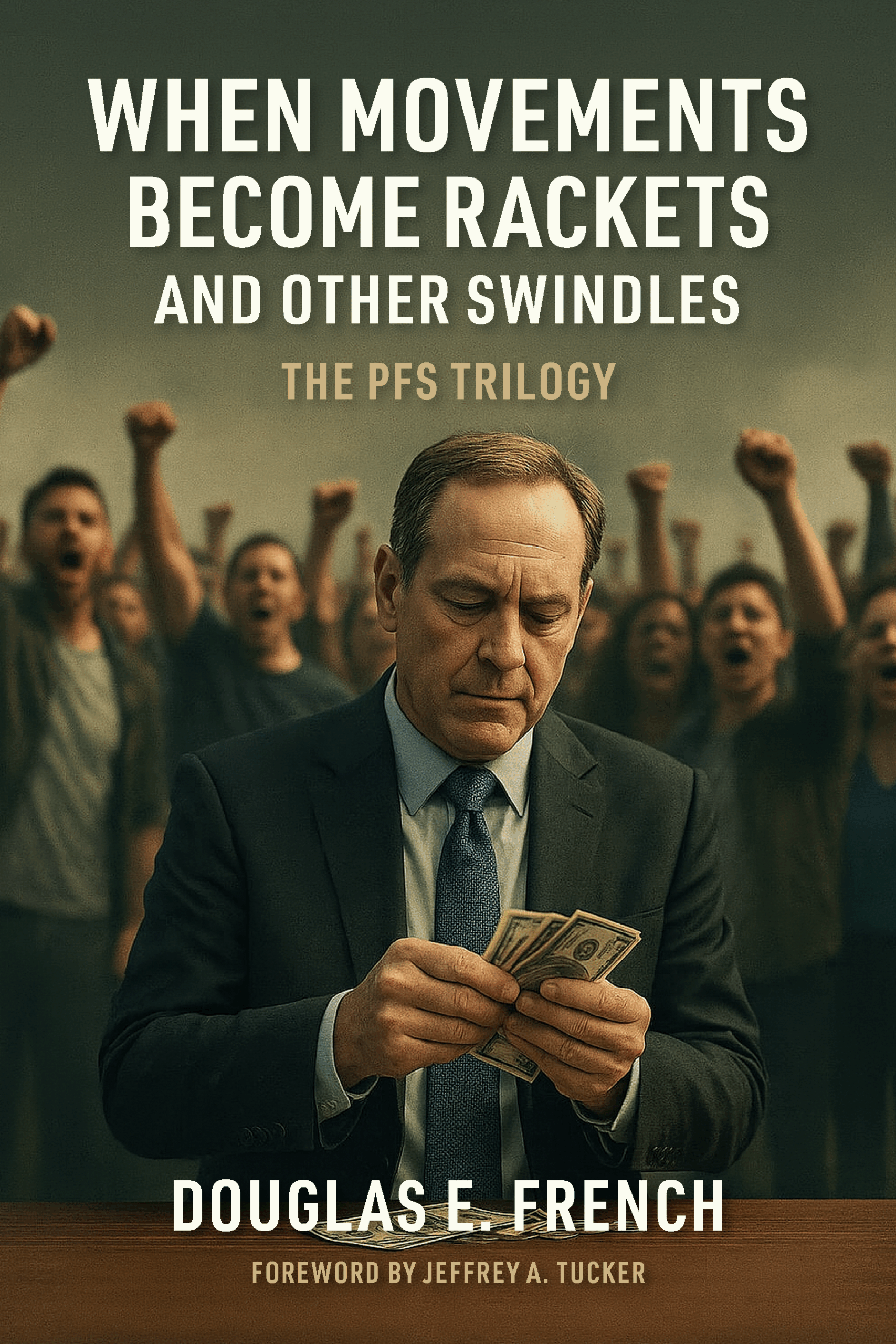
- Douglas E. French, When Movements Become Rackets and Other Swindles: The PFS Trilogy, Stephan Kinsella, ed. (Houston: Papinian Press and Property and Freedom Society, 2025); see PFS books. [↩]
- Hoppe, “Mises Institute: Quo Vadis?” [↩]
- Kinsella, “My Years with the Mises Institute,” “Conclusion: A Hope and a Forecast.” [↩]













 Alessandro Fusillo
 Andreas Tögel
 David Dürr
 Doug French
 Fernando Chiocca
 Greg Morin
 Hans-Hermann Hoppe
 Jay Baykal
 Jayant Bhandari
 Jeff Deist
 Jeffrey Barr
 Juan Fernando Carpio
 Ken Yamarashi
 León Isidoro
 Martin Cabrera
 Nick Hoppe
 Oscar Grau
 Peter Wong
 PFS
 scholarium
 Saifedean Ammous
 Sean Gabb
 Sean Ring
 Stephan Kinsella
 Stéphane Geyres
 Thomas Jacob
 Tom DiLorenzo

Follow Us!