Below is the video and text of the speech by PFS member Fernando Chiocca of Instituto Rothbard (Brazil/Brazil) at 100 Years with Rothbard (Porto, Portugal, June 27, 2026).1 See also Chiocca’s Prezi presentation .
See Cataláxia Editora Rothbard 100 Youtube playlist (Chiocca video forthcoming). For further information, photos, and so on, see Kinsella, Rothbard Takes Portugal: 100 Years with Rothbard: A Personal Account .
https://youtu.be/qMp-L3EUFdk?si=d75H-2w2Nd0q3OMD
Editor’s note: in the text below, Chiocca writes:
And the third test, Israel, Milei failed spectacularly. And although most libertarians passed, this test also failed one of the, until then, greatest libertarians in the world: Walter Block. Block was considered by many to be among the three greatest Rothbardians, alongside Lew Rockwell and Hoppe, and he passed the first two tests with merit.
Block was actually terrible on Covid-related issues. In his spoken remarks, Chiocca in fact added a caveat at this part saying that Block was not so good on Covid as well, and saying that he took some strange stances. See Stephan Kinsella, “ A Tour Through Walter Block’s Oeuvre ,” in Walter Block – Anarcho-Capitalist Austro-Libertarian , Elvira Nica and Gheorghe H. Popescu, eds. ( Addleton Academic Publishers , 2025):
This article is not a comprehensive overview of all of Walter’s publications, and does not include mention or criticism of his pro-covid lockdown writing2, his more recent Israel-Gaza related publications,3 or his pro-Milei views.4 As noted above, this is one reason I had withdrawn this piece from the volume, as I agree with Tucker (and Hoppe) on the covid/infectious disease lockdown issue, with Hoppe on Israel-Gaza issues, and also with Hoppe on Milei issues.
Related
- 100 Years with Rothbard (Porto, Portugal, June 27, 2026)
- Posts on Milei: PFS; Hoppe; Kinsella
The President of Argentina, Javier Milei, has declared that modern-day Israel gave birth to Western civilization.
He says Israel is the last wall protecting Western civilization, and that if Israel falls, the rest of Western civilization will fall with it.
Milei is placing… pic.twitter.com/kyKaTfO5cl
— Shadow of Ezra (@ShadowofEzra) July 1, 2026
Photos
-

- Rothbard 100, Portogal, Fernando Chiocca, Saifedean Ammous, Hoppe
-

- Rothbard 100, Portogal, Fernando Chiocca, Hans Hoppe
-

- Rothbard 100, Portogal, Fernando Chiocca, Stephan Kinsella
***
Rothbardianism at Rothbard’s Centenary
100 Years with Rothbard • Porto, Portugal • June 27, 2026
[Google translation]
Thank you Manuel for the invitation and for making this event happen.
The Communist Manifesto was published on February 21, 1848. 69 years later, the Marxist Bolsheviks, most of whom weren’t even truly Russian – 85% of them were Jewish – would seize power in Russia through a coup d’état. The Marxist movement gained power over seven decades.
The abolitionist movement took shape in the United Kingdom among Christian religious groups. The Quakers were the main founders of the Society for Effecting the Abolition of the Slave Trade. In 1787, 20 years later, in 1807, they succeeded in ending the British slave trade. And in 1833, 46 years after the founding of this abolitionist society, the end of slavery throughout the British Empire would be achieved.
In 2014, Stephan Kinsella gave a lecture titled “Libertarianism After Fifty Years: What Have We Learned?” where he estimated that the libertarian movement began 50 to 60 years earlier.5 So today, in 2026, on Rothbard’s centenary, the libertarian movement would be between 60 and 70 years old. And before that, 80 years ago, Leonard Reed had founded the Foundation for Economic Education, which even helped publish Mises’s Human Action.
It goes without saying that, compared to the other two movements mentioned, the libertarian movement, in terms of practical results, has failed.
British abolitionists wanted the abolition of slavery and, within a few decades, succeeded in having slavery abolished throughout the British Empire. The libertarian movement, formed by minarchists and anarcho-capitalists, advocated for a minimal state or the abolition of the state. Therefore, if it had had the same success as the anti-slavery movement, the large state, outside of its functions of protection and justice, would have already been abolished at least throughout the American Empire – which is where the libertarian movement originated. Compare the founding of the Abolitionist Society, which 46 years later abolished slavery in the Empire, and the founding of the FEE, Foundation for Economic Education, in 1946, 80 years ago: the American Empire is even further behind than before the minarchism they advocated… it has only gone backward… the state has only grown.
We’ve reached six or seven decades of the movement, and 100 years since Rothbard, without many “practical results” to show for it; we only have a false libertarian who became president of a country in South America, and did nothing to end or diminish the state… on the contrary, he increased the state. (I’ll give details about this later.)
I think only the most naive libertarians want to “change the world,” because the rest of us just want to be left in peace, in our corner. That’s why secession is our main political banner. But we haven’t yet achieved a free society anywhere on the planet. And we didn’t even need a large country, since there aren’t many millions of libertarians in the world. Most people reject the product we’re offering. They don’t want freedom. They want a leader. They want security, stability. They want to be bossed around… they prefer to remain slaves. Or whatever it is they want.
So, just a small territory would be good to start with. We have many libertarian projects, such as Seasteading, Free Cities, and the Free State Project in New Hampshire. And among these projects, there is a promising attempt underway on a small river island between Croatia and Serbia, Liberland. Liberland has counted on the collaboration of three of the greatest Rothbardian Austro-libertarians in the world today, who are present here today: Kinsella, Alessandro Fusillo, and Hoppe. These three, on December 19th of last year, were at a Liberland event where they lectured and discussed its constitution. If this project becomes viable, taking into account the advice of these three masters, we will have something practical of value to show in the future.
But that’s not what’s happening now.
If he were alive, Rothbard would celebrate his 100th birthday seeing the libertarian movement far behind the abolitionist and communist movements in achieving its goals. And that’s not all. He would also witness on his birthday a major crisis within Rothbardianism, with institutions and individuals betraying his legacy.
But of course, he certainly had much to celebrate. His ideas have grown enormously in popularity, with people and institutions doing justice to his legacy (the main ones gathered here today in this celebration). So, I want to talk about who the true and false Rothbardians are, and for that, we need to understand what it means to be a Rothbardian.
Rothbard was an Austrian economist, but being an Austrian economist doesn’t mean being a Rothbardian. In economics, Rothbard was a Misesian. Therefore, to be a Rothbardian, one must be a Misesian, that is, understand economic science as a branch of praxeology. Economics is an axiomatic, logical-deductive science. This means that its propositions have the same status as the axioms from which they are derived, that is, they are irrefutable. This is, for example, quite different from being a Hayekian. Hayek was a Wieserian influenced by Popper who disregarded praxeology.
Rothbard was the foremost and greatest economist after Mises. But Rothbard was not just an economist. Therefore, being merely a praxeologist does not mean being a Rothbardian. Rothbard was a polymath, with profound knowledge in various sciences, but Rothbardianism is characterized by Rothbardian ethics, and the implications of this ethics in his political philosophy.
In this respect, Rothbard departs from Mises. Rothbard is not a Misesian in ethics and political philosophy, only in economics. So, being a complete Misesian is different from being a complete Rothbardian. And when I say “complete” or “true,” it’s good to clarify that being a Rothbardian doesn’t mean agreeing with everything Rothbard said about everything. We are not part of a cult. True, or complete, Rothbardians disagree with Rothbard on some points. For example, Kinsella disagreed with Rothbard on some approaches to intellectual property. He corrected and developed them, using the Rothbardian framework, and we can say that Rothbardians today are Kinsellians on intellectual property. Another example: Hoppe disagreed with Rothbard on his positive view of Democracy as an evolution, and we can also say that Rothbardians today are Hoppeans regarding democracy. Another point… Most Rothbardians disagree with Rothbard’s position on abortion, but that doesn’t make them any less Rothbardians.
But there are issues on which it is impossible to disagree with Rothbard and remain a Rothbardian, as they are contrary to the Rothbardian essence. Therefore, Mises is not a Rothbardian, and Rothbard is not a Misesian, because Mises was not an anarcho-capitalist. Mises, like all liberals, was a walking contradiction. The contradiction of Mises that Rothbard freed himself from, and freed us from, was that of “attacking monopolies but at the same time defending monopolies.” Mises concluded that monopolies are bad. That everything provided through monopolies is more expensive and of lower quality than it would be if provided by the free market environment. But he defended the monopolistic provision of justice and security services by the state.
Rothbard, like Gustave de Molinari before him, overcame this contradiction and defended the private production of security and justice! So, we can say that the complete Rothbardian is an anarcho-capitalist praxeologist … But Rothbard was not only that, and being a true Rothbardian requires more than that.
To be a Rothbardian means to have a passion for justice. But passion and hatred go hand in hand. So it is also necessary to hate injustice. Rothbard made this clear in his article “Do You Hate the State?” There he compares himself to another anarcho-capitalist, David Friedman. Friedman makes a cold analysis and concludes that a stateless society would be superior to one with a state… Not that the state is particularly bad. Just that there is a better alternative. He doesn’t hate the most criminal and murderous institution in history. He shows no feeling towards the endless list of injustices perpetrated by it. At this point Rothbard says he prefers minarchists, who demonstrate a hatred of the state, to indifferent anarcho-capitalists.
To be considered a true Rothbardian, one must hate the state and want to end it as quickly as possible. In his book The Ethics of Liberty, Rothbard wrote:
The libertarian must be possessed of a passion for justice, an emotion derived from and channeled by his rational insight into what natural justice requires. Justice, not the weak reed of mere utility, must be the motivating force if liberty is to be attained; … (and) this means that the libertarian must be an “abolitionist,” i.e., he must wish to achieve the goal of liberty as rapidly as possible…. [He] should be an abolitionist who would, if he could, abolish instantaneously all invasions of liberty
Rothbard also believed that libertarianism alone would not be sufficient to achieve and maintain a free society, and he considered cultural conservatism to be a sociological presupposition of libertarianism.
Furthermore, another fundamental characteristic of a Rothbardian is historical revisionism. In the talk “Coming of Age with Murray“, Hoppe recounts that one of the two main lessons he learned in the 10 years he spent daily with Rothbard was to be a revisionist. He said:
Moreover, in our countless conversations, I learned from Murray about the importance of complementing Austro-libertarian theory with revisionist history in order to come up with a truly realistic assessment of historic events and global affairs. … But above all it was Murray, who taught me never to trust official history, invariably written by the victors, but to conduct all historical research instead like a detective investigating a crime.
So to speak …
And lastly, but no less importantly, a Rothbardian must be anti-war. Opposition to war was the fundamental piece in the formation of Rothbard’s philosophy, which began in the American Old Right. The American Old Right was a group that united against the New Deal and against the US entry into World War II. The issue of war was so important to Rothbard that he, later in life, even attempted an alliance with the Left, solely because of their opposition to the Vietnam War. But above all, Rothbard’s opposition to war stemmed from his opposition to aggression. And war is the ultimate aggression. It involves increased state interference in the economy and large-scale murder and destruction of property.
So, to recap, the complete and true Rothbardian must be:
- Misesian Praxeologist
- Anarcho-capitalist
- Abolitionist who hates the state.
- Cultural conservative
- Historical revisionist; and
- antiwar
This is the basic Rothbardian kit.
So, what do we have of true and false Rothbardianism today, on the centenary of Rothbard’s birth?
First, let’s talk about the first president elected in history who calls himself a Rothbardian anarcho-capitalist, Javier Milei. Milei is not a praxeologist. His economic discourse is heavily based on statistics, and he does not reject the positivist economic schools which, epistemologically, are diametrically opposed. opposed to the Austrian School. Milei ‘s intellectual confusion could already be seen in the names he gave to his 4 Cloned dogs : Murray, Milton, Robert, and Lucas. He mixed positivists with Austrians, which are actually incompatible. And a guy who considers Ben Bernanke one of the best economists in history and says he saved the world! can never be considered an Austrian.
Milei is clearly not an abolitionist, since he received the mandate from the ballot box to abolish the main source of money, and power, of the state, the central bank, and he did not do so. On the contrary, he saved Argentina’s central bank!
Milei is not a historical revisionist; on the contrary, he swallows all mainstream history to the point of considering the villain Churchill as his great hero.
And worst of all, Milei is not anti-war, quite the contrary. While Rothbard identified only two just wars in history (the secession of the 13 American colonies and the attempted secession of the South), Milei considers all wars of the American Empire just. He most vehemently supported the US proxy war against Russia in Ukraine, the US-sponsored Israeli genocide in Gaza, and the current US-Israeli war against Iran.
Milei is the archetype of the false Rothbardian. And although many Americans don’t pay him any attention, denouncing the fraud that is Milei is one of the most important missions in this Rothbard centenary period. That’s why one of the greatest champions of Rothbardianism today is a Paraguayan musician named Oscar Grau, who has dedicated much of his energy to combating not only the Milei farce but also its apologists within the Austro-libertarian movement, such as Phillip Bagus and Jesús Huerta de Soto.
And besides these two propagandists, there are others who may not be considered Milei followers, but whose positions regarding Milei and his propagandists reveal their true priorities. Milei is currently at the center of an institutional crisis that is shaking Rothbardianism in the centenary of Rothbard’s birth.
In recent years, we’ve had three issues that served as Rothbardian tests for individuals and institutions: Covid, Ukraine, and Israel. Most passed the first test. When the globalist alarmism surrounding the Covid pandemic began, virtually all Rothbardians and libertarian institutions raised their voices to oppose this tyranny being imposed on humanity: LewRockwell.com, Mises Institute, Ron Paul Institute, Libertarian Institute, Future of Freedom Foundation, American Institute for Economic Research, FEE… Only institutions we already knew weren’t libertarian remained silent or sided with the tyranny… such as Reason and Mises Brazil, which advocated for staying home, vaccines, and even sold masks. The mask issue is interesting because, for me, it was the first sign that something was very wrong with Milei. At the time, I followed Milei ‘s social media, and he was campaigning for Congress. Campaigning in the streets, outdoors, he appeared wearing a mask all the time. The thing is, almost no one around him was wearing a mask. So it wasn’t even an obligation. He truly believed in it. An absolutely ridiculous measure that anyone could discover in 5 minutes of research is a thousand times larger than the virus. But there he was, every day displaying this symbol of the fear induced by the Covid dictatorship. I couldn’t stand it and I stopped following him. I unfollowed him. Then I ended up letting it go… saying “okay, he’s not a true libertarian. But he’s someone who’s out there saying that taxes are theft and that he’s going to abolish the central bank, etc… ”
But Milei was never in favor of mandatory masks, nor mandatory vaccination. He was against lockdowns, published a book defending individual liberties during the pandemic… so I’d say he passed that test. Not with merit. He also said a lot of nonsense.
The war in Ukraine was another test that most libertarians passed, and in this one, Milei failed. In Brazil, there was one of the few who also failed, a YouTuber who calls himself an ancap, and who, because of his popularity, diverted many potential Rothbardians away from Rothbardianism.
And the third test, Israel, Milei failed spectacularly. And although most libertarians passed, this test also failed one of the, until then, greatest libertarians in the world: Walter Block. Block was considered by many to be among the three greatest Rothbardians, alongside Lew Rockwell and Hoppe, and he passed the first two tests with merit. He did very well with the articles he wrote about Ukraine, and he did relatively well on Covid, too. He spouted some nonsense, but he did well.6 But his perverse position in favor of Israel and its wars revealed that he is neither a Rothbardian nor even a libertarian. It showed that he never ceased to be a genocidal collectivist Randian.
Of course, defending Israel’s monstrosity in Gaza is absolutely incompatible with Rothbardianism, but institutions and people who did not oppose or simply remained silent in the face of the Gaza genocide also simply cannot be considered Rothbardian. But what about those who do not oppose those who actively defend Israel’s atrocities? (like Block and Milei ) How does this affect the degree of Rothbardianism?
So I would say that Block and Milei—Milei especially—represent the fourth Rothbardian test that predated this centenary period.
This brings us to the main institutional crisis in Rothbard’s centenary year. A crisis within the institute he founded and served as academic director until his death, and which was the cornerstone of Rothbardianism worldwide: the Mises Institute.
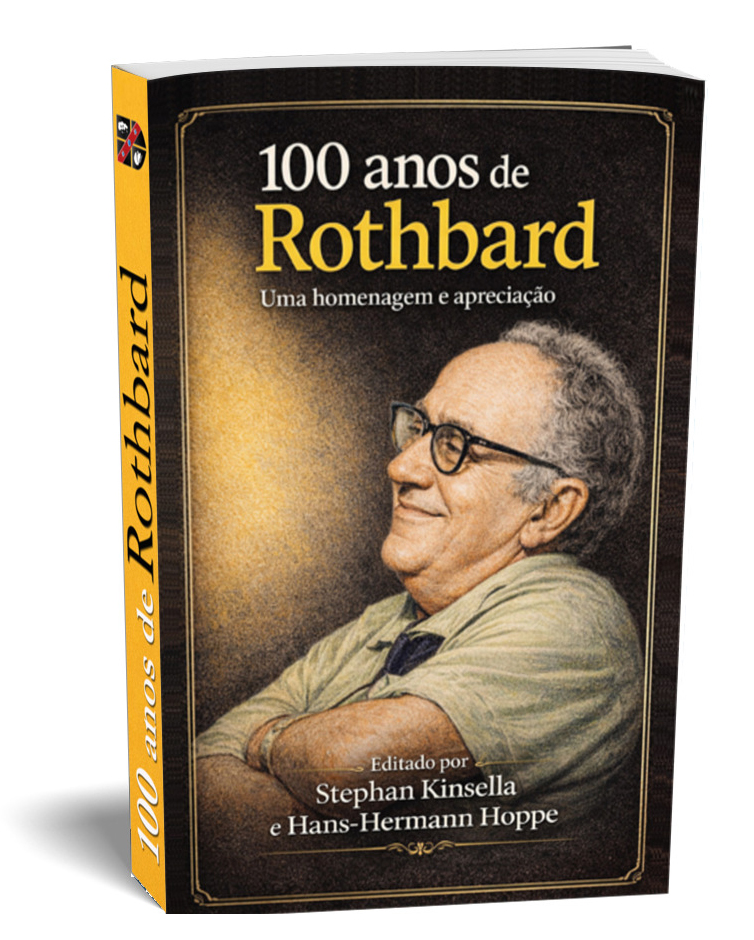
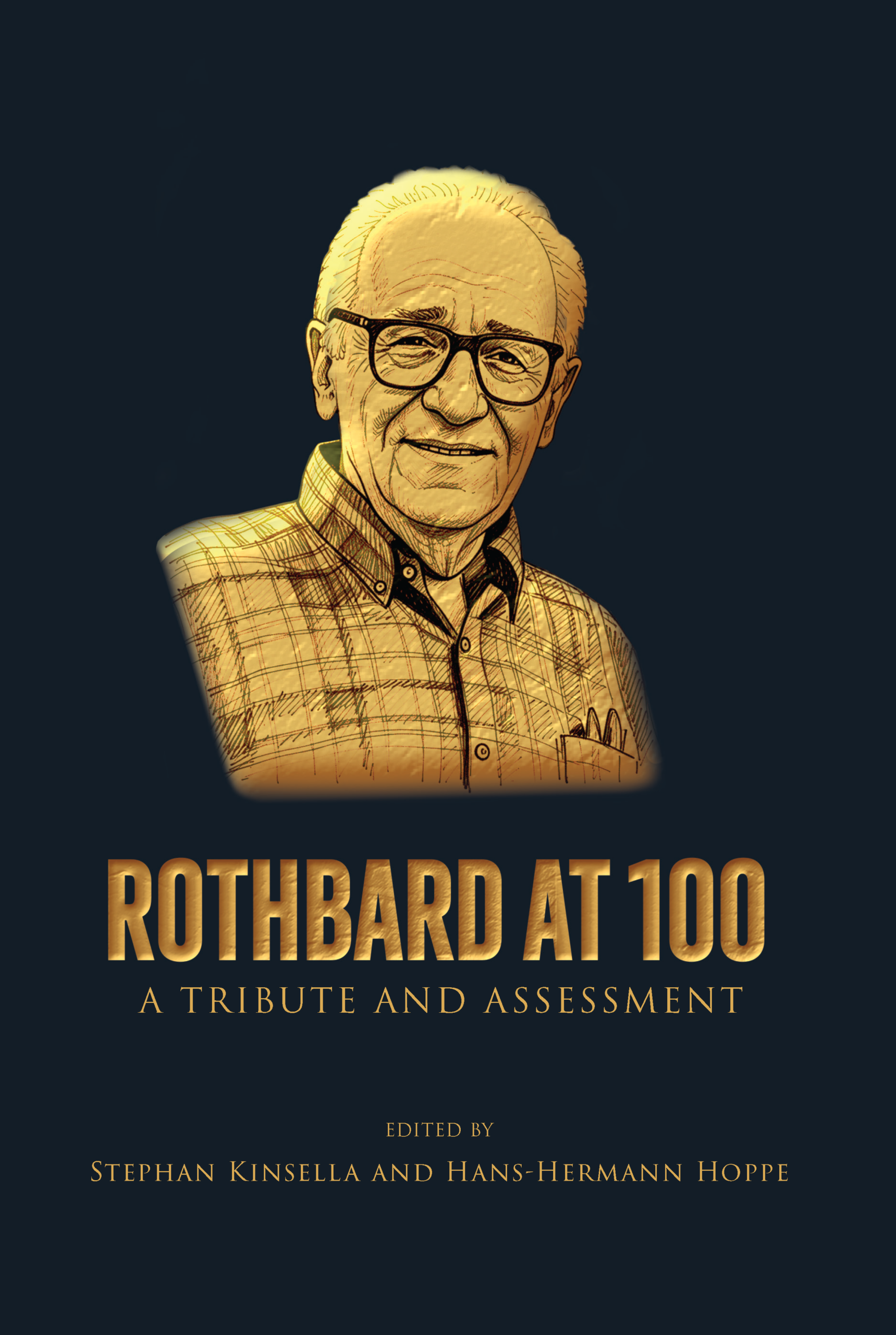
By becoming a propagandist for Milei, Jesús Huerta de Soto not only betrayed Rothbardianism, but also his Catholicism, by supporting an agent of Chabad-Lubavitch, a Jewish sect that hates Christ. Judaism itself is already a cult based on hatred of Jesus. Chabad is even worse. But the institutional crisis in question came to light when this apologist for Milei was invited to speak at this year’s Austrian Scholars Conference. Following this invitation, Hoppe published the commemorative book for Rothbard’s centenary, with a highly critical introduction to Milei. Apparently, so as not to displease the guest of honor at his conference, the Mises Institute refused to publicize the book and publish the introduction.
Then Huerta de Soto gave his lecture, in which he called Milei the greatest Austro-libertarian hero of all time, and was applauded. The funny thing is that he considers Milei a hero for something that is actually the greatest tragedy of the Milei phenomenon, which is that he drew the attention of a huge audience to Austro-libertarian ideas. But this is terrible, because now this audience associates libertarianism and the Austrian School with Zionism, inflationism, wars, censorship, genocide, and all the other imbecility that Milei has been defending and practicing. The Austrian School is having its reputation tarnished by this fraud. And perhaps we have already lost the term “libertarianism” forever. Perhaps we need a new name.
After that, Hoppe published an article, “Mises Institute: Quo vadis?” , and revealed what lay behind the entire institutional crisis that culminated in this dark moment for Rothbardianism. He exposed a system of incentives and conflicts of interest within the institution involving over $70 million. This went a long way toward explaining why the institute cast Rothbardianism aside and embraced the apologists for a monumental fraud. Quo vadis?—where is it headed?—was the question. And the Mises Institute has already gone somewhere. Where to?
Away from Rothbardianism. It expelled Hoppe and remained with Milei ‘s apologists. It distanced himself from intransigent radicalism and has promoted classical liberals and Hayekians. It still has good collaborators and good content, but it is no longer a reliable source for Rothbardians. Now it is necessary to filter this content to avoid consuming impurities. Or poisons! The position of reliable source is being filled by the PFS blog and journal. And at the Rothbard Institute, we try to be faithful to Rothbard’s legacy, giving exclusivity to praxeology and anarcho-capitalism, publishing a lot of revisionist and culturally conservative content. And we are always fighting against war. It’s one of the most frequent themes there.
Well, we’ll soon have Hoppe’s first lecture since the eruption of this crisis and his break with the Mises Institute, and we may get a glimpse of the current state and future of Rothbardianism in the world. Hoppe is not only Rothbard’s main intellectual heir, but he has also assumed the role of beacon of Austro-libertarianism. Rothbardian. All of this makes this Mises Portugal event a historic occasion of the utmost importance, and I thank you once again for the opportunity to be here and to have been able to make this humble contribution.
Thank you.
***
[Original Brazilian Portuguese]
O rothbardianismo no centenário de Rothbard
[Palestra proferida na comemoração do centenário do nascimento de Murray Rothbard, em 27 de Junho de 2026 – Porto, Portugal. Slides aqui.]
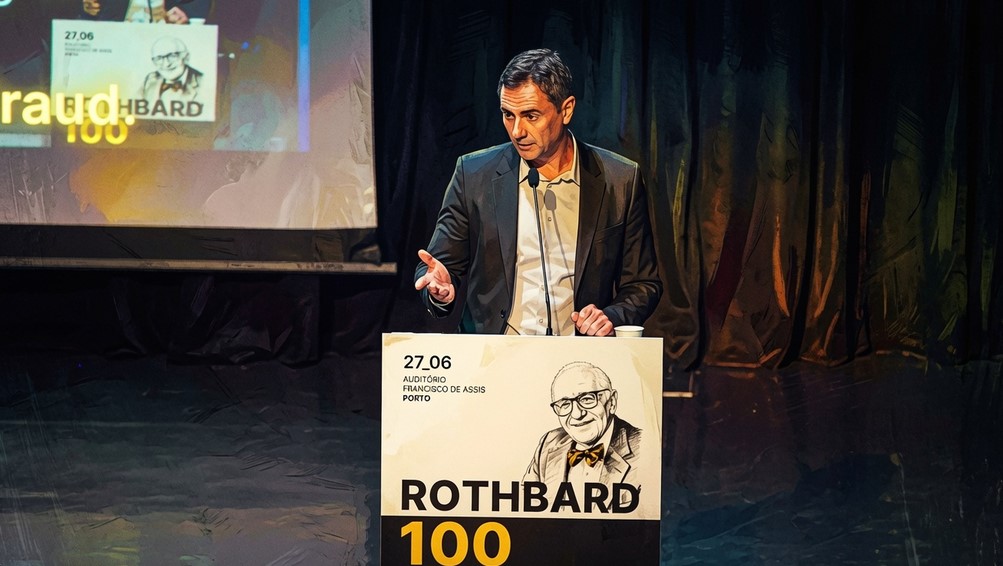 Obrigado Manuel pelo convite e por ter concretizado este evento.
O Manifesto Comunista foi publicado em 21 de fevereiro de 1848. 69 anos depois, os bolcheviques marxistas, que na maioria nem eram realmente russos – 85% deles eram judeus – tomariam o poder na Rússia através de um golpe de estado. O movimento marxista conquistou um poder em 7 décadas.
O movimento abolicionista ganharia forma no Reino Unido entre religiosos cristãos. Os Quakers seriam os principais fundadores da Sociedade para Efetuar a Abolição do Comércio de Escravos em 1787. 20 anos depois, em 1807 eles conseguiram acabar com o comércio britânico de escravos. E em 1833, 46 anos depois da fundação dessa sociedade abolicionista, o fim da escravidão em todo o Império Britânico seria alcançado.
Em 2014, o Stephan Kinsella deu uma palestra com o título “Libertarianismo após cinquenta anos: O que aprendemos?” onde ele estimou que o início do movimento libertário havia sido 50 a 60 anos antes. Então hoje, em 2026, no centenário de Rothbard, o movimento libertário teria entre 60 e 70 anos. E antes disso, há 80 anos, o Leonard Reed havia fundado a Foundation for Economic Education, que ajudou inclusive na publicação do Ação Humana de Mises.
Não preciso nem dizer que em comparação com esses outros dois movimentos citados, o movimento libertário, em termos de resultados práticos, fracassou.
Os abolicionistas britânicos queriam a abolição da escravidão e conseguiram, em poucas décadas, que a escravidão fosse abolida em todo o império britânico. O movimento libertário, formado por minarquistas e anarcocapitalistas, pregou o estado mínimo ou a abolição do estado. Então, se tivesse o mesmo sucesso dos antiescravagistas, o estado grande, fora das funções de proteção e justiça, já teria sido abolido ao menos em todo o império americano – que é onde o movimento libertário surgiu. Comparem a fundação da Sociedade Abolicionista, que 46 anos depois aboliu a escravidão no Império, e a fundação da FEE, Foundation for Economic Education, fundada em 1946, 80 anos atrás: o Império Americano está ainda mais longe do que antes do minarquismo que eles defendiam. . . só foi pra trás. . . o estado só cresceu.
Chegamos às 6/7 décadas de movimento, e 100 anos de Rothbard, sem muitos “resultados práticos” para mostrar; temos apenas com um falso libertário que se tornou presidente de um país na América do Sul, e não fez nada para acabar ou diminuir o estado. . . ao contrário, ele aumentou e fortaleceu o estado. (Vou dar detalhes sobre isso mais pra frente)
Acho que só os libertários mais ingênuos querem “mudar o mundo”, por que o resto de nós, só quer ser deixado em paz, no nosso canto. Por isso a secessão é nossa principal bandeira política. Mas não conseguimos ainda alcançar uma sociedade livre em nenhuma parte do planeta. E nem precisávamos de um grande país, pois nem existem muitos milhões de libertários no mundo. A maioria das pessoas rejeita o produto que estamos oferecendo. Elas não querem liberdade. Querem um líder. Querem segurança, estabilidade. Querem ser mandadas. . . preferem permanecer escravas. Ou seja lá o que for que elas querem.
Então, apenas um pequeno território estaria bom pra começar. Temos muitos projetos libertários, como Seasteading, Free Cities e o Free State Project de New Hampshire. E entre esses projetos existe uma tentativa promissora em andamento, numa pequena ilha de rio entre a Croácia e a Sérvia, a Liberland. A Liberland tem contado com a colaboração de 3 dos maiores austrolibertários rothbardianos do mundo atualmente, que estão presentes aqui hoje, Kinsella, Alessandro Fusillo e Hoppe. Esses 3, em 19 de dezembro do ano passado, estiveram em um evento da Liberland, onde palestraram e discutiram sua constituição. Se esse projeto se viabilizar, levando em conta o conselho desses 3 mestres, teremos algo prático de valor para mostrar no futuro.
Mas não é o que acontece agora.
Se estivesse vivo, Rothbard comemoraria seu aniversário de 100 anos vendo o movimento libertário muito atrasado em seu objetivo, quando comparado ao movimento abolicionista e ao comunista. E não é só isso. Ele também testemunharia no seu aniversário uma grande crise do rothbardianismo, com instituições e pessoas traindo seu legado.
Mas claro, ele certamente teria muito o que comemorar. Suas ideias tiveram um enorme crescimento em popularidade, com pessoas e instituições fazendo jus ao seu legado. (as principais delas reunidas aqui hoje nesta celebração). Então, eu quero falar sobre quem seriam os verdadeiros e os falsos rothbardianos, e pra isso, precisamos entender o que é ser um rothbardiano.
Rothbard era um economista austríaco, mas ser um economista austríaco não significa ser um rothbardiano. Em economia, Rothbard era um misesiano. Então, para ser rothbardiano é preciso ser misesiano, ou seja, entender a ciência econômica como um ramo da praxeologia. A economia é uma ciência axiomática lógico-dedutiva. Isto quer dizer que suas proposições possuem o mesmo status dos axiomas de que são derivadas, ou seja, são irrefutáveis. Isso já é, por exemplo, bem diferente de ser um hayekiano. Hayek era uma wieseriano influenciado por Popper que desprezou a praxeologia.
Rothbard foi o principal e maior economista depois de Mises. Mas Rothbard não era só um economista. Então, ser apenas um praxeologista não significa ser um rothbardiano. Rothbard era um polímata, com profundo conhecimento em diversas ciências, mas o rothbardianismo se caracteriza pela ética rothbardiana, e as implicações dessa ética em sua filosofia política.
Nisso Rothbard se afasta de Mises. Rothbard não é um misesiano em ética e filosofia política, somente em economia. Então, ser misesiano completo é diferente de ser um rothbardiano completo. E quando eu falo de “completo” ou “verdadeiro”, é bom esclarecer que ser rothbardiano não significa concordar com tudo que Rothbard falou sobre tudo. Não fazemos parte de um culto. Os rothbardianos verdadeiros, ou completos, discordam de Rothbard em alguns pontos. Por exemplo, Kinsella discordou de Rothbard em algumas abordagens sobre propriedade intelectual. Ele as corrigiu e as desenvolveu, usando a estrutura rothbardiana, e podemos dizer que os rothbardianos hoje são kinsellianos em propriedade intelectual. Outro exemplo. Hoppe discordou de Rothbard em sua visão positiva sobre Democracia como uma evolução, e também podemos dizer que os rothbardianos hoje são hoppeanos em relação a democracia. Outro ponto ainda. A maioria dos rothbardianos discordam da posição de Rothbard em relação ao aborto e não deixam de ser rothbardianos por conta disso.
Mas existem temas que não é possível discordar de Rothbard e permanecer um rothbardiano, pois são contrários à essência rothbardiana. Então Mises não é um rothbardiano, e Rothbard não é um misesiano, pois Mises não era um anarcocapitalista. Mises, assim como todo liberal, era uma contradição ambulante. A contradição de Mises que Rothbard se livrou, e nos livrou, foi a de “atacar monopólios mas ao mesmo tempo defender monopólios”. Mises concluiu que monopólios são ruins. Que tudo que é fornecido através de monopólios é mais caro e com menos qualidade do que seria se fosse fornecido pelo ambiente de livre concorrência do mercado. Mas ele defendia que os serviços de justiça e segurança fossem fornecidos monopolisticamente pelo estado.
Rothbard, como tinha feito Gustave de Molinari antes dele, superou essa contradição e defendeu a produção privada de segurança, e de justiça! Então, podemos dizer que o rothbardiano completo é um praxeologista anarcocapitalista. . . Mas também Rothbard não era só isso, e ser um rothbardiano verdadeiro exige mais do que isso.
Ser um rothbardiano significa ter paixão pela justiça. Só que paixão e ódio andam juntos. Então também é preciso odiar a injustiça. Rothbard deixou isso claro em seu artigo “Você odeia o estado?”. Ali ele se compara com outro anarcocapitalista, David Friedman. Friedman faz uma análise fria e conclui que uma sociedade sem estado seria superior a uma com estado. . . Não que o estado seja particularmente ruim. Apenas que existe uma alternativa melhor. Ele não odeia a instituição mais criminosa e assassina da história. Não demonstra nenhum sentimento em relação a lista interminável de injustiças perpetrada por ela. Nesse ponto Rothbard diz preferir minarquistas, que demonstram um ódio ao estado, do que anarcocapitalistas indiferentes.
Para ser considerado um rothbardiano verdadeiro, é preciso odiar o estado e querer acabar com ele o mais rápido possível. No livro A ética da liberdade Rothbard escreveu:
“O libertário deve possuir paixão pela justiça, uma emoção originada e canalizada por sua percepção racional que a justiça natural exige. A justiça, e não discursos débeis ditados por mera utilidade, deve ser a força motriz para alcançar a liberdade… (e) isto quer dizer que o libertário deve ser um “abolicionista”, i. e., ele deve desejar atingir o objetivo da liberdade o mais rápido possível… [Ele] deveria ser um abolicionista que, se pudesse, aboliria instantaneamente todas as invasões de liberdade.”
Rothbard também acreditava que só o libertarianismo não seria suficiente para se alcançar e se manter uma sociedade livre, e ele considerava que o conservadorismo cultural era uma pressuposição sociológica do libertarianismo.
Além disso, outra característica fundamental de um rothbardiano é o revisionismo histórico. No discurso “Amadurecendo com Murray”, Hoppe conta que uma das duas principais lições que ele aprendeu nos 10 anos que conviveu cotidianamente com Rothbard, foi ser um revisionista. Ele disse:
“em nossas inúmeras conversas, aprendi com Murray a importância de complementar a teoria austrolibertária com a história revisionista, a fim de apresentar uma avaliação verdadeiramente realista de eventos históricos e assuntos globais. . . . acima de tudo, foi Murray que me ensinou a nunca confiar na história oficial, invariavelmente escrita pelos vencedores, mas a conduzir toda a pesquisa histórica como um detetive investigando um crime.”
So to speak
E por último, mas não menos importante, o rothbardiano tem que ser antiguerra. A oposição à guerra foi a peça fundamental na formação da filosofia de Rothbard, que começou na Velha Direita americana. A Velha Direita americana era um grupo que se uniu contra o New Deal e contra a entrada dos EUA na Guerra Mundial. A questão da guerra era tão importante para Rothbard que ele, mais pra frente em sua vida, até ensaiou uma aliança com a Esquerda, apenas por causa da oposição dela à guerra do Vietnã. Mas acima de tudo, a oposição de Rothbard à guerra derivava de sua oposição a agressão. E a guerra é a agressão máxima. Ela envolve aumento da interferência do estado na economia e assassinato e destruição de propriedade em larga escala.
Então, recapitulando, o rothbardiano, completo e verdadeiro, deve ser:
- Praxeologista misesiano
- Anarcocapitalista
- Abolicionista que odeia o estado
- Conservador cultural
- Revisionista histórico
- Antiguerra
Esse é o kit básico do rothbardiano.
Então, o que temos de rothbardianismo verdadeiro e falso, hoje, no centenário de Rothbard?
Primeiro vamos falar do primeiro presidente eleito na história que se autodenomina anarcocapitalista rothbardiano, Javier Milei. Milei não é um praxeologista. Seu discurso econômico se baseia fortemente em estatísticas e ele não rejeita as escolas econômicas positivistas que, epistemologicamente, são diametralmente opostas a Escola Austríaca. A confusão intelectual de Milei já poderia ser vista nos nomes que ele deu aos seus 4 cachorros clones: Murray, Milton, Robert e Lucas. Misturou positivistas com austríaco, que na verdade são incompatíveis. E um sujeito que considera que Ben Bernanke foi um dos melhores economistas da história e diz que ele salvou o mundo! nunca pode ser considerado um austríaco.
Milei claramente não é um abolicionista, pois recebeu o mandato das urnas para abolir a principal fonte de dinheiro, e poder, do estado, o banco central, e não o fez. Ao contrário, ele salvou o banco central da Argentina!
Milei não é um revisionista histórico, ao contrário, ele engole toda a história mainstream a ponto de considerar o facínora Churchill como seu grande herói.
E pior de tudo, Milei não é antiguerra, muito pelo contrário. Enquanto Rothbard identificou apenas duas guerras justas na história (a secessão das 13 colônias americanas e a tentativa de secessão do Sul), Milei considera justas todas as guerras do Império Americano. Ele, como presidente, apoiou mais veementemente a guerra por procuração dos EUA contra a Rússia na Ucrânia, o genocídio de Israel em Gaza, patrocinado pelos EUA e a guerra atual de EUA e Israel contra o Irã.
Milei é o arquétipo do falso rothbardiano. E embora muitos americanos não deem importância a ele, denunciar a fraude que é Milei é uma das missões mais importantes neste período do centenário de Rothbard. É por isso que um dos maiores paladinos do rothbardianismo hoje é um músico paraguaio chamado Oscar Grau, que tem dedicado grande parte de sua energia para combater não só a farsa Milei como também os seus apologistas dentro do movimento austrolibertário, como Phillip Bagus e Jesús Huerta de Soto.
E além destes dois propagandistas, existem outros que podem não ser considerados mileístas, mas que suas posições em relação a Milei e seus propagandistas revelam suas verdadeiras prioridades. Milei é atualmente o pivô de uma crise institucional que está abalando o rothbardianismo no centenário de Rothbard.
Nos últimos anos tivemos 3 temas que serviram como provas rothbardianas para pessoas e instituições. Covid, Ucrânia e Israel. Na primeira prova a maioria passou. Quando começou o alarmismo globalista da fraudemia Covid, praticamente todos os rothbardianos e instituições libertárias levantaram suas vozes para se opor a essa tirania sendo imposta a humanidade. LewRockwell.com, Mises Institute, Ron Paul Institute, Libertarian Institute, Future of Freedom Foudantion, American Institute for Economic Research, FEE. . . todas foram muito bem e muito ativas nessa fraudemia. Somente instituições que já sabíamos que não eram libertárias se calaram ou se posicionaram ao lado da tirania… como por exemplo a Reason e o Mises Brasil, que defendeu o Fica em Casa, Vacinas e até vendeu máscaras. O negócio das máscaras é interessante pois pra mim foi o primeiro sinal de que havia algo muito errado com Milei. Na época eu acompanhava as mídias sociais de Milei, e ele estava em campanha para deputado. Fazendo campanha, nas ruas, ao ar livre, ele aparecia o tempo todo de máscara. Isso que em volta dele, não se via quase ninguém de máscara. Então não era nem uma obrigação. Ele acreditava realmente naquilo. Uma medida absolutamente ridícula que qualquer um em 5 minutos de pesquisa descobriria que o tamanho dos orifícios das máscaras é mil vez maior que o vírus. Mas ele estava lá, todo dia exibindo esse símbolo do medo induzido da ditadura covidiana. Eu não aguentei e parei de seguir ele. Dei unfollow. E depois eu acabei relevando quando ele foi candidato a presidente. Era um cara que tava aí dizendo que imposto é roubo, que ia abolir o Banco Central e tinha chance de ser eleito. Eu entrei na onda do Milei nessa época.
Mas o Milei nunca foi a favor da obrigatoriedade de máscara, nem da obrigatoriedade de vacina, embora ele tenha defendido esses venenos – acho que defende até hoje.. Ele foi contra lockdowns, publicou um livro defendendo liberdades individuais durante a pandemia. . . então eu diria que ele passou nesse teste. Não com méritos.
A guerra da Ucrânia foi outra prova que a maioria dos libertários passou, e nessa, Milei foi reprovado. No Brasil teve um dos poucos que também não passou, um youtuber que se autodenomina ancap, e que por causa da sua popularidade, desviou muitos potenciais rothbardianos para longe do rothbardianismo.
E a terceira prova, Israel, Milei fracassou estrondosamente. E embora a maioria dos libertários tenha passado, essa prova acabou reprovando também um dos, até então, maiores libertários do mundo. Walter Block. Block era colocado por muitos entre os 3 maiores rothbardianos, ao lado de Lew Rockwell e Hoppe, e ele passou com mérito nas duas primeiras provas. . Ele foi muito bem nos artigos que escreveu sobre a Ucrânia; e sobre o Covid também foi relativamente bem. Falou umas bobagens, mas foi bem.
Mas, sua posição perversa a favor de Israel e suas guerras revelaram que ele não é rothbardiano e nem sequer um libertário. Mostraram que ele nunca deixou de ser um randiano coletivista genocida.
Claro, defender a monstruosidade de Israel em Gaza é absolutamente incompatível com o rothbardianismo, mas instituições e pessoas que não se opuseram ou simplesmente se calaram diante do genocídio de Gaza também simplesmente não podem ser consideradas rothbardianas. Mas e quanto a quem não se opõem a quem ativamente defende as atrocidades de Israel? (como Block e Milei) Como isso afeta o grau de rothbardianismo?
Então eu diria que Block e Milei – Milei principalmente – seriam a quarta prova rothbardiana que antecederam esse período de centenário.
Nisso chegamos na principal crise institucional no centenário de Rothbard. Uma crise no instituto que ele fundou e atuou como diretor acadêmico até sua morte, e que era o pilar do rothbardianismo no mundo, o Mises Institute.
Ao se tornar um propagandista de Milei, Jesús Huerta de Soto não só traiu o rothbardianismo, como traiu seu catolicismo, ao apoiar um agente do Chabad-Lubavitch, uma seita judaica que odeia Cristo. O Judaísmo em si já é um culto baseado no ódio a Jesus. O Chabad é ainda pior. Mas a crise institucional em questão, veio à tona quando este apologista de Milei foi convidado para palestrar na Austrian Scholars Conference deste ano. Após esse convite, Hoppe publicou o livro comemorativo do centenário de Rothbard, com uma introdução altamente crítica a Milei. Aparentemente, para não desagradar o convidado de honra de sua conferência, o Mises Institute se recusou a divulgar o livro e a publicar a introdução.
Then Huerta de Soto gave his lecture, in which he called Milei the greatest Austro-libertarian hero of all time , and was applauded. The funny thing is that he considers Milei a hero for something that is actually the greatest tragedy of the Milei phenomenon, which is that he drew the attention of a huge audience to Austro-libertarian ideas. But this is terrible, because now this audience associates libertarianism and the Austrian School with Zionism, inflationism, wars, censorship, genocide, and all the other imbecility that Milei has been defending and practicing. The Austrian School is having its reputation tarnished by this fraud. And perhaps we have already lost the term “libertarianism” forever. In Argentina it has already been lost; it is now synonymous with all of that. Perhaps we need a new name.
After that, Hoppe published an article, “ Mises Institute: Quo vadis? ”, and showed what was behind the entire institutional crisis that culminated in this dark moment for Rothbardianism. He revealed a scheme of incentives and conflicts of interest within the institution, involving more than 70 million dollars. This explained much of why the institute abandoned Rothbardianism and embraced the apologists of a monumental fraud. Quo vadis?, Where are they going? was the question. And the Mises Institute has already gone. Where to?
 Away from Rothbardianism. He expelled Hoppe and remained with Milei’s apologists . He distanced himself from intransigent radicalism and has promoted liberals and Hayekians . He still has good collaborators and good content, but he is no longer a reliable source for Rothbardians. Now it is necessary to filter this content to avoid consuming impurities. Or poisons! The position of reliable source is being filled by the blog and journal of the Property and Freedom Society. And at the Rothbard Institute we try to be faithful to Rothbard’s legacy, giving exclusivity to praxeology and anarcho-capitalism, publishing a lot of revisionist and culturally conservative content. And we are always fighting war. It is one of the most frequent themes there.
Well, shortly we will have Hoppe’s first lecture since the eruption of this crisis and his break with the Mises Institute, and we can get a glimpse of the current state and future of Rothbardianism in the world. Hoppe is not only Rothbard’s main intellectual heir, but has also assumed the role of beacon of Rothbardian Austrolibertarianism. All this makes this Mises Portugal event a historically significant event, and I thank you once again for the opportunity to be here and to have been able to make this humble contribution.
Thanks.
- See also PFP327 | Fernando Fiori Chiocca, “The First Knight of Libertarianism” ( Rothbard at 100 ) ; Fernando Chiocca, How to win the economic debate (PFS 2012) . [↩]
- See Walter Block, “Forced Vaccinations,” LewRockwell.com (Feb. 4, 2013); see also Libertarianism and Compulsory Vaccinations and others listed here. And more recently, Walter Block, “A Libertarian Analysis of the COVID-19 Pandemic,” J. Libertarian Stud. 24 (2020): 206–37. Jeffrey Tucker criticized Walter for some of these views here; a few days later the same program had Walter on to defend his pro-Covid lockdown/mandate views he had expressed at the height of the pandemic lockdown period. Tucker also rightly called out Block for his illiberal and unlibertarian views on infectious diseases, including his bizarre defense of jailing “Typhoid Mary,” in The Downfall of the Gurus. See, e.g., Walter Block, “My Response to Jeffrey Tucker on COVID,” Epoch Times (Feb. 8, 2023; substack version); Jeffrey A. Tucker, “The Downfall of the Gurus,” Epoch Times (Jan. 23, 2023); Block’s appearance online talking about the Typhoid Mary issue. And Walter Block, “Rejoinder to Slenzok on COVID,” J.Libertarian Stud. 25 (1) (2021): 264–68. Other “libertarian” groups like Cato were also bad on this. See Kinsella, What Kind of Libertarian Are You? (see the “COVID Update” section). [↩]
- See Walter E. Block & Alan G. Futerman, “Rejoinder to Hoppe on Israel vs. Hamas,” MEST Journal (2024) which is a response to Hans-Hermann Hoppe, “An Open Letter to Walter E. Block,” LewRockwell.com (Jan. 31, 2024). See also David Gordon and Wanjiru Njoya, “The Classical Liberal Case For Israel,” LewRockwell.com (Feb. 2, 2024; Mises.org version) and Walter’s response, Alan G. Futerman and Walter E. Block, “Rejoinder to Gordon and Njoya on Israel and Libertarianism,” MESTE Journal (Position Paper) (2024). [↩]
- On Milei, see Hans-Hermann Hoppe, “PFP280 | Special: Hans-Hermann Hoppe, “Javier Milei” (PFS 2024),” Property and Freedom Podcast (Dec. 23, 2024); idem, “Resignation from the Scientific Advisory Board of the Ludwig von Mises Institute Germany,” HansHoppe.com (Aug. 18, 2025); idem, “PFP290 | Hoppe: Considerations and Reflections of a Veteran Reactionary Libertarian (AERC 2025),” Property and Freedom Podcast (March 23, 2025); idem, “A ‘Great Thinker’ at Work,” Power & Market (June 19, 2025); Kristoffer Mousten Hansen, “PFP306 | Kristoffer Mousten Hansen: Mileinomics (PFS 2025),” (Jan. 12, 2026). See also, concerning Milei and the (non-)closure of Argentina’s central bank, Hoppe, “A ‘Great Thinker’ at Work,” and the recent interchange between Philipp Bagus and Jörg Guido Hülsmann, beginning with Philipp Bagus, “Credit Money, Pesos, Dollars and Argentina,” Power & Market (Oct. 20, 2025), first published, in German, as Philipp Bagus, “Kreditgeld, Pesos, Dollars und Argentinien,” Ludwig von Mises Institut Deutschland (Oct. 20, 2025). The Power & Market article contains links to others in the interchange. [↩]
- Stephan Kinsella, “Libertarianism After Fifty Years: What Have We Learned?“, in Legal Foundations of a Free Society (Houston, Texas: Papinian Press, 2023). [↩]
- Editor’s note: Re Covid, Block actually terrible on Covid related issues. See comments above. [↩]
Discover more from The Property and Freedom Society
Subscribe to get the latest posts sent to your email.











 Alessandro Fusillo
 Andreas Tögel
 David Dürr
 Doug French
 Fernando Chiocca
 Greg Morin
 Hans-Hermann Hoppe
 Jay Baykal
 Jayant Bhandari
 Jeff Deist
 Jeffrey Barr
 Juan Fernando Carpio
 Ken Yamarashi
 León Isidoro
 Martin Cabrera
 Nick Hoppe
 Oscar Grau
 Peter Wong
 PFS
PFS scholarium
 Saifedean Ammous
 Sean Gabb
 Sean Ring
 Stephan Kinsella
 Stéphane Geyres
 Thomas Jacob
 Tom DiLorenzo