Related
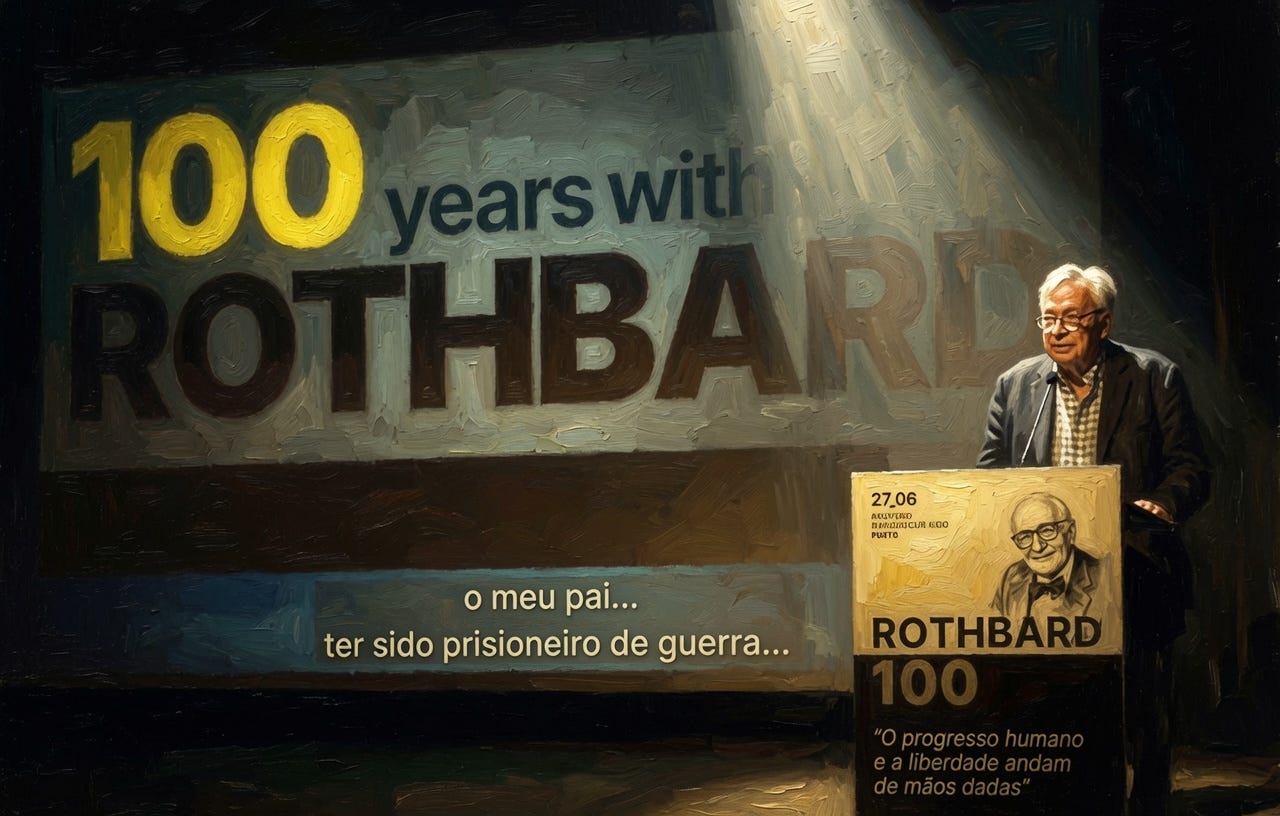
100 Years with Rothbard was held yesterday in beautiful Porto, Portugal (June 27, 2026), featuring and attended by a number of PFS members, including Professor Hoppe and Gülçin Imre Hoppe, Stephan Kinsella, Saifedean Ammous, Thomas Jacob, Gregory and Joy Morin, and Alessandro and Domitia Fusillo. Hoppe, Kinsella, and Ammous spoke at the conference. It was a wonderful event, attended by hundreds from Portugal and many other countries. A full report will be published presently. In the meantime here is an outside commentary.
***
Rothbard 100, in Porto: A Misunderstood Genius in a Room of People Who Understood
Probably the best libertarian event of all time.
BEEGARC • June 28, 2026
I had the privilege of attending Rothbard 100 in Porto yesterday. A celebration of the centenary of Murray Rothbard, a man who identified absolute truths about how the world works, and was systematically ignored for it. That is not a coincidence, or bad luck. It’s strategy.
Fernando Chiocca put his finger on it straight away: Rothbard’s ideas have gone unadopted for longer than it took abolitionism to end slavery. But there’s a reason for that, and it’s not because Rothbard was wrong.
It’s because he was too damn right.
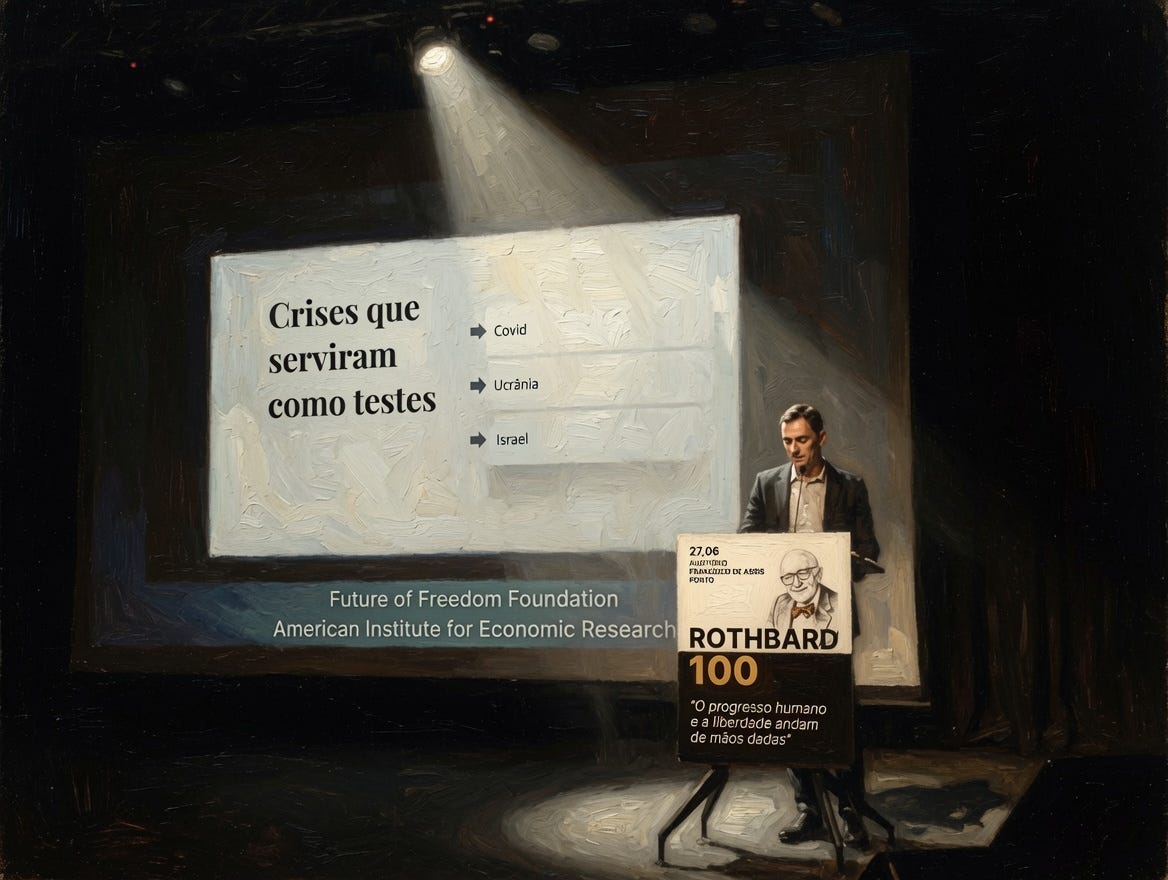
Abolitionism was a simple idea. You cannot appropriate one hundred percent of another person’s labour. Technically, that’s parasitism — the kind where the parasite ends up destroying the host entirely. Humanity, after much struggle, accepted that. What it didn’t accept was the next step, which Rothbard had the courage to take:
The parasitism rate can only be zero.
Not 23%. Not 48%. Zero. Everything else is slavery with a contract. Percentual parasitism. In Portugal they even have the honesty to publish the table — it’s called the IRS tax bracket, and it is literally a menu of how much the State thinks it can parasite you, depending on whether you produce more or less. And then you still get hit with 23% VAT on top, plus a few little extra taxes underneath, just to make sure you feel the shackles continuously.
Slavery didn’t end. It was regulated.
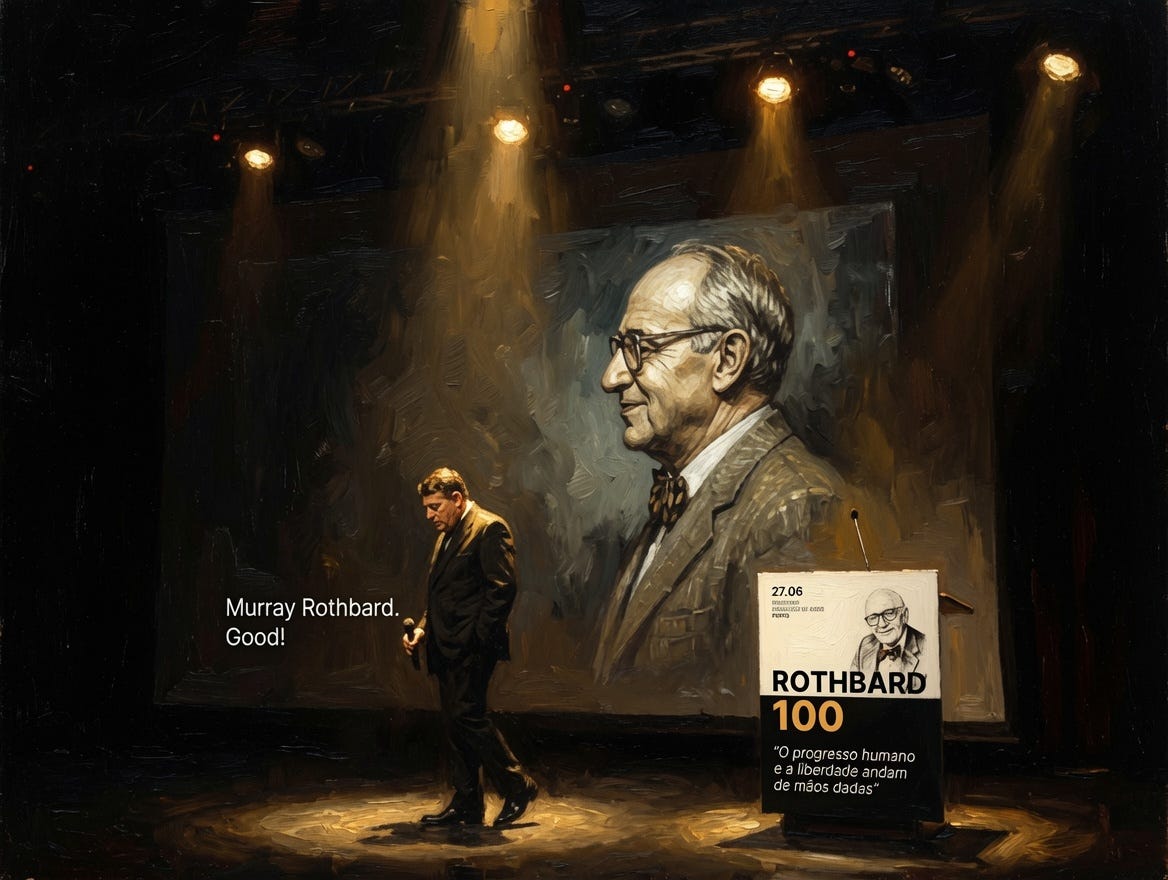
Luís Gomes and Professor Anxo Bastos explained another Rothbardian truth that also has no answer: monopolies don’t come from the market, they come from the State. The culprit is always the same.
Ask yourself why there’s no real competition in telecoms, television, or energy. It’s not because the market failed, or because businessmen want to bleed their customers dry. The truth is that monopolies happen because the State won’t let anyone else in. It protects whoever is already there, guarantees their slice, keeps prices artificially high, and then still charges taxes on top of those inflated prices. Rothbard identified this with surgical precision. It isn’t taught at universities, it doesn’t appear in newspapers, because whoever controls the universities and the newspapers — paid by the same hand that parasites citizens — lives very comfortably with the current arrangement.
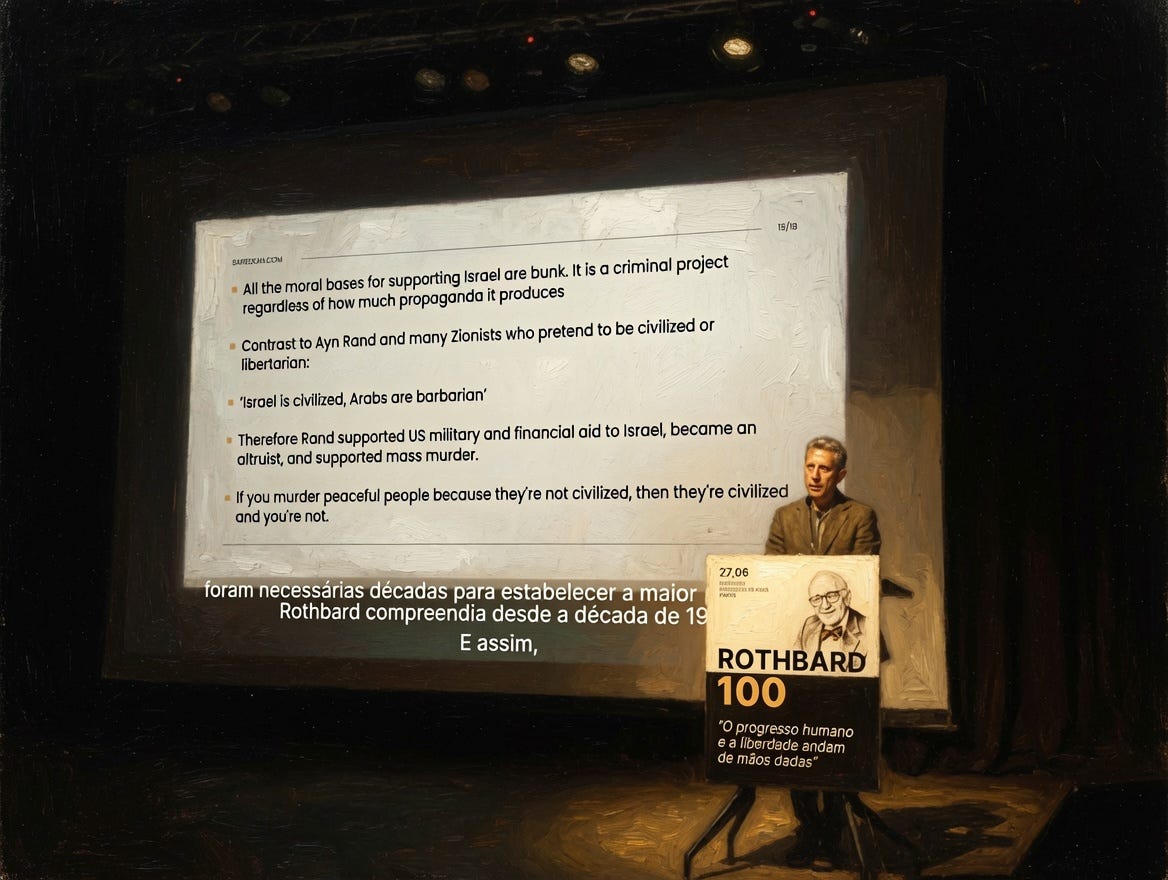
Saifedean Ammous brought to the stage the Israeli-Palestinian problem, and Rothbard’s solution fits in a single sentence: respect for private property. The land had owners — it always did. Then came the British mandates, the gifting of other people’s land, the expropriations, the ethnic cleansing, the colonisation of entire provinces. They call them settlements, which is literally the word for lands conquered by force — and they say it out loud, without shame. After the Second World War, European colonies were returned to their natives. Israel today is the sole and solitary exception, continuing to conquer what is not its own, backed by a divine mandate three thousand years old that, curiously, carries more weight than private property. Rothbard was Jewish, and he was absolutely clear: no religious, ethnic, or historical argument justifies stealing the land of those who live there. Peoples who lived in peace for centuries became enemies because of this violation of a simple principle. Simple principles, when violated, produce complex catastrophes.
Hoppe spoke about his father. He was held in an American concentration camp after the war, without charges, without trial, without crime. An uncomfortable truth: the liberators also built concentration camps. The American occupation of Europe, sold as collective defence and institutionalised through NATO, is imperialism with better public relations. European colonies were handed back because there can only be one empire, and the American empire tolerates no competition. It finances itself by printing money — another of Rothbard’s criticisms, who argued, with unanswerable logic, that the quantity of money must be fixed. It cannot be inflated to finance wars. The United States has attacked more countries than any other in history. Someone paid that bill. It was paid by destroying purchasing power, with inflation, with the poverty that appears mysteriously after a great deal of money printing. And they print a LOT of money.
Rothbard’s legacy is inconvenient precisely because it is irrefutable. He was denied recognition in his lifetime through organised cowardice — by those who live comfortably parasiting a percentage of other people’s work, managing other people’s money, producing regulations that justify their salary and nothing else. He was diminished, ignored, treated as an eccentric academic curiosity. So was Nikola Tesla. Truth has that problem: it doesn’t need approval to keep being true.
It will take time. It may take a hundred years, it may take two hundred. But Rothbard’s message is the only one that points toward a humanity that realizes its full potential, without being taxed to humiliation by a growing class of people who produce nothing.
It’s not a message for cowards. It never was.
One final word, and it’s the most deserved of all.
Stephan Kinsella and Hans-Hermann Hoppe said it was one of the best libertarian events they had ever attended. These were not polite remarks for the occasion — these people don’t waste time on those. The organisation of Rothbard 100 was a collective effort, carried out overwhelmingly by volunteers, people who offered their time without compensation, because they believe in something. But it was one person’s idea: Manuel Ogando. He decided to do what had never been done before. The best libertarian event ever held in Portugal, in the Iberian Peninsula, in Europe, and probably in the world. That’s not an exaggeration. It’s what was said by people who know what they’re talking about.
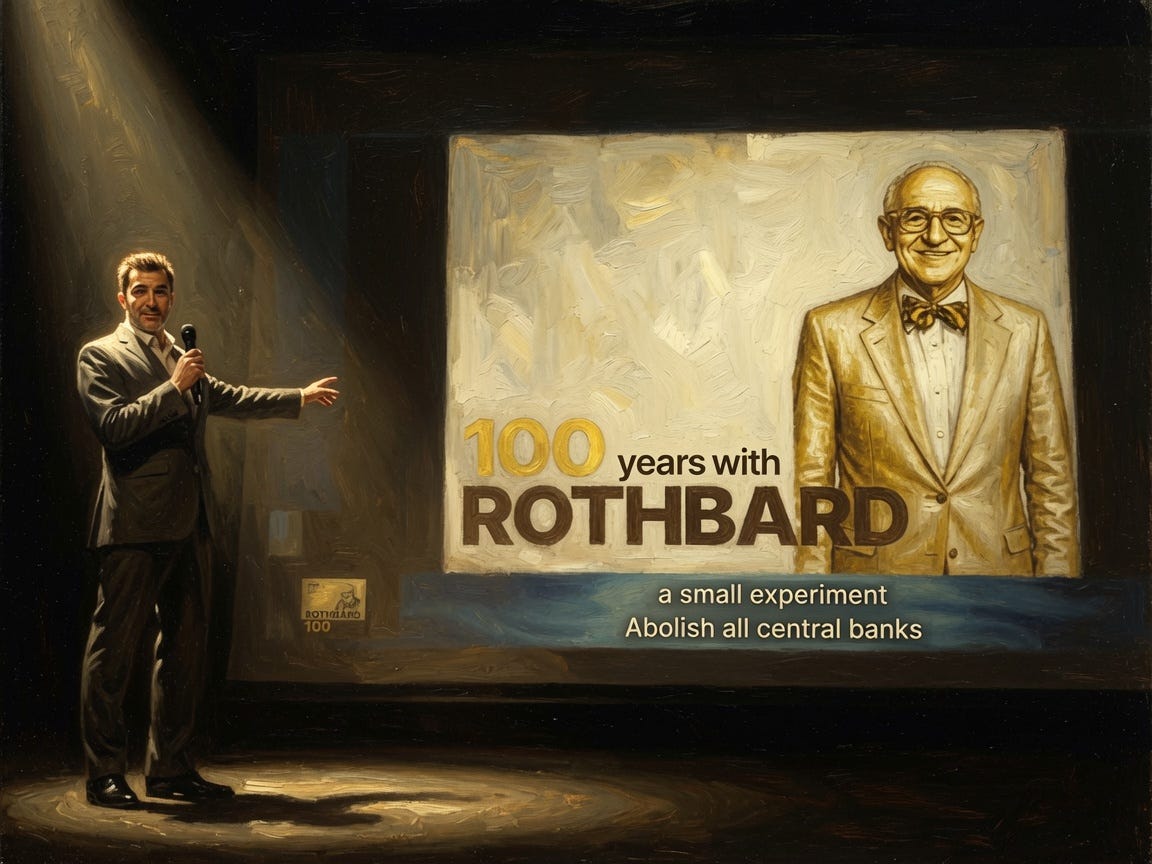
Rothbard’s ideas came alive yesterday, because they were handed to a new generation — one that already senses the world isn’t quite as they were told, that some things don’t add up, that the official answers aren’t enough. Many of those answers are in the work of Murray Rothbard, and yesterday that generation found them in a room in Porto.
Manuel Ogando earned his place in the history of the libertarian movement by conceiving and executing this event. Everyone who loves liberty is left with a debt of gratitude — to the speakers, to the organisation, and to the man who had the audacity to want to do the best.
A heartfelt and enormous thank you to all.
***
Tweets:
I stole your photo. Apologies for not mentioning you, I arrived late https://t.co/vAMa9BkNVq
— beegarc. (@beegarc_) June 28, 2026
The Rothbard 100 conference in Porto was an amazing success
With H. H. Hoppe, @NSKinsella, @saifedean and many others
Congrats and many thanks to the organizers, especially @mcaogando https://t.co/3iCBFcp2e1 pic.twitter.com/LV58GtDSt7
— Yorick de Mombynes (@ydemombynes) June 28, 2026
FYMNR! pic.twitter.com/8X72NbRJwZ
— Stephan Kinsella (@NSKinsella) June 27, 2026
Terminou o evento https://t.co/vcORQSJOpN
O melhor e mais memorável evento que participei e vejo que é opinião também de muitos dos palestrantes.
O libertarianismo português lembra muito o brasileiro pre-covid.
A oportunidade que eles têm nas mãos é gigantesca e o conteúdo…
— Fhoer 🧉 (@Fhoer_here) June 27, 2026
Listening to the greats, Hans-Hermann Hoppe and @NSKinsella, at the Rothbard at 100 conference in Porto. pic.twitter.com/OcL1z4Tv9M
— Saifedean Ammous (@saifedean) June 27, 2026
A palestra do Kinsella no evento deixa algo muito claro: Não se levem tanto a sério, ao menos não o tempo todo
O aprendizado ficar mais palatável, leve e até mesmo cativante.
O Rothbard dos livros, artigos e teses era o mesmo das piadas, peças e memes.
Se você não conseguir… pic.twitter.com/y48MqYkduT
— Fhoer 🧉 (@Fhoer_here) June 28, 2026
Podcast with @R38TAO, so to speak https://t.co/ERtwAtMIp0
— Hans-Hermann Hoppe (@HoppeQuotes) June 28, 2026
A palestra do Kinsella no evento deixa algo muito claro: Não se levem tanto a sério, ao menos não o tempo todo
O aprendizado ficar mais palatável, leve e até mesmo cativante.
O Rothbard dos livros, artigos e teses era o mesmo das piadas, peças e memes.
Se você não conseguir… pic.twitter.com/y48MqYkduT
— Fhoer 🧉 (@Fhoer_here) June 28, 2026
Happy 100th birthday Murray Rothbard, so to speak!
With @NSKinsella in Porto 🇵🇹https://t.co/koamzNCSzJ pic.twitter.com/lP89ikB9Eb
— Hans-Hermann Hoppe (@HoppeQuotes) June 28, 2026
Os memes que plantamos 8 anos atrás renderam frutos, juros e dividendos. pic.twitter.com/rVWOAZlFlg
— Fhoer 🧉 (@Fhoer_here) June 27, 2026
FYMNR! pic.twitter.com/8X72NbRJwZ
— Stephan Kinsella (@NSKinsella) June 27, 2026
In Porto 🇵🇹, so to speak pic.twitter.com/dxDa0SGeVK
— Hans-Hermann Hoppe (@HoppeQuotes) June 27, 2026
Discover more from The Property and Freedom Society
Subscribe to get the latest posts sent to your email.









 Alessandro Fusillo
 Andreas Tögel
 David Dürr
 Doug French
 Fernando Chiocca
 Greg Morin
 Hans-Hermann Hoppe
 Jay Baykal
 Jayant Bhandari
 Jeff Deist
 Jeffrey Barr
 Juan Fernando Carpio
 Ken Yamarashi
 León Isidoro
 Martin Cabrera
 Nick Hoppe
 Oscar Grau
 Peter Wong
 PFS
PFS scholarium
 Saifedean Ammous
 Sean Gabb
 Sean Ring
 Stephan Kinsella
 Stéphane Geyres
 Thomas Jacob
 Tom DiLorenzo