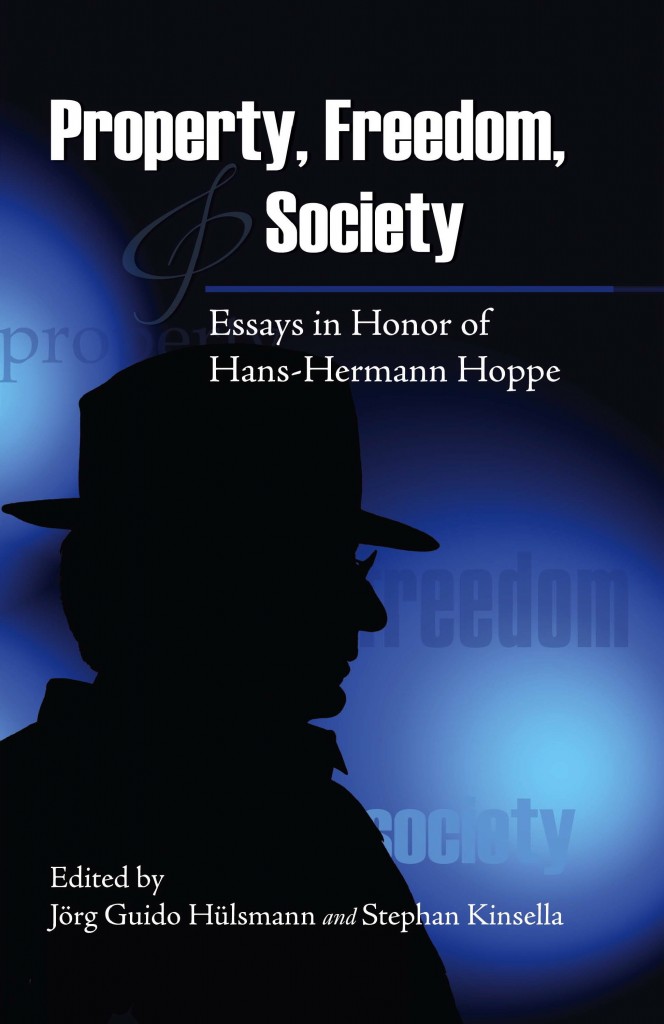
 In 2009, the Mises Institute published Property, Freedom, and Society: Essays in Honor of Hans-Hermann Hoppe, a project Guido Hülsmann and and Stephan Kinsella spearheaded to honor Hans Hoppe on the occasion of his 60th birthday. Only a few of the pieces were published independently; we are posting some of them here in this Bookstream.
The first entry was republished at Property, Freedom, and Society Bookstream: Introduction, Hülsmann and Kinsella. Links to the remaining chapters may be found at the book’s landing page here, which will be updated as the book is streamed here. Here’s the next entry.
3
The Power of Argument in a Crazy World
We should not be very surprised that the world is crazy. Human nature leads to individual pursuit of goals, which leads to conflicts, power, and abuse of power. The world, however, is even more than crazy nowadays. Instead of looking for the solutions as to how to deal with the dark side of human nature, the world’s political and opinion leaders are busy ignoring the problem or making it much bigger. There are constant attacks on market economics and personal responsibility. Regulation, education, subsidies—everything is employed in the service of these attacks.
There are any number of strategies for dealing with this crazy world. You may go in line with it, rationalize its craziness, and earn a living by serving those whose interests are to keep the public ignorant. Or, you may analyze the world around you, showing what is wrong with it and how things really are. Hans Hoppe is one of those people who always looks for the truth, digs deeper than others, and does not hesitate to expose his ideas to others.
Let’s take some examples. Time preference is an essential issue when we speak about the creation of wealth. Hoppe explains that you may accumulate capital only if you are ready to postpone the pleasures of today for the sake of tomorrow. Saving, learning, and working mean the postponing of leisure and consumption.1 But, if we look to the policies and sentiments dominant in the world today, we see that quite opposite virtues are being promoted: spending is treated as good, while saving is treated as bad, as is it hampers consumption today. Attacking the skilled, the talented, and the educated, not only with taxation, but with “progressive” taxation is treated as moral. Education is regarded as a benefit to the individual and society only for studies of things that do not bring financial gain. Working is discouraged by taxes, while not working is encouraged by subsidies. Hans Hoppe’s arguments demonstrate that you get exactly what you encourage and subsidize. If you subsidize laziness, you get laziness. If you subsidize poverty, you get poverty. As he writes,
As a result of subsidizing the malingerers, the neurotics, the careless, the alcoholics, the drug addicts, the AIDs-infected, and the physically and mentally “challenged” through insurance regulation and compulsory health insurance, there will be more illness, malingering, neuroticism, carelessness, alcoholism, drug addiction, AIDs infection, and physical and mental retardation.2
The economic crisis of 2008 (and the artificial boom preceding it) is another example of how crazy the world is. Everyone is in panic, everyone is desperately looking for solution, and most turn to the government for a rescue plan. But what about the credit expansion as the ultimate precondition to the crisis? The Austrian theory of the business cycle was ignored before the crisis because there was no crisis. Now the theory is ignored because it explains that the government is the source of the crisis, and because it counsels that we need patiently to wait while the market consummates the malinvestment which has been encouraged for years. Hoppe explains that if you want to address the crisis, you must change the monetary system and abolish state-imposed fiduciary media.3
Hoppe’s axiom of private property is also of crucial importance. If you debate about ethical issues, it means that you presuppose your own right, as well as the right of other people, to debate the issue.4
This acceptance implies that you do respect the rights of others people involved in the debate to control their own bodies. And the conclusion is crucial: if you even begin debating what is right and what is wrong, it means that you already have acknowledged that private property is necessary and inescapable for any moral judgment. This applies even to those who try to argue against private property. The ethical ground for private property has never been so strong and deep before.
There are also many other fields where Hans Hoppe has pushed the limits of political and economic science. Monarchy is not as bad as democracy, he argues.5 This was and still is unacceptable to many intellectuals, and most people have followed the lead of the intellectuals because they have had no good arguments to the contrary. A simple reference to the “strong hand” of a dictator was not only politically incorrect and old fashioned, but also contrary to the goals and the image of society most people actually have. Hoppe provides a clear explanation to sort through this intellectual mess. The absence of democracy in public decision-making does not necessarily mean dictatorship and the most terrible exploitation of the people. On the contrary: democracy is the system which leads to dictatorship, exploitation of others, ignorance, and vulgarity.
The private provision of security is another topic which has benefitted from Hoppe’s insights.6 Every decent person often feels that the police are actually not providing adequate protection. But what is the alternative? Better this than nothing, or so many of those unsatisfied with government tend to conclude. An army of intellectuals is ready to help them reach this conclusion. Hoppe provides sound arguments and explains the economics of the private production of defense. No serious scholar can ignore Hoppe’s important arguments. Those who claim that there will be no security without government are simply mistaken. Now, you can direct them to Hans Hoppe’s works.
Immigration, democracy, regulation—so many bad ideas abound concerning all of these issues, and Hoppe addresses them so well in his writings and speeches.7
Hans Hoppe is not, however, just a scholar who presents good arguments and defends them competently and passionately. He is like an argument himself. Meeting Hans is quite an event for many. He is a person who possesses a natural authority; it is impossible not to notice him in any group of people. I do not mean that Hans speaks loud, tells jokes, or acts in some kind of bizarre or excited manner. On the contrary, he respects manners, and is self-confident enough not to need to show that he is “not like others.” It is just these good, old-fashioned manners, combined with huge intellect and knowledge which he never tries to hide from others, that make him a natural leader.
Hans knows how to present an argument in a way which is very understandable, even to a man of average intellectual capacities. His examples are sometimes so unexpected and direct that they really help or even force you to rethink what you have thought about the world before. It appears very natural for him, for example, to put a footnote in a book with a short explanation why public slavery is even worse than private slavery.8
It does not mean that Hans tries to be simple. He is just very straightforward. He does not hesitate to criticize even free-market advocates who are not consistent in their argumentation. If you say something absurd or make flawed arguments, he usually will not hide the fact from you. Perhaps for this reason, some people even seem to be intimidated by Hans Hoppe. Understandably, it is not always pleasant to have your arguments smashed in public.
I met Hans first when he was giving one of his brilliant lectures. I traveled the whole day from Vilnius to Krakow to hear that lecture. It was a complete satisfaction. It is not only Hoppe’s written texts which are so clear and appealing, but also his speeches. Subsequently, I have listened to his lectures, including on the same topics, several times. The strange thing is that they do not get boring, even the third or fourth time. The way he puts arguments in order to address the topic properly may be called an intellectual story. Accuracy comes together with intellectual elegance, and “elegant” is precisely the world to describe his speeches. They have nothing special—no fancy slides or funny stories—just the precision, strength, and the elegance of the argument.
Hans does not present himself as a big scholar. On the contrary, his ambition is not very great when he speaks about the role of the scholar (including himself) in society. It is not his ambition to invent some completely new theory or find a terra incognito. On the contrary, Hoppe claims that the role of a decent scholar is, first of all, to preserve what is already found, explained, and discovered. Not to waste the knowledge of the mankind, but to preserve
and explain it in modern language to new generations, is to him an already ambitious task. He does it perfectly. Contrary to many of those who are happy with their ambitious and often fallacious new theories, or with “philosophical razzle-dazzle,”9 he is always stressing the role of his teachers and predecessors, Rothbard and Mises.
Courage is another thing which goes well with Hans Hoppe’s name. Political correctness is not a good principle to hold to when you are looking for the truth, and while many people pay lip service to the importance of truth, not everyone will defend it even when his own career and name are at stake. But when liberty and the truth are at the stake, Hans Hoppe will never give up. The well-known controversy surrounding an example given about the different time preferences among different groups of people perfectly illustrates this courage.10
Our world has become crazy, but there is hope. Hans Hoppe and his works are an essential part of this hope. ❧
*Remigijus Šimašius is [was] Minister of Justice of the Republic of Lithuania. Prior to his appointment to this position in December 2008, he was President of the Lithuanian Free Market Institute.
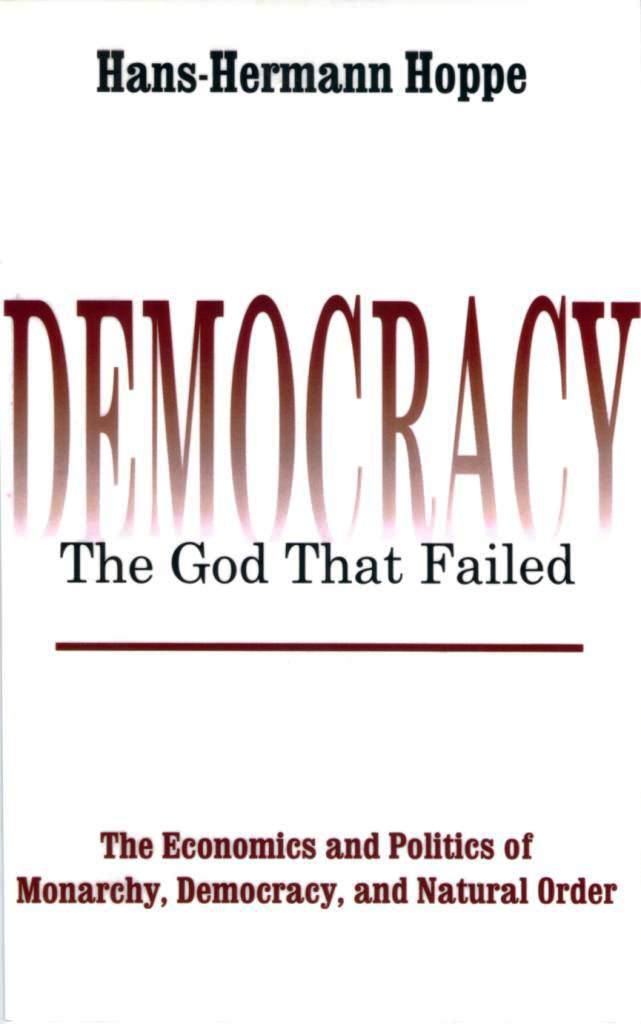
- Hans-Hermann Hoppe, “On Time Preference, Government, and the Process of De-Civilization—From Monarchy to Democracy,” in Democracy—The God that Failed: The Economics and Politics of Monarchy, Democracy, and Natural Order (New Brunswick, N.J.: Transaction Publishers, 2001); previously published in Journal des Economistes et des Etudes Humaines 5, no. 2 (1994) [also published in John Denson, ed., The Costs of War (New Brunswick: Transaction Publishers, 1997)]. [↩]
- Idem, Democracy, p. 99. [↩]
- Idem, Democracy, ch. 1 et pass.; idem, “How is Fiat Money Possible?—or, The Devolution of Money and Credit,” Review of Austrian Economics 7 no. 2 (1994): 49–74 [also in EEPP]; Hans-Hermann Hoppe, Jörg Guido Hülsmann & Walter Block, “Against Fiduciary Media,” Quarterly Journal of Austrian Economics 1, no. 1 (1998): 19–50 [also in EEPP]. [↩]
- Hans-Hermann Hoppe, A Theory of Socialism and Capitalism: Economics, Politics, and Ethics (Boston: Kluwer Academic Publishers, 1989), chs. 2 & 7; idem, The Economics and Ethics of Private Property: Studies in Political Economy and Philosophy [EEPP], 2nd ed. (Auburn, Ala.: Ludwig von Mises Institute, 2006 [1993]), chs. 11–13, 15, and “Appendix: Four Critical Replies.” [↩]
- Idem, Democracy. [↩]
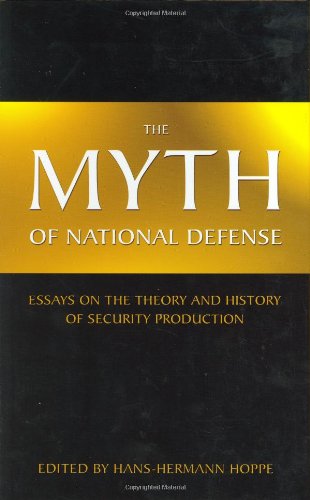
- Idem, “Government and the Private Production of Defense,” in idem, ed., The Myth of National Defense: Essays on the Theory and History of Security Production (Auburn, Ala.: Ludwig von Mises Institute, 2003). [↩]
- On immigration, see Hans-Hermann Hoppe, “The Case for Free Trade and Restricted Immigration,” Journal of Libertarian Studies 13, no. 2 (Summer 1998): 221–33 [also in The Great Fiction, and as “On Free Trade and Restricted Immigration” in Democracy: The God That Failed]; idem, “Natural Order, the State, and the Immigration Problem,” Journal of Libertarian Studies 16, no. 1 (Winter 2002): 75–97 [also in The Great Fiction]. [↩]
- Idem, “On Time Preference, Government, and the Process of De-Civilization,” p. 24, n. 25. [↩]
- Cf. Hoppe’s discussion of Robert Nozick’s “disparate or loosely jointed arguments, conjectures, puzzles, counterexamples, experiments, paradoxes, surprising turns, startling twists, intellectual flashes, and philosophical razzle-dazzle,” in “Murray N. Rothbard and the Ethics of Liberty,” Introduction to Murray N. Rothbard, The Ethics of Liberty, 2nd ed. (New York and London: New York University Press, 1998), pp. xxiv. [↩]
- Stephan Kinsella & Jeffrey Tucker, “The Ordeal of Hoppe,” The Free Market 26, no. 4 (April 2005). [↩]
Discover more from The Property and Freedom Society
Subscribe to get the latest posts sent to your email.














 Alessandro Fusillo
 Andreas Tögel
 David Dürr
 Doug French
 Fernando Chiocca
 Greg Morin
 Hans-Hermann Hoppe
 Jay Baykal
 Jayant Bhandari
 Jeff Deist
 Jeffrey Barr
 Juan Fernando Carpio
 Ken Yamarashi
 León Isidoro
 Martin Cabrera
 Nick Hoppe
 Oscar Grau
 Peter Wong
 PFS
PFS scholarium
 Saifedean Ammous
 Sean Gabb
 Sean Ring
 Stephan Kinsella
 Stéphane Geyres
 Thomas Jacob
 Tom DiLorenzo