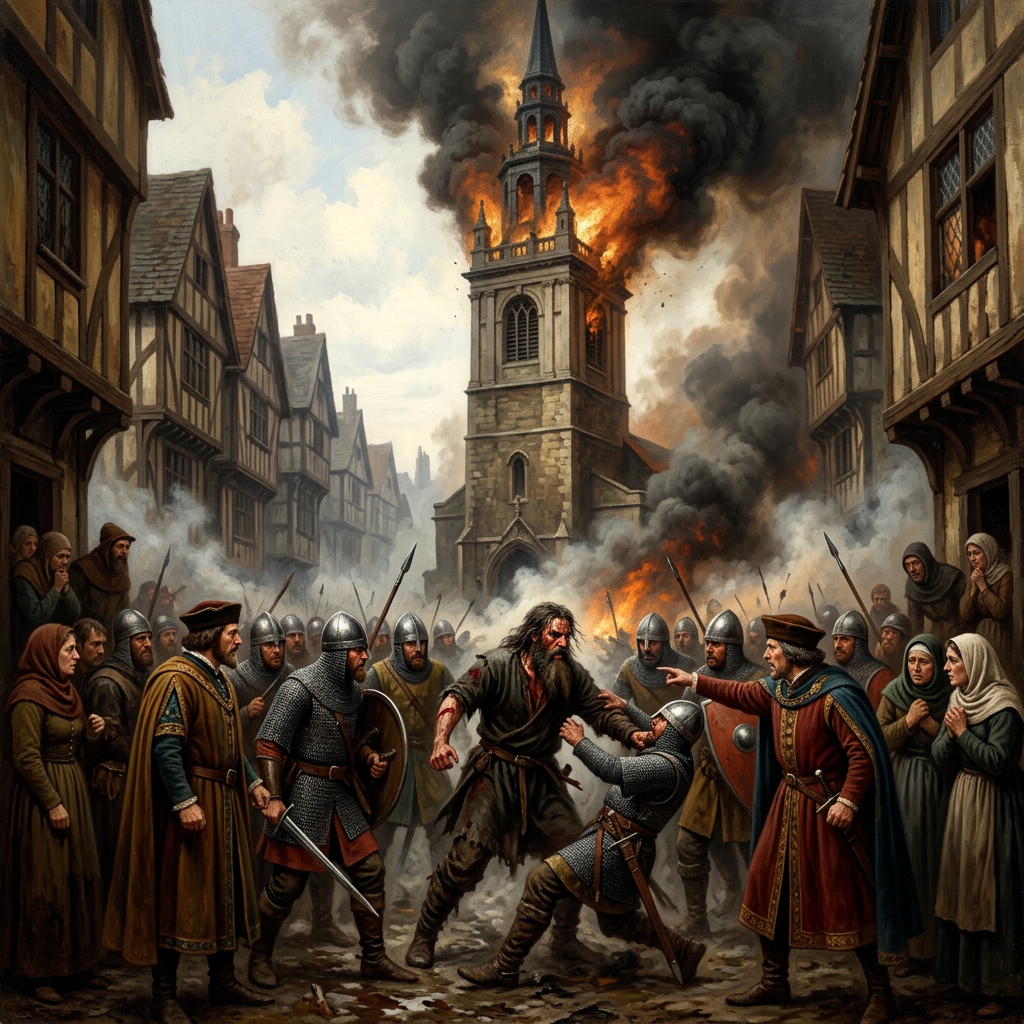
This YouTube video explains how cities in the twelfth century arrested criminals by detailing one particular case that may be of interest to those advocating for the private production of security and justice. The title card stating “no police, no problem” attracted my attention.
It begins with the intriguing statement that there “…were no police officers, no detectives, no fingerprints, no CCTV, and no Scotland Yard, so instead medieval cities relied on a system of collective responsibility in which ordinary people were expected to help hunt down criminals themselves.”
Then, just how were criminals apprehended without permanent, tax-funded, badged, bureaucrats on patrol?
The hue and cry was made mandatory through a legal requirement that any victim or witness of a crime must immediately raise the alarm by shouting “thief” or “wolf” loudly enough to alert the neighborhood. Anyone who heard the cry was legally obligated to stop their work and join the pursuit. The requirement was explicitly formalized in the Statute of Winchester of 1285, which decreed residents must follow the cry with “all the town and the towns near” from “town to town” until the culprit was captured.
The system was enforced primarily through financial penalties. If a resident heard the hue and cry but failed to join the chase, they could be personally fined. If a village or community failed to join the pursuit or catch the criminal when reasonably expected to do so, the entire village could be fined by the authorities. Communities were organized into groups of ten households, or a tithing system, whereby members were liable for each other’s conduct; if one member committed a crime and fled, the others were forced to either bring him to justice or pay compensation to the victim. This made a neighbor’s criminal behavior a direct financial problem for the rest of the group and incentived villagers to participate in law enforcement activities.
Of course, all of this took place under public administration and not a private law society of an ideal type.
Constables were appointed annually from among the leading villagers or citizens. The constable’s primary job was to lead the hue and cry when it was raised. In walled cities, once the hue and cry was raised, the city gates could be closed to trap the fugitive inside, aiding the residents in their mandatory pursuit. If the local community failed to capture a fugitive, the County Sheriff could raise a posse comitatus (literally, the power of the county). All men over the age of 15 could be forced to join this temporary militia to pursue a criminal across a larger area.
Here is where this case study in supposedly “private law enforcement” turns ironic. The illustration of a supposedly citizen-based criminal apprehension system describes the arrest of William “Longbeard” Fitz Osbert for inciting a tax revolt in London in 1196. Longbeard, himself a veteran of the Crusades, cited the unfair burdens imposed by the British crown due to foreign interventionism. Paying the Saladin Tax, King Richard’s Ransom, and other levies fell unevenly upon the poor and middle class while a wealthy merchant oligarchy shaped policy to shield their purses.
Longbeard challenged the established civic leadership, essentially creating a situation of “dual power” in London until the authorities suppressed the movement by force. With many citizens turning a blind eye, Longbeard evaded capture for a time and, as aligned with local customs, claimed sanctuary on holy ground. After authorities set fire to St Mary-le-Bow church to smoke him out, a wounded William Longbeard was captured and subsequently executed by being dragged through the streets of London behind a horse and then hanged at the Smithfield execution grounds outside London’s central district.
Discover more from The Property and Freedom Society
Subscribe to get the latest posts sent to your email.



















 Alessandro Fusillo
 Andreas Tögel
 David Dürr
 Doug French
 Fernando Chiocca
 Greg Morin
 Hans-Hermann Hoppe
 Jay Baykal
 Jayant Bhandari
 Jeff Deist
 Jeffrey Barr
 Juan Fernando Carpio
 Ken Yamarashi
 León Isidoro
 Martin Cabrera
 Nick Hoppe
 Oscar Grau
 Peter Wong
 PFS
PFS scholarium
 Saifedean Ammous
 Sean Gabb
 Sean Ring
 Stephan Kinsella
 Stéphane Geyres
 Thomas Jacob
 Tom DiLorenzo