The Demolition
by Jeffrey F. Barr*
Author’s note: This year marks the 100th anniversary of Murray Rothbard’s birth, and much has deservedly been written to mark the occasion. But any understanding of Rothbard at UNLV in the early 1990s would be incomplete without a corresponding discussion of the impact of Hans-Hermann Hoppe. It was a magical, if abbreviated, time for Austrian Economics.
Hoppe walked into the seminar room, set his notes on the table without sitting down, and started talking before most of us had our pens out. No preamble, no small talk about the reading—just straight into the labor theory of value, mid-thought, as if we’d been in the middle of a conversation he was simply resuming. That was how every one of his lectures began, and by the third week I’d stopped being surprised by it and started scrambling to keep up instead.
He was tall and gaunt, with glasses in that unmistakably ‘eighties style—sleek, contemporary, of-the-moment, not the thick, heavy frames people tend to picture on a European academic—and a Germanic inflection so thick it seemed less like an accent and more like a warning. He looked like a man built specifically to deliver bad news to bad ideas, and that, it turned out, was exactly his function in the seminar room.
This was the era of Schwarzenegger action movies, and it occurred to me more than once that Hoppe had the same quality Arnold did on screen, except where Schwarzenegger’s imperturbable stoicism was physical, walking through gunfire without changing expression, Hoppe’s was philosophical. He walked through an argument the same way, unhurried, untouchable.
The course was called “Marxism and Its Critics,” and it was really two courses stitched together.1 For the first eight weeks, Hoppe built Marxism out of Marx’s own words. We read Marx, himself, not a summary of him, not a caricature, and we constructed Marxism brick by brick, the way an engineer builds a bridge he intends to load-test later. The labor theory of value. Alienation. The dialectic. Surplus value and the falling rate of profit. We took notes like disciples. By October, if you’d handed any of us a soapbox, we could have made the case for revolution with a straight face because Hoppe had made sure we understood it well enough to believe it, at least for the length of a lecture.
Then, without any real announcement, the second half began, and with it, a new book—David Conway’s A Farewell to Marx, which told you exactly what was coming just by its title.
And then Hoppe took it all apart.
Both Hoppe and Rothbard had contempt for Marxism, but it wore different clothes in each of them. Rothbard’s contempt was joy-filled, almost merry—he could demolish an idea in a single aside, laughing the whole time, and be three subjects away before you’d finished appreciating the wreckage. I loved Rothbard’s lectures for exactly that reason; you never knew what country you’d be in by the end of the hour. Hoppe’s contempt was a different animal entirely: biting, rigorous, unsmiling. He dismantled Marxism the way a technical specialist disassembles an engine that’s failed a test—methodically, part by part, laying each piece on the table in the order it came out, so that by the time he was done you weren’t just told the machine didn’t work. You’d watched it fail, step by step, under its own logic. Surgical precision. Stringent logic. No detours, no asides, no wasted motion. It was the most structured teaching I have ever sat through, and I mean that as the highest compliment I know how to give.
I used to think of it as Teutonic, and I still do, though I mean something specific by that—not a stereotype, but a style: the conviction that intellectual rigor itself is a form of respect for the listener. Hoppe never let an idea get away with being merely persuasive. It had to survive premise by premise, or it didn’t survive at all. His own Argumentation Ethics—the idea that certain norms are presupposed the moment you open your mouth to argue, so that you can’t coherently argue against them without contradicting the act of arguing itself—came straight out of his training under Habermas. Habermas built a discourse ethics meant to ground a left-liberal consensus. Hoppe took the same architecture and corrected it, arriving at conclusions about property and liberty his own teacher would never have signed off on.
I remember finding that almost funny—the son taking his father’s tools and building a different house with them entirely. What still fascinates me, years later, is that Hoppe’s intellectual life was framed by two of the most diametrically opposed political economists of the twentieth century—Habermas on one side, Rothbard on the other—and he passed through both orbits and came out the other end genuinely and unmistakably himself.
What I didn’t fully appreciate at the time, sitting in that room with my notes on surplus value slowly being dismantled around me, was how rare it is to watch two great minds work in such different registers on adjacent problems. Rothbard taught me that ideas could be alive, mobile, fun, and dangerous in the way a river is exhilarating. Hoppe taught me that ideas could and should bear weight—that you could take a structure seriously enough to build it faithfully before tearing it down, and that tearing it down was itself a form of intellectual honesty most people never bother with.
Needless to say, I didn’t become a Marxist that semester. But I’d gone in assuming that if I understood Marxism well enough, I’d at least understand why intelligent people had believed it. By the end of the semester, I couldn’t even say that anymore. Hoppe had demolished that assumption right along with the labor theory of value—not by mocking the people who’d held it, but by showing, premise by premise, that the structure itself couldn’t stand, which meant believing it had never been a matter of intelligence at all. That’s what I remember most, more than the accent or the glasses or the imposing frame at the front of the room: a professor who built an idea faithfully enough to earn the right to take it apart, and then demolish it without mercy.
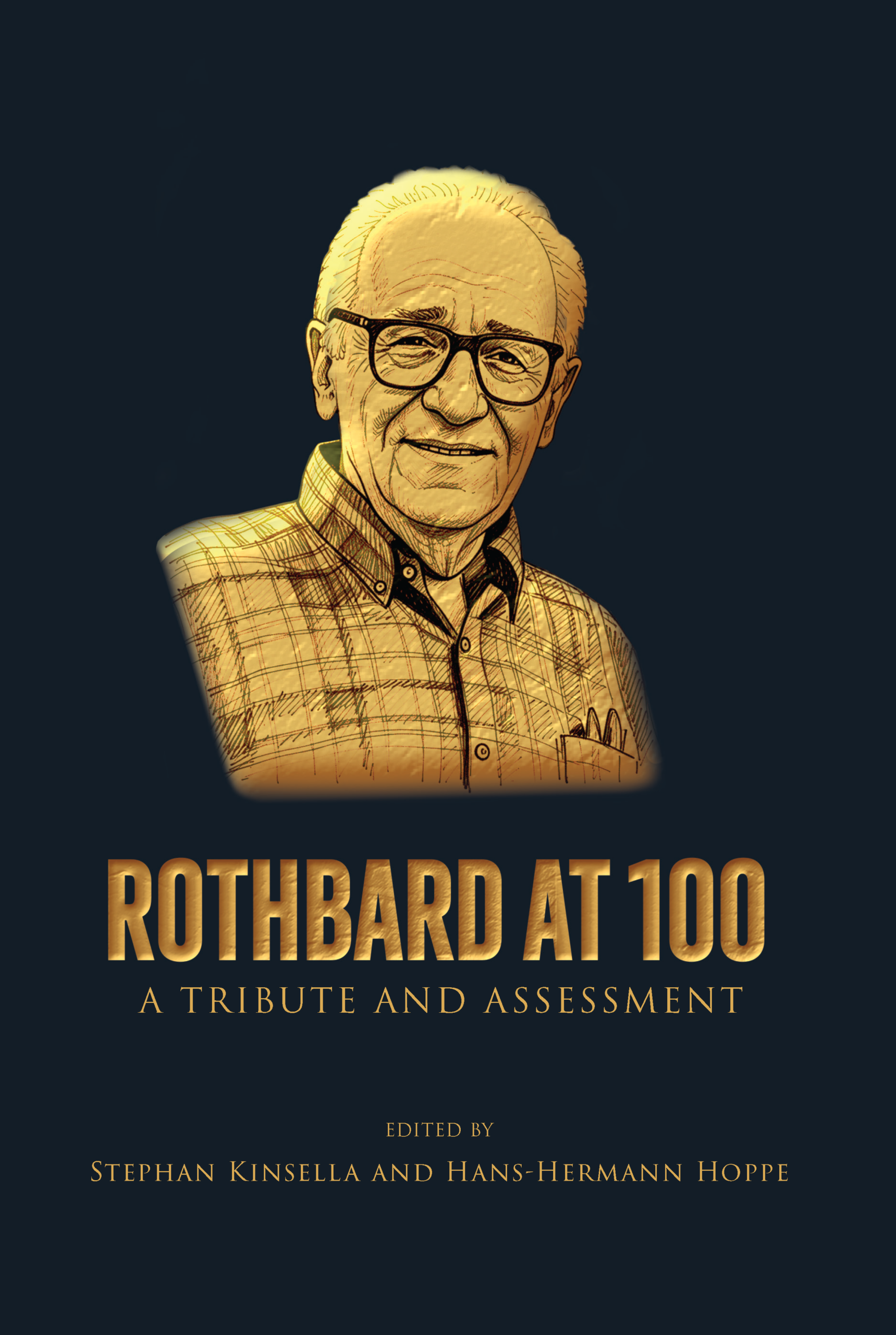
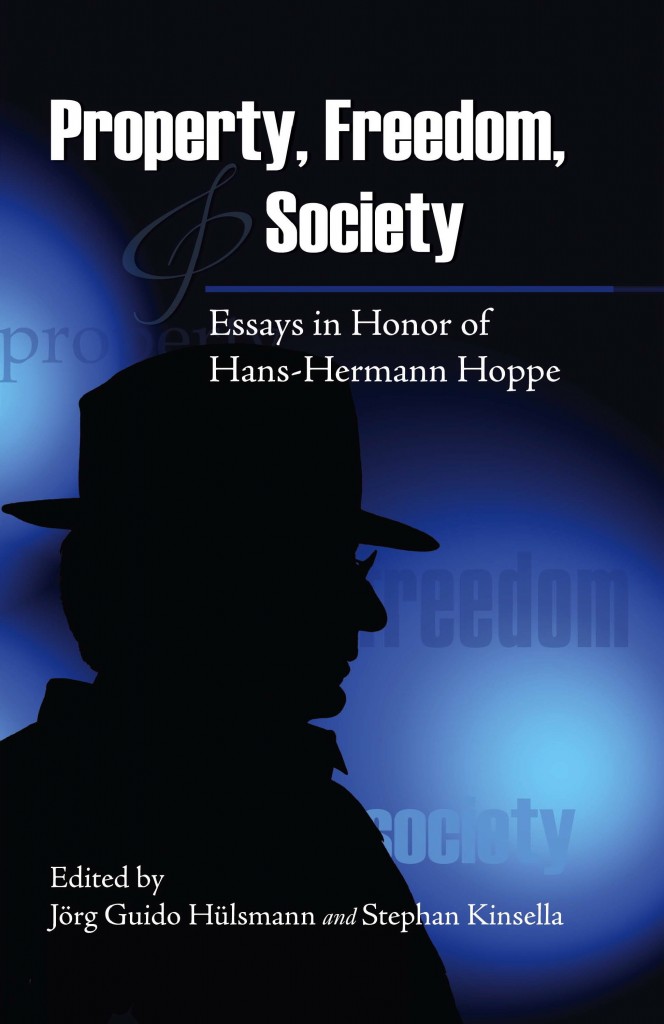
*Jeffrey F. Barr practices law in Las Vegas, Nevada. He studied under Murray Rothbard and Hans-Herman Hoppe in the late 1980s and early 1990s. For other pieces by the author on his experience with Hoppe and Rothbard, see Jeffrey Barr, “A Student’s Appreciation of Professor Hoppe,” in Property, Freedom, and Society: Essays in Honor of Hans-Hermann Hoppe (Mises Institute, 2009); idem, “Principled,” ch. 12 in A Life in Liberty: Liber Amicorum in Honor of Hans-Hermann Hoppe, edited by Jörg Guido Hülsmann & Stephan Kinsella (Papinian Press, 2024); and idem, “The Last Lecture,” ch. 2 in Rothbard at 100: A Tribute and Assessment, Stephan Kinsella and Hans-Hermann Hoppe, eds. (Papinian Press and The Saif House, 2026).
See also Kinsella, Hoppe: A Précis; Hoppe on Property Rights, “Panel: The Significance of Hans-Hermann Hoppe.”
- See Hans-Hermann Hoppe, “Marxist and Austrian Class Analysis,” J. Libertarian Stud. 9, no. 2 (Fall 1990): 79–93, also in The Economics and Ethics of Private Property, 2d ed. (Auburn, AL: Ludwig von Mises Institute, 2006); idem, A Theory of Socialism and Capitalism (Laissez Faire Books, 2012), chs. 3–6 (providing a systematic analysis of various forms of socialism, Socialism Social-Democratic Style, Socialism Russian-Style, the Socialism of Conservatism, and the Socialism of Social Engineering); Stephan Kinsella, “Hoppe: Marx was ‘Essentially Correct,’” StephanKinsella.com (Aug. 2, 2009); Jeffrey A. Tucker, “Marxism Without Polylogism,” in Property, Freedom, and Society: Essays in Honor of Hans-Hermann Hoppe, Jörg Guido Hülsmann and Stephan Kinsella, eds. (Auburn, Ala.: Mises Institute, 2009). [↩]
Discover more from The Property and Freedom Society
Subscribe to get the latest posts sent to your email.













 Alessandro Fusillo
 Andreas Tögel
 David Dürr
 Doug French
 Fernando Chiocca
 Greg Morin
 Hans-Hermann Hoppe
 Jay Baykal
 Jayant Bhandari
 Jeff Deist
 Jeffrey Barr
 Juan Fernando Carpio
 Ken Yamarashi
 León Isidoro
 Martin Cabrera
 Nick Hoppe
 Oscar Grau
 Peter Wong
 PFS
PFS scholarium
 Saifedean Ammous
 Sean Gabb
 Sean Ring
 Stephan Kinsella
 Stéphane Geyres
 Thomas Jacob
 Tom DiLorenzo