PFS member Thomas Jacob of Switzerland, editor of Hoppe Unplugged, initiator of the Swiss Gold Coin Initiative, and creator of OboxPlanet, was recently interviewed by Benjamin Mudlack on the German YouTube channel Der Ökonomische IQ. See: Thomas Jacob, interview by Benjamin Mudlack, “A Stateless Society According to Hoppe! But How?” [“Staatenlose Gesellschaft nach Hoppe! Aber wie?”], Der Ökonomische IQ (YouTube, Nov. 5, 2026; 1:00:45; in German, with English auto-dubbed audio and subtitles).
The interview is in German, but English speakers can follow along: YouTube provides an English auto-dubbed audio track (click the gear icon, then “Audio track”) and English subtitles (the CC button).
A few highlights:
- Meeting Rothbard and Hoppe (5:10). Jacob, then a Swissair pilot and a lonely Randian in Switzerland, attended the 1990 Mises University at Stanford, where he met Rothbard and Hoppe and left an anarcho-capitalist. What stayed with him most about Rothbard was his unshakable good mood: the happy libertarian, drinking beer and laughing with students late into the night. He tells the story at more length in his chapter in Rothbard at 100.1
- Hoppe Unplugged (11:56). Jacob wanted something short and attractive enough to leave on the coffee table, or to hand to someone in the middle of a political argument.2 Each page takes up a single political question, from immigration to whether intellectual property can be “stolen,” and answers it in Hoppe’s own words, starting from a stateless society and working back to the present. On his daughter’s advice he cut the most provocative quotes (killing his darlings, as filmmakers say), but added QR codes linking to the original talks, so the juicy bits are still one scan away. Along the way he recommends Hoppe’s A Theory of Socialism and Capitalism as the book to read if you read only one economics book.
- OboxPlanet (32:20). “Obox” is short for “out of the box.” Put Earth in a box, close the lid, set it aside, and imagine an identical planet, with the same continents and the same people, but no politics: no parliament, no bureaucracy, no taxes, no military. Then ask the usual questions (who builds the roads, who provides security, who takes care of the poor?) and answer them with stories rather than theory. Jacob walks through the planet’s ground rules: what he calls the Zero Aggression Principle, property acquired by original appropriation, contract, and neutral judges to resolve disputes. He is developing a half-day “adventure” workshop for students, which he has already tried out with a student group in Nepal.
Related
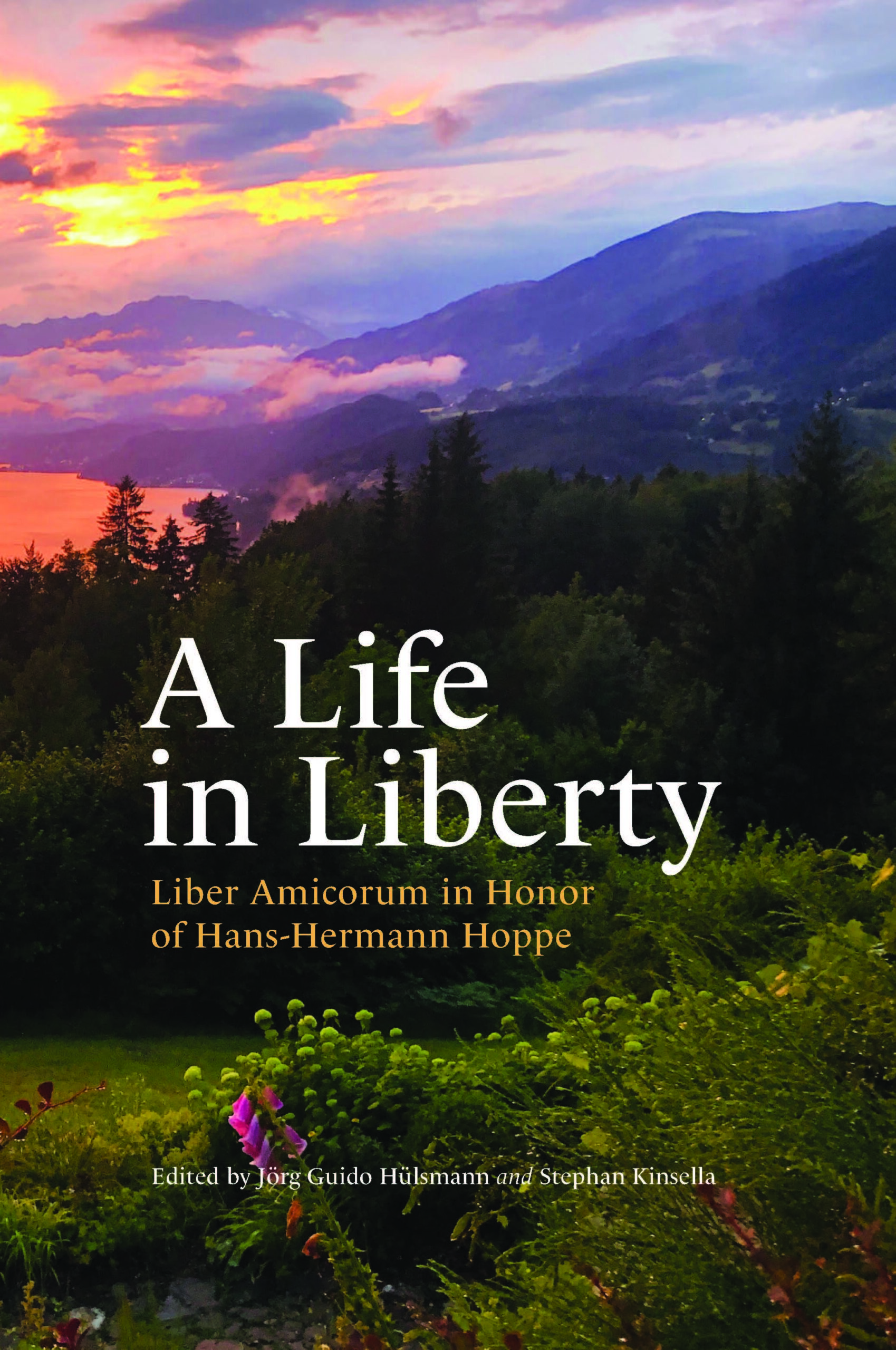
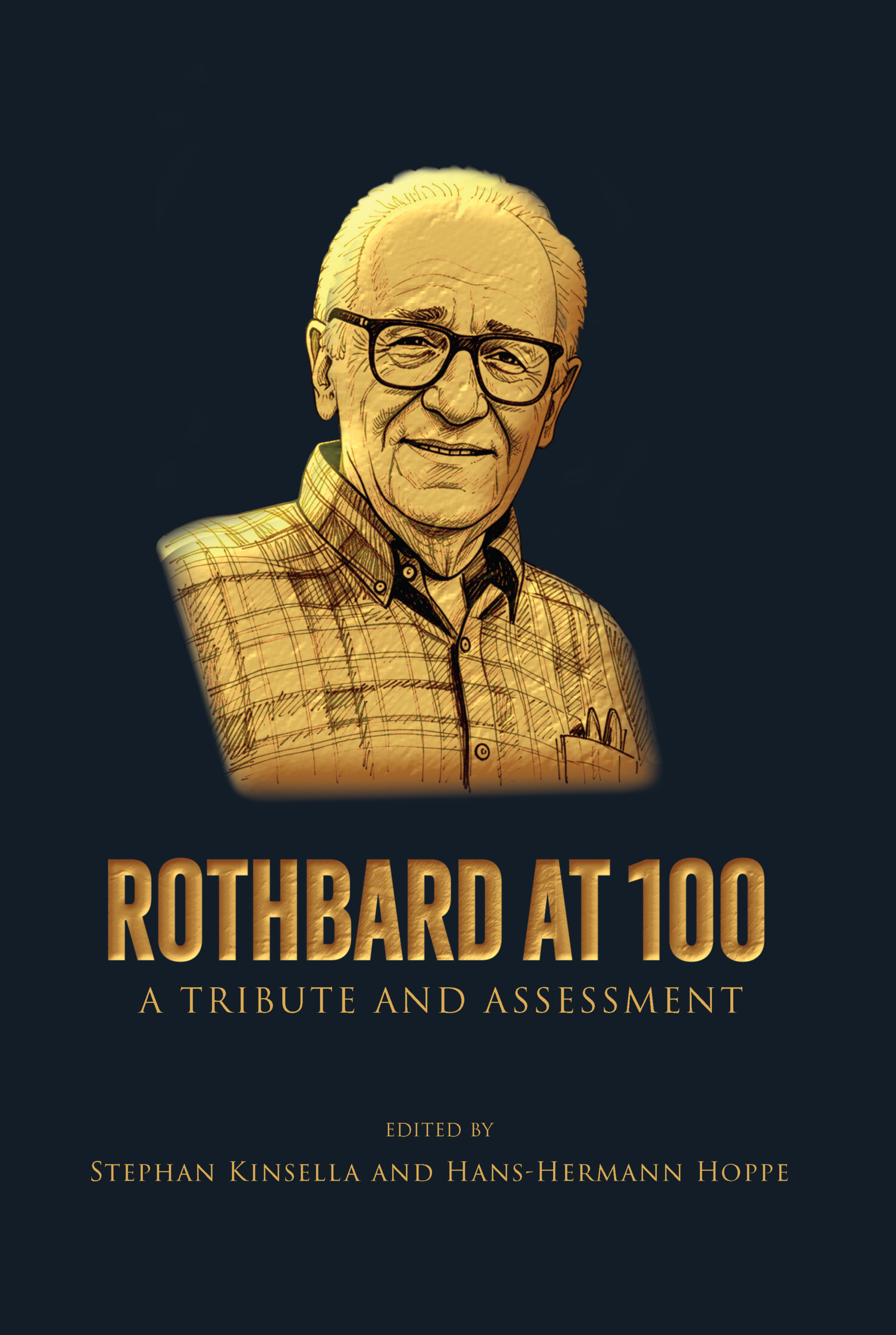
- Thomas Jacob, “Murray Rothbard, Mises University 1990, and the Power of Living Institutions,” in Stephan Kinsella & Hans-Hermann Hoppe, eds., Rothbard at 100: A Tribute and Assessment (The Saif House and Property and Freedom Society Press, 2026)
- Stephan Kinsella, “Libertarian Party of Switzerland Live Stream in Honor of Rothbard and Reading of Hoppe’s ‘Introduction’ to Rothbard at 100,” PFS (Mar. 7, 2026)
- “PFP313 | Thomas Jacob: Oboxplanet Presentation (PFS 2025),” Property and Freedom Podcast (Mar. 2, 2026)
- Thomas Jacob, “OboxPlanet 0.0: From Idea to Scale (PFS 2026)” (YouTube)
- Stephan Kinsella, “Hoppe Unplugged Available in Print,” HansHoppe.com (May 29, 2023)
Transcript
The interview was conducted in German. This transcript is based on YouTube’s English auto-dubbed version (a machine translation), lightly edited for readability: filler words and false starts removed, and garbled names corrected where the meaning was clear. It may still contain errors. Timestamps are approximate.
[00:00] Preview clips
Thomas Jacob: If you want to convince people in my circle, you’ll lose them with these quotes. And those were, of course, the quotes I loved the most, the most provocative ones. I have to cross all of those out.
Benjamin Mudlack: I’ve often heard, “But I still want to believe in it.” Stop believing in it. There are no better rulers. It is a problem when people rule over people, because it is always connected to force.
Thomas Jacob: It is a graphic illustration of Hans-Hermann Hoppe’s thinking. Whether he does it consciously or not, what has always fascinated me is the structure of his thought: he starts from a stateless society and works back to the current situation. And afterwards, things very, very often become very simple and clear, and exhaustive, in the sense that there is nothing more fundamental than a stateless society.
[00:56] Benjamin Mudlack: Welcome, dear friends of voluntary cooperation. We are back today with a super exciting guest: Thomas Jacob. He actually met Rothbard personally (this year, Murray Rothbard would have turned 100), and he also works very closely with Hans-Hermann Hoppe, organizing the Property and Freedom Society meeting that takes place every year in Bodrum. And he published this book here, where you can read, explained wonderfully and in short, compressed form, everything that Hans-Hermann Hoppe demands: the essence of all the writings and the truly radical demands of Hans-Hermann Hoppe. He also founded OboxPlanet; we’ll talk about that as well. You used to be a pilot, which is perhaps also important to mention. Maybe you’d like to round out the picture a bit: where you stand now, what you focus on, and your journey into and out of the cockpit.
[01:56] Thomas Jacob: Okay. First, a huge thank you. I was of course very happy to be able to contribute something to this illustrious circle. I hope I live up to it.
Perhaps more exciting than the pilot thing, though it naturally has something to do with it, is my libertarian path. Around 1980, I stumbled upon Rand, and then in the ’80s I was a relatively lonely Randian, so to speak, in Switzerland. Then in 1990 came the Mises University, where I converted to anarcho-capitalism, as Hoppe so wonderfully and provocatively puts it. That’s where I met Hans-Hermann Hoppe and Rothbard, and that was that.
Since I became aware of what an anarch is in this sense, three main projects naturally emerged where I wanted to contribute something: the Gold Franc project, the gold coin project, in 2010; then the little book Hoppe Unplugged; and now OboxPlanet, as you already hinted. All of that emerged later in this spirit, from this origin.
I was a pilot from 1986 to 2001, until 9/11. That was when Swissair was grounded and subsequently went bankrupt. After that, I went into the financial industry. But my time as a pilot was naturally a wonderful opportunity to get to know the libertarians scattered around the world quite easily. That is the connection with the pilot.
[03:53] Mudlack: Yes. And a pilot also has something freedom-loving about him. He is up there traveling with a bird’s-eye view, so that really has something of this meta-level that we freedom-loving people also talk about sometimes. That is definitely related, I would say. Of course, not every pilot is a freedom-loving person when he returns to earth, but they are generally inclined to be freedom-loving people who hover freely over things like a bird, so to speak. And I believe in your case that certainly applies.
[04:24] Jacob: Yes. What was especially exciting was witnessing the world back then, in the ’80s and ’90s, and above all experiencing the changes in the world live. I was in Beijing for the first time in 1986, and half the people were still walking around in Mao jackets. And in India, too: the huge progress there during the fifteen years I was lucky enough to be a pilot. And, of course, the opportunity to get to know libertarians all over the world. That was mainly the result of my pilot career.
[05:07] Mudlack: That’s how the circle closes. Regarding the Gold Franc, there is a great article that we will link under this video; I highly recommend it to everyone. But what I would be interested in first is how you perceived Rothbard and how you got to know him. He was said to be someone who skipped two grades: a really brilliant man who was very, very fast in his thinking and also very precise in his writing. In his speaking, he was said to often be a bit more confusing. I don’t know. It is always exciting to speak with people who actually got to know him, or at least stood face to face with him once. Maybe you can give us a little insight into that. Especially this year, I find it particularly interesting to talk about this, since he would have turned 100. And this book, Anatomy of the State, was for me an absolute eye-opener as to what the state actually is. But back to the beginning: how did you get to know him? How did you perceive him? Was there a difference between his writing and his speaking?
[06:13] Jacob: Yes, well, it was the Mises University, which is a one-week introduction to the Austrian way of thinking (Mises, Rothbard, Hoppe), and that was back in 1990, at Stanford. They were all still relatively young back then, like Hoppe and Salerno and all of them. Rothbard was already in his sixties, and he was a night owl. He mainly gave one lecture during the day, and that was relatively structured. It was obviously planned as an introduction for relative beginners like me, and that’s why those Mises University lectures were recorded. I would highly, highly recommend them, especially the last lecture he gave at the 1990 Mises University. You can certainly find it on YouTube.
But what was truly special about Rothbard is that it wasn’t obvious that he was this brilliant, groundbreaking intellectual. He was as approachable as anyone else. He was there in the evening drinking beer at the buffet, and he always had this wonderful, contagious laugh. And I really believe the inspiring thing that has stayed with me about Rothbard is simply his good mood. Nothing could bring down his good mood, despite the fact that he never got what he deserved. It never noticeably depressed him in any way. He really was the “happy libertarian.” That is my primary impression. And he was approachable until late at night.
I didn’t have any deep conversations with him, of course, because for me it was really just an introductory seminar, an induction week. And Hans-Hermann Hoppe, with his German thoroughness, structure, and systematic approach, resonated a bit more with me. But reading Rothbard’s lectures today is an absolute joy, because he was simply a genius and had such incredible knowledge, which allowed him to sprinkle pearls of wisdom into his talks left and right. I’d recommend it to everyone. Luckily, these things were recorded, so you can get a really good impression. Actually, for a book put out by the PFS, the Property and Freedom Society, I wrote a small article on exactly this topic: what I would recommend to experience Rothbard.
[09:46] Mudlack: Yes, and that is also currently being translated by Andreas Tank. We have already recorded a conversation about it and called for donations so that he can continue this wonderful work, translating Hans-Hermann Hoppe’s writings into German and, of course, especially those of Murray Rothbard. He is very, very diligent. He even translated America’s Great Depression, that massive tome; I have it lying right here in front of me. That is actually one of the central topics: boom and bust cycles, and the mother of all busts after 1929. Rothbard broke that down wonderfully, and it’s great that Andreas is translating it.
We’ve both managed to keep our good humor, which is perhaps worth mentioning. I’ve never had such a curious lead-up to a conversation as we’ve had. We made an appointment, then missed each other, then the internet didn’t work, and yesterday, while I was recording something else, you suddenly appeared on screen. We’ve had so much fun and laughed so much already. I was reminded of that when you said Rothbard was this cheerful fellow, the good-mood libertarian. I felt the same between the two of us: we didn’t get annoyed about it, but made the best of it, and were able to get to know and appreciate each other better this way. Above all, we were delightfully amused. So that was great.
[11:08] Jacob: Yes, I was also very, very impressed by how you reacted to all of that.
[11:14] Mudlack: Yes, because you know, everything happens for a reason. This way we got to know each other through a different situation and saw how each of us reacts to such things. That was definitely a stressful situation: I was in the middle of recording, you suddenly appeared, and we just laughed. Maybe we can cut that out, but it will definitely stay with us and connect us.
You just said that in 1990 Hoppe was around 50 and Rothbard 60. Unfortunately, Rothbard died only a few years later, still relatively early. And then you engaged more closely with Hans-Hermann Hoppe and got to know him better. You still organize the conference to this day, and you wrote this wonderful book. Perhaps you could elaborate a little on that, and we can draw attention to this book and pique some interest.
[12:04] Jacob: Yes, well, he was only 40 back then, so relatively early in his career, and he had written his first book in English, A Theory of Socialism and Capitalism. By the way, I always say: if you only want to read one economics book, it should be this one by Hans-Hermann Hoppe, because he performs a comparative analysis of economic theories, and everything that needs to be said is essentially said there, namely the destructive influence of the state. He covers its effect on prosperity and on the morality of society almost exhaustively. So I would recommend it to everyone.
And for those wanting a first impression of Hans-Hermann Hoppe, this booklet is it. My goal was to make him more accessible than he otherwise is in his usual writings. Those are actually relatively good; for the depth of the topics, they are very, very understandable. He covers these topics with German sobriety and thoroughness. But essentially, I wanted to make something where I could say in political discussions: here, take this and read it. That corresponds to my ideas. And I wanted to make it so short and so attractive that you could just leave it on the coffee table and browse through it a bit, or read one topic at a time in the restroom.
It is a collection of quotes, but not classically just quotes: I compiled them so that each one addresses a specific political question. And I also wanted to present Hoppe as I have found him, because what has always fascinated me is that when I ask him a question, his answers are short, understandable, and exhaustive. So if I ask, what about immigration? he says: well, if it were a private law society, everything would simply be private, and everyone would decide who can come to them and under what conditions. And then he brings the topic into today’s world: what can we learn now from this situation in a stateless world? That is what runs through the topics here, and later it was also the structure I needed for the “Hoppe Explained” [?] project, which is the further development of that perspective. It is a graphic illustration of the thinking of Hans-Hermann Hoppe. Whether he does it consciously or unconsciously, that has always fascinated me: the structure of his thinking, that he comes back from a stateless society to the current situation. And afterwards, things very, very often become very simple and clear and exhaustive, in the sense that there is nothing more fundamental than a stateless society, and nothing simpler: the natural order, so to speak. That is what eventually emerged from this collection of quotes, from this focus on one topic per page.
And the QR codes have a funny little story. I gathered these quotes from everywhere and then simply arranged them to fit the topics. I naturally had the advantage that Hans trusted me to do it correctly, or in his spirit, and when I asked, “Can I publish it like this?” he said, “Yes, that works.” But then I showed the quotes to my daughter, who was a student, and asked, “Would you say it like this too?” And she said, “Well, look: if you want to convince and entertain your own people, then keep those really juicy and provocative quotes in there. If you want to convince people in my circle, you’ll lose ninety percent of them with those quotes.” And those were, of course, the quotes I loved most, the worst ones, the most provocative ones, so I had to strike them all out. Apparently there is an expression in the film industry, “killing your darlings”: directors always have to cut the scenes they love most so that the film will be effective with the audience. So I did that with the written quotes. I crossed out all those very provocative statements, but I linked them to Hans’s original speeches and statements, so the juicy bits are linked in the QR codes.
[18:03] Mudlack: Yes, it turned out great. It is didactically excellent. I’ve picked out a page here: intellectual property. Can you steal intellectual property? And then there’s a little picture, and so on. It’s very easy to read, easily digestible, always in little chunks. And this is actually where I have to agree with your daughter, from my own experience. People come into the world, and then they enter the state educational system, where they are trained and raised to be dependent on the state. And the longer they are in this state educational system, the more they are conditioned to this state model. Unfortunately, the state model is of course not compatible with the reality of acting human beings. In terms of the logic of action, these are always hostile acts against peaceful people. That is what is happening there.
And the problem I often have is when I put my theses out there. I have already made several attempts to inform and enlighten people who are still completely stuck in this state model, and that is very difficult. Of course, you scare people off, because you take away their sense of security. People are belittled in the school and education system. They are instilled with harmful attitudes: guilt, inadequacy, fear, the idea that they are too small, that humans are antisocial, and so on. I mean, it’s the biggest nonsense ever. People can of course organize themselves peacefully and get a grip on their community right where it arises, not somewhere far away.
For me, the education system is one of the big points where one can illustrate this well right now, because the distress in Germany is very great. Take the PISA study: one can think whatever one wants about such surveys; different people collect different data and arrive at different results, and that’s how it is with the PISA study, too. But one does see a distressing tendency: the level keeps going down the drain. And there’s a great song about that: “Says the bishop to the minister: you keep them poor, I’ll keep them stupid.” That is exactly what is happening in the educational apparatus.
And what one should take into account psychologically, based on my observation, is that people have many beliefs. These are instilled in them at school, and from these beliefs a worldview is formed. Then someone like you or me, or like Hoppe, comes along and smashes that worldview to pieces. That worldview has become like a part of their own body, so tearing it down causes pain, mental pain, and their sense of stability is gone. I have often heard, “But I want to believe in it.” I say, stop believing in it. There are no better rulers. It is a problem when people rule over people, because it is always connected with violence.
And back to the education system: quality is going down the drain, and costs are exploding. Why? Because the ultimate regulatory mechanism, saying no, is missing. People cannot say no. Their subjective value judgments do not flow into it, and the quality of the service plays no role, because the needs of the people play absolutely no role in what is happening there. And if people cannot say no, the regulatory mechanism is gone: costs explode, and quality goes down the drain. That is what happens everywhere, no matter where the state is active.
But now we land back at the psychological challenge. That is where we are often too harsh, where I am also often too harsh. I am now trying to put myself in the other person’s position to find common ground. So I try to find a topic that hits a pain point for them, something there’s consensus on, like bureaucracy or taxes being too high, whatever it may be. Then I try to build on that foundation, and not start right away with the toughest narratives, like the climate or something else. That’s my little take on it. So I can understand your daughter’s point very well. But I think this book is truly excellent, and I’d recommend it to anyone who wants to sharpen their own perspective. And Hoppe isn’t just brilliant in how he explains things and in the stories he incorporates (Robinson Crusoe and so on always play a big role there); he is also extremely entertaining and funny. At least, I personally like the humor he displays. That’s subjective, of course, and some people might not like it, but I think the way he presents it is brilliant. So, where can we find this book? On the usual platforms? Where else can one look it up and order it?
[22:36] Jacob: Yes. But first, perhaps a brief word on the previous topic. That’s why we need to reach children and young people as early as possible. And second, there’s the topic of what I always call the rationally disinterested majority when it comes to politics. You’re touching on an important issue: if I’m relatively content, or at least in my ignorance have no resistance, and then a libertarian comes along and tells me how messed up everything is (come join me in the valley of tears!), then the legitimate question is: why should I put myself through that? Why shouldn’t I just stay in my relatively content illusion? Or why do we really have to spread libertarianism through fear and terror? In that regard, we aren’t much better than the others. And that is, of course, the bridge to my next project; I’ll get to that in a moment.
To your question: there is a website, hoppeunplugged.com, where you can download it for free, of course, and do whatever you want with it. I usually print about 2,000 or 3,000 copies and keep them in my basement, in German and in English, and you can order them from me in large quantities, for a maximum of 5 euros each, including shipping. In larger quantities it only costs about 1.50 euros each, and I just sell those out of my basement. But if someone wants to do it themselves, they can get them at cost price.
And very important: the Amazon account is available to any freedom entrepreneur, meaning any freedom-oriented business. If any student wants to earn a regular income, this Amazon page is currently unmanaged and has a lot of potential. I only have about three or four languages there, but there are ten translations. Long story short: if there is any student out there, or some other freedom entrepreneur, who wants to take over this account, they should definitely contact me, so that this account gets more use.
And I have made it a habit to always have at least one copy in German and one in English with me. When discussions get political somewhere, usually either there’s no time, or you get through a topic like schools, and you might even agree that schools have room for improvement, but when it gets really interesting, the time or the interest is lacking. Then I just say: here, take this and read it, and then we can talk on a different basis, if at all. So I give away one or two of these every week, everywhere: at campsites, in restaurants, to friends left and right, and my wife gives them to clients. It’s really a lot of fun, with consistently positive reactions, even people saying, “Of course, we need to discuss this further.”
I once described a funny experience in another festschrift for Hans. I was on a tram where two strangers were discussing politics, so I said, “Hey, the way you’re discussing this, you might find this interesting.” And one of them said, “Oh, the Hoppe. Yes, I know it.” Those are the funny things that happen when you give this little book away left and right.
[27:12] Mudlack: But you have…
Jacob: Excuse me.
Mudlack: Yes, you go first.
Jacob: You said that enlightenment is a matter close to your heart, and you pulled out the little book by Rothbard, Anatomy of the State. At the end of it he says, as we often do, that we still need new ideas, new ways to get our message across. I made a small video about how we have better ideas than the socialists but a much smaller following. What are we doing wrong? One thing is the economic aspect, which I want to address. If you have socialist convictions and identify with the state, you have countless earning opportunities with the state, whereas liberals or libertarians who want to reduce or eliminate the state as a provider of bread obviously have worse cards in a job interview than the socialist who says every bureaucracy should be much larger. Ideally, we should have an entrepreneurial model for libertarian thinking. The other thing is that the socialists still work with emotions: with justice, with equality, with the socialist paradise, with utopia, with that vague idea of “from each according to his ability, to each according to his needs.” That’s simply something you don’t have to explain. It goes directly to young people’s sense of well-being. So far, when we hold youth seminars and come with Hoppe’s theory, it only interests those who are already interested, and the others say: “Yes, I’ll get through this, but it has no significance at all for my daily life.”
[29:42] Mudlack: The whole thing has many facets, and I have a few thoughts in my head right now that I don’t want to lose. For one thing, what you just said about the deep meaning of life: Antony Mueller, who passed away a few months ago, at the end of May, once said to me, “The deep meaning of life, that is what drives us here, and what connects both of us, and Hans, and the others.” That’s just how it is. And my observation is that it is of course not particularly sexy to explain such theoretical, complex things (economic questions, incentive systems) to people. That is difficult. And also, what you just said about this Cassandra theme, the crash and so on, spreading fear: that is exactly what we should not be doing, in my observation. Of course one should provide a rock-hard analysis of what is going on: how harmful the fiat money system is, and how harmful the state is, especially those who harness the state for their own purposes and use it as a tool to control and, above all, to manage people. That is the decisive point. But what we need is not just pure educational work, in writings and such. We need positive narratives, positive freedom narratives, and entrepreneurial implementations and solutions, to actually lead by example.
And you just put it wonderfully, this word “freedom entrepreneur.” I like that. One can shape that in different ways. One thing is what we do here with the videos and so on. The other is to approach it entrepreneurially and take into account that the world today is how it is, that people are how they are, that in Germany the boomer generation is in the majority numerically, and that they are shaped by trust in the state, by a belief in institutions, and so on. So until they experience a break with reality, especially in West Germany, until they realize what game is actually being played, it is difficult. In the meantime, the thing is to offer entrepreneurial solutions. And I’ll now turn to OboxPlanet, because that is what I want to talk about: to lead the way and say, yes, everything is as it is now. Okay, we’ll leave that aside, in a value-neutral way. That’s how it is, and it will likely stay that way for now, but we are now taking a step further. This is where you and your OboxPlanet come into play. And you have a wonderful YouTube channel, which we will of course link; hopefully it will get many more views in the near future. So what are your plans for this project, and how can we all support it? How can we participate ourselves?
[32:22] Jacob: Yes. First of all, Obox stands for “outside the box,” or “out-of-the-box thinking,” which we know from business life. When we look for new ideas, we take what we know, put it all into a box, a crate, forget it, and think outside the box. That is also an image for how I think, and you can use it to illustrate how Hans-Hermann Hoppe thinks, or how it’s possible to think that way: by first going into a stateless world (I prefer to say a world without politics), looking at what it’s like there, and then coming back to Earth.
So first we put Earth, as I said, into a box, close the lid, set it respectfully to the side, and imagine a parallel planet outside the box: the Outside the Box Planet, or OboxPlanet for short. Copy-paste Earth: the same continents, animals, size, everything, including humans. It just has no politics: no parliamentarians, no bureaucracy, no taxes, no military. And then, of course, come the immediate questions: Who builds the roads? Who takes care of the poor? Who ensures security? We don’t answer them with theory; we simply go there and take a look, or rather, we imagine how it could be. I have already prepared stories on OboxPlanet, which one can then comment on, and so on. But the basic idea is actually quite simple, and that’s already it: I simply offer a stateless parallel planet. Now you take any topic and imagine how it could work there.
At first it was intended as a new way to convey libertarian theory, through adventures and stories instead of theory, with just a little theory so that you can find your way around. But it then also became a personal feel-good program, simply because the more I thought my way into this world, the simpler, clearer, and also funnier, if not more absurd, today’s reality becomes. I think the first time it really happened to me was when I got a completely brainless parking ticket. I thought: how would that actually be solved in a city on OboxPlanet? How would parking be handled there? And immediately a great many possibilities and ideas came to mind. Then I looked back and thought: you can’t be serious with these regulations. And with other topics, it’s often the case that when I encounter an annoyance, say passport control or security checks at the airport, I imagine how it would be solved there. Those obviously don’t exist there, because there is no terror and so on. Then I look back and sometimes have to say: “This is so crazy, I almost have to admire it. I couldn’t have imagined it being solved so stupidly.” It turns the annoyances of reality into a more playful challenge, and that’s relaxing.
And this dichotomy also has very, very great didactic potential: if you start with a society that is very simply organized and then bring in the state, it becomes very easy to structure, like learning 1 + 1 first and multiplication later, or, when analyzing something, taking the simple part first and then overlaying the other part. I’ve also illustrated that in images. Maybe we can take a look at one or two, just as a teaser, to motivate people to watch these explanatory films.
[37:31] Mudlack: Yes. While you’re talking, it occurs to me that it would also be an idea for another video to go through one point thoroughly. You have many videos here. One is called “No Alternative,” a thought experiment called OboxPlanet. It lasts almost 40 minutes, and you explain very well there how the whole thing can work. It might be an idea to just play it through: pick a topic, talk about it together, philosophize about it, and take a look. And what you just said is quite crucial, I think: that you are able to endure these things more lightheartedly, more playfully, with a lot of humor, and also to carry the path forward yourself into practice, to how it could look in this parallel universe. Because what is happening today often doesn’t work. Basically, people have been put into a model, through the education system, through state media, and so on, that cannot be reconciled with how people actually tick. And that is the decisive point at this stage.
[38:30] Jacob: Yes. And I think something important is that you have to be able to imagine something first, before it is seriously considered, or before you are even motivated to commit to it. Hayek, for instance, said that what we must learn from the socialists is their courage to be utopian, which won them the support of the intellectuals and thus made possible what only yesterday seemed impossible. That is also this image, specifically with the intellectuals and their utopia.
And if you’d like, I have a world premiere here of two small images. I need them for the films. And I definitely want to recommend the English films; they are shorter, and also much, much simpler and more modern. I will translate them soon. May I show this one, the organizational principle on OboxPlanet?
[39:48] Mudlack: Sure, yes, very good.
[39:51] Jacob: Right. So the planet is based on the Zero Aggression Principle, and this limits the other principles of order: property, contract, and the neutral judge. Property, of course, because it is a private property society. And how does property arise without violating the Zero Aggression Principle? Through original appropriation. Then contract, which regulates what I may do with my property, and that is also limited by the Zero Aggression Principle. And in case of conflict, there is a neutral judge. Funnily, David Dürr used exactly the same term. The Zero Aggression Principle is basically like the law of gravity, which limits all the other laws. And that is the whole thing: these are the peaceful actions on OboxPlanet.
And then, of course, there is the “Prick,” the private criminal. I made a little mascot for him, double meaning intended. The question is always: how are private criminals dealt with on OboxPlanet? And here I can immediately recommend Oliver Janich’s excellent book Sicher ohne Staat [Safe Without the State], which thinks this through; it’s an eye-opener. Criminals dominate the headlines, and if you only read the headlines, all of humanity seems evil, but in everyday life they play practically no role. My indicator is: how much do we spend to ensure security? Do you know how much that is in Western European countries?
[41:50] Mudlack: I don’t know. And nobody knows what it is worth either, because people cannot say no.
[41:57] Jacob: Oh yes. Well, in Switzerland it is around 2%: police, justice, military, prisons; I think the fire department and internal security are included too. 2%. So the question is: how would private entities on OboxPlanet ensure security with 2% of this money? There would also be no military, so it would be even less. You could ensure the security that the state provides on Earth with 1% of income, and more efficiently, too. In the European countries it is under 2%, though without the military, in all of them. And if that were also done privately, OboxPlanet would be so safe that some would find it boring there. That safe.
And if you illustrate it like this, with these as 100% of actions, then the 2% Prick slice of the pie is almost invisible. Everything else is peaceful action. We have the P, the mascot for peaceful interaction, and we can illustrate very nicely that the ZAP, the Zero Aggression Principle, only states what you must not do. But what is really important, and can also be illustrated this way, is that in a private law society you can, of course, have any number of voluntary orders, ranging from house rules to marriage contracts to all the contracts we have, voluntary or even religious ones. The most important thing is simply that you can exit these contracts. That’s what you always emphasize, too: the problem with the state is that you cannot exit it. In principle, the state has many of these same kinds of rules too, if one were to look at them, but one must simply be able to exit. That is the difference.
So you see the whole order of a private law society illustrated very simply. And if you then include the state, you can see nicely that the state introduces an additional organizational principle at the highest level: the monopoly on force. And non-violence and a monopoly on force are mutually exclusive. Everything the state does would make a private individual a Prick if he did it. We don’t even want to judge that, but with it the state can naturally do whatever it wants below: with property, with contracts, and if it comes before a judge, the judge is judge in his own cause. You can illustrate all of this so playfully. And if you bring in the state, we can even see how omnipresent it is, and that it partially replaces the private, voluntary orders of OboxPlanet. It’s not that OboxPlanet doesn’t want marriage contracts or traffic rules, but they would be voluntary. The state, though, additionally interferes in all private areas, saying I’m not allowed to smoke weed, for instance. And the entire monetary system would probably not even be a voluntary order, but a spontaneous order, with no contract at all.
And you can even illustrate negative and positive rights; that’s brand new. Here I call it the defensive state, which wants to fight the Prick: the DeMoC. MoC is the Monopoly of Coercion; that’s the little mascot. And below you have the AMoC, the active state that interferes everywhere. Those are the positive rights, and in Switzerland the positive rights need about fifteen times more tax money than the negative rights…
[46:40] Mudlack: Insane.
Jacob: …and when you look at it like that, I think even fourteen-year-olds can see it afterwards: “Aha, there are the positive and negative rights.” And for preschool age, I have the mascots in this form. Here we have the P: private, voluntary actions. Here we have the Prick: the private criminals. And here we have the MoC: the legal monopoly on force. Technically, they do the same thing; one just does it legally, and the other illegally. And quite funny: after I created these mascots with these names, I went to IKEA, and they had these three mascots in this size. So I have three large mascots, and my little five- and six-year-old children always ask which one is the Prick, which one is the MoC, and which one is the ZAP. So they are already being playfully indoctrinated in the essence of political theory.
[48:06] Mudlack: Short question, long answer, but I find that a great achievement, to approach these topics so playfully and creatively. So my question is: the YouTube channel is one thing, but what else is there? How can people participate? How can they get into this thought experiment and these figures themselves? What else is planned, and what is the status today?
[48:32] Jacob: Yes. To start with, there is the website [name unclear in the recording]. It is a bit theoretical, a bit overloaded, and it is simply not maintained; it’s no longer a priority at the moment. Then there is the OboxPlanet YouTube channel. You definitely have to watch the English films there. I will translate them as quickly as possible, because the others are partially outdated. And what I am working on is a half-day adventure program for young people into a world without politics, with the goal that after this half-day you view the world with more clarity, calmness, and confidence. The test would simply be that next week, when you watch the news, you view it with calmness, perhaps with amusement and entertainment value, instead of annoyance. And the funny thing is, if we manage to make it really work like that, then of course there’s a business offer. There are many people who are not happy when they hear the news, or the Covid victims, and so on, and I ask them: assuming I could guarantee that you would view the world with calmness and confidence from next week on, what would that be worth to you? Better blood pressure, better cortisol levels, and so on; you can even measure it if you want. What would that be worth to you in time and money?
[50:22] Mudlack: It is almost priceless.
[50:26] Jacob: So let’s say 100 francs and one Saturday, with a money-back guarantee. Then I just need ten people, and we’ll do such a workshop. I have already tried it out, but not yet with the structure I have now. I’d like to try out this structure next, build a concept on it, and then optimize it, so that there can be a franchise. The vision, of course, is that we start with the student organizations (Students For Liberty and all the others), later the parties, and then the larger public. In that sense it is a non-political undertaking: just let yourself be whisked away into another world. I don’t want to convince anyone. Go take a look, come back, and take what you want from it. Those who are interested will find their own way. But between us (nobody else should know this), once you have looked through this keyhole into this world, your world will never be the same again, because you then have the alternative, the idea that there could be another world, another way of looking at the world. It’s a bit like the Middle Ages, when suddenly someone says: there is also America. Just knowing that it exists will change your feeling toward the world, right?
[52:16] Mudlack: I can confirm that. Once the spirit of freedom is out of the bottle, you can’t get it back in. That’s the first thing. The second thing, which I have also observed very often, is that people who thought in a very collectivist way, and economically very state-oriented, at some point came across the writings of the Austrian School and never went back. I don’t know anyone who went from the Austrian School in the collectivist direction, but I know so many people who went from collectivism, and from mathematical economics, from all the intellectual fallacies of the hired scholars and their paymasters, toward the Austrian School. The same is naturally to be expected here as well. And the seminars and workshops: will they take place in German, in Switzerland? Do you already have dates, or what is the status?
[53:08] Jacob: That is the next step; that is what I will plan next, where the next seminars will take place. But as I said, the material itself is all online, on OboxPlanet, and otherwise you can also contact me. The material is available, and it can also be changed; it’s just about making the excursion to OboxPlanet as attractive as possible. I suggest doing it in three parts with clear goals. The first part is the introduction, just to understand a little: what is the organizational structure, so that you can find your way around on this planet. That is supposed to provide some clarity: after the first two hours, you should see the political world with more clarity. Then another two hours, the big tour, as I call it, where we look at security without the state in detail, so we can check that topic off. And that is just awesome. For example, the first time we go to OboxPlanet together, it’s with three stories, and the third story is about how we deal with the poor. On OboxPlanet, the poor have rights too, and they get justice, much better than here, because in a market for security and law there is competition for justice, and there is nothing better for a competitor than to show that a rival has wrongly locked up a poor or rich person. It’s even a business model to get such people back out and share the compensation. Those are just some of the promises and surprises you experience when you venture onto this planet.
[55:32] Mudlack: Totally brilliant. I’m diving into it right now too, and I’m excited about the first workshop. Maybe we’ll have the opportunity to promote that together, to organize it…
[55:47] Jacob: Exactly. But in principle, any of your listeners can already try it out; just take a look at what I’ve already done. And what might also be quite exciting: I was already able to run a test with the Libertarian International. My friend [name unclear] in Nepal had a group of students available, so to speak. I did it just like that: first a bit of theory, and then very quickly moving to OboxPlanet with stories. After the theory, they said it was interesting but a bit theoretical: how do I approach this? And with the very first stories they said: now it makes sense, now I see it, now I’m experiencing it. It’s more vivid.
[56:40] Mudlack: It is. I believe that learning without emotions, or any theory without emotions, is basically at zero when it comes to retaining it.
[56:54] Jacob: And then for the grand tour, I already have 20 stories available, on individual topics. For example: businesses without permits: who controls them? Or media without politics: what news do we really need? In the second part you can take a topic, work on it, and present it, and when you have five or six topics, that world becomes real and alive. Then in the third part, I want to encourage people to take topics from everyday life, simply anything that annoys them, go to OboxPlanet, and see what happens when they look back at Earth. That’s the great thing. However you do it, let me know: get in touch, and tell me what your experiences are and what you need.
[58:04] Mudlack: That was almost a wonderful closing statement, dear Thomas. Totally brilliant, and with how much emotion and conviction you presented this project! And I believe you said something decisive. The theoretical part is, of course, important; the intellectual foundation is certainly important. But what is decisive, and the opposing collectivist side always managed this very well, is that they had much better marketing. They played with emotions, unfortunately also with fear-based emotions, which we should avoid at all costs. But we also need positive, freedom-based emotions. That is very, very important. Dear Thomas, perhaps one last short closing word from you. We will, of course, continue this and dive into OboxPlanet, and continue to follow the project with open eyes and a lot of enthusiasm. Perhaps it will bring us even closer together; we’ll see what happens, perhaps with one or two questions under this video. Where can people find you? Where can they send you emails, or whatever? And a little closing word would be nice.
[59:04] Jacob: Yes, the easiest email address is [email protected], and otherwise there’s the OboxPlanet website. And to close: I think it was Casablanca that said, “I think this is the beginning of a beautiful friendship.” Thank you very much for your interest, and for your patience in letting me present everything in such detail.
[59:31] Mudlack: Well, I thank you. It was really great how we met and how everything has played out. I can only return the sentiment, and I’m looking forward to everything still to come. Dear viewers, I hope we were able to bring you just as much joy. Please dive into OboxPlanet, dive into this book, and engage with the writings, everyone in their own way. And intellectual independence [the English dub says “intellectual property”], that is the crucial point. Think things through for yourself, and take these ideas further. Common sense and your own independent thinking are what actually move us forward, because many things simply can’t be explained by common sense and don’t serve you; you know that if you’ve followed our channel for a while. In that sense, I thank you, dear Thomas, and thanks to the viewers. Share the video with friends and acquaintances, and of course get active: dive into OboxPlanet, and you’ll see this crazy Earth from a different perspective. Thanks to you, thanks to all of you. See you soon. Bye.
- Jacob, “Murray Rothbard, Mises University 1990, and the Power of Living Institutions.” [↩]
- Hans-Hermann Hoppe, Hoppe Unplugged (Thomas Jacob, ed., 2023); English edition here. [↩]









 Alessandro Fusillo
 Andreas Tögel
 David Dürr
 Doug French
 Fernando Chiocca
 Greg Morin
 Hans-Hermann Hoppe
 Jay Baykal
 Jayant Bhandari
 Jeff Deist
 Jeffrey Barr
 Juan Fernando Carpio
 Ken Yamarashi
 León Isidoro
 Martin Cabrera
 Nick Hoppe
 Oscar Grau
 Peter Wong
 PFS
 scholarium
 Saifedean Ammous
 Sean Gabb
 Sean Ring
 Stephan Kinsella
 Stéphane Geyres
 Thomas Jacob
 Tom DiLorenzo

Follow Us!