From the Vault: Hans-Hermann Hoppe, “Die Wurzel des Übels: Ausbeutung und Rechtsbruch” (“The Root of Evil: Exploitation and Lawbreaking”), lecture at the inaugural conference of the Ludwig von Mises Institut Deutschland, Hotel Bayerischer Hof, Munich (June 15, 2013).
The talk is in German, but YouTube now offers an English-dubbed audio track: in the player, click the gear (settings) icon, choose “Audio track,” and select English. We first posted the video back in 2013 as “On Taxes and Parasites”; below we add a summary and a full English translation.
Hoppe spoke in Munich, home of FC Bayern, a few weeks after Bayern president Uli Hoeneß admitted he had evaded taxes on a secret Swiss bank account (he would be convicted in March 2014 and sentenced to three and a half years in prison). Taking the furor over Hoeneß as his hook, Hoppe argues that taxes are theft; that every attempt to ground them in contract, whether as rent, as consent through the constitution, or as the hypothetical contracts of John Rawls and James Buchanan, collapses; and that tax evasion is therefore nothing but self-defense against a band of robbers. He then turns to the economics and sociology of the democratic tax state, which splits society into producers and tax-consuming parasites: the welfare underclass, state employees and politicians, and, above all, the plutocrats who buy the politicians, while what is left of the productive middle class is squeezed flat. It isn’t Hoeneß who is “antisocial,” he concludes, as German President Joachim Gauck had claimed, but Gauck and company.
Related
- Hoppe, “On Taxes and Parasites,” PFS Blog (July 15, 2013) (the original 2013 post of this video)
- Hans-Hermann Hoppe, “Philosophie Magazine Interview on Taxation,” HansHoppe.com (Mar. 10, 2011), reprinted as “Interview with Philosophie Magazine,” in The Great Fiction, 2d ed., ch. 27; German translation: “Steuern sind Diebstahl,” PFS Blog (April 2012)
- Hans-Hermann Hoppe, “State or Private-Law Society?,” in The Great Fiction, 2d ed., ch. 13
- Hans-Hermann Hoppe, “The Economics and Sociology of Taxation” (1990), HansHoppe.com
- Hans-Hermann Hoppe, “‘Taxes Are Expropriation’: Interview in Wirtschaftswoche,” HansHoppe.com (Jan. 2014)
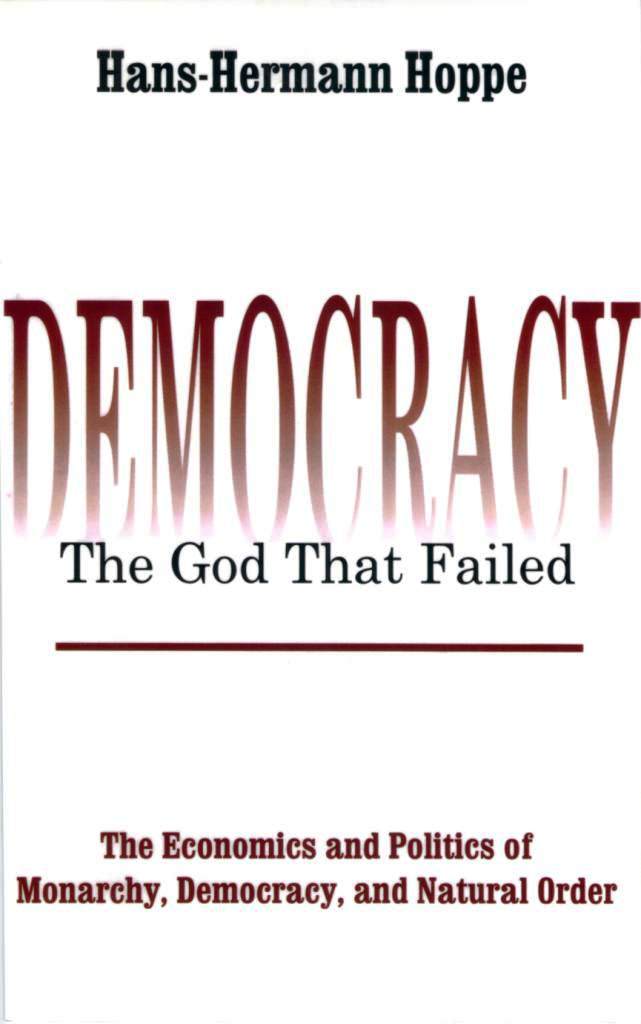
- Hans-Hermann Hoppe, Democracy: The God That Failed (2001)
- “Hoppe Lecture at Modelhof Academy: “Private law society without a state” (2012),” PFS Blog (July 28, 2026)
- “Lao Gu: Why You Should Never Introduce an Inheritance Tax,” PFS Blog (Nov. 13, 2026)
- Stephan Kinsella, “Why Should the Government be Limited?,” StephanKinsella.com (Sept. 2011)
Summary
- Introduction (0:19). The moderator opens the day’s program by introducing Hoppe: his studies in Saarbrücken, Frankfurt, and Michigan; his doctorate under Jürgen Habermas (1974) and habilitation (1981); his years with Murray Rothbard, his colleague at UNLV, where Hoppe taught from 1986 until 2008; and his founding of the Property and Freedom Society. Hoppe’s writings, he says, force readers to question, and often discard, their own political and economic convictions.
- Opening remarks (2:28). Hoppe thanks his hosts and notes that when he left Germany some thirty years earlier, he was, as far as he knew, the only Misesian in the country. Progress since then has been modest, but satisfying.
- Hoeneß and Mencken (3:05). Taxes and tax evasion are in the headlines thanks to Uli Hoeneß, and the conference is in Hoeneß’s own city. Hoppe reads H.L. Mencken’s observation that the average man sees government as a separate and often hostile power, and that robbing the government is everywhere regarded as a lesser offense than robbing a private person: in the latter case a worthy man loses the fruits of his industry, in the former “rogues and loafers have less money to play with.” (For his Bavarian audience he also passes along, as a bit of Mencken’s flair, a joke: a day has 24 hours, a case of beer has 24 bottles; coincidence?) Hoppe wonders whether Mencken was too optimistic about ordinary people, given the indignation in readers’ letters about Hoeneß. The politicians’ hatred he expected, since they live off men like Hoeneß. But perhaps the average man has simply grown, or been made, more simple-minded, and has degenerated intellectually and morally.
- The thesis (7:48). It is not tax evaders like Hoeneß who belong in prison, but those who levy and collect the taxes: Merkel, Schäuble, Steinbrück, Steinmeier, and the rest. Taxes are not only theft, making politicians a gang of thieves; they are also economic nonsense that systematically reduces prosperity. Politicians and their tax-funded intellectuals naturally say otherwise, but no amount of intellectual contortion can change the facts.
- Taxes are not voluntary payments (9:13). You aren’t punished for no longer buying Volkswagens and so no longer paying the salaries of VW’s CEO and workers; you are jailed for refusing to pay for the pomp of the Berlin government and the salaries of Merkel and her cronies. The only way to defend taxes as just is to claim some contractual basis for them, so that tax evaders are guilty of breach of contract. Every such attempt fails.
- Taxes as rent? (10:34). If taxes were rent, the state would have to prove that it, and no one else, owns every square centimeter of the country, and that it has a lease with every single citizen setting the use and price. No state has such title deeds or leases.
- Consent through the constitution? (11:43). The fallback claim is that citizens consented “at a meta-level,” by agreeing to a constitution that authorizes taxation, giving the state a kind of general power of attorney. But where are the signatures? A few politicians signed the constitution and a few swear an oath to it; Hoppe never signed it, and neither has almost anyone else.
- Rawls, Buchanan, and fictitious contracts (13:17). Rawls, celebrated as the leading “practical philosopher” of the left, and the Nobel laureate Buchanan, touted as a radical free-marketeer of the right, offer the same “harebrained” argument: a fictitious contract among hypothetical reasonable people (Rawls’s “veil of ignorance,” Buchanan’s “conceptual contract”) binds us without our signing anything, on the motto that “no contract is also a contract.” Fictitious contracts even bind all future generations, a feat no real contract can manage.
- Would reasonable people agree to a state? (15:46). Hoppe takes the idea seriously long enough to refute it. Imagine someone proposing, as a permanent and irrevocable agreement, an institution that acts as the ultimate judge in a territory, with the final word in every conflict, including conflicts in which it is itself involved. Those who expect to run such an institution would welcome it, but no one in his right mind would agree: the state could provoke conflicts and always decide them in its own favor. No one would be secure in life or property anymore. The state would let us live until it ordered us to kill and die for it, and leave us our property until it decided to expropriate it. All private property would become “fiat property,” property by the grace of the state. Only a real pistol to the head, not a fictitious one, could extract consent to such a deal.
- Tax evasion is self-defense (19:59). Taxes are therefore theft and robbery with no contractual basis, and tax evasion is self-defense against a robber band. It is not wrong to refuse to pay these thieves, or to lie to them about one’s income and assets. That doesn’t make it prudent: the state, as Nietzsche said, is the coldest of all cold monsters, and it can destroy anyone who defies it. But it is just. Hoeneß had no reason to apologize; it is understandable that he did, given the overwhelming power of the robbers and the mob they had stirred up, and given that he probably lacked the arguments to defend himself and counterattack.
- “But you get something for it” (21:32). Hoppe disposes of the popular argument that taxes buy valuable benefits, such as a paved road in front of my house. First, it may not be a benefit (perhaps I hate paved roads). Second, it is an expensive benefit, since those spending other people’s money are generous, that is, careless and wasteful, with costs and their own “expense allowances.” Third, even at minimal cost it is waste, because taxpayers would otherwise have spent the money on things they valued more; otherwise they wouldn’t have to be forced. State benefits therefore satisfy at best lower-ranking wants at the expense of higher-ranking ones. Fourth, taxes are never one-time payments: the road must be maintained and further fees paid, so the waste is institutionalized and perpetuated.
- Producers versus tax consumers (24:35). The deeper damage is to the structure of society and of personality, especially under a democratic tax state. Every tax redistributes wealth and income from those who produced it to those who did not, discouraging future production and encouraging the confiscation and consumption of what others have produced. Society splits into two antagonistic classes: producers, who earn their living by selling what voluntarily paying customers want, and who shrink in number as taxes rise; and tax consumers, who live parasitically off taxes levied on the producers, and whose number grows as tax revenues grow. Society as a whole becomes poorer.
- The parasite class, part 1: the underclass (27:35). Welfare recipients (in Germany, “Hartz IV”) pay no taxes and are rewarded for having nothing and doing nothing, so the more they are paid, the more have-nots and do-nothings there are, and the underclass becomes a permanent plague. But since its members are, “to put it diplomatically,” not the brightest, they have little real influence on policy and are not the main beneficiaries of redistribution.
- The parasite class, part 2: state employees and politicians (29:46). State employees, from the municipality up to the central government, including all politicians, pay no taxes either. The tax deduction on their pay slips is a bookkeeping fiction: without taxes their income would not rise from net to gross but fall to zero, and tax increases are, for them, raises. They are parasites like welfare recipients, but at a far more expensive level, paid at best to do what the market would do better and more cheaply, and usually, under the politicians’ direction, wreaking economic havoc. Politicians are not especially bright either, but they need a certain cunning to get elected and run an enterprise whose aim is not profit from satisfying customers but maximizing tax revenue and debt-financed spending. The state is “a gigantic robber band,” and the politician’s skill lies in disguising its robbery as social welfare, appealing to the voters’ envy, and, after each election (Mencken’s “advance auction of stolen goods”), distributing the loot so as to keep voters in line. As unscrupulous demagogues and cunning crooks, they are far more dangerous to producers than the underclass.
- The parasite class, part 3: the plutocrats (34:04). The main beneficiaries, though, are a small but enormously influential group: the plutocrats. Presidents, chancellors, and party leaders are often mere agents of a power elite that stays in the background and decides who rises to those offices in the first place. The plutocrats are not simply the super-rich, but that subset of big bankers and industrialists who have grasped that the state’s powers to tax and legislate can make them even richer, even faster, through subsidies, large government contracts, and laws that shield them from competition or even bail them out of bankruptcy, as the recent financial crisis showed. They need not enter politics themselves; they buy the less wealthy and less bright top politicians, directly through bribes or indirectly with lucrative post-political posts as managers, consultants, and lobbyists (just look at what the leaders of the left-wing parties earn afterward). Caught between the plutocrats, the state’s employees, and the underclass, the much-invoked middle class, that is, what is left of the producers, is increasingly squeezed and flattened.
- Conclusion (38:16). Taxes are unjust and a moral disgrace, and the democratic tax state is an immeasurable waste of scarce material and human resources and a breeding ground of economic parasitism. Tax evasion is therefore not “antisocial,” as German President Joachim Gauck had said, but a positive social contribution to draining an enormous moral and economic swamp. It is not tax sinners like Uli Hoeneß who are antisocial, but Gauck and company.
English Translation
PFS translation from the German transcript of the video, lightly edited for readability. Timestamps refer to the video. Editorial notes appear in brackets.
Introduction by the Moderator (0:19)
And so I would now like to open today’s program of lectures. It is my great pleasure to welcome our first speaker, Professor Hans-Hermann Hoppe. Professor Hoppe is one of the most important social scientists of our time and one of the leading representatives of the Austrian School of economics. As philosopher, sociologist, and economist, he devotes himself to the key questions of scholarship and society.
Hans-Hermann Hoppe studied philosophy, sociology, history, and economics at the University of the Saarland in Saarbrücken, at the Johann Wolfgang Goethe University in Frankfurt am Main, and at the University of Michigan. He earned his doctorate in 1974 under Jürgen Habermas and completed his habilitation in 1981. [The recording is unclear here. —Ed.] From 1985 on he worked closely with Mises’s student Murray Rothbard; they were colleagues at the University of Nevada, Las Vegas, where Professor Hoppe taught from 1986 until his retirement in 2008. He is a Fellow of the Ludwig von Mises Institute in Alabama, a member of the academic advisory board of the Ludwig von Mises Institut Deutschland, and the founder and president of the Property and Freedom Society. He teaches and lectures worldwide.
Professor Hoppe’s numerous writings have been translated into many languages. They are not only intellectually stimulating and exciting; above all, their clear language and compelling logic lead the reader to question his own previous political and economic convictions, and in the end to have to reject many of them as false.
Dear Professor Hoppe, it is a great honor for us that you have come. We now look forward to your lecture, “The Root of Evil: Exploitation and Lawbreaking.” The floor is yours.
Opening Remarks (2:28)
Well, first of all I would like to thank Thorsten Polleit and Andreas Marquart for the invitation. When I left Germany thirty years ago, I was, as far as I know, the only Misesian there was in Germany. The progress made since then may not have been quite at the rate Thorsten Polleit sketched, four times, four times, four times [apparently a reference to earlier remarks; the recording is unclear here. —Ed.], but still, I think we can be satisfied.
Taxes, Tax Evasion, and Uli Hoeneß (3:05)
I want to talk about taxes. The subject of taxes and tax evasion is, of course, on everyone’s lips again, not least thanks to Uli Hoeneß. And we are, after all, here in the hometown of Uli Hoeneß and FC Bayern.
Let me begin with a quotation from H.L. Mencken, whom I hold in high esteem, and who in the 1920s and 1930s was one of the best-known and most famous American journalists and social critics. On taxes and tax evasion, Mencken wrote the following (this is my translation):
The average man, whatever his errors otherwise, at least sees clearly that government is something lying outside him and outside the generality of his fellow-men—that it is a separate, independent and often hostile power, only partly under his control, and capable of doing him great harm.… Is it a fact of no little significance that robbing the government is everywhere regarded as a crime of less magnitude than robbing an individual, or even a corporation?… When a private citizen is robbed a worthy man is deprived of the fruits of his industry and thrift; when the government is robbed the worst that happens is that certain rogues and loafers have less money to play with than they had before. The notion that they have earned that money is never entertained; to most sensible men it would seem ludicrous. They are simply rascals who, by accidents of law, have a somewhat dubious right to a share in the earnings of their fellow men. When that share is diminished by private enterprise the business is, on the whole, far more laudable than not.1
So much for Mencken. And since we are here in Bavaria, perhaps I might also convey a bit of Mencken’s flair, a little joke. Mencken is also the source of the saying: “A day has 24 hours. A case of beer has 24 bottles. Coincidence? I think not.” [Laughter]
When I look at the readers’ letters about the Hoeneß case published on the Internet, I wonder whether Mencken, in his assessment of the common sense of the average Joe, isn’t perhaps too confident and optimistic after all. That politicians of all parties would fall upon Mr. Hoeneß, full of hatred, I naturally expected. After all, they are the ones who let gentlemen like Hoeneß finance their salaries, their do-gooderism, their little games, and their playmates too, and who would have to go without if this financing dried up. But the average Joe, too, seems indignant at the offense of tax evasion. Then again, perhaps that is all an illusion. Perhaps it isn’t the average Joe at all who publishes readers’ letters on the Internet? Or (and I actually fear that this is the case) the average Joe has simply, plainly, since Mencken’s day, become more simple-minded, or been made more simple-minded, and has degenerated intellectually and morally.
The Thesis (7:48)
Be that as it may, in what follows I want to try to show why the ordinary citizens Mencken described are not only right, but, going beyond that, why it is not the so-called tax evaders like Uli Hoeneß who should be convicted and locked up, but, conversely, those who enact and collect these taxes: that is, our highly esteemed politicians, Merkel, Schäuble, Steinbrück, Steinmeier, Rösler, Trittin, Lafontaine, and whatever else their names may be. [Then-Chancellor Angela Merkel and Finance Minister Wolfgang Schäuble; the Social Democrats Peer Steinbrück and Frank-Walter Steinmeier; FDP leader Philipp Rösler; the Green Jürgen Trittin; and Oskar Lafontaine of the Left Party. —Ed.] And I want to show that taxes are not only theft, and politicians therefore a gang of thieves, but that taxes are, moreover, economic nonsense and systematically reduce the general prosperity.
Naturally, though, politicians, who are after all paid with and out of taxes, will declare taxes justified and legitimate and want to portray tax evaders as criminals. And in this undertaking they will be zealously supported by a whole pack of intellectuals who are likewise financed by taxes. But even the greatest zeal and the greatest intellectual contortions cannot simply make the facts go away.
Taxes Are Not Voluntary Payments (9:13)
What are the facts? First, and who would deny it: taxes are obviously not a normal, voluntary payment for goods and services, since one is not permitted to stop paying if one ceases to be satisfied with the product. You are not punished if you stop buying VW cars, and thereby stop paying the salary of Mr. Winterkorn [then CEO of Volkswagen —Ed.] and of all the VW workers. But you are thrown in jail if you refuse to pay for the pomp and swagger of the government in Berlin, and thereby the salaries of Mrs. Merkel, her cronies, and all the other state employees.
If one nonetheless wants to present taxes as just and the refusal to pay them as unjust, there is only one way out, argumentatively: one must try to argue that taxes somehow have a contractual basis, and that tax evaders are therefore guilty of some breach of contract. But these attempts to justify taxes, as I will show in a moment, are all doomed to fail.
Taxes as Rent? (10:34)
For example, people have tried to present taxes as something like rent payments, that is, as user fees of the sort a tenant pays his landlord. But then the German state, for example, would have to be the owner of all of Germany and the landlord of all Germans. And to be that, it would have to be able to prove two things: first, that the state, and no one else, is the owner of every square centimeter of German soil; and second, that it has concluded a lease with every single German concerning the use and the price of this property. No state, neither the German nor the American nor the French nor any other, can furnish this proof. There are simply no corresponding title deeds, and there are no corresponding leases. The argument of the taxpayer qua rent payer thus founders glaringly on the facts.
Consent through the Constitution? (11:43)
So people then tried to think up another justification, which runs something like this. Granted, taxpayers have no contractual obligation to pay the state, of the sort a tenant has toward his landlord. But they are nonetheless guilty of a breach of contract if they do not pay their taxes. How so? Why? Because they have supposedly given their consent to taxation on a higher level (grandly, this is always called a “meta-level”) by giving their consent to a higher law, namely the constitution, and this constitution in turn permits taxation. So it is supposedly not necessary to consent to each individual tax measure, because through one’s consent to the constitution one has, so to speak, issued the state a general power of attorney.
But this argument, too, founders on the facts. For where, oh where, is the contractual consent to the constitution? Where are the signatures of all the persons supposedly subject to the constitution? A few politicians once signed the constitution, and a few politicians swear an oath to it nowadays. But I didn’t sign it, and practically no one else has signed it either. How could one have made oneself guilty of a breach of contract by refusing to pay taxes?
Rawls, Buchanan, and Fictitious Contracts (13:17)
So yet another argument is needed. This argument has recently been warmed over again by big-name intellectuals such as John Rawls and James Buchanan. Rawls is generally regarded as a leftist, and is presented to us by the so-called authorities in the usual-suspect mainstream media as the greatest practical philosopher of the twentieth century. And Buchanan is described by the same authorities as a Nobel laureate in economics and a man of the right, and touted as a great radical free-marketeer. In substance, however, the argument of the two does not differ in the slightest. And, as is hardly unexpected of officially approved big-name intellectuals, their argument is equally harebrained.
According to their argument, it is not necessary to have signed a contract in order to have concluded a contract nonetheless, on the motto: “No contract is also a contract.” Well, how is that supposed to work? For this, it is supposedly enough for a fictitious contract to have been concluded between hypothetical, supposedly reasonable people. In Rawls, this is a contract concluded behind the “veil of ignorance,” and in Buchanan the same fictitious contract is called a “conceptual contract.” And with this trick, using fictitious or notional contracts instead of real ones, Rawls and Buchanan then even claim to have solved yet another problem. For with real contracts it is obviously impossible to bind future generations as well: how could they have signed a contract? With merely notional contracts between hypothetical reasonable persons, on the other hand, this is no longer any difficulty at all. With fictitious contracts it is a breeze to regard all persons as bound for all time.
Would Reasonable People Agree to a State? (15:46)
Now, the absurdity of this construction of fictitious contracts ought really to be obvious. But perhaps it is worth briefly pursuing the question whether it is actually conceivable that reasonable persons could conclude a contract à la Rawls or Buchanan. So imagine a supposedly reasonable person making the following proposal:
“In view of the reality and possibility of interpersonal conflicts, I propose, as a permanent and indissoluble agreement, the establishment of a state. We will found an institution that has the authority to act as the ultimate judge in a given territory. The state, or, to put it more concretely, the owner or owners and administrators of the state, shall have, in every case of conflict, including all conflicts in which they, the agents of the state, are themselves involved, the very last word on who is right and who is wrong in a dispute.”
And it should be clear that persons who see or imagine themselves as the owners of the state, who imagine that under this agreement they will become the owners of the state, would welcome such an agreement enthusiastically. What couldn’t one get up to as the owner of such an institution, deciding in every conflict who is right and who is wrong! That would be just too great. But is it conceivable that all reasonable persons could agree to such an institution?
And here I say (and I don’t think I’m being very daring when I claim this) that it is completely out of the question. One would sooner regard the proponent of such a proposal as crazy and ripe for the loony bin than agree with him. For any person even halfway in his right mind would immediately recognize what this contract means in its consequences. On its basis, the state, or its agents, can themselves cause conflicts and then always decide them in their own favor. In view of that, one could literally no longer be secure in one’s life and property. One no longer has a right to life; rather, the state lets us live so long as it does not command that we must kill and die for its owners. And one no longer has a right to one’s property; rather, the state leaves us our property so long as it does not decide to take it away from us and expropriate it. That is, all private property becomes fiat property, property by the grace of the state.
Let me stress once more that all of this follows immediately from the fact that the state is always the ultimate judge in all cases of conflict, including conflicts in which it is itself involved. It is a logical consequence of this. Whoever agrees to this contract can no longer be secure in his life and his property. Hence my claim: no reasonable person could ever agree to such a contract. Only with a real, a very real, pistol to one’s head, not a fictitious one, could one agree to this nonsense, whether in fact or merely fictitiously.
Tax Evasion as Self-Defense (19:59)
So however you twist and turn it, you always arrive at the same conclusion: taxes are theft and robbery. There is no contractual basis for them whatsoever, and tax evasion is therefore nothing other than self-defense against a band of robbers. It is no wrong to refuse to pay these thieves, or to lie to them about one’s income or assets.
That does not mean, of course, that it is smart and wise to do so and not pay one’s taxes. After all, the state, as Nietzsche put it, is the coldest of all cold monsters.2 It can ruin your life and destroy you, and if you resist its commands, it will finish you off. But there can be no doubt that it is just not to pay one’s taxes.
Uli Hoeneß, then, had no reason whatsoever to apologize for his conduct. But it is understandable that he did so nonetheless, given the overwhelming power of the robber band arrayed against him and the mob it had stirred up, especially since he probably also lacked the arguments to defend his conduct rigorously and to go on the counterattack. Too bad he didn’t turn up here.
“But You Get Something for It” (21:32)
That brings me to the economic assessment of taxation. And as a transition to this topic, so to speak, I’d like to quickly dispose of one particularly popular pro-tax argument that everyone knows. The argument is yet another intellectual contortion to turn a no, that is, a rejection, into a yes, that is, consent. In its simplest version, the argument runs roughly like this: “Yes, taxes are compulsory levies, but in return one at least gets something valuable. The state takes my taxes, but with them it finances, say, the paving of the road in front of my house, and so it does me a good turn.”
To this one need only reply the following.
First, it is not certain that this really is a benefit. Perhaps I hate paved roads.
Second, even if it should be a benefit, it is nonetheless an expensive one. For the owners of the state demand, for their do-gooding, a reimbursement of costs, or an expense allowance, which they set themselves. And when one spends other people’s money, one is, as is well known, much more generous with the costs and the expense allowances (that is, more careless and more wasteful) than when one has to spend one’s own money.
Third, even if the expense allowance were zero and the costs of the benefit really were minimal, it is nonetheless, in every case, an economic waste. For the taxpayers would have spent their money on something else, something more valuable from their point of view; otherwise they wouldn’t have had to be forced. This proves that state benefits, whatever they may consist of, at best only ever satisfy secondary or lower-ranking wants. Their satisfaction, in other words, always comes at the expense of the satisfaction of first-ranking and higher-priority wants, and to that extent it always represents a waste of scarce resources.
And fourth, with taxes a one-time payment is, as a rule, not the end of it. After I have been compelled to contribute to paving the road in front of my house, I must then also pay for the further upkeep of the paved road and pay an additional user fee. So to the first waste of scarce resources another is added, and waste becomes institutionalized and perpetuated.
Producers versus Tax Consumers (24:35)
With the keyword “perpetuated waste,” I now come to the core of my analysis of the economic and social effects of taxation. For with taxes it does not end with the ongoing waste of scarce resources. The existence of a tax state, and in particular the existence of a democratic tax state, in which those who hold the reins of government emerge from majority elections, has fundamental effects on the structure of society and of personality, whose economic damage is immeasurably greater still.
First of all, every tax means a redistribution of wealth and income. Wealth and income are forcibly taken from their owners and producers and redistributed to persons who did not possess this wealth and did not produce this property. All future accumulation of wealth and all future production of income is thereby discouraged; and conversely, the confiscation and consumption of existing assets managed by other persons, and of income produced by others, is encouraged. Society splits into two antagonistic classes.
On the one side are the producers, who earn their wealth and income standing on their own two feet, by achieving and producing something that is demanded by voluntarily paying customers and judged worth its price. The pressure on these producers becomes all the greater and more unbearable the higher the tax burden imposed on them. The higher the taxes, therefore, the smaller the number of producers and the smaller the rush into productive activities.
On the other side are the tax consumers, who obtain their wealth and income not by producing and selling their products on the free market, but parasitically, by living off the wealth and income taxes imposed on and wrung from the producers. The higher the tax revenue, the greater the number of such parasites, and the greater the rush into unproductive activities and employment, will be. That a society thereby becomes not richer, but on the whole poorer, ought really to go without saying.
The Underclass (27:35)
But the picture becomes bleaker still when one takes a somewhat closer look at the parasite class, as it develops especially under democratic conditions. There is, first, the underclass of so-called welfare recipients: keyword, Hartz IV. [Germany’s basic welfare benefit for the long-term unemployed. —Ed.] They pay no taxes; rather, their income is paid for entirely out of the tax payments of productive persons. They are rewarded for being have-nots, being nothing, and doing nothing; and consequently, the greater the reward, the more have-nots and do-nothings there are. Poverty and unemployment are not reduced or alleviated. Quite the contrary: the incentive to free oneself from poverty and pursue a productive activity is reduced, and poverty and unemployment are increased. The underclass grows, and it becomes a permanent, ugly plague.
But the underclass has only little influence on state policy. True, their numbers are large; members of the underclass vote too, and as a politician angling for votes one must therefore satisfy them somehow. But it would be naive to assume that they have a decisive influence on policy and are among the main beneficiaries of the state’s redistribution policies. For, after all, there is as a rule a good reason why some people are have-nots and other people have achieved prosperity. To put it diplomatically: the members of the underclass are, as a rule, not exactly the brightest minds in society, and it is hardly conceivable that they, of all people, could prevail over their brighter fellow men in the long run when the tax loot is divided up in the democratic struggle over redistribution.
State Employees and Politicians (29:46)
That brings me directly to the second group within the class of economic parasites. That is the group of all state employees, salaried employees and civil servants, from the municipality on up to the central state, including in particular, of course, all politicians. They too pay no taxes. True, a tax deduction appears on their pay slips, and they therefore regularly, brazenly, claim to be taxpayers themselves. But this is merely a bookkeeping fiction, a trick to feign the equality of all persons before the tax law. In reality, their entire net income, and all the wealth built up out of it, comes from taxes. Their income would not go up from net to gross if there were no more taxes; instead, it would fall to zero. And tax increases do not mean a loss of income for them, as they do for producers; rather, for them tax increases mean, as a rule, a raise. They are thus, one and all, just as much economic parasites as Hartz IV recipients, only at a much higher, more expensive, and costlier level.
At best, they are paid to do things that could be done much more cheaply and better by the market. In some cases, they are simply paid for loafing. But as a rule, guided in this by the politicians, they are busy wreaking economic havoc.
The politicians aren’t the brightest in the land either. But they do, after all, have to be elected by the masses in order to rise to key state positions, to become chancellor, minister, or parliamentary or party leader. And once elected, they must run and administer an enormous enterprise in order to be re-elected afterward. That undoubtedly takes a certain intelligence. Only, it is a very special enterprise that they run. The goal of the enterprise called the state is not to earn an economic profit from selling products or services that customers judge worth their price. Rather, the goal of the state is to maximize the tax revenue whose use one, as its manager, can decide, and in addition, where possible, to increase its spending further by taking on debt that must be serviced later by means of future taxes. In short, the state is a gigantic robber band, bent on maximizing its loot.
And the intelligence of politicians then consists in ideologically disguising this fact (using the intellectuals for this, of course) and dressing up their robbery as social welfare, by appealing to the seemingly ineradicable envy of the voting masses and promising to give them an appropriate share of the loot. And the intelligence consists in then, after the election, which Mencken aptly described as “a sort of advance auction of stolen goods,” actually distributing this loot so skillfully that the voters stay on board in the future too. The intelligence of politicians is thus the intelligence of morally unscrupulous demagogues and cunning crooks. And that is why they and their parasitism pose an incomparably greater danger to all producers than the intellectually underprivileged freeloaders of the underclass.
The Plutocrats (34:04)
Yet even the state’s employees, and even the highest-ranking politicians, can hardly be described as the main beneficiaries of the state’s rip-offs. And with that I come to the last, much smaller, but all the more influential group within the class of economic parasites: namely, the plutocrats.
Under democratic conditions, a new kind of power elite and a new kind of ruling class arises. Presidents, chancellors, ministers, and parliamentary and party leaders also belong to this class. But it would be naive to assume that they themselves are the most powerful and influential of all persons. More often they are merely agents and delegates of other persons, who themselves remain in the background and stay out of the limelight. The real power elite, which determines and controls who gets to be president, chancellor, party leader, and so on in the first place, are the plutocrats.
These are not simply the super-rich, the big bankers and big industrialists. Rather, the plutocrats are a subgroup of these super-rich. The plutocrats are those big bankers and big industrialists who have recognized the enormous potential that the state, as an institution with the right to tax and to legislate, can offer for the purpose of their own enrichment, and who, on the basis of this insight, then get involved in politics. They have recognized that by means of the state, that is, by political means, one can become even richer, even faster, than one already is: whether by receiving state subsidies, through large government contracts, or through laws that protect one from unwelcome competition or even save one from bankruptcy, as we have experienced very clearly just recently, in the last financial crisis.
And these plutocrats then decided to use their wealth to conquer the state apparatus. For this it is not even necessary to become a politician oneself. Plutocrats have more important and more lucrative things to do than to busy themselves with day-to-day politics. But they have the money and the social position to buy the top politicians, who as a rule are far less wealthy and far less bright, whether directly, through bribes and kickbacks, or indirectly, by securing for them, once their political careers are over, highly paid posts as corporate managers, consultants, and lobbyists. Just look at all the left-wing parties, and at the salaries their leaders draw afterward!
And through this purchase they are then able to influence the laws in their favor. And that is why it is these plutocrats, the people most closely tied economically to the state, big bankers and big industrialists, who profit most from the gigantic machinery of income and wealth redistribution that democracy is. And between this group of plutocrats, the real power elite, on the one hand, and the state’s employees and the underclass on the other, the much-cited middle class of society, or more precisely, what is still left of the producers, is increasingly squeezed and flattened.
Conclusion (38:16)
I must come to a close. Taxes are unjust, a moral disgrace, and the entire democratic tax state is nothing other than an immeasurable waste of scarce material and human resources and a breeding ground of economic parasitism. Tax evasion is therefore not antisocial, as a certain Mr. Gauck tries to con us into believing [Hoppe puns on Gauck’s name with vorgaukeln, “to delude.” —Ed.],3 but a positive social contribution to draining an enormous moral and economic swamp. It is not tax sinners like Uli Hoeneß, but gentlemen like Joachim Gauck and company, who are antisocial.
[Applause]
Thank you.
- H.L. Mencken, A Mencken Chrestomathy (New York: Alfred A. Knopf, 1949), pp. 145–46. Hoppe read his own German rendering of this passage, adding, for example, that the government is robbed “through tax evasion”; Mencken’s original English is given here. [↩]
- Friedrich Nietzsche, Thus Spoke Zarathustra, Part I, “On the New Idol.” [↩]
- In a Stern interview, German Federal President Joachim Gauck had said, with the Hoeneß case in view, that “whoever evades taxes is antisocial.” See “Gauck: „Wer Steuern hinterzieht, ist asozial“,” Der Tagesspiegel (May 1, 2013). [↩]







 Alessandro Fusillo
 Andreas Tögel
 David Dürr
 Doug French
 Fernando Chiocca
 Greg Morin
 Hans-Hermann Hoppe
 Jay Baykal
 Jayant Bhandari
 Jeff Deist
 Jeffrey Barr
 Juan Fernando Carpio
 Ken Yamarashi
 León Isidoro
 Martin Cabrera
 Nick Hoppe
 Oscar Grau
 Peter Wong
 PFS
 scholarium
 Saifedean Ammous
 Sean Gabb
 Sean Ring
 Stephan Kinsella
 Stéphane Geyres
 Thomas Jacob
 Tom DiLorenzo

Follow Us!