Originally published at The Rude Awakening.
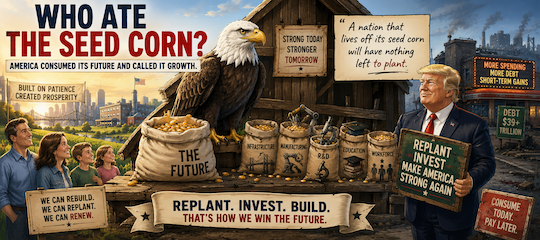
Who Ate the Seed Corn?
The Rude Awakening (May 21, 2026)
By Sean Ring
 We’ve named time preference and interventionism so far. Here’s the next important step on our map: capital consumption.
This is what Donald Trump is trying to prevent in the United States, in his own way… with mixed results so far.
Why?
Because he knows it’s the one thing most responsible for America’s manufacturing decline. It’s one thing for a better team to beat you. It’s another thing entirely for your team to give the game away to foreigners.
How did that happen?
Like Papa Hemingway said, “Gradually, and then suddenly.”
This is the particular kind of bankruptcy that accountants fear most.
Not the sudden kind, when the business that blows up overnight, or the fraud that collapses in a week. That kind is painful, but quick. Everyone just deals with it because nothing can be done about it. The ship has already sailed.
The dangerous bankruptcy is the prolonged one.
Imagine a company that seems perfectly healthy. Its revenue is holding, its staff is settled, and its logo adorns the building.
But unbeknownst to anyone, the owners had been cashing out. They deferred equipment maintenance, skipped software upgrades, and slashed the R&D budget. In other words, they’d been eating the seed corn.
Everything looks fine… until the day it doesn’t.
Accountants call it capital consumption. And the United States of America has been doing it, at a national scale, for 30 years.
What’s Capital?
Most people think of capital as money. It isn’t.
Capital is the accumulated result of deferred consumption. It’s the factory someone built instead of spending that money on wine and vacations. It’s every physical and human asset that enables future production.
Capital is patience, made into something creative, useful, and productive.
It takes time to build. And, like reputations, it can be destroyed surprisingly fast. Most critically, it can be consumed without anyone noticing for a very long time.
When a farmer eats his seed corn, the barn looks full. It’s only at planting time, when there’s nothing left to put in the ground, the disaster becomes visible.
By then, it’s too late for that season.
How A Nation Eats Its Seed Corn
America’s capital consumption didn’t happen in a single dramatic act. Remember: gradually, then suddenly.
- Infrastructure. The American Society of Civil Engineers grades U.S. infrastructure every four years. The most recent report graded it a C-minus. Bridges built in the 1960s are carrying loads they were never designed for. Water mains laid in the 1890s are still in service in major cities. The FAA is running air traffic control software so old that replacement parts have to be sourced from eBay.
This isn’t neglect exactly. It’s an implicit choice to consume the capital stock rather than maintain it.
- Manufacturing. In 1979, American manufacturing employed 19.5 million people. Today, it employs roughly 13 million people in an economy and population that’s dramatically larger. The factories didn’t just move. The knowledge moved with them. The toolmakers, the machinists, the process engineers, the supply chain relationships… a generation of productive capital, human and physical, was shipped to Shenzhen.
You felt this during COVID, when you needed masks, ventilators, and semiconductor chips, and the productive capacity wasn’t there. It had been quietly consumed over decades in exchange for slightly cheaper consumer goods.
- Human capital. A workforce is capital. A skilled, educated, healthy workforce is enormous capital that compounds over generations. America’s workforce is increasingly neither skilled nor healthy. Forty percent of adults are obese. Deaths of despair from drugs, alcohol, and suicide have carved life expectancy below that of most peer nations. Literacy and numeracy scores have declined over the past 30 years.
These aren’t social statistics. They’re capital consumption numbers. Every preventable death is a write-down. Every person who exits the workforce due to disability is an asset written down on the national balance sheet.
This Trick Hides It
When a business consumes capital without corresponding production, it eventually shows up in earnings. The margins fall, and investors flee.
Nations have a trick businesses don’t: they can print money, borrowing from the future.
When America’s physical capital was deteriorating, the Fed cut rates. Cheap money inflated asset prices. Stocks, bonds, gold, and crypto went up. 401(k)s looked amazing. The wealth felt real.
When the workforce was hollowing out, the government sent checks. GDP held steady as no one adjusted their consumption. The economy looked healthy.
But GDP measures spending, not wealth creation. You can inflate GDP by borrowing a trillion dollars and setting it on fire. The number goes up. The nation gets poorer.
And that’s the trick: consumption is disguised as production. Borrowing is disguised as growth. The barn looks full, but the seed corn is gone.
The Scorecard You Don’t See
Let’s put some numbers to this.
U.S. federal debt has gone from $5 trillion in 2000 to over $39.2 trillion today. The vast majority of it funded current consumption, like transfer payments, military operations, and interest on prior debt. Future generations will pay for the steaks we already ate.
U.S. net national savings — what’s left after consumption and depreciation — has collapsed from roughly 8% of GDP in the 1960s to near zero today. Some years it goes negative. The nation as a whole isn’t saving. It’s consuming its capital and borrowing the difference.
Corporate capital expenditure, as a share of revenue, has declined over the past 30 years, even as corporate profits have reached record highs. Companies chose buybacks over factories and financial engineering over productive investment. They consumed their own capital bases and called it shareholder value.
And while we were asleep at the wheel, China built the world’s largest high-speed rail network and port infrastructure, and cornered the supply chains for solar panels, batteries, rare-earth processing, and pharmaceutical precursors.
The Chinese were planting. The West was gorging.
The Revelation
Capital consumption has a long fuse and a violent detonation.
Japan consumed capital through the 1980s, with accouterments such as zombie banks, misallocated credit, and deferred restructuring. The Nikkei peaked in 1989 and didn’t recover for 35 years. Not a crash. A slow, grinding revelation that the prosperity had been borrowed, not built.
The Soviet Union consumed capital for decades, even as its military statistics looked impressive. Then one day, the shelves were empty, and the system simply stopped.
Rome consumed capital for two centuries while the bread and circuses continued. The legions were still on the frontiers. The forums were full until they weren’t.
The consumption phase is long and comfortable. The revelation is fast and brutal. And between them is a gap that leads people to believe the good times were earned rather than borrowed.
We’re somewhere in that gap right now.
What Accumulation Looks Like
This isn’t a counsel of despair. Capital can be rebuilt. It has been before.
But you cannot rebuild what you won’t first honestly name.
The first step is to stop mistaking financial asset inflation for real wealth creation. Your stock portfolio going up is not the same as the country getting more productive. One is a claim on future production. The other is future production itself. Right now, the claims are multiplying faster than the production they’re on.
The second step is to own real capital, like productive land and physical resources. Own companies that make things, extract things, process things. Own assets with cash flows attached to physical reality, not narrative.
The third step is to think generationally. Capital consumption is nothing more than high time preference. Eat now, plant never. With every financial decision you make, ask, “Am I building something or am I consuming something?”
The farmer who ate his seed corn didn’t starve immediately. He had a full meal the night before the planting season.
The question isn’t how the barn looks tonight.
The question is what you’re putting in the ground tomorrow.
Discover more from The Property and Freedom Society
Subscribe to get the latest posts sent to your email.



















 Alessandro Fusillo
 Andreas Tögel
 David Dürr
 Doug French
 Fernando Chiocca
 Greg Morin
 Hans-Hermann Hoppe
 Jay Baykal
 Jayant Bhandari
 Jeff Deist
 Jeffrey Barr
 Juan Fernando Carpio
 Ken Yamarashi
 León Isidoro
 Martin Cabrera
 Nick Hoppe
 Oscar Grau
 Peter Wong
 PFS
PFS scholarium
 Saifedean Ammous
 Sean Gabb
 Sean Ring
 Stephan Kinsella
 Stéphane Geyres
 Thomas Jacob
 Tom DiLorenzo