Originally published at The Rude Awakening.
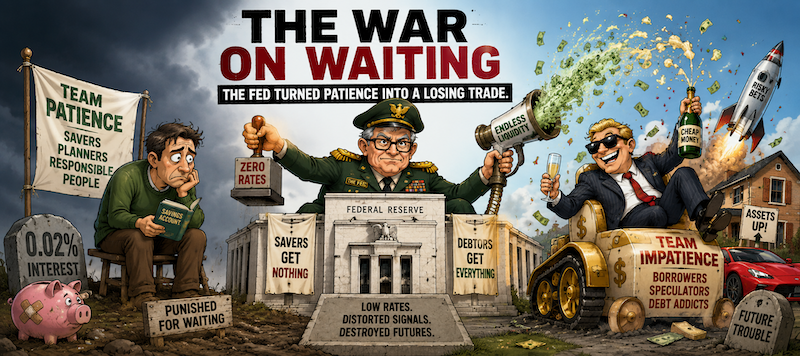
The War on Waiting
The Rude Awakening (May 19, 2026)
By Sean Ring
 I’m perfectly fine with receiving feedback from subscribers who disagree with my view. After all, reasonable people disagree all the time. And since I live in a different part of the world and hold a different perspective, inevitably, readers will sometimes wonder what I’m getting at.
After writing Uncle Sam’s Invisible Hand for the Daily Reckoning last week, I received what I’ll politely call the most misguided criticism I’ve ever received. It was positively inane and missed my point by what Elaine from Airplane! would call “a tad.” I won’t print it for those reasons.
But the email reminded me that we at Paradigm get new subscribers all the time, and many may not understand where I’m coming from.
With this in mind, I’m going to show you a map of the economic world no one else has.
Why? Because the people who benefit from your confusion have spent a century making sure it stays out of the educational curriculum.
A group of economists working in Vienna in the late 19th and early 20th centuries drew this map. Carl Menger. Eugen von Böhm-Bawerk. Ludwig von Mises. Friedrich von Hayek. In America, their work continued under Murray Rothbard. These men understood that an economy is not a machine to be managed by experts. It’s a spontaneous order, generated by millions of individual human decisions, that no central authority can replicate, replace, or safely override.
They were laughed at, ignored, and driven from their university professorships.
Their ideas survived anyway because true ideas do.
Today marks the start of a five-part series built on their most important insights. These are live, working explanations of the forces that are acting on your money, your savings, your standard of living, and your children’s future… right now, today, whether you know their names or not.
Why These Five
I chose these five concepts for one reason.
Because they’re the five you feel every day without being able to name.
You feel The Patience Tax (the subject of today’s article) every time your savings account earns nothing while your grocery bill climbs.
You feel The Ratchet (tomorrow) every time a government program makes the problem it was designed to solve dramatically worse.
You feel The Hollowing (Thursday) every time something that used to work no longer does.
You feel The False Boom (Friday) every time a hot new industry turns out to be a graveyard.
You feel The Knowledge Illusion (Monday) every time the experts are catastrophically, publicly, expensively wrong… and then explain why they need more authority and more budget to get it right next time.
What This Series Will Do For You
By the time you finish these five pieces, something will have changed.
Not your politics; I’m not interested in your politics. These ideas sit upstream of the left-right debate. They apply equally to Republican farm subsidies and Democratic rent controls, to conservative military Keynesianism and progressive green energy mandates. The machine doesn’t care which party is running it.
What will change is your map.
Right now, when you see a policy announced, a boom celebrated, an expert consulted, a crisis blamed on greed or bad luck or foreign adversaries, you have to take someone else’s word for what’s happening.
After this series, you’ll have a framework that predicts failure before it arrives.
This isn’t investment advice. It’s more valuable than a single trade recommendation.
This is your new thinking map.
Without further ado, here’s your first entry on perhaps the most important concept you were never taught: time preference.
Taxing Your Patience
In 1972, a Stanford psychologist named Walter Mischel sat children down at a table.
One marshmallow. Right in front of their faces. Eat it now, and that’s all you get. Or, wait fifteen minutes, and you get two!
It was a simple test with profound results.
The kids who waited, who delayed gratification, went on to score higher on the SATs, earn more money, maintain healthier relationships, and stay out of prison at higher rates.
It turned out that patience was one of the most powerful predictors of life success ever identified.
So, of course, The State built an economy that punishes it.
Time Preference
Austrian economists have a name for this: time preference.
It sounds dry. It isn’t.
Time preference is simply your preference for having something now versus later. High time preference means you want it now — the marshmallow, the car, the dopamine hit. Low time preference means you’re willing to wait for something better.
And here’s the kicker: interest rates are the price of time preference.
When you save money instead of spending it, you’re lending your present consumption to someone else. The interest rate is your reward for waiting. It compensates you for the sacrifice.
A high interest rate signals that waiting is valuable, savers are rewarded, and patience pays.
A low interest rate signals that waiting is worthless, borrowing everything is worthwhile, and the future is cheap.
For most of Western history, rates reflected reality. Savers got paid. Capital accumulated. Living standards rose slowly and steadily because patience was systematically rewarded.
Then the central banks broke the signal.
The Fed’s Great Marshmallow Heist
Between 2008 and 2022, the Federal Reserve held interest rates near zero for most of 14 years.
Think about what that means in time preference terms.
If you saved $100,000 in a bank account during that period, you earned a pittance. Your patience was punished. In real terms, the careful saver lost purchasing power every year for over a decade.
Meanwhile, the person who borrowed $100,000 to buy assets such as stocks, real estate, or crypto got rich. Not because they were smart. Not because they worked hard. Because they had a high time preference and the system rewarded them for it.
The Fed didn’t just set a rate. It sent a signal to 330 million people:
Stop waiting. The extra marshmallow isn’t coming.
What Happens When You Corrupt the Signal
Here’s where it gets dark.
Mischel’s experiment didn’t just measure patience. Later researchers found something more disturbing: children who had been raised in unstable, unreliable environments were rational to eat the marshmallow immediately.
If you live in a world where promises get broken, where the second marshmallow might never arrive, where adults can’t be trusted, you eat now. It’s not a character flaw, but an adaptation.
Over 14 years, the Federal Reserve trained an entire generation of Americans to behave exactly like those children.
It made high time preference rational.
Why save when savings earn nothing? Why defer when borrowers get rich? Why wait when the Fed might goose asset prices tomorrow, and you’ll be priced out of everything you wanted?
The result is exactly what Austrian economists predicted and what you can see with your own eyes:
- Personal savings rates are near historic lows.
- Consumer debt is at record highs.
- $1.7 trillion in student loans for many degrees with no economic return.
- A retirement crisis affects half of all Americans over 55.
- An entire asset class, starter homes, is effectively out of reach for young families.
This isn’t a culture problem, laziness, or moral decline. It’s a price signal problem. The system told people not to wait. The people responded in the most rational way they could.
Opportunity Cost
When the Fed keeps interest rates below what the free market would charge, it levies the Patience Tax.
You pay it when your bank account earns nothing, but your grocery bill climbs 4%.
You pay it when your pension fund, chasing yield, piles into junk bonds and private equity that blow up in the next crisis.
You pay it when the neighbor who borrowed against his house to buy Bitcoin gets a second house, and you, despite having saved carefully and waited, still can’t afford your first one.
The children in Mischel’s experiment who couldn’t wait weren’t bad kids. They became less successful adults. The gap between who they were and who they could have been is the tax.
Multiply it by 200 million working Americans. That’s the real cost of cheap money.
Wrap Up
The honest answer is: you can’t opt out of the system entirely. But you can stop playing by its corrupt rules.
First, understand that the signal is broken. When you feel the urge to borrow and spend rather than save and wait, recognize that feeling as an engineered response, not a natural one. An economic system that’s built on consumption runs on that urge. You don’t have to honor it.
Second, find assets that reward patience the way interest rates used to. Gold has done this for 5,000 years. Build or buy a quality business with pricing power. Invest in productive land. These things hold value because someone waited and worked to build them.
Third, teach your children to wait. The Patience Tax is most brutal on the young. But the marshmallow lesson still works, even if the Fed has done everything in its power to convince them otherwise.
The kids who waited in that Stanford room grew up to win.
The economy that punishes waiting will eventually have to pay its bill.
When it does, the patient ones will be the only ones left standing.
Discover more from The Property and Freedom Society
Subscribe to get the latest posts sent to your email.









 Alessandro Fusillo
 Andreas Tögel
 David Dürr
 Doug French
 Fernando Chiocca
 Greg Morin
 Hans-Hermann Hoppe
 Jay Baykal
 Jayant Bhandari
 Jeff Deist
 Jeffrey Barr
 Juan Fernando Carpio
 Ken Yamarashi
 León Isidoro
 Martin Cabrera
 Nick Hoppe
 Oscar Grau
 Peter Wong
 PFS
PFS scholarium
 Saifedean Ammous
 Sean Gabb
 Sean Ring
 Stephan Kinsella
 Stéphane Geyres
 Thomas Jacob
 Tom DiLorenzo