From A Day in the Life of Alex in AnCapville (Jun 04, 2026) by PFS member Adam Haman.

Yesterday I wrote about statism and security, remarking on two incidents of horrific police abuse over in Europe that have gone viral online recently.
Some people remarked that my complaints smacked of utopianism. Sure, policing needs reform, but to eliminate the state itself and its monopoly on violence? Surely that would lead to “Mad Max” style chaos. Who wants that?
(sigh)
We’ve lived in statist society, educated by statist schools, for so long that we can’t even imagine ourselves free. So today, folks, I’m going to do just that: imagine what being free would look like.
Let me paint you a picture of an ordinary guy named Alex navigating a typical day in a vibrant, decentralized society. There exists no overarching state anywhere near where he lives.
There’s no single cop shop or law monopoly. Just property owners, contracts, insurance networks, and people figuring out the complexities of life through voluntary cooperation.
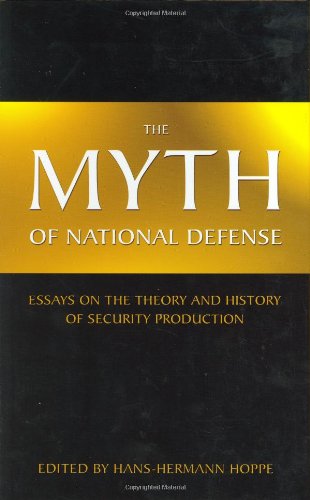
If you want further details afterwards, read up on Murray Rothbard’s vision of natural order, Stephan Kinsella’s emphasis on strict property rights and restitution-based common law, Hans-Hermann Hoppe’s covenant communities keeping the peace through free association, and Bob Murphy’s Austrian (meaning, rational) economics showing how and why markets deliver what governments promise but botch.
Here goes:
Alex wakes up in his modest home on a privately developed plot in a loose network of neighborhoods. The land isn’t under some uniform zoning code.
The developer who sold it to him included clear covenants in the deed — basic rules on setbacks, noise, and shared roads, etc, enforced by an HOA (which is really just a contractual service provider, easy to exit if it goes rogue).
The rules, responsibilities, and conflict remedies are well spelled out, and the amendment process for making future alterations to the contract if necessary are also very clearly stated. It’s nice having stable, rational rules in place.
He brews coffee from beans traded through a reputation-based online marketplace. No FDA stamp, but his insurer gives discounts for verified suppliers with strong track records. Markets punish fraud and poor quality faster than regulators ever could.
Further reading
- Hoppe, The Private Production of Defense, in The Great Fiction (version from J. Libertarian Stud 14:1 (Winter 1998-1999): 27-52)
- Oliver Janich, Sicher ohne Staat: Wie eine natürliche Rechtsordnung ohne Gewaltmonopol funktioniert (Secure/Safe without the State: How a Natural Legal Order without a Monopoly on Violence Works)
- Kinsella, Libertarian Answer Man: Restrictive Covenants and Homeowners Associations (HOAs)
- Richman on Inalienable Rights
- What It Means To Be an Anarcho-Capitalist
- How much richer would be in a free society? L. Neil Smith’s great speech
- On the Non Liquet in Libertarian Theory and Armchair Theorizing
- On Pushing the Button–the problem with magic
And some related thoughts from Kinsella: The Problem with Intellectual Property:
As argued above, it is fairly straightforward to explain what is wrong with IP, once the nature and purpose of property rights, and the nature of IP rights, us understood: patent and copyright are artificial state-granted monopoly privileges that undercut and invade property rights. But the consequentialist and utilitarian mindset is so entrenched that even people who see the ethical problems with IP law sometimes demand that the IP opponent explain how innovation would exist in an IP-free world. How would authors make money? How would blockbuster movies be funded? Why would anyone invent if they could not get a patent? How could companies afford to develop pharmaceuticals if they had to face competition?
When I see such demands and questions, I am reminded of John Hasnas’s comments in his classic article “The Myth of the Rule of Law.” After arguing against the state and for anarchy, Hasnas observes:
What would a free market in legal services be like?
I am always tempted to give the honest and accurate response to this challenge, which is that to ask the question is to miss the point. If human beings had the wisdom and knowledge-generating capacity to be able to describe how a free market would work, that would be the strongest possible argument for central planning. One advocates a free market not because of some moral imprimatur written across the heavens, but because it is impossible for human beings to amass the knowledge of local conditions and the predictive capacity necessary to effectively organize economic relationships among millions of individuals. It is possible to describe what a free market in shoes would be like because we have one. But such a description is merely an observation of the current state of a functioning market, not a projection of how human beings would organize themselves to supply a currently non-marketed good. To demand that an advocate of free market law (or Socrates of Monosizea, for that matter) describe in advance how markets would supply legal services (or shoes) is to issue an impossible challenge. Further, for an advocate of free market law (or Socrates) to even accept this challenge would be to engage in self-defeating activity since the more successfully he or she could describe how the law (or shoe) market would function, the more he or she would prove that it could be run by state planners. Free markets supply human wants better than state monopolies precisely because they allow an unlimited number of suppliers to attempt to do so. By patronizing those who most effectively meet their particular needs and causing those who do not to fail, consumers determine the optimal method of supply. If it were possible to specify in advance what the outcome of this process of selection would be, there would be no need for the process itself.[86]
In other words: the answer such a challenge might be, as Leonard Read said, “I don’t know.”[87]
To return to the current subject: with the advent of state IP legislation, the state has interrupted and preempted whatever other customs, business arrangements, contractual regimes and practices, and so on, that would no doubt have arisen in its absence. So it is natural for those accustomed to IP to be a bit nervous about replacing the current flawed IP system with … nothing. With a vacuum. It is natural people to wonder, “Well, what would occur in its absence?” As noted above, the reason we are not sure what an IP-free world would look like is that the state has snuffed out alternative institutions and practices.
Consider the analogous situation in which the FCC preempted and monopolized the field of property rights in airwaves just as they were starting to develop in the common law. Nowadays people are used to the idea of the state regulating and parceling out airwave or spectrum rights and might imagine there would be chaos if the FCC were abolished. Still, we have some idea as to what property rights might emerge in airwaves absent central state involvement.[88]
In any case, because people are bound to ask the inevitable, we IP opponents sometimes try to come up with some predictions and solutions and answers. Thus, in the end we must agree with Hasnas:
Although I am tempted to give this response, I never do. This is because, although true, it never persuades. Instead, it is usually interpreted as an appeal for blind faith in the free market, and the failure to provide a specific explanation as to how such a market would provide legal services is interpreted as proof that it cannot. Therefore, despite the self-defeating nature of the attempt, I usually do try to suggest how a free market in law might work. (pp. 226–227)
Exit and Consent to Rules
- How We Come To Own Ourselves
- A Libertarian Theory of Punishment and Rights
- The Universal Principles of Liberty
- The Title-Transfer Theory of Contract
- On Kissing the Girl, Changing One’s Mind, Reserving Rights, and Voluntary Slavery
- A Tour Through Walter Block’s Oeuvre
- Murder Park: The Podcast that Never Was
- Richman on Inalienable Rights
Incidentally, regarding HOAs, covenant communities, and things like that, issues such as inalienability and the nature of contracts could arise. In my view, contracts are not binding promises but rather simple transfers (alienations) of title to alienable, owned resources; but this does not include our bodies which are owned not because of original appropriation or homesteading but because of one’s direct control of one’s body.
The right to exit from an HOA or any other territory an implication of libertarian principles. If you are playing American football or boxing or even fighting, you have consented to others hitting you, just as when you consent to surgery or sex and those actions by others are not considered battery. But you have the right to change your mind because contracts are not binding promises but only future, conditional transfers of title to owned, alienable resources. A girl who promises to kiss or have sex with you can change her mind and may not be forced to perform the promised action. A boxer can step out of the ring.
And if you are in a shopping mall, or a “murder park,” or a HOA, or a covenant community, you may not be prevented from leaving. Even if you agreed ahead of time not to. You cannot alienate your rights against proportional punishment. You cannot alienate your right to object to aggression of any type. You can change your mind. Jefferson was right that one generation cannot bind another. As I pointed out in Richman on Inalienable Rights,
even if some previous residents/citizens of a given region had agreed to be “bound by” some “constitution” or laws, there are still problem with this. One is that contracts do not create binding obligations but are only transfers of title to resources.1 Another is that rights are inalienable, and one generation cannot bind future ones anyway. Even Jefferson recognized this. For example, in a letter to James Madison (6 September 1789), he argued that “the earth belongs in usufruct to the living,” i.e. that each generation holds the world in temporary stewardship and cannot impose perpetual obligations, laws, or debts on future ones. He calculated that, based on life expectancy, constitutions and laws should naturally expire after about 19 years—the span of a majority generation—to avoid binding successors without their consent. Or as he wrote, “no generation can contract debts greater than may be paid during the course of it’s own existence.” This view influenced his view that the U.S. Constitution should lapse around 1808 unless renewed:
Every constitution then, and every law, naturally expires at the end of 19 years. If it be enforced longer, it is an act of force, and not of right.—It may be said that the succeeding generation exercising in fact the power of repeal, this leaves them as free as if the constitution or law had been expressly limited to 19 years only.2
(Note also Jefferson’s famous quote (November 13, 1787 letter to William Stephens Smith), responding to Shays’ Rebellion: “The tree of liberty must be refreshed from time to time with the blood of patriots and tyrants. It is it’s natural manure.” This also reflects Jefferson’s philosophy of periodic renewal—whether through peaceful constitutional resets or, if needed, rebellion—to ensure liberty isn’t constrained by the past.)
Madison, in his reply (4 February 1790), partially disagreed, suggesting some obligations could descend between generations for societal continuity.
So there are limits to what can be agreed to ahead of time in HOAs or covenant communities.
- Kinsella, A Libertarian Theory of Contract; The Title-Transfer Theory of Contract. [↩]
- See also Liberty Fund excerpt. [↩]












 Alessandro Fusillo
 Andreas Tögel
 David Dürr
 Doug French
 Fernando Chiocca
 Greg Morin
 Hans-Hermann Hoppe
 Jay Baykal
 Jayant Bhandari
 Jeff Deist
 Jeffrey Barr
 Juan Fernando Carpio
 Ken Yamarashi
 León Isidoro
 Martin Cabrera
 Nick Hoppe
 Oscar Grau
 Peter Wong
 PFS
PFS scholarium
 Saifedean Ammous
 Sean Gabb
 Sean Ring
 Stephan Kinsella
 Stéphane Geyres
 Thomas Jacob
 Tom DiLorenzo
Follow Us!