Reprint from PFS member David Dürr.
Related
- PFP300 | David Dürr, A Brief History of Swiss Anarchism (PFS 2025)
- PFP273 | Rahim Taghizadegan: “Understanding Switzerland and the Swiss” (PFS 2024)
- PFP261 | David Dürr, “Swiss Confederation 2023: The Last 25 Years Ahead” (PFS 2023)
- PFP232 | David Dürr, A Short History of the Swiss Constitution (PFS 2021)
- PFP152 | Daniel Model, “On the Hardship of Doing Business (in Switzerland)” (PFS 2016)
- PFP109 | Robert Nef, Understanding Switzerland and the Swiss (PFS 2013)
- Hoppe, Small is Beautiful
The Worst Form of Government Except for All the Others
David Dürr / October 31, 2024
Time and again I hear: You in Switzerland surely have the perfect political system. You are, after all, the country with the world’s best form of government. You have precisely that which the French Revolution had set out to achieve, namely a system in which the people are governed by laws that they themselves have made. Just recently, a journalist from Poland told me this again in an interview. With the political conditions in his own country, he did not seem all too happy, while Switzerland for him was something like a democratic paradise.
I then unfortunately had to disappoint him: Even from a purely statistical standpoint, direct popular votes in Switzerland do not amount to much. Of the currently existing roughly five thousand enactments at the federal level, far less than one percent have ever been submitted to the people for a decision. And when it is further taken into account that in each case no more than 15 to 20 percent of those subject to the law have agreed, then the true democracy rate sinks into the per mille range.
My conversation partner then kindly suggested to consider that this low rate might be due to the fact that the people are simply fully satisfied with the laws enacted by the state. To me, however, a more sober explanation seemed more plausible, namely that the hurdles for a referendum are simply too high, since 50,000 signatures must be collected within 100 days. Something like that is achieved only by a very few who are connected with the power cartel of the political system; the democratic rank and file, however, is practically excluded.
My friendly conversation partner did not let up: But in comparison to other countries, where referendums are not even possible, Switzerland has, if perhaps not the best, then at least the least bad form of government. Probably that famous Churchill quote was going through his mind, according to which democracy is the worst form of government except for all the others. And in this respect, I could thoroughly agree with him. That pleased him very much, and he expressed his thanks for the joint elaboration of this solution to the state problem, which, while not thrilling, was pragmatically acceptable.
But now I had to disappoint him all the more. For I do not consider a worst form of government to be the solution even if all other forms of government are even worse. The tongue-in-cheek Churchill quote does not give an answer—no, it actually poses a question, namely what else exists besides this worst form and all the other even worse forms of government.
And the answer forces itself upon us: If all forms of government are so bad, then precisely no state-form, but on the contrary, a form of society without a state. A form of society that does not commit the stupidity of installing an official monopolist for such important things as combating violence, legislation, justice, and much more, only to wonder then when it soon abuses its power and cares precious little about the democratic participation of its subjects—or at most, as in Switzerland, throws them small referendum crumbs every now and then.
***
Related
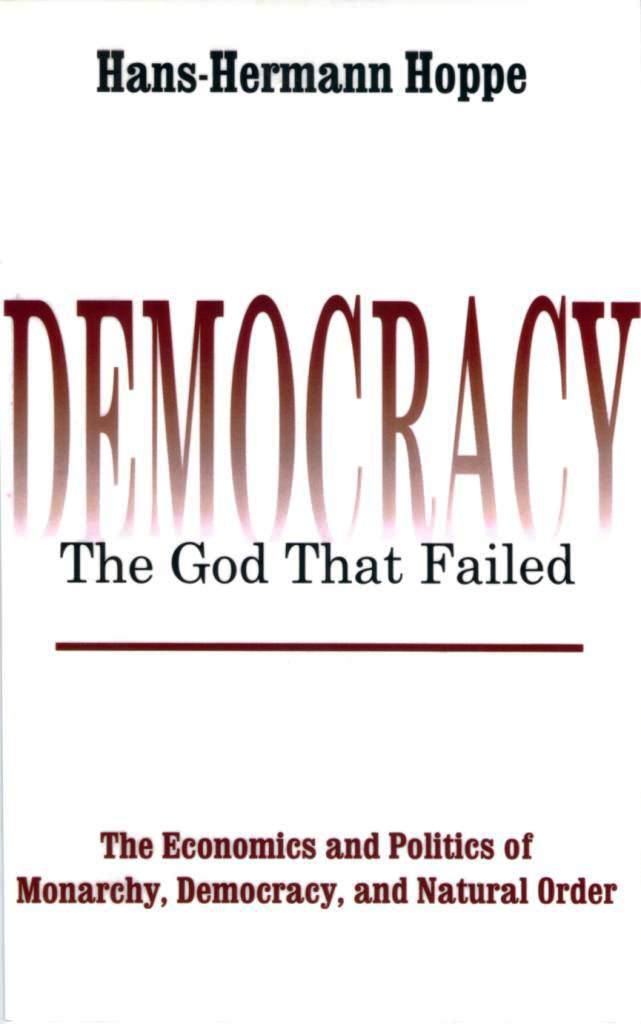
- Hoppe, Democracy: The God That Failed (Transaction, 2001)
- Introduction to Democracy: The God That Failed
- From Aristocracy to Monarchy to Democracy (Mises 2014)
- The Trouble With Democracy, Nov. 12, 2001
- Down With Democracy, Nov. 17, 2000
- Kinsella, Rockwell on Hoppe on the Constitution as Expansion of Government Power
- Kinsella, The Nature of the State and Why Libertarians Hate It
“socialism, by no means an invention of nineteenth century Marxism but much older, must be conceptualized as an institutionalized interference with or aggression against private property and private property claims. Capitalism, on the other hand, is a social system based on the explicit recognition of private property and of nonaggressive, contractual exchanges between private property owners. Implied in this remark, as will become clear in the course of this treatise, is the belief that there must then exist varying types and degrees of socialism and capitalism, i.e., varying degrees to which private property rights are respected or ignored. Societies are not simply capitalist or socialist. Indeed, all existing societies are socialist to some extent.” Hoppe, A Theory of Socialism and Capitalism, ch. 1
“We have defined socialism as an institutionalized policy of redistribution of property titles. More precisely, it is a transfer of property titles from people who have actually put scarce means to some use or who have acquired them contractually from persons who have done so previously onto persons who have neither done anything with the things in question nor acquired them contractually.” Hoppe, A Theory of Socialism and Capitalism, ch. 3
“To assure its very existence, any institution that enforces a socialist theory of property must rely on the continual threat of violence. Any such institution threatens people who are unwilling to accept its noncontractual appropriations of their natural property with physical assault, imprisonment, enslavement, or even death, and it must carry out such threats if necessary, in order to stay ‘trust-worthy” as the kind of institution that it is. Since one is dealing with an institution—an organization, that is, which performs these actions on a regular basis—it is almost self-explanatory that it refuses to call its own practice of doing things “aggression,” and instead adopts a different name for it, with neutral or possibly even positive connotations. In fact, its representatives might not even think that they themselves are aggressors when acting in the name of this organization. However, it is not names or terms that matter here or elsewhere, but what they really mean.132 Regarding the content of its actions, violence is the cornerstone of socialisms existence as an institution.
…
“It is not at all difficult to recognize the truth of this. In order to do so, it is only necessary to assume a boycott of any exchange-relation with the representatives of socialism because such an exchange, for whatever reasons, no longer seems profitable. It should be clear that in a social system based on the natural theory of property—under capitalism—anyone would have the right to boycott at any time, as long as he was indeed the person who appropriated the things concerned by using them before anyone else did or by acquiring them contractually from a previous owner. However much a person or institution might be affected by such a boycott, it would have to tolerate it and suffer silently, or else try to persuade the boycotter to give up his position by making a more lucrative offer to him. But it is not so with an institution that puts socialist ideas regarding property into effect. Try, for instance, to stop paying taxes or to make your future payments of taxes dependent on certain changes or improvements in the services that the institution offers in return for the taxes—it would fine, assault, imprison you, or perhaps do even worse things to you. Or to use another example, try to ignore this institution’s regulations or controls imposed on your property. Try, that is to say, to make the point that you did not consent to these limitations regarding the use of your property and that you would not invade the physical integrity of anyone else’s property by ignoring such impositions, and hence, that you have the right to secede from its jurisdiction, to “cancel your membership” so to speak, and from then on deal with it on equal footing, from one privileged institution to another. Again, assumedly without having aggressed against anyone through your secession, this institution would come and invade you and your property, and it would not hesitate to end your independence. As a matter of fact, if it did not do so, it would stop being what it is. It would abdicate and become a regular private property owner or a contractual association of such owners. Only because it does not so abdicate is there socialism at all. Indeed, and this is why the title of this chapter suggested that the question regarding the socio-psychological foundations of socialism is identical to that of the foundations of a state, if there were no institution enforcing socialistic ideas of property, there would be no room for a state, as a state is nothing else than an institution built on taxation and unsolicited, noncontractual interference with the use that private people can make of their natural property. There can be no socialism without a state, and as long as there is a state there is socialism. The state, then, is the very institution that puts socialism into action; and as socialism rests on aggressive violence directed against innocent victims, aggressive violence is the nature of any state.” Hoppe, A Theory of Socialism and Capitalism, ch. 8
“The state is always socialistic, and socialism always implies a state.” Kinsella, Afterword, in Hoppe, The Great Fiction













 Alessandro Fusillo
 Andreas Tögel
 David Dürr
 Doug French
 Fernando Chiocca
 Greg Morin
 Hans-Hermann Hoppe
 Jay Baykal
 Jayant Bhandari
 Jeff Deist
 Jeffrey Barr
 Juan Fernando Carpio
 Ken Yamarashi
 León Isidoro
 Martin Cabrera
 Nick Hoppe
 Oscar Grau
 Peter Wong
 PFS
PFS scholarium
 Saifedean Ammous
 Sean Gabb
 Sean Ring
 Stephan Kinsella
 Stéphane Geyres
 Thomas Jacob
 Tom DiLorenzo
Follow Us!