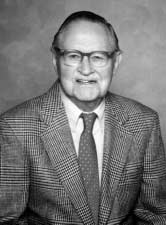
George Koether, born in 1907, is a retired businessman, author, economist, journalist, lecturer, and consult-ant, and a long-time advocate of free-market principles and practices. He lived much of his life close to the Mises circle in the United States and to many Misesians abroad. He knew every important player, including Mises, Hazlitt, Rothbard, and Hayek, on a personal level, from World War II and forward.
From the Vault: “A Life Among Austrians: An Interview With George Koether,” Austrian Economics Newsletter 20, no. 3 (Fall 2000). See George Koether (1907-2006).
A Life Among Austrians
An Interview With George Koether
AEN: When did you first meet Mises?
KOETHER: It was 1947, a few years after Mises had arrived in the United States and a few months after I had been hired by The Foundation for Economic Education to prepare a journal which later became The Freeman. Leonard Read, founder and president of FEE as it came to be called, walked into the room where I was lunching, with a stranger on his arm, and said: “George, this is Dr. Mises, may we join you for lunch?”
I later compared this to a physics student being asked if Dr. Einstein could lunch with him. With Mises on my left and Read on my right we plunged into a discussion of post-World War II economic problems. Mises quickly sensed my interest and asked me: “Would you like to attend my seminar?” I accepted the invitation immediately. From then on Mises became my intellectual father and personal friend.
My previous exposure to economics had come when I worked with an advertising agency. Economists would sometimes consult with the marketing department where I worked. A lot of wacky ideas were being promoted as economic theory. As soon as Mises started talking, I knew that this man realized what was really behind business activity. That fact alone distinguished him among economists at the time.
AEN: This was more than 50 years ago, when Austrian economics barely existed in the U.S.
KOETHER: It was my good fortune to have been involved in the revival of Mises’s thought from its earliest days. I watched the movement toward Mises from the beginning—when Henry Hazlitt introduced him to the United States—to the founding of the Mises Institute and the thriving Misesian movement of today. The movement today is huge, international, interdisciplinary, and the writings are voluminous. If Mises had lived to the 102 I hope to reach, he would have died a happy man.
AEN: How long did you attend the famous Mises seminar?
KOETHER: For the first two years my attendance was quite regular. But with a family to support and a demanding job I could not continue on a steady basis. But off and on I did attend over a period of about 16 years. The important thing to me was his books. I would take them on business trips and read them in my hotel every night. It was great to have Mises’s company to get his informal comments on points in his books.
In his seminars, Mises would repeatedly encourage participation. And you got the impression that if a housemaid had spoken up with a silly question, Mises would have gladly answered her and patiently explained her question.
“Don’t be afraid to ask any question,” Mises would say. “Anything you might say has probably been said by some eminent economist.”
He was a patient—even polite—teacher. I think it was this, and his great wisdom, that endeared him to us. We were all so awed by his intellect that what he hoped would be a seminar became, in fact, a lecture series.
The first seminar took place in a large lecture hall and must have attracted many curiosity seekers. Shortly afterward, we were directed to a much smaller room where no more than fifteen or twenty students (apparently hand-picked by Mises) could attend.
I remember vividly his first comment to that small group. Holding a book in his hand he said: “To understand economics, this is the book you should read first.” The book was Morris Cohen’s An Introduction to Long and Scientific Thought.
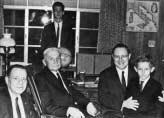
Professor Vernon Carbonari, Ludwig von Mises, David Petro, George Koether, and Sam Petro.
At later meetings he would recommend books other than his own for extended study. He never had to puff his own books. They puffed themselves! One book, Lombard Street by Walter Bagehot, should be, in my opinion, required reading in every college and university in America. Mises’s other recommendations included Robbin’s The Nature and Significance of Economic Science, Hutt’s Theory of Collective Bargaining, C.F. Bastable’s Theory of International Trade, Knight’s Risk, Uncertainty and Profit, and Hayek’s The Counter-Revolution of Science—which Mises said “was Hayek’s best book.” Mises’s recommended readings also included authors outside the field of economics which made us realize that economics—human action—is involved in every field of human study. I found his recommendation of philosopher Ernst Cassirer’s works, among them The Myth of the State and The Problem of Knowledge, most profitable.
Mises was the complete economist. His seminar not only covered economics in the narrow sense; he also demonstrated the role of human action related to other disciplines: history, for example, and even mathematics. Mises was a walking, talking university.
Mises was as generous with his time as he was with his talent. Lu, as we called him, would allow me, on many occasions, to bring my wife or sons to the meetings. Today, those sons and grandsons are not only applying what they learned to their businesses but are also helping to spread the word on free-market principles.
After the seminar we often walked over to a nearby restaurant for informal discussion. This group usually included Henry Hazlitt, Bill Peterson, George Reisman, Murray Rothbard, and many others. The conversation was always lively.
AEN: Which lectures by Mises got you hooked?
KOETHER: All of them. But his many discussions on money and inflation left the longest-lasting impression: the causes, the process, the tragic results. I had known that inflation was caused by devious men for their own reasons—but I hadn’t realized the many diverse methods used, the uneven effects resulting, and the almost universal approval of disastrous inflation policy by so many economists before Mises.
These discussions on inflation hit home with me because I could remember, when I was a ten-year old, my mother handing me a nickel and an empty glass quart bottle and sending me to the dairy store. For one five-cent piece and an empty bottle, I would get a fresh new bottle of milk with rich cream filling the neck of the bottle. The dollar was worth much more. For example, when the beer man came to pick up a case of empty bottles from the back porch he would leave 24 bottles of beer and pick up just a few dollars.
AEN: Did you ever gain any insight into why Mises was so tenacious and principled?
KOETHER: Even if you believed in the scientific legitimacy of psycho-analysis, which I don’t, I don’t think anyone could pinpoint the reasons for his Rock-of-Gibraltar independence and unwavering adherence to principle. But I’ll venture a guess: in Austria, he had seen with his own eyes the futility of war, the stupidity of state-directed inflation, and the efficacy of sound practice based on sound principle. He had also seen the harm caused by a flaccid academic character and bad policy. He had lived through it all and had been an active participant in reform. After all this, he saw no use in trimming or compromising. That, combined with his own unique and superior qualities of mind, made him determined to follow what he knew was true.
He simply would not adopt the view that we should have a “pragmatic policy.” He would not “go along to get along.” To illustrate his firmness, I remember Mises’s first comment on getting a telephone call from Arthur Goddard of Yale University Press to report to Mises that his manuscript for Human Action had been accepted for publication. Mises’s phone rang and he heard: “This is Arthur Goddard at Yale Press”—and before Goddard could say more, Mises broke in: “I will not change a word!”
Mises never succumbed to the temptation to sell out. Milton Fried-man called this “intolerance.” But Fritz Machlup called it “character.” Mises could do no other than present the truth as he saw it. He wouldn’t trim his theories to accommodate someone else’s idea of academic etiquette. We loved that about him. He was a man to admire.
Mises knew that he paid a heavy price for sticking to the truth. Academia was so thoroughly Keynesian and Marxist there was no place for this old-world classical liberal. Some of his followers may have trimmed their sails just enough to be accepted by universities.
That’s only my guess—but I remember Bruno Leoni, later elected president of the Mont Pèlerin Society, reminding me that Hayek’s famous Road to Serfdom contained more than one approval of state intervention into the market. Leoni felt that these were concessions.
But Mises’s loyalty to and respect for Hayek never revealed, to my knowledge, any wavering. I remember Margit Mises telling me some of Mises’s last words on his death bed. Among other thoughts was this dying wish by Mises: “Oh, for another Hayek.”
AEN: And Mises got you involved in the Mont Pèlerin Society?
KOETHER: Yes, in 1957 Mises asked if I would like to attend the Mont Pèlerin Society meeting in St. Moritz, Switzerland. The meeting dates conflicted with an important date I had in Detroit to supervise a photographic first—the group meeting of the entire board of directors of the General Motors Corporation—for a major story I was writing on the corporation’s fiftieth anniversary.
I decided that the attendance at Mont Pèlerin was more important to me and my future “life of the mind” than the Detroit engagement. I turned the job over to my photographer and took my wife to St. Moritz.
The next year I was again a guest at the Princeton meeting where I met Hayek and Antony Fisher who also became a member of the Society. In my third year as a guest, 1959, at Oxford, I was sitting between Margit and Lu Mises. Hayek, from the podium had referred to teachers, preachers, and journalists as “dealers in secondhand ideas.”
I found the comment to be a bit condescending, if not insulting, to journalists—even though for the most part I had to agree. I whispered to Margit: “Most professors, too, are dealers in secondhand ideas.” Margit whispered back: “You should go to the podium and say that!”
I took my turn during the comments from the assemblage, walked up to the podium and introduced myself: “I am one of these journalists who deal in the secondhand ideas mentioned by Professor Hayek—but I would like to suggest that, after all, are we not all dealers in secondhand ideas—going back perhaps as far as Aristotle?”
That brought a chuckle from the assembly and later that day I was voted into membership in the Society. And that resulted in many enjoyable and stimulating meetings with men like Professor Rougier and his wife, Phillip Cortney, Professor Röpke, Peter Bauer, and Bruno Leoni, who, before his tragic death, had planned to enlist my journalistic experience with his hope that the Society would publish a journal to disseminate its ideals around the world.
AEN: What are your most vivid memories of these meetings?
KOETHER: I’ll never forget my first meeting in St. Moritz. The main topic for discussion was the Common Market, and most of the comments came from the French, with interminable papers proposing “planification”—which really means planning. Apparently they had never read Mises’s address “Planning for Freedom,” given twelve years before at the Academy of Political and Social Science in Philadelphia. As Lu used to say, laughing: “The question is whose planning?” the obvious answer being: your own, not the government’s.
One memorable Mont Pèlerin meeting at Princeton was the four-way conversation with Mises, Hayek, myself, and a new guest, Anthony Fisher, the man who had sold his broiler chicken farm for a reputed $20 million in England. He was a remarkably handsome and beautifully articulate conversationalist, and he had just made a rousing speech to the academics of Mont Pèlerin. I did not see him for some time after that meeting but when I was in London I called him and he came up to my hotel. “I have something I want to discuss with you,” he said.
My wife left the suite and Tony told me what was on his mind—something obviously that deserved much careful thought. It involved his whole future life. “Hayek wants me to devote my money and energies,” he said, “to setting up institutes for the propagation and dissemination of free-market ideas all around the world—what do you think of the idea?”
I was inwardly overjoyed. Here was a combination of money power and mind power that any true freedom lover would relish–and Tony Fisher had the business acumen to organize the effort and the intellectual honesty to make it a success. I looked at him with all the conviction I could express and replied: “Absolutely—Hayek is 100 percent correct and you should get right to it and I know you’ll make a huge difference.”
Certainly Tony must have queried several other free-marketers—but I surely felt elated when he left my hotel, acting like a man who was satisfied with having made a big decision.
As years went by, Mises’s health did not permit his regular attendance at Mont Pèlerin meetings. As a result, I assume, his input into the general tone of the meetings was considerably diminished. I recall the days when Karl Popper was briefly a star. I had read his book The Open Society and wasn’t too impressed. My instincts were confirmed at the meeting when everyone fell asleep during his lecture. Yet it is not impossible for Austrian principles to return with force into Mont Pèlerin discussions.
In any case, Mises’s ideas are in greater circulation than ever before. Another hopeful sign may be the Heritage Foundation’s president, Ed Fuelner’s selection of Mises’s essay “Liberty and Property” for his “President’s Essay” of the year.
I had heard that essay delivered in person by Mises at the 1958 Princeton meeting where, incidentally, it drew little attention. It even suffered some disturbing audience noise that seemed, to me at the time, almost a deliberate snub to an old scholar whose adherence to old principles was considered passé.
In many ways, he was still attached to the old world: he had a color picture of the Emperor Franz Josef II hanging on the wall in his apartment.
AEN: And you were also close to the Rothbards.
KOETHER: I met Murray at Mises’s first NYU seminar. We were riding the subway uptown together, and Murray handed me a book and said “you should read this.” It was Albert Jay Nock’s Our Enemy, The State. I began to read it, and I noticed two people across the aisle from me watching me very closely. And then I recognized them as Alger Hiss and his wife! I’ve always wondered what they thought about my reading Nock!
Murray and I became close friends, as did my wife and Joey Rothbard. Joey and Murray Rothbard were in the city while we were in the suburbs, but I would frequently see them at Mises’s apartment. They were regular visitors. There were occasions when we would all have dinner
together: the Miseses, the Rothbards, the Hazlitts, the Fertigs, and others, sometimes in New York and in Connecticut. We had a grand time.
I’ll always remember that the Miseses were very punctual. When we would invite them for 7:00 pm, at 7:00 pm, bang on the dot, the doorbell would ring. Margit would always bring flowers or a bottle of wine. They were very generous. At these meetings, we didn’t discuss economic theory to any great extent. They were mostly social.
Rothbard was a character. He used to have a pet rabbit and he would walk it. He was also a night person. We all knew better than to call before 1:00 pm because he would stay up until 4:00 am and later. He would sometimes look at me and with an excited voice say: “George Koether, we will meet on the ramparts!” He was a firebrand. Emotionally, he was deeply into individual freedom. He made Tom Paine look like a conservative.
It was under Rothbard’s influence that I became ever more radical. For example, The Wall Street Journal printed an excerpt from my lecture “Free Market and Free Press” given at the Journalism School, University of Michigan, in which I paraphrased Thomas Jefferson’s famous phrase about the press: “If I had to choose between a government without a free market and a free market without a government, I would far prefer the latter.”
Imagine a speech writer from a major industrial corporation writing those words today!
AEN: Why do you suppose that it is so unlikely?
KOETHER: The problem for all of us in trying to spread free-market understanding and support is this: big government has so entwined big business, through contracts, “emergencies,” and social projects, that corporations have lost their one-time independence of thought and action. Worse still is the government’s (state and national) throat hold on money and curriculum in education. Resistance to this control can only vent resentment. But we need a loud and massive outcry to scrap the absurd system.
Consider this example of the problem from my own experience. I had drafted a speech for the chairman of a corporation in which I made a point of casting more light on foreign aid. At the time the ignorance of the popular press did not distinguish between the “merchandise balance” of trade and the financial balance of payments. With all of our “foreign aid” thrown in with our trade balance, the U.S. was in a negative balance-of-payments mode and the press loudly bemoaned it.
In my speech draft presented to the chairman—just the two of us at the table in the boardroom—I had written this line: “we do not suffer from an unfavorable balance of trade—we suffer an unfavorable balance of aid. I thought that was a nice turn of phrase and he would like it. Without saying a word he picked up his pen and drew a line through the statement, excluding it from the speech. “What’s the matter,” I asked, “it’s true, isn’t it?”
“Yes, George,” he smiled. “It’s
true but I can’t say it.” I kept my peace and the rest of the speech was cleared with no major hurdles. On the way back to my office his problem with my phrase dawned on me. The chairman of a large corporation could hardly criticize foreign aid when his company was the beneficiary of a contract with the government to build a structure worth millions and millions of dollars with foreign aid funds in a foreign country. That was the situation almost forty years ago. The problem must be much more serious today.
AEN: How did Rothbard and Mises get along?
KOETHER: Murray was even closer to Mises than I was. Murray was the young student Mises cared about most intensely. Murray and Lu were opposite personalities, but they understood and respected each other.I agreed with Rothbard: I would like to see the government completely eliminated. Of course I understand the practical problems, as did Mises. We’ll never get a world without government—but I believe we must organize and maintain a strong antigovernment movement simply to keep the beast in its cage.
Rothbard did not view his anarchism as being contrary to Mises’s position. And so far as I know, Lu never tried to dissuade Murray from his view. The important thing for Lu was that he had a brilliant student who could carry the free-market message on. Rothbard’s anarchism just wasn’t an issue.
People would sometimes try to set their views against each other. “Professor Mises,” a person would say, “your student Rothbard has a different view of monopoly from yours. How do you explain why your student doesn’t share your opinion?” But Mises would never take the bait. He would only say “Professor Rothbard is a very fine economist.”
AEN: How did you come to work with Margit on My Years With Ludwig von Mises?
KOETHER: After Mises’s death, I said to Margit, “You know, you ought to do a history of your life with Mises.” “I’ve been thinking about that,” she said.
Sure enough, she did it. One day, she called me up and said she had a manuscript. She asked for my help, since she realized that her facts needed better organization and readability. It was obvious from the first read that it was a very interesting, very human story. I gave it chapter names, and smoothed out the narrative. My Years With Ludwig von Mises was a success.
Margit was wonderful about promoting her husband’s ideas after his death. But she wasn’t giving anything away. She was prepared to find homes for Mises’s books and papers but she wanted cash on the barrel. Finally, she got it. Hillsdale College paid $25,000 for his books and desk. And Grove City College bought the papers.
I also helped Margit with several of her speeches and ideas. One of the most gratifying was my editing of a garbled transcription of Mises’s lectures in Argentina. We titled it Economic Policy: Thoughts for Today and Tomorrow.
Thanks to Mises’s clarity of thought and expression, it was, in effect, a wonderfully easy-to-grasp view of the whole world of economics and its use and misuses in the modern world. My friend, economist Toshio Murata, whom I met at Mises’s seminar, translated it and published it in Japan.
Margit also had a hand in my condensation of several passages from Human Action published by FEE in September 1981. I suggested the idea to Margit in response to her search for some way to honor Lu’s centennial.
AEN: You have also worked to promote Mises’s thought.
KOETHER: From the day I met him in 1947 I took every opportunity I could to do so. One project which is still thriving was the commissioning of a bronze bust of Mises in 1956, followed by similar busts for Hayek, Rothbard, and Leonard Read.
Ten years ago, I carried the bronze busts of Hayek and Mises to Europe. The Cato Institute presented the Hayek bust to the Russians and I presented the Mises bust to the University of Warsaw where it rests in a special exhibit of Mises’s books just down the hall from the socialist professor Oskar Lange’s old study. Bronze copies of all these busts are available from Monumentstoliberty. com in Sarasota, Florida. [Busts of Hayek and Rothbard, in addition to Margit’s bust of Mises, are displayed in the Mises Institute’s Ward Library.]
AEN: Why were you drawn to the Misesian case for the market economy rather than the neoclassical model?
KOETHER: It always seemed to me that other schools of economic thought overlooked key elements of the way the market really works. They conceived of the economic problem in static terms with no element of time. From their writings, you got the impression that economic development was just a matter of having the right inputs. Mix up some land, labor, and capital, and you’ve got wealth. That’s all there is to it.
More important, other schools of thought seem to forget the importance of the word “free” in discussing the market. In my view if it’s not free it’s not a market—it’s managed trade, resulting in managed people.
But the Austrian position is far more intellectually satisfying. It views prosperity as a result of a complicated mixture of physical and human resources plus time plus liberty. Capital investment requires the sacrifice of present consumption and investment in the future. It requires entrepreneurial judgment and risk taking. It requires businessmen with the ability to forecast. It requires institutions that take generations to build up and secure. And it requires freedom.
The Austrian view of the economy as a process is lost in neoclassical models. As a result, their theories only take you so far. And because they are mechanistic, they sometimes seem more like central plans rather than descriptions of reality. It’s why you don’t often find Austrians in government. They don’t lend themselves to manipulating others.
AEN: What do you think Mises would find most distressing about today’s business environment?
KOETHER: Business has become so intermingled with the state that it no longer has the independence it once did. If you become too big as a result of satisfying your customers, you are expected to hire lobbyists to go to Washington to fight for the right to continue conducting business.
Even a businessman who tries to go about his affairs honestly has to spend far more time dealing with regulators and lawyers than defending the ideas of economic freedom that form the foundation of his business and the capitalist system. The saddest sight is seeing huge corporations donating to outfits like the Clinton administration. Capitalists funding socialists: that is really pathetic.
Many industrialists from previous eras set up foundations they hoped would support free enterprise. But today many of these foundations now peddle left-wing ideas. Those great pioneers were savvy men, but even they couldn’t figure out how to insulate their own foundations from the influence of the left. How much better off would they have been to support the Mises Institute!
AEN: How do you account for Mises’s continuing fame?
KOETHER: It’s partly because Mises is given credit for predicting the collapse of communism. So many people think economics is a science of prediction, which it is not, that Mises is given credit for his vision. That impresses a lot of people. Of course what he said is slightly different: he said that communism, whatever else it is, is not a system that can rationally calculate and hence it must fail economically. This isn’t so much a prediction but a deduction from the logic of the system itself.
I also think that Mises’s fame owes a lot to the unofficial channels that have kept his ideas alive, FEE in the early days and the Mises Institute today. In the end, however, I think you have to credit the sheer power of his books and ideas. People who come to these ideas do so without having been pressured to do so.
There are no institutional rewards available for being a Misesian. Young people are drawn to it out of their own commitment to truth, which suggests that they are a special breed of self-starters. They are drawn in by the
power of ideas. In the long run, that is the essential power we must count on. There’s an ongoing debate in the Austrian world about whether we need to focus our resources on gaining academic influence or reaching the public. Mises always worked to do both, but we should never forget the last chapters of Human Action in which Mises places special emphasis on public education. You have got to get the message out to the public. This is essential. Mises worked to boil down his views for a popular audience.
We need to keep this activity going. Let’s let the mainstream economists adopt the attitude that they have some secret knowledge which they refuse to share with the public. We want to get the ideas out there, and we can. We can do an end run around the arrogance of the mainstream. That’s what Mises did.
AEN: Plans for the future?
KOETHER: I have been busy arranging for a trip to Spain next year. I would like to meet some members of the growing Austrian movement there, and visit the University of Salamanca, where the Late Scholastics first presented the understanding of subjective value—the bedrock of economic science and the foundation of Austrian School thought and practice.










 Alessandro Fusillo
 Andreas Tögel
 David Dürr
 Doug French
 Fernando Chiocca
 Greg Morin
 Hans-Hermann Hoppe
 Jay Baykal
 Jayant Bhandari
 Jeff Deist
 Jeffrey Barr
 Juan Fernando Carpio
 Ken Yamarashi
 León Isidoro
 Martin Cabrera
 Nick Hoppe
 Oscar Grau
 Peter Wong
 PFS
PFS scholarium
 Saifedean Ammous
 Sean Gabb
 Sean Ring
 Stephan Kinsella
 Stéphane Geyres
 Thomas Jacob
 Tom DiLorenzo
Follow Us!