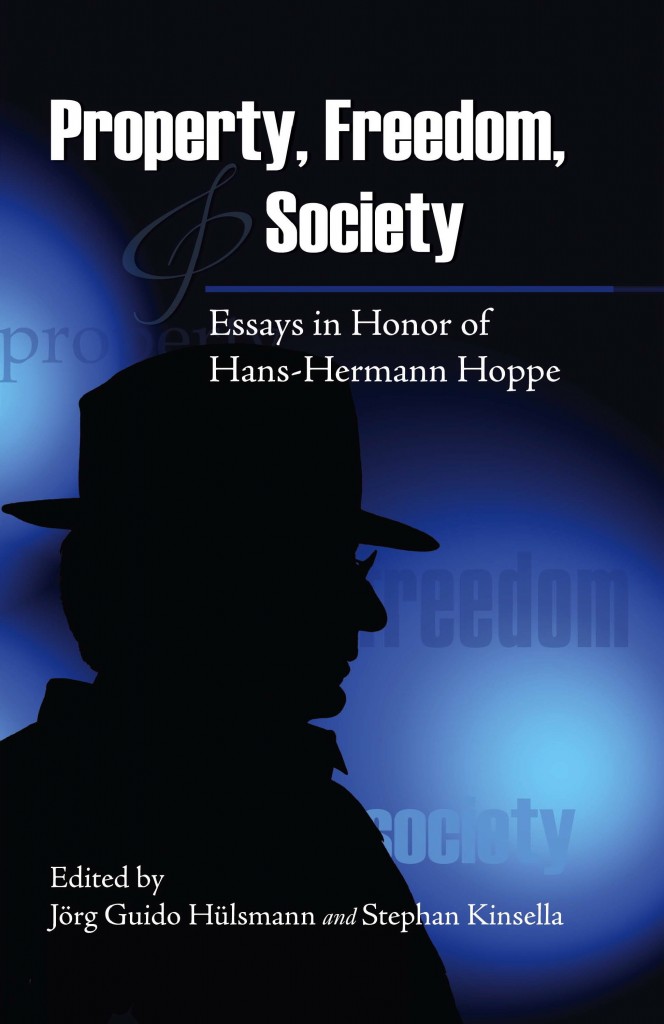
 In 2009, the Mises Institute published Property, Freedom, and Society: Essays in Honor of Hans-Hermann Hoppe, a project Guido Hülsmann and and Stephan Kinsella spearheaded to honor Hans Hoppe on the occasion of his 60th birthday. Only a few of the pieces were published independently; we are posting some of them here in this Bookstream.
The first entry was republished at Property, Freedom, and Society Bookstream: Introduction, Hülsmann and Kinsella. Links to the remaining chapters may be found at the book’s landing page here, which will be updated as the book is streamed here. Here’s the next entry. It was also republished at LewRockwell.com (Oct. 21, 2009).
Related
- Robert W. McGee, “Book Review: A Theory of Socialism and Capitalism: Economics, Politics, and Ethics by Hans-Hermann Hoppe,” The Freeman (Sept. 1, 1989)
34
A Theory of Socialism and Capitalism
Mark Thornton*
In the wake of the downfall of the Berlin Wall, the breakup of the Soviet Union, and the emergence of capitalism in China, I was asked to teach the comparative-economic-systems class at Auburn University for the summer term in 1989. My only exposure to the topic had been as an undergraduate student, where my teacher was a Cold War—era professor who concentrated almost exclusively on the Soviet Union. His implicit message was to fear the Soviet Union, which would soon come to smother the American dream.
My assignment came at the last minute, so there would be no reviewing of textbooks and preparations of lectures in advance. I spent the summer term preparing lectures on the fly and staying one chapter ahead of the students. Also, I had to choose a textbook somehow, even though I wasn’t familiar with my options, which meant I didn’t know what political punch line the author would deliver at the end. My unorthodox choice was the recently published A Theory of Socialism and Capitalism by Hans-Hermann Hoppe.
My first exposure to Hans was at a public lecture he delivered to the economics faculty at Auburn University. As I remember, his topic was the theory of public goods. His German accent was particularly thick at this time and he read his manuscript as only Hans can — with precision and authority.
Public-goods theory was, and largely still is, sacred ground for most economists, and at the time it had not been subjected to many Austrian criticisms. I remember being impressed by Hans’s detailed critique, but even more than that, the utter shock and surprise on the faces of the members of the economics departments. When the lecture was completed you could have heard a pin drop. The economics department was largely “free market” and “Austrian friendly,” but questioning the validity of public-goods theory was apparently a sort of desecration of Holy Scripture. Afterwards, and for several days, I defended Hans and debated his position. I would win over concession after concession in these debates with my professors, but failed to win a single convert.
The book arrived in the bookstore in time for my class, but it looked nothing like a textbook. In fact, the production values of the book were the worst I had ever seen. Neither of these factors mattered to me, but I do note them here to indicate that the deck was stacked against me the first day I walked into class. Plus the class was completely full of students who had little or no interest in comparative economic systems; they simply needed an elective of some type.
To my great surprise, the class went much better than I had hoped and was one of the most gratifying teaching experiences in my career. Free-market-oriented economics students seemed to revel in the complete and utter devastation of socialism that would follow, but even outright socialist students and more unbiased minds appeared to have a certain respect for the material presented in class. Much of the credit for this success I attribute to A Theory of Socialism and Capitalism, because more than three-quarters of class time relied specifically on the book.
The success of the book in reaching the students rests first on that fact that it is a theoretical, rather than empirical, treatise that provides a clear, unambiguous analytical framework to understand any particular economy that a student might face. Second, the book analyzes and debunks, or rather reconstructs, the two major “exceptions” of mainstream economics — monopoly and public-goods theory — and therefore presents economic theory as a unified whole. Third, the moral and ethical aspects of economics and economic policy are introduced in an integrated and scientific fashion, and fourth, the book provides an understanding of economic and social change. Although this latter point may not have been a primary aim of the author, it sure was handy to answer questions regarding why socialism was imploding — especially given that most other professors on campus were teaching that socialism and redistributionism of all kinds were the panacea for social ills.
In addition to all these positive traits of the book, long-time readers of Professor Hoppe will clearly recognize the consistency of his writings over time. Beginning in the Garden of Eden (so as to highlight the role of scarcity), he proceeds deductively to establish the concepts of property, contract, and aggression, and then to establish the meaning of pure capitalism as a social system based on property and the absence of coercion, while pure socialism is a system based on systemic violence and the absence of property rights. ❧
Endnotes
*Mark Thornton … is a Senior Fellow at the Ludwig von Mises Institute and Book Review Editor of the Quarterly Journal of Austrian Eco-nomics.
Discover more from The Property and Freedom Society
Subscribe to get the latest posts sent to your email.













 Alessandro Fusillo
 Andreas Tögel
 David Dürr
 Doug French
 Fernando Chiocca
 Greg Morin
 Hans-Hermann Hoppe
 Jay Baykal
 Jayant Bhandari
 Jeff Deist
 Jeffrey Barr
 Juan Fernando Carpio
 Ken Yamarashi
 León Isidoro
 Martin Cabrera
 Nick Hoppe
 Oscar Grau
 Peter Wong
 PFS
PFS scholarium
 Saifedean Ammous
 Sean Gabb
 Sean Ring
 Stephan Kinsella
 Stéphane Geyres
 Thomas Jacob
 Tom DiLorenzo