Jim Powell, “Markets Unlimited: A Biography of Murray Rothbard,” Libertarianism.org (July 3, 2000). Reprinted from The Triumph of Liberty: A 2,000-Year History Told through the Lives of Freedom’s Greatest Champions (Free Press, 2000).
Related
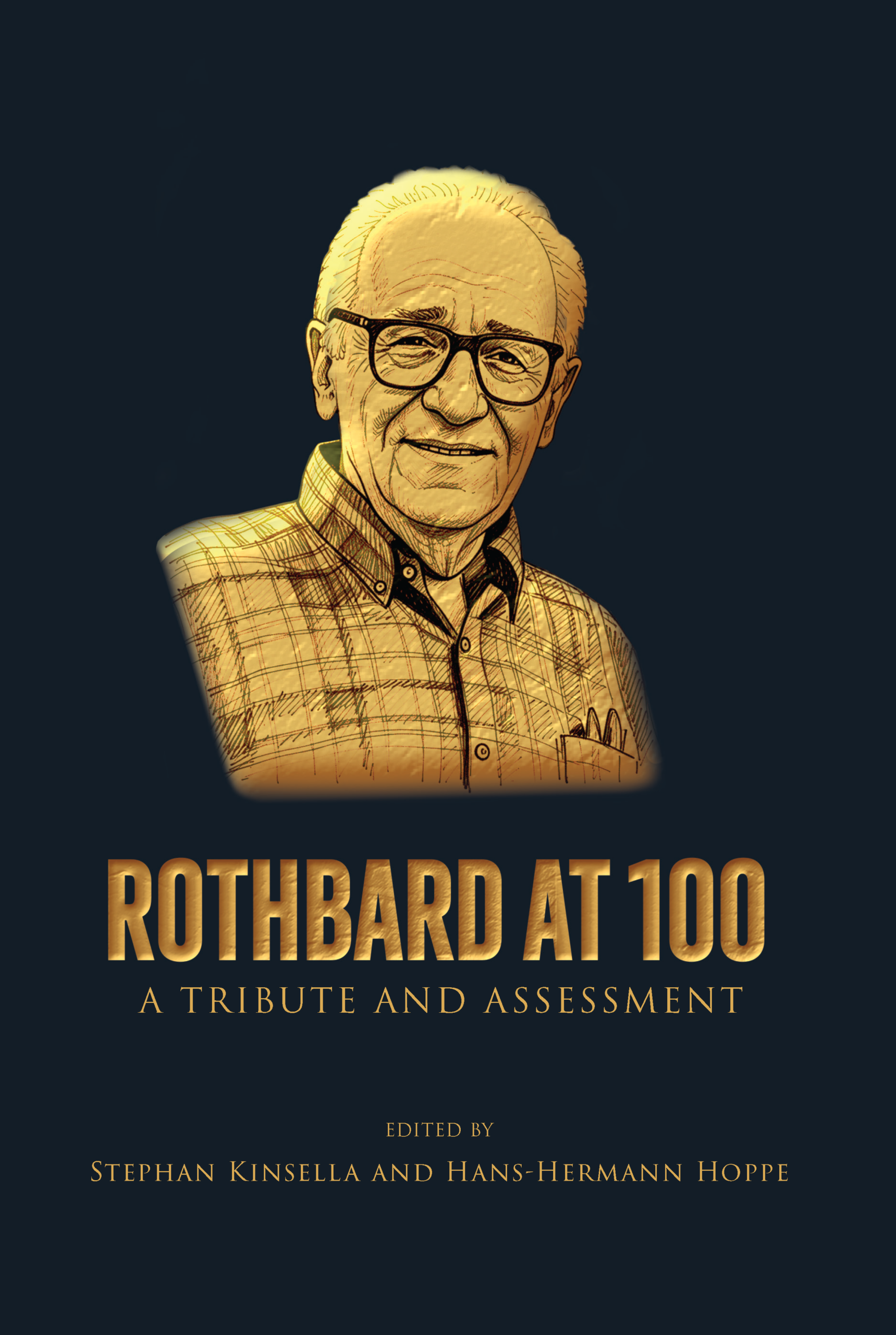
- Rothbard at 100: A Tribute and Assessment, Stephan Kinsella and Hans-Hermann Hoppe, eds. (Papinian Press and The Saif House, 2026)
- Tyler Kubik, “Murray N. Rothbard Bibliography: 1940s–2019,” Property and Freedom Journal (May 16, 2026)
Markets Unlimited: A Biography of Murray Rothbard
By Jim Powell
A prolific author and Austrian economist, Murray Rothbard promoted a form of free market anarchism he called “anarcho-capitalism.”
Economist Murray N. Rothbard mounted the most comprehensive intellectual challenge ever attempted against the legitimacy of government. During a career that spanned more than 40 years, he explained why private individuals, private companies and other voluntary associations can do whatever needs to be done.
He insisted that individuals should be free to go about their business peacefully without interference from anybody, including government. He objected to robbery whether committed by a private criminal or a tax collector. He acknowledged that there are plenty of problems affecting the private sector, but historically government has made things worse by throttling enterprise and oppressing people. Governments, he noted, are driven to expand their power, not to serve people. That’s why regardless of which political party is in power, governments tend to get bigger, enact more laws, tax and spend more of what hard-working people produce.
Rothbard wrote a dozen major books and several hundred articles about ethics, philosophy, economics, American history and the history of ideas. His work appeared in the New York Times, Wall Street Journal, Washington Post, Los Angeles Times, Christian Science Monitor, Fortune and other major publications, and he was interviewed in Penthouse. He contributed to such scholarly journals as American Economic Review, Quarterly Journal of Economics, Journal of Economic History, Columbia Journal of World Business, Journal of the History of Ideas and the Journal of Libertarian Studies. He contributed to just about every publication in the libertarian movement, including Reason and Liberty. For a number of years he published his own newsletters, Left and Right and The Libertarian Forum. His work has been translated into Chinese, Czech, French, German, Italian, Japanese, Polish, Portugese, Romanian, Russian and Spanish.
He gave talks and participated in conferences across the United States, at Harvard Law School, Yale University, Princeton University, Columbia University, Stanford University, New York University, the University of California (Los Angeles), the University of Virginia and elsewhere. For a long time, he was involved with the Libertarian Party after it was established in 1972. He worked with the Cato Institute (started in 1977) during its early days, and later became a key player at the Ludwig von Mises Institute which he served for the rest of his life. In 1994, Rothbard received the $20,000 Richard M. Weaver Award for Scholarly Letters from the Illinois-based Ingersoll Foundation — previous winners included distinguished American historians Shelby Foote and Forrest McDonald. The New York Times Sunday Magazine featured Rothbard among the most important contemporary thinkers about liberty.
***
Soon after Rothbard’s death, the project started by Mark Skousen appeared as the two-volume An Austrian Perspective on the History of Economic Thought: Volume I, Economic Thought Before Adam Smith; Volume II, Classical Economics. Rothbard traced the intellectual history of natural rights and economic liberty from ancient China to early 19th century Europe. His favorite thinkers included Lao-Tzu, Chrysippus, Marcus Tullius Cicero, Francisco Suarez, Jacques Turgot, Jean-Baptiste Say and Frederic Bastiat.
Rothbard’s wife Joey suffered a stroke in January 1999 and was transferred to Virginia where her relatives lived, and his papers were shipped to the Mises Institute. There scholar Jeff Tucker reported the discovery of several unpublished manuscripts. The Mises Institute issued Making Economic Sense (1995), 112 of his topical essays from Free Market. Then came The Logic of Action (1997) with 43 of Rothbard’s major essays about economics; Education: Free and Compulsory (1999); and a reissue of America’s Great Depression (1999) with a new introduction by Paul Johnson.
Murray Rothbard did more than anyone else to show that society generally does just fine without government interference. He helped inspire confidence in the unlimited potential of free people.
Discover more from The Property and Freedom Society
Subscribe to get the latest posts sent to your email.









 Alessandro Fusillo
 Andreas Tögel
 David Dürr
 Doug French
 Fernando Chiocca
 Greg Morin
 Hans-Hermann Hoppe
 Jay Baykal
 Jayant Bhandari
 Jeff Deist
 Jeffrey Barr
 Juan Fernando Carpio
 Ken Yamarashi
 León Isidoro
 Martin Cabrera
 Nick Hoppe
 Oscar Grau
 Peter Wong
 PFS
PFS scholarium
 Saifedean Ammous
 Sean Gabb
 Sean Ring
 Stephan Kinsella
 Stéphane Geyres
 Thomas Jacob
 Tom DiLorenzo