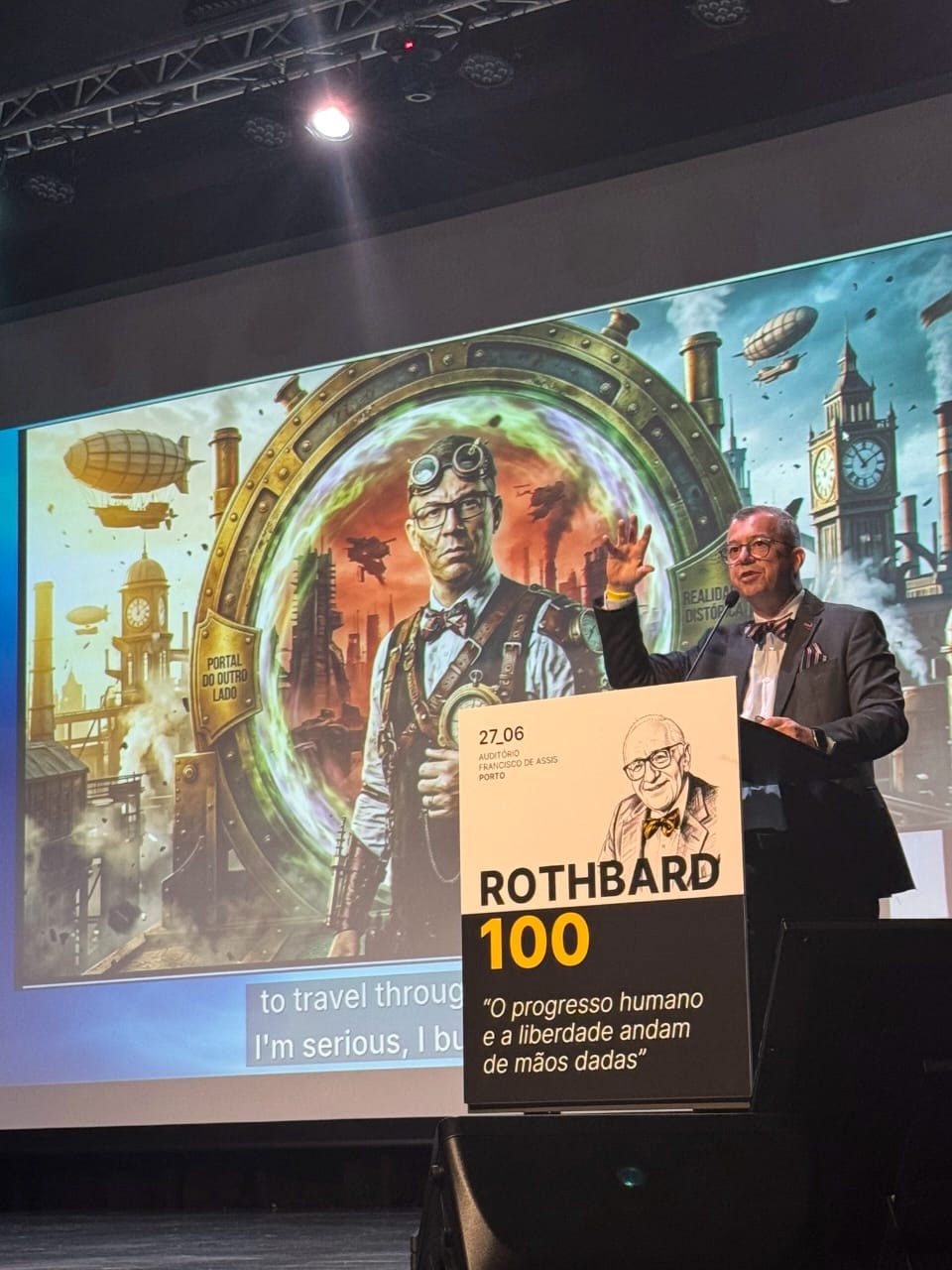
 Below is the text of the speech by Professor Adriano Paranaiba at 100 Years with Rothbard (Porto, Portugal, June 27, 2026). We will add a link to the video when it is eventually posted. PDF of presentation.
For further information, photos, and so on, see Kinsella, Rothbard Takes Portugal: 100 Years with Rothbard: A Personal Account.
Related:
- 100 Years with Rothbard (Porto, Portugal, June 27, 2026)
- Kinsella, The Three Fusionisms: Old, New, and Cautious (Jan. 16, 2022)
- Adriano Paranaiba
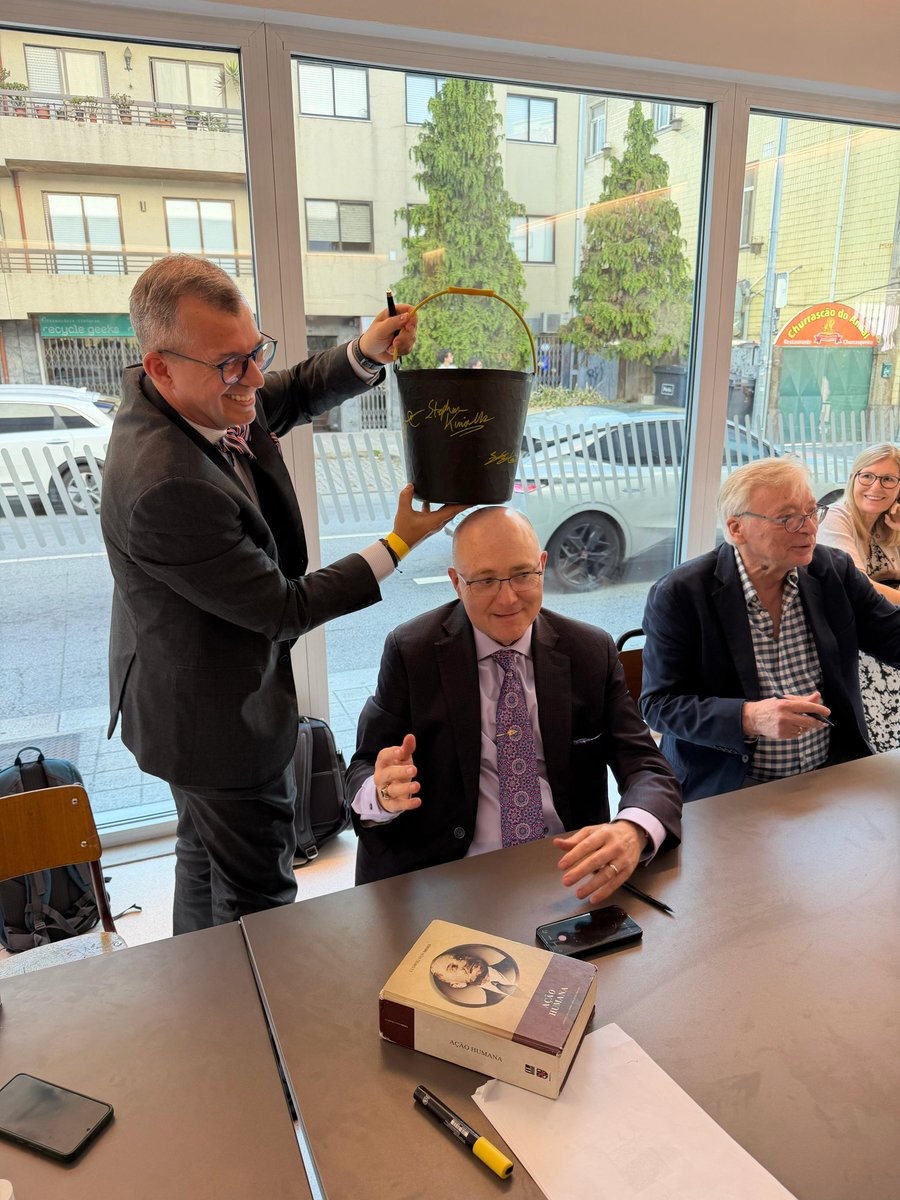
Rothbard at 100. Adriano Paranaiba, Stephan Kinsella, Hans Hoppe: Brazilian libertarian “bucket” meme
See also:
A palestra do Kinsella no evento deixa algo muito claro: Não se levem tanto a sério, ao menos não o tempo todo
O aprendizado ficar mais palatável, leve e até mesmo cativante.
O Rothbard dos livros, artigos e teses era o mesmo das piadas, peças e memes.
Se você não conseguir… pic.twitter.com/y48MqYkduT
— Fhoer 🧉 (@Fhoer_here) June 28, 2026
See: Cataláxia Editora Rothbard 100 Youtube playlist
Rothbard 100 in Portugal, with Adriano Paranaíba – PMB #568 :
In this episode of the Mises Brazil Podcast, Adriano Paranaíba talks about the largest libertarian event ever held in Portugal, Rothbard 100, which will celebrate the 100th anniversary of Murray Rothbard’s birth. It will bring together some of the most important names in the Austrian School, libertarianism, the Bitcoin universe, and contemporary political philosophy.
Watch the Mises Brazil Podcast!
***
Would a Libertarian Movement Have Existed Without Murray Rothbard?
Adriano Paranaiba
100 Years with Rothbard • Porto, Portugal • June 27, 2026
Adriano Paranaiba is an economist, holds a PhD in Transportation, and serves as the academic vice president of the Instituto Mises Brasil.
On June 27, I had the distinct honor of participating in the Rothbard 100 conference in Porto, Portugal, an event commemorating the centenary of Murray Rothbard’s birth. Addressing an audience eager to understand the foundational roots of our movement, I proposed a provocative reflection: “Would there have been a libertarian movement without Murray Rothbard?”.
The lecture could have concluded within a few seconds, as the elementary response is a simple and potent: NO.
Nevertheless, I believe it is imperative to elucidate the reasons why this proposition is regarded as an absolute truth among libertarians.
The Post-War Crossroads and the Peril of “Fusionism”
In the aftermath of the Second World War, the American right sought political reorganization. Within this context, William F. Buckley Jr. and National Review magazine established themselves as the primary locus of opposition to the New Deal. It was during this period that Frank Meyer proposed “fusionism”—a strategy designed to amalgamate the free-market economics of classical liberals with the traditional morality and geopolitical anti-communism of conservatives.
The inherent danger of this proposal was entirely evident to Rothbard. Fusionism presupposed that conservatives would oversee morality and the military, whereas liberals would confine themselves strictly to economics. Rothbard recognized that endorsing Cold War militarism and the defense apparatus would inevitably destroy the essence of individual liberty. Without his unyielding refusal to compromise with this model, the liberal movement would have devolved into a mere economic advisory committee within a conservative party, thereby legitimizing the expansion of the State.
The Construction of a Distinct Identity
Rothbard’s intellectual leadership was decisive in ensuring that radicals did not become mere window dressing for the economic wing of the right. He instigated an explicit ideological rupture in the 1960s, positioning himself firmly against the Vietnam War and conscription. This principled stance was crucial in securing the autonomy of libertarianism.
Furthermore, Rothbard actively combated what Professor Joseph Salerno termed “fuzzy Hayekianism,”1 which frequently flirted with state concessions and empiricist methodology. As Boettke accurately observed: “After 1944, Hayek abandoned studies in economics proper to become, allegedly, one of the wide-ranging social theorists of the twentieth century.”2
This intellectual “breadth” was, in reality, a departure from the Misesian legacy—an approach devoid of praxeology that relativized coercion and substituted the rigorous concept of Human Action with mere “ignorance.” By steadfastly insisting upon praxeology, Murray Rothbard preserved the doctrinal purity and the correct trajectory of the modern Austrian School, successfully resisting its dilution into neoclassical macroeconomics.
The Gravitational Center of Libertarian Thought
Rothbard’s profound impact was not restricted to theoretical developments; it extended significantly into institutional practice. He functioned as a gravitational force that coalesced young intellectuals, such as Ralph Raico and George Reisman, around unified endeavors like the “Bastiat Circle” and the South Royalton Conference. The latter may be genuinely regarded as the authentic resurgence of the Austrian School—a milestone that many erroneously attribute to Hayek’s Nobel Prize.
A Journey Through a Multiverse Without Rothbard
In order to demonstrate the magnitude of the impact caused by Murray’s absence from the world of ideas, I utilized a counterfactual dystopia. Had we traversed alternative multiverses in which Rothbard never existed, the intellectual landscape would be, at the very least, unrecognizable. Bereft of his influence, we would likely observe a weakened liberal movement, reduced to an economic advisory panel embedded within traditional conservative parties.
Instead of the Journal of Libertarian Studies, which Rothbard established in 1977 to advance ethical libertarianism, one would encounter publications such as the Review of Very Limited Government—preoccupied with bow ties and a “strictly limited” state apparatus—or the Journal of Friedmanite Practicality, dedicated to incrementalism and pragmatic public policy. It was Rothbard who explicitly separated purely ethical libertarianism from classical conservatism; without his intervention, the movement would remain fused with the traditional right or focused exclusively on economic efficiency. In an alternative multiverse, I discovered The Minarchist Compromise Quarterly—a publication asserting that taxation is theft, “yet permissible in small measures to finance the judiciary.”
Without the Review of Austrian Economics (1987), which Rothbard established to secure a purely praxeological academic space, Austrian economists would have succumbed to mainstream academic pressures. I encountered a Journal of Econometrics with a Touch of Menger, saturated with the mathematical equations that Rothbard so thoroughly despised.
I also observed two additional multiverses: one featured the Quarterly Journal of “Mises was mostly right, but…” and the other contained The National Review’s Economic Appendix—which endorsed state military interventions globally, provided they adhered to fiscal responsibility.
Without Left & Right: A Journal of Libertarian Thought, founded by Rothbard in 1965 precisely to break away from the bellicose, anti-communist right of National Review and to pursue strategic anti-state alliances, I discovered two further multiverses: The Cold War & Low Taxes Bulletin and Right & Center-Right—intellectual realms entirely lacking a radical third way. Without Rothbard, the liberal movement would have been completely engulfed by conservative fusionism.
Regarding the institutions he assisted in establishing and organizing:
- Libertarian Party (Founded in 1971): Although David Nolan was the official founder, Rothbard served as the primary ideologue and strategist who established the programmatic tone of the party’s formative years. Without his influence directing the movement toward the Non-Aggression Axiom, the party would have been nothing more than a disgruntled faction of existing political entities. We would have inherited the Socially Acceptable Liberty Party—an organization that offers apologies prior to defending free markets.
- Cato Institute (Founded in 1977): Originally, Rothbard helped establish the Cato Institute to serve as a beacon for radical ideas. Following the historic rupture with Charles Koch and Ed Crane, the institute relocated to Washington, D.C., and adopted a posture far more palatable to the political establishment. Without Rothbard’s initial radical influence, the institute would have been thoroughly moderate from its inception. It is worth recalling that Cato’s Letters (authored by John Trenchard and Thomas Gordon in the 18th century) were named in honor of Cato the Younger, the steadfast defender of the Roman Republic and sworn adversary of Julius Caesar’s tyranny, corruption, and absolute power. Without Rothbard, we would have witnessed the Caesar Institute—advocating for the centralization of power, albeit seasoned with a touch of stoicism to maintain a favorable appearance.
- Mises Institute (Founded in 1982): Rothbard and Lew Rockwell established the Mises Institute precisely to rescue the Austrian School from academic obscurity and to prevent it from being hollowed out and integrated into mainstream neoclassical economics. Without his foundational work, we would find the Math Praxeology Institute: Institute for a Lightly Decentralized Bureaucracy, bearing the motto: “Mises is Good for Inflation, But Let Us Not Overdo It”—a title perfectly suited for those who recall Misesian insights exclusively during economic crises.
Conclusion
Rothbard did not create liberty; rather, he provided its definitive ethical and methodological armor. He removed us from a defensive posture and placed us firmly on the intellectual offensive. Without his contributions, libertarianism would constitute nothing more than a minor footnote within the annals of classical conservatism.
Murray left us a comprehensive intellectual edifice: an economic treatise, a political manifesto, and a historical revision. He transformed the defense of liberty into an uncompromising logical and moral imperative. Without the structural backbone of the Non-Aggression Axiom (NAA), the movement would be purely technical in nature. We would be engaged in debates regarding tax brackets and bureaucratic efficiency, rather than challenging the ethical legitimacy of the State. We would merely be disputing the dimensions of the chains that bind us, rather than debating absolute principles.
I express my deepest gratitude to Mises Portugal for their exceptionally warm hospitality and for publishing the commemorative edition of my book, Understanding Rothbard, translated into European Portuguese. May the centenary of Rothbard serve to remind us that he was the gravitational center that unified generations of liberals around a radical, non-negotiable project of human liberty.
- Salerno, J.T. The rebirth of austrian economics—in light of austrian economics. Quart J Austrian Econ 5, 111–128 (2002). https://doi.org/10.1007/s12113-002-1008-5. [↩]
- Boettke, Peter J. Hayek’s The Road to Serfdom Revisited: Government Failure in the Argument Against Socialism. Eastern Economic Journal, Vol. 21, No. 1 (Winter 1995): 7-26. [↩]
Discover more from The Property and Freedom Society
Subscribe to get the latest posts sent to your email.










 Alessandro Fusillo
 Andreas Tögel
 David Dürr
 Doug French
 Fernando Chiocca
 Greg Morin
 Hans-Hermann Hoppe
 Jay Baykal
 Jayant Bhandari
 Jeff Deist
 Jeffrey Barr
 Juan Fernando Carpio
 Ken Yamarashi
 León Isidoro
 Martin Cabrera
 Nick Hoppe
 Oscar Grau
 Peter Wong
 PFS
PFS scholarium
 Saifedean Ammous
 Sean Gabb
 Sean Ring
 Stephan Kinsella
 Stéphane Geyres
 Thomas Jacob
 Tom DiLorenzo