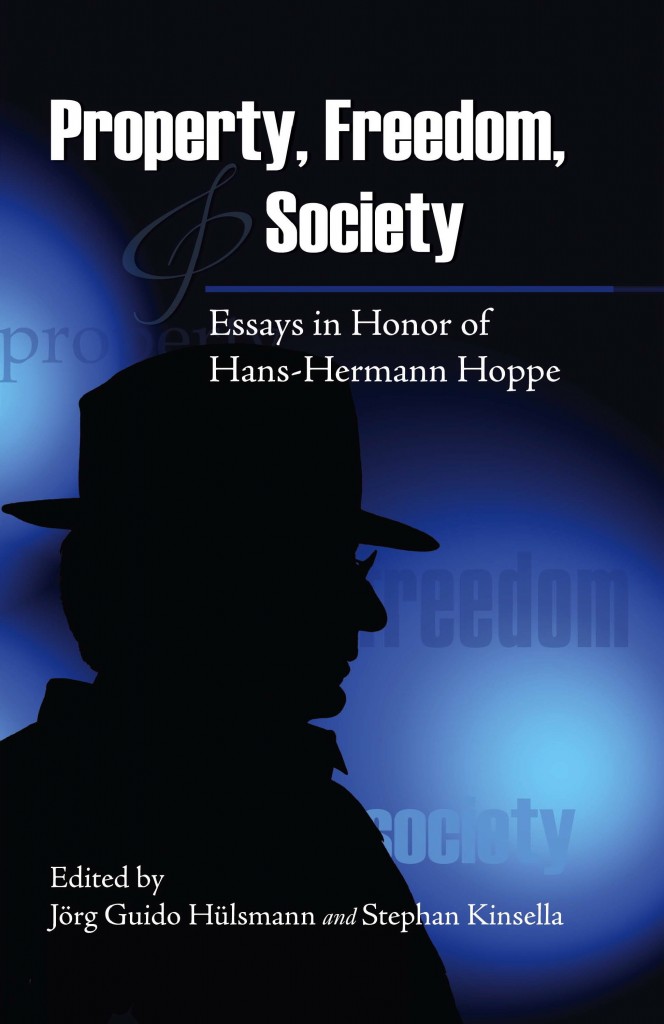
 In 2009, the Mises Institute published Property, Freedom, and Society: Essays in Honor of Hans-Hermann Hoppe, a project Guido Hülsmann and and Stephan Kinsella spearheaded to honor Hans Hoppe on the occasion of his 60th birthday. Only a few of the pieces were published independently; we are posting some of them here in this Bookstream.
The first entry was republished at Property, Freedom, and Society Bookstream: Introduction, Hülsmann and Kinsella. Links to the remaining chapters may be found at the book’s landing page here, which will be updated as the book is streamed here. Here’s the next entry.
Related
- Habermas, Hoppe’s Teacher and PhD Advisor, dies at 96
- Hoppe, “A Realistic Libertarianism,” LewRockwell.com (Sept. 30, 2013)
- Hoppe, “On War, Democratic Peace, and Reeducation: The ‘German Experience’ in Reactionary Perspective”
4
Hans-Hermann Hoppe and the Libertarian Right
Paul Gottfried*
To most of his colleagues in the libertarian movement here and in Europe, Hans-Hermann Hoppe is known to be an intellectually energetic companion in arms. This reputation seems entirely deserved for anyone who looks at
Hans’s numerous writings presenting libertarian views from a recognizably Austrian School perspective. Whether his subject is the welfare state’s effect on economic growth, the Federal Reserve System, the possibility of privatizing most modern government functions, business cycles, or public consumer protection agencies, Hans has come down invariably against the “State.” Although debate may occur about the details of these positions, Hans can always be found on policy questions among the advocates of the least possible government. Those who do not take such a stand would presumably not qualify as libertarians.
But beyond this area of consensus, there is an obvious gulf between left- and right-libertarians. This area of disagreement can be seen in a wide range of cultural, social, and historical issues, and the dividing line among self-described libertarians may be even more important than the consensus duly noted above. Although not the only illustration of a left-libertarian stance, a book by Stephen Moore and Julian Simon, It’s Getting Better All The Time, contrasting the U.S. in 1900 and in 2000, exemplifies the left-libertarian worldview—which is presumably that of Cato Institute, the foundation with which Moore is closely associated. For almost 300 pages, Moore and Simon dwell on the political, social, economic, and moral progress that the U.S. underwent between 1900 and 2000.1
This book is written against the “gloom and doom industry”; Lawrence Kudlow, in a breathlessly ecstatic endorsement, thanks Moore and Simon for “dismantling the doomsday pessimism that’s still so commonplace in academia and the media.”2
Examining what they see as convincing data for the preceding one-hundred-year period with a view toward increased life expectancy; continuing technological advances; the availability of public education for the majority of American youth—including college degrees for half of our high-school graduates; the acquisition of civil rights for blacks, women, and gays; a successful national crusade against xenophobia; and a vast increase in per capita wealth, Moore and Simon argue that the U.S. “is a vastly better place today than it was a hundred years ago.” In contrast to those who complain about social disintegration and other signs of national decline, Moore and Simon see improvement in every aspect of human life.
Much of the evidence offered that “the human condition has improved dramatically” relates to a cluster of technological and medical advances that have been going on for centuries. Such developments deserve to be noted but also need to be treated in historic context. For example, infant mortality has been steadily
declining because of medical discoveries that were made partly in the nineteenth century, and the effect of this in the twentieth century was that fewer infants and mothers died during childbirth or shortly thereafter. This has caused a dramatic rise in median life expectancy. Nonetheless, it is misleading to suggest that 47 year old people were dropping dead all over the U.S. in 1900, when what was really happening was that a higher proportion of infants did not survive their first year of life.
Moore’s and Simon’s comments on education verge on the ludicrous, a judgment that my forty years in academia would amply confirm. The authors should have looked at the by now proliferating studies showing the plummeting standards of literacy, mathematical knowledge, and cultural knowledge among American youth;3 and the particularly meager results yielded by the heavy public investment in bringing up standards for minorities and the underclass. In their celebration of progress, the authors are also not particularly sensitive to the drastic reductions of academic freedom in the U.S. and in Europe as a result of the triumph of the multicultural Left. Public discourse on a variety of issues has been reduced to the recitation of PC platitudes about designated victims and the dangers of racism, sexism, and homophobia.
But my point here is less to challenge this book-length expression of heady optimism about human improvement than to stress the obvious. The authors do not object to massive governmental efforts to impose equality and end discrimination; this, in fact, is what much of their book is celebrating. Their argument, with due respect to the blurbers who praise this book as a hymn to freedom and free enterprise, is not a call for amelioration by getting government out of our faces. Quite the opposite conclusion might be drawn by anyone who reads the supposed good news from cover to cover. The rise of the most powerful states in modern history in the “democratic West” is not only not seen as a problem; it is made to appear to be the real means for advancing what our left-libertarian authors truly value. The consequence of the enormous consolidation of administrative power between 1900 and 2000 has been the entirely acceptable price for promoting human equality.4
Left-libertarians have a special thing for equality. They see it as foundational for a foreign policy as well as domestic commitment, which is the bringing of equality to as much of the human race as they can manage to extend it to. One may agree or disagree with this value-preference, but the plain fact is that equality shapes the left-libertarian understanding of history and human affairs to a degree that its representatives may not even recognize. Thus, an argument one typically encounters among them is that it is silly to talk about liberty while blacks, women, gays, and so on have not yet been granted the same amount of this good as white males. And, even if we have achieved a reasonable amount of freedom for ourselves, we should value the natural right held by all human beings to have the same blessing made available to them.
Whence the willingness of the left-libertarian Virginia Postrel to entertain the idea of wars fought to spread “democracy” and whence the morbid sensitivity of all left-libertarians to any theory that would make minorities feel uncomfortable by suggesting the existence of inherited cognitive inequalities? Although modern libertarians may talk about “equal rights,” among left-libertarians as much as socialists, the stress is on the “equal” distribution of the rights being privileged. This emphasis is what renders left-libertarians totally inoffensive to the big-government Left and the neo-conservatives. Give or take some possible disagreements about particular regulations or drug laws, their views of history and the human good are largely indistinguishable.
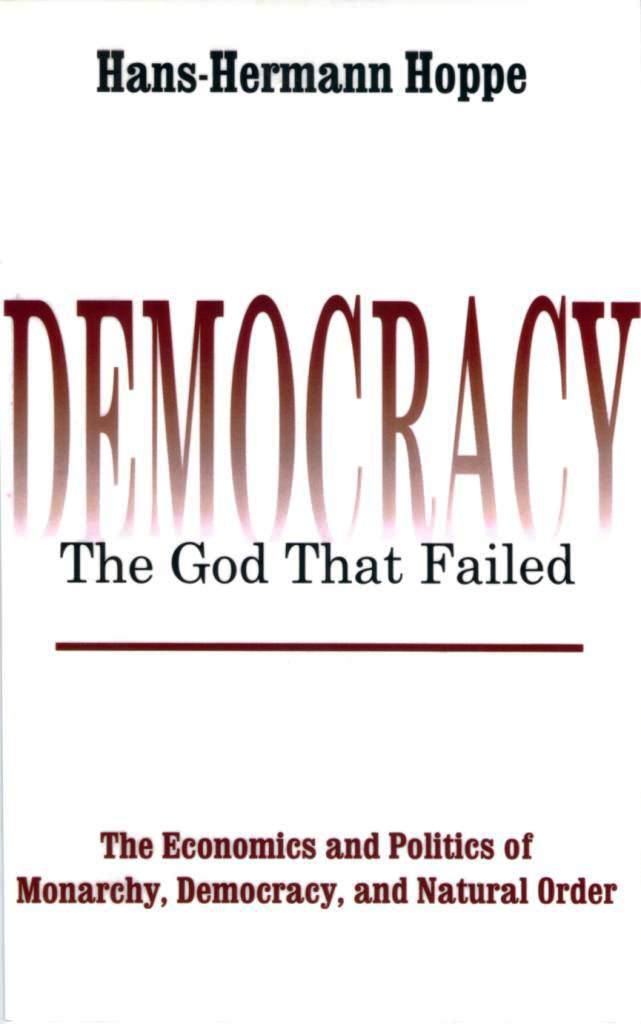
It is hard to imagine, on the other hand, anyone who personifies more fully the right-libertarian stance than Hans. Indeed, his work Democracy—The God that Failed is a treasure trove of right-libertarian statements about life and history. In contrast to Moore and Simon, Hans observes that
[i]n comparison to the nineteenth century, the cognitive capacities of political and intellectual elites and the quality of public education have declined. And the rates of crime, structural unemployment, welfare dependency, parasitism, negligence, recklessness, incivility, psychopathy, and hedonism have increased.5
Such assertions, which pervade his magnum opus, would obviously upset the statistical researchers Moore and Simon or the editors of the Wall Street Journal. Supposedly, they have demonstrated to our satisfaction the continuous unfolding of human Progress, whereas Hoppe has the temerity to propose exactly the opposite view.6
In point of fact, his cultural and political assertions are at least as demonstrable as theirs. But unlike them, he has no special regard for the principle of equality. From his point of view, equality and the democratic form of government that the advocates of that ideal enshrine is a “decivilizing force.” It generates a constantly expanding public administration that interferes in social institutions, particularly the family, and confiscates wealth, in the name of “social justice” and the “public good.” Administered democracy may also seem to require, for the sake of doctrinal consistency, the overrunning of one’s country by immigrants. At the very least, such a practice would offset the inertia that Postrel condemns in her book The Future and Its Enemies, in which she calls for “a world of constant creation, discovery, and competition.”7 In her hatred of “stasis,” Postrel is annoyed that people prefer custom to change: “I like my neighborhood the way it is. That is the all-too-understandable sentiment that motivates stasist policy.”8 The alternative to “keeping things as they are” is, for Postrel, among
other things, favoring a continuing transformation of one’s culture and environment.
If the subject were the aggregate effects and distributed costs of our present immigration policy, Hoppe would have a stronger argument than the late Julian Simon. The social costs of our passion for diversity and undocumented, cheap labor are at least as great as Hoppe suggests. But it must be kept in mind that he and the left-libertarians are coming from entirely different value directions. Unlike them, he does not believe it is the duty of civil society to advance equal opportunities for the rest of the world, or even less, that the modern administrative state is a fitting instrument to carry out such a task. Nor does he have any patience with other characteristic assumptions of the left-libertarians, e.g., that democracy and liberal immigration policies expand the amount of ordered liberty in a country, that the more people we encourage to vote, the more “just” our society becomes, or that the quality of a civilization can be raised by increasing the extent of minimal literacy. Hoppe engages all of these sticky points—and other ones as well.
There is also much in his thought that is typically libertarian, such as his defense of Austrian economics and his model of civil society drawn at least partly from John Locke. For Hans the ideal society is a collection of property-owning individuals, who are left free to accumulate and spend wealth. They may also act collectively, on the basis of agreements, to restrict the membership of their property-holding community—or else to allow others to come in if they see fit. In this “anarcho-capitalist” vision, which was developed by Hans’s mentor Murray Rothbard, individual property-holders should be free to conclude protective pacts, including agreements for raising their own military forces. They should also be authorized to bar from their communities unwanted immigrants who did not receive permission to settle there. Least of all should they be forced to provide for those with whom they did not elect to share their property assets. In this view, the state has co-opted activities that could be done more efficiently, or does not have to be done at all, by consenting property-holders. And these other arrangements would be possible if the state were not around.9
But because of the present impossibility of junking this parasitic institution, Hans suggests (perhaps not entirely tongue-in-cheek) a return to an already tried political alternative, namely, monarchy. Much of Democracy—The God that Failed deals with this other model and with showing that it is less predatory than a democratic regime. Monarchs have the advantage over democratic rulers that they view the realm that they control as a hereditary possession, albeit one with restrictions on what they could do to others. Their hereditary right to their position, however, renders monarchs less inclined to plunder than democratic officeholders, who have only limited tenures and who therefore feel impelled to take as much as they can from taxes and public properties before they retire from office.
Moreover, democratically selected rulers are usually emboldened by their popular mandate to enrich themselves ad libitum, whereas monarchs have been surrounded by jealous aristocrats and churchmen who have imposed limits on their appetites. Although Hans may overstate both the countervailing forces in monarchies and the lack of controls in democracies, his larger point—that everything being equal, monarchies are not as oppressive as democracies can be and have been—is probably correct. Both the elevation of democratic government to godlike status and the preoccupation of this form of government with equality have increased the potential of modern democratic regimes for destroying property rights and communal rights. Such regimes practice a form of interventionism that was not available to most monarchies—and certainly not to the Western-type monarchies that existed in the nineteenth century.
Significantly, Hans does not hold back in criticizing monarchies for doing in a quite primitive way what democratic administrations have succeeded in accomplishing with less fallout, which is monopolizing power. Like democrats, kings tried to marginalize their opposition by declaring all political authority to be a prerogative of the centralized state. Monarchical sovereignty was a prelude to democratic sovereignty, and it was based the same “original sin,” “the monopolization of the function of judge and peacemaker.”10 The best form of authority for Hans is, in fact, “the natural order,” one that is “[t]he natural outcome of the voluntary transactions between various private property owners” and which is “decidedly nonegalitarian, hierarchical, and elitist.”11
Any effort to bring this about in our democratic, late modernity is hailed as a positive step: “Thus, in addition to advocating the abdication of democracy, it is now of central strategic importance that at the same time ideological support be given to all decentralizing or even secessionist social forces.”12
A question that might be raised is whether the generality of humankind would endorse the tendencies that Hans is promoting. Would democratic populations (who have ceased to be citoyens (citizens) or Staatsbürger in any meaningful sense) really want to live in the decentralized, elitist society that Hans recommends, one in which a “natural elite” possess “natural authority,” and, because of “selective mating” and the “laws of civil and genetic inheritance,” these “positions of natural authority are more likely than not passed on within a few noble families.”13
Why would the majority want to acknowledge these “authority persons,” who presumably would arbitrate conflicts on the basis of the social deference that others extend to them? It is hard to see why most people would accept such arrangements, as opposed to a democracy, in which the promise is made and often fulfilled of redistributing goods to the voters. The question is not whether the democratic state robs from Peter to pay Paul (it obviously does that!) but whether Hans’s “natural order” offers most people what they want. The answer is an emphatic “no” and therefore this order (which looks a bit like Friedrich Hayek’s conception of “spontaneous order”) depends for its realization on the possibility of “decentralization and secession.” Absent such a possibility, this order is in no way feasible.
Two other observations may be appropriate for understanding more fully the libertarianism of the Right that Hans exemplifies. One, this libertarianism is a recognizable subspecies of what the Italian Marxist Domenico Losurdo calls “aristocratic radicalism,” which he explores in voluminous works on Friedrich Nietzsche (1844–1901). According to Losurdo, Nietzsche’s “critique of modernity” is based on his opposition to the leveling tendencies that he perceives in democracy and socialism.14 It was therefore perfectly consistent for Nietzsche to praise aristocratic societies, including the Indian caste system, and to advocate liberty in the Western world of his time. That is because the state, as Nietzsche understood it, was becoming an instrument of equalization; and its attack on property relations would belong to a larger effort to remove all social and gender distinctions. Nietzsche, as Losurdo points out, also disliked Christianity, because he thought the “slave morality” that pervaded this religion and the culture it nurtured rendered them ineffective against the Left. He therefore broke with classical conservatives, who had viewed established religions as bulwarks against revolution. From Nietzsche’s perspective, Christianity and the Left were related worldviews, and only a new aristocratic order, one that had shed its Christian past, could save civilization from the unfolding of the egalitarian ideal, going from democracy into socialism and feminism.
In addition to the aristocratic radicalism that animates Hans’s libertarianism (albeit without Nietzsche’s passionate dislike for Christianity), there is another influence on his work that deserves to be stressed. His German background has made him allergic to the “American democratic” ideal, as Hans states candidly in the opening lines of the Preface to the German edition of his magnum opus:
“Politically incorrect” is what the rulers and in particular the victors among the rulers proclaim. The great victor of the 20th century, in particular as far as Germany is concerned, is the USA. Hence, the USA has determined the “correct” interpretation especially of recent history. Defeated Germany was not only occupied, but also reeducated. Germany’s schools and universities, under almost complete government control, and the governmentally licensed mass media, have proclaimed to this day the official American view of history and in particular of the 20th century as a triumph of good over evil.15. See also similar comments in Hoppe, Democracy, pp. x–xi; and xxiii, noting that “both Mises and Rothbard had a soft spot for democracy and tended to view the transition from monarchy to democracy as progress.” ))
It is hard to ignore the likely connection between Hans’s detestation of the “State” in all of its modern manifestations and the use of postwar public administration in West Germany, perhaps even more than in the Communist East, to humiliate his nation. His sense of what was done to “reeducate” defeated Germans after the War, which is documented in detail in Caspar von Schrenk-Notzing’s Charakterwäsche: Die Politik der amerikanischen Umerziehung in Deutschland, has left Hans understandably skeptical about the modern democratic project.16 His relation as a student to Jürgen Habermas, the German thinker and publicist who more than anyone else in his country has called for a rejection of a German national identity and for the creation of a new “constitutional patriotism,” based on supposedly universal democratic values, may explain even more about Hans’s intellectual odyssey.
Hans has seen the ugliest side of modern, guided democracy, which is the side that keeps getting shoved into the faces of its critics. The fact that the advocates of an American global democratic mission, a group now insanely referred to as “conservatives,” have elevated German reeducation to a global model is further proof of the imperialistic side of the ideology that Hans goes after. This new democratic undertaking may have added to his discomfort with “the god that failed.” If this is the case, then his discomfort is fully justified. ❧
*Paul Gottfried ([email protected]) is Horace Raffensperger Professor of Humanities at Elizabethtown College and author of Multiculturalism and the Politics of Guilt, The Strange Death of Marxism, and Conservatism in America: Making Sense of the American Right, and his newly published autiobiography, Encounters: My Life with Nixon, Marcuse, and Other Friends and Teachers.
- Stephen Moore and Julian L. Simon, It’s Getting Better All the Time: 100 Greatest Trends of the Last 100 Years (Washington, D.C.: Cato Institute, 2000), p. 1. [↩]
- Kudlow’s blurb can be found on the Amazon.Com advertisement for It’s Getting Better All the Time. Attention should also be paid to the critical assessment of the book’s figures for GDP growth between 1900 and 2000 in Brendan Nyan and Ben Fritz, “The deceptive advocacy of Stephen Moore,” Spinsanity blog (September 22, 2003) [] (visited Jan. 12, 2009). [↩]
- See, e.g., Chris Hedges, “America the Illiterate,” Truthdig (Nov. 10, 2008); Robert Roy Britt, “14 Percent of U.S. Adults Can’t Read,” LiveScience.com (January 10, 2009). [↩]
- See It’s Getting Better All the Time, especially pp. 241–60; also Paul Edward Gottfried, After Liberalism: Mass Democracy and the Managerial State (Princeton, N.J.: Princeton University, 1999); and Robert Higgs, Crisis and Leviathan: Critical Episodes in the Growth of Government (New York: Oxford University Press, 1987). [↩]
- Hans-Hermann Hoppe, Democracy—The God that Failed: The Economics and Politics of Monarchy, Democracy, and Natural Order (New Brunswick, N.J.: Transaction Publishers, 2001), p. 42–43. [↩]
- See also ibid., p. 69: “The Whig theory of history, according to which mankind marches continually forward toward ever higher levels of progress, is incorrect.” [↩]
- Virginia Postrel, The Future and Its Enemies (New York: Free Press, 1998), p. xiv; see also David Gordon’s penetrating review of Postrel’s book, “Ask a Silly Question,” Mises Review 5, no. 1 (Spring 1999). [↩]
- Postrel, The Future and Its Enemies, p. 204. [↩]
- Hoppe, Democracy; and Murray N. Rothbard, Power and Market (Kansas City: Sheed, Andrews and McMeel, 1977). [↩]
- Hoppe, Democracy, p. 72. [↩]
- Ibid., p. 71; and Hans-Hermann Hoppe, Eigentum, Anarchie und Staat: Studien zur Theorie des Kapitalismus (Opladen: Westdeutscher Verlag, 1987). [↩]
- Hoppe, Democracy, p. 74; and Hans-Hermann Hoppe, The Economics and Ethics of Private Property: Studies in Political Economy and Philosophy (Boston: Kluwer, 1993). [↩]
- Hoppe, Democracy, p. 71. [↩]
- Domenico Losurdo, Nietzsche il Ribelle Aristocratico: Biografia Intelettualle e Bilancio Critico (Turin: Bollati Boringhieri, 2002). [↩]
- Hans-Hermann Hoppe, Der Gott, der keiner ist, Robert Grözinger, trans. (Waltrop & Leipzig: Manuscriptum Verlagsbuchhandlung, 2003), pp. 7–8 (English translation from Hans-Hermann Hoppe, “Demokratie. Der Gott, Der Keiner Ist,” LewRockwell.com (December 5, 2003 [↩]
- Caspar von Schrenck-Notzing, Charakterwäsche: Die Politik der amerikanischen Umerziehung in Deutschland (Graz: Ares Verlag, 2004); and Ernst von Salomon, Der Fragebogen, seventeenth ed. (Rowohlt Taschenbuch Verlag, 2007). [↩]
Discover more from The Property and Freedom Society
Subscribe to get the latest posts sent to your email.
















 Alessandro Fusillo
 Andreas Tögel
 David Dürr
 Doug French
 Fernando Chiocca
 Greg Morin
 Hans-Hermann Hoppe
 Jay Baykal
 Jayant Bhandari
 Jeff Deist
 Jeffrey Barr
 Juan Fernando Carpio
 Ken Yamarashi
 León Isidoro
 Martin Cabrera
 Nick Hoppe
 Oscar Grau
 Peter Wong
 PFS
PFS scholarium
 Saifedean Ammous
 Sean Gabb
 Sean Ring
 Stephan Kinsella
 Stéphane Geyres
 Thomas Jacob
 Tom DiLorenzo