 Former federal reserve chair Alan Greenspan (March 6, 1926–June 22, 2026) has died at the age of 100.1 He was born just 4 days after Murray Rothbard (March 2, 1926–Jan. 7, 1995), who died at age 68. Ah, would that Rothbard had lived to 100 instead.
Greenspan was, at least at one point, a libertarian, or at least Objectivist, and he and Rothbard knew each other as Greenspan was associated with Ayn Rand from the 1950s to her death in 1982—Rand nicknamed him “The Undertaker”2 —overlapping with Rothbard’s interaction with Rand and her crowd in the late 1950s. Greenspan wrote two good essays, favoring the gold standard and opposing antitrust law, in Rand’s Capitalism: The Unknown Ideal.3
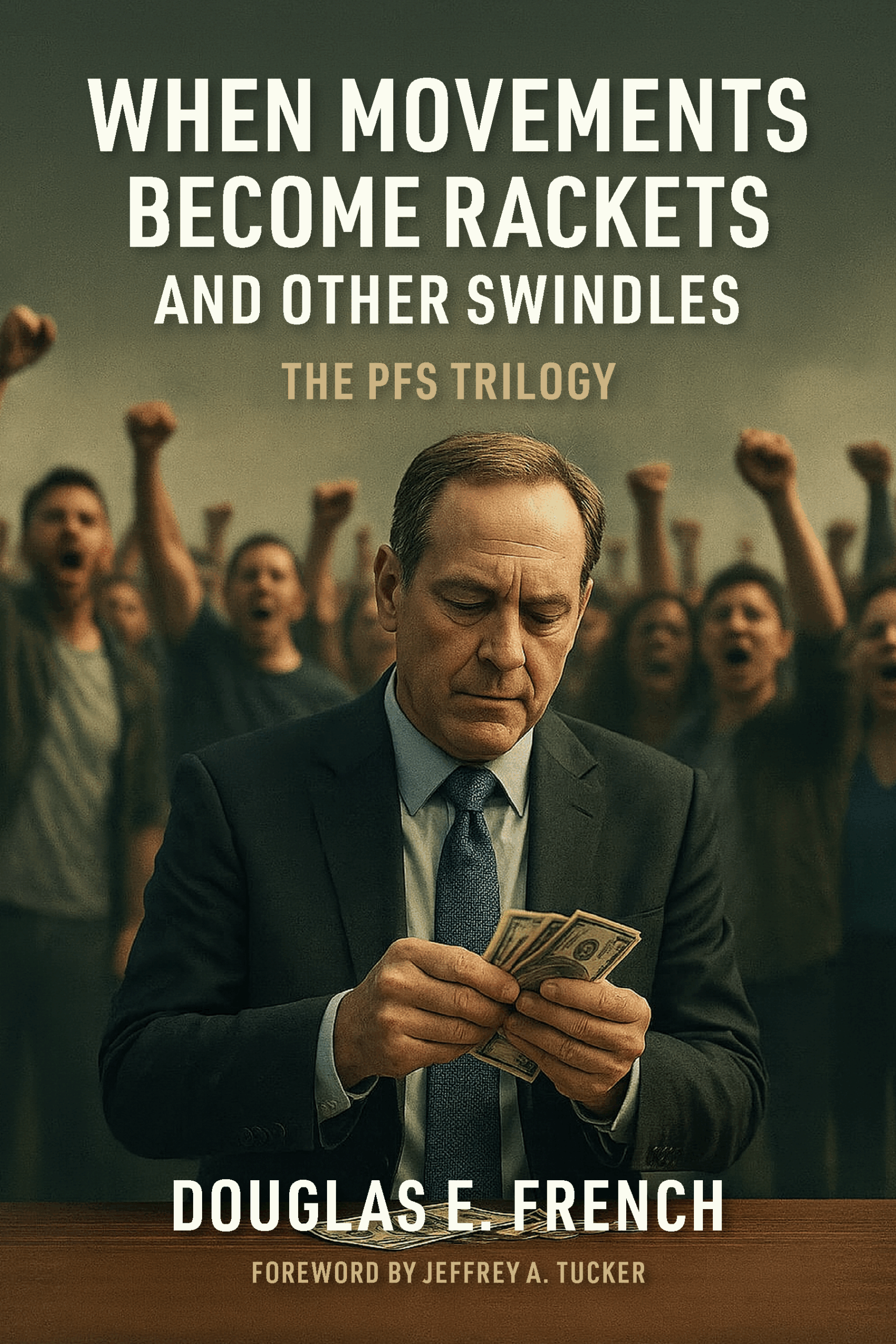
But he was no Austrian. As Doug French writes,
If Greenspan was familiar with Austrian Business Cycle Theory, and he should have been, he’d have known crashes and recessions are needed to correct the malinvestments created by central bank monetary interference. To paper over crashes and bail out losers is to destroy precious capital by keeping it in the hands of those who waste it.
However, Greenspan was a Keynesian forecaster who, as Rothbard explains [see below], had no interest in Austrian economics or economic theory at all. Murray, who had met Greenspan, admitted he didn’t understand how Greenspan rose to power. “He’s the least charismatic person I’ve ever seen,” Rothbard said. “He has the persuasiveness of a dead mackerel.”4
Transcript from above video
[Question about Greenspan] What do you think about Alan Greenspan? How did he go from being … from studying under Mises …
Rothbard: Yeah, that’s very interesting. Greenspan, well he was never … he was always a Keynesian, even in the old Randian Period. He had no interest in Austrian economics at all, and no interest in economic theory. He was basically a forecaster. He was a lousy forecaster, interestingly enough.
When he got his Fed post a couple years ago, he had to give up its forecasting business because the forecasting firm—Townsend and Greenspan—admittedly, they were lousy forecasters, and so without Greenspan, there’s no point in having it. In other words, Greenspan was sold not as forecasting but as access the power. Like Kissinger—why did Kissinger and Associates make $10 million a year, or whatever it is, because he knows all these bigshots and can get them in with the bigshots, that’s high-fallutin’ lobbying.
And so, how so did he rise to fame and fortune? I don’t quite know. I mean, if you ever … I’ve met Greenspan, and I think he’s the least charismatic person I’ve ever seen practically. He’s got the persuasiveness of a dead mackerel. So I don’t know how he got … it’s difficult to figure out. He got in with I guess the Ford administration, … And the interesting thing is he gets in, he got into the Council of Economic Advisors and recently the Fed. The New York Times would write about him about say, “well he has these peculiar philosophical views, like gold standard and Ayn Rand etc., but don’t worry about it folks, he’s really a pragmatist.” That’s the tip-off—regardless of these views, they’re sort of in the closet; he doesn’t care about them; in practice, he’s like everybody else. Which of course is true.
But you also have the unique … see he has the advantage or the establishment of having conservative or Randian whatever “aura,” so he can get away with stuff, a conservative will back him. And so he can do the the same stuff everybody else is doing. It has sort of an aura or right-wing connection. I think that’s probably the usefulness. But basically he’s like Volker or the other people—he’s a Volker without a cigar, is what he is. He’s probably better than a lot of other guys.
The interesting thing how the conservative Keynesians like Volker and Greenspan are better than the Reaganite supply-siders who want more inflation, they want a lot more inflation, a lot lower interest rates, … they’re holding a line, such as it is. It’s too glad because Greenspan saved the Social Security system for a century, by increasing taxes of course. So he has a lot to answer for… But in contrast to … in contrast to … he’s less bad than the Reaganites, is all you can say for him.
But the interesting thing is he follows the Randian strategic view. The Randian strategic view is—see most people think of Randians as being libertarian with a slight quirk. They’re not really libertarians politically at all, because what they want is, before you can do anything politically, before you can cut taxes, eliminate price controls or anything—before you do anything, you have to have everybody agree on Randian philosophy—free will, and concept and percept and all the other crap—so before you can do anything, have any coalition with anybody, you have to everybody agree on all the Randian metaphysics. Well since you’re not going to have that, in practice you have just regular statists.
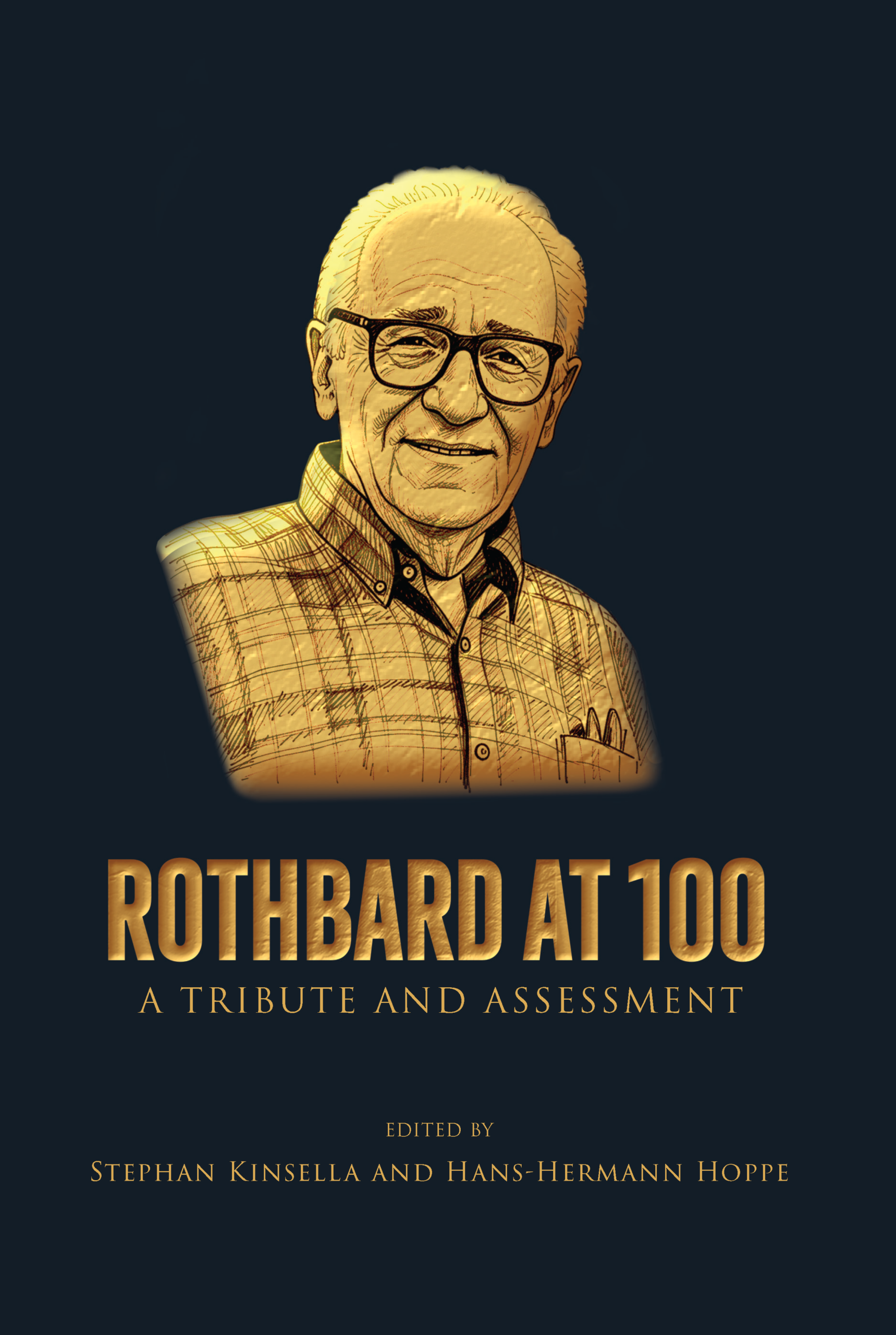 As Tom DiLorenzo notes, referring to Rothbard at 100: A Tribute and Assessment, published this year by the PFS on Rothbard’s 100th birthday:
No one is celebrating “100 Years of Greenspan.” Or publishing “The Speeches of Alan Greenspan.” His congressional testimonies sounded like the ramblings of “Chance Gardener” in the movie Being There.
From Tom: “Here’s a good imitation of Greenspan advising the president:”
Rothbard had some good commentary on Greenspan, in “Alan Greenspan: A Minority Report” and “The Mysterious Fed,” both reprinted below.5
Alan Greenspan: A Minority Report
The press is resounding with acclaim for the accession to Power of Alan Greenspan as chairman of the Fed; economists from right, left, and center weigh in with hosannas for Alan’s greatness, acumen, and unparalleled insights into the “numbers.” The only reservation seems to be that Alan might not enjoy the enormous power and reverence accorded to his predecessor, for he does not have the height of a basketball player, is not bald, and does not smoke imposing cigars.
The astute observer might feel that anyone accorded such unanimous applause from the Establishment couldn’t be all good, and in this case he would be right on the mark. I knew Alan thirty years ago, and have followed his career with interest ever since.
I found particularly remarkable the recent statements in the press that Greenspan’s economic consulting firm of Townsend-Greenspan might go under, because it turns out that what the firm really sells is not its econometric forecasting models, or its famous numbers, but Greenspan himself, and his gift for saying absolutely nothing at great length and in rococo syntax with no clear-cut position of any kind.
As to his eminence as a forecaster, he ruefully admitted that a pension-fund managing firm he founded a few years ago just folded for lack of ability to apply the forecasting where it counted – when investment funds were on the line.
Greenspan’s real qualification is that he can be trusted never to rock the establishment’s boat. He has long positioned himself in the very middle of the economic spectrum. He is, like most other long-time Republican economists, a conservative Keynesian, which in these days is almost indistinguishable from the liberal Keynesians in the Democratic camp. In fact, his views are virtually the same as Paul Volcker, also a conservative Keynesian. Which means that he wants moderate deficits and tax increases, and will loudly worry about inflation as he pours on increases in the money supply.
There is one thing, however, that makes Greenspan unique, and that sets him off from his Establishment buddies. And that is that he is a follower of Ayn Rand, and therefore “philosophically” believes in laissez-faire and even the gold standard. But as the New York Times and other important media hastened to assure us, Alan only believes in laissez-faire “on the high philosophical level.” In practice, in the policies he advocates, he is a centrist like everyone else because he is a “pragmatist.”
As an alleged “laissez-faire pragmatist,” at no time in his prominent twenty-year career in politics has he ever advocated anything that even remotely smacks of laissez-faire, or even any approach toward it. For Greenspan, laissez-faire is not a lodestar, a standard, and a guide by which to set one’s course; instead, it is simply a curiosity kept in the closet, totally divorced from his concrete policy conclusions.
Thus, Greenspan is only in favor of the gold standard if all conditions are right: if the budget is balanced, trade is free, inflation is licked, everyone has the right philosophy, etc. In the same way, he might say he only favors free trade if all conditions are right: if the budget is balanced, unions are weak, we have a gold standard, the right philosophy, etc. In short, never are one’s “high philosophical principles” applied to one’s actions. It becomes almost piquant for the Establishment to have this man in its camp.
Over the years, Greenspan has, for example, supported President Ford’s imbecilic Whip Inflation Now buttons when he was Chairman of the Council of Economic Advisers. Much worse is the fact that this “high philosophic” adherent of laissez-faire saved the racketeering Social Security program in 1982, just when the general public began to realize that the program was bankrupt and there was a good chance of finally slaughtering this great sacred cow of American politics. Greenspan stepped in as head of a “bipartisan” (i.e., conservative and liberal centrists) Social Security Commission, and “saved” the system from bankruptcy by slapping on higher Social Security taxes.
Alan is a long-time member of the famed Trilateral Commission, the Rockefeller-dominated pinnacle of the financial-political power elite in this country. And as he assumes his post as head of the Fed, he leaves his honored place on the board of directors of J.P. Morgan & Co. and Morgan Guaranty Trust. Yes, the Establishment has good reason to sleep soundly with Greenspan at our monetary helm. And as icing on the cake, they know that Greenspan’s “philosophical” Randianism will undoubtedly fool many free market advocates into thinking that a champion of their cause now perches high in the seats of power.
***
The Mysterious Fed
AIan Greenspan has received his foreordained reappointment as chairman of the Fed, to the smug satisfaction and contentment of the entire financial Establishment. For them, Greenspan’s still in his heaven, and all’s right with the world. No one seems to wonder at the mysterious process by which each succeeding Fed chairman instantly becomes universally revered and indispensable to the soundness of the dollar, to the banking and financial system, and to the prosperity of the economy. “When it looked for a while that the great Paul Volcker might not be reappointed as Fed chairman, the financial press went into a paroxysm of agony: no, no without the mighty Volcker at the helm, the dollar, the economy, nay even the world, would fall apart. And yet, when Volcker finally left the scene years later, the nation, the economy, and the world, somehow did not fall apart; in fact, ever since, none of those who once danced around Volcker for every nugget of wit and wisdom, seem to care any longer that Paul Volcker is still alive.
What was Volcker’s mysterious power? Was it his towering, commanding presence? His pomposity and charisma? His strong cigars? It turns out that these forces really played no role, since Alan Greenspan,.now allegedly the Indispensable Man, enjoys none of Volcker’s qualities of personality and presence. Greenspan, a nerd with the charisma of a wet mackerel, drones on in an uninspired monotone. So what makes him indispensable now? He is supposed to be highly “knowledgeable,” but of course there are hundreds of possible Fed chairmen who would know at least as much.
So if it is not qualities of personality or intellect, what makes all Fed chairmen so indispensable, so widely beloved? To paraphrase the famous answer of Sir Edmond Hilary, who was asked why he persisted in climbing Mt. Everest, it is because the Fed chairman is there. The very existence of the office makes its holder automatically wonderful, revered, deeply essential to the world economy, etc. Anyone in that office, up to and including Lassie, would receive precisely the same hagiographical treatment. And anyone out of office would be equally forgotten; if Greenspan should ever leave the Fed, he will be just as ignored as he was before.
It’s too bad that people aren’t more suspicious: that they don’t ask what’s wrong with an economy, or a dollar, that supposedly depends on the existence of one man. For the answer is that there’s lots wrong The health of Sony or Honda depends on the quality of their product, on the continuing satisfaction of their consumers. No one particularly cares about the personal qualities of the head of the company. In the case of the Fed, the acolytes of the alleged personal powers of the chairman are never specific about what exactly he does, except for maintaining the “confidence” of the public or the market, in the dollar or the banking system.
The air of majesty and mystery woven around the Fed chairman is· deliberate, precisely because no one knows his function and no one consumes the Fed’s “product.” What would we think of a company where the President and his P.R. men were constantly urging the public: “Please, please. Have confidence in our product- our Sonys, Fords, etc.” Wouldn’t we think that there was something fishy about such an enterprise? On the market, confidence stems from tried and tested consumer satisfaction with the product. The proclaimed fact that our banking system relies so massively on our “confidence” demonstrates that such confidence is sadly misplaced.
Mystery, appeals to confidence, lauding the alleged qualities of the head: all this amounts to a con-game. Volcker, Greenspan, and their handlers are tricksters pulling a Wizard of Oz routine. The mystery, the tricks, are necessary, because the fractional reserve banking system over which the Fed presides is bankrupt. Not just the· S&Ls and the FDIC are bankrupt, but the entire banking system is insolvent. Why? Because the money that we are supposed to be able to call upon in our bank deposit accounts is simply not there. Or only 10% of that money is there.
The mystery and the confidence trick of the Fed rests on its function: which is that of a banking cartel organized and enforced by the federal government in the form of the Fed. The Fed continually enters the “open market” to buy government securities. With what does the Fed pay for those bonds? With nothing, simply with checking accounts created out of thin air. Every time the Fed creates $1 million of checkbook money to buy government bonds, this $1 million quickly finds its way into the “reserves” of the banks, which then pyramid $10 million more of bank deposits, newly created out of thin air. And if someone sensibly wants cash instead of these open book deposits, why that’s OK, because the Fed just prints the cash which immediately become standard “dollars” (Federal Reserve notes) which pay for this system. But even these fiat paper tickets only back 10% of our bank deposits.
It is interesting that, of the rulers of the Fed, the only ones that seem to be worried about the inflationary nature of the system are those Fed regional bank presidents who hail from outside the major areas of bank cartels. The regional presidents are elected by the local bankers themselves, the nominal owners of the Fed. Thus, the Fed presidents from top cartel areas such as New York or Chicago, or the older financial elites from Philadelphia and Boston, tend to be pro-inflation “doves,” whereas the relatively anti-inflation “hawks” within the Fed come from the periphery outside the major cartel centers: e.g., those from Minneapolis, Richmond, Cleveland, Dallas, or St. Louis. Surely, this constellation of forces is no coincidence.
Of course, anyone who thinks that these regional bank presidents are insufferable anti inflation “hawks” ain’t seen nothing yet. Wait till they meet some Misesians!
- “Former Federal Reserve Chairman Alan Greenspan Dies at 100,” Breitbart News (Jun. 2026). [↩]
- Douglas French, “Greenspan the Undertaker and His Countless Victims,” Fee.org (Jan. 25, 2017; republished at DouglasinVegas.com, Feb. 7, 2017). [↩]
- Alan Greenspan, “Antitrust” and “Gold and Economic Freedom,” in Ayn Rand, Capitalism: The Unknown Ideal (New York: New American Library, 1966). His essay “The Assault on Integrity,” about regulation of business, was also included in this collection. [↩]
- French, “Greenspan the Undertaker and His Countless Victims.” [↩]
- Murray N. Rothbard, “Alan Greenspan: A Minority Report,” The Free Market (Aug. 1987), reprinted in Llewellyn H. Rockwell, Jr., ed. The Free Market Reader: Essays in the Economics of Liberty (Auburn, Ala.: Mises Institute, 1988) and on LewRockwell.com; idem, “The Mysterious Fed,” The Free Market 9, no. 10 (October 1991): 1, 7. Rothbard also mentioned Greenspan in “Nine Myths About the Crash,” The Free Market (Jan. 1988): 1–3 and “Is There Life After Reaganomics?” (late 1987), both in The Free Market Reader. [↩]









 Alessandro Fusillo
 Andreas Tögel
 David Dürr
 Doug French
 Fernando Chiocca
 Greg Morin
 Hans-Hermann Hoppe
 Jay Baykal
 Jayant Bhandari
 Jeff Deist
 Jeffrey Barr
 Juan Fernando Carpio
 Ken Yamarashi
 León Isidoro
 Martin Cabrera
 Nick Hoppe
 Oscar Grau
 Peter Wong
 PFS
PFS scholarium
 Saifedean Ammous
 Sean Gabb
 Sean Ring
 Stephan Kinsella
 Stéphane Geyres
 Thomas Jacob
 Tom DiLorenzo
Follow Us!