Ira Katz, “Hierarchy, Oligarchy, and Democracy,” IK’s Substack (Nov. 6, 2026), reprinted at LewRockwell.com (Nov. 10, 2026):
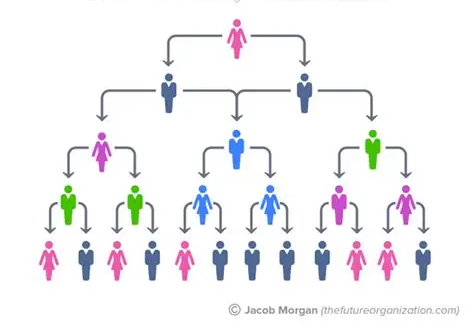
Everyone lives within hierarchies. They are natural and necessary. This is obvious in our daily working lives. This short video is good at explaining hierarchies in organizational structure, Are Hierarchies Evil? | Jacob Morgan. Thinking way back in my life, I recall playing time on the high school baseball team as my first overt hierarchical experience. I am amazed that as a young 24 year-old engineer I had the foresight to keep a copy of the organization chart of Y-12 ENGINEERING BOMB SEARCH COORDINATORS shown below and the insight that this would be the highpoint of my organizational life. My managers did not even know what the bomb search coordinator was supposed to do. I might have been the only person to investigate the library of notebooks with procedures to find the page that explained that I, and my team, where to stay in the building to look for the bomb after an alarm was sounded. I did exhibit my leadership potential in the unprecedented practice of holding an occasional meeting where we ate the best donuts I could find.
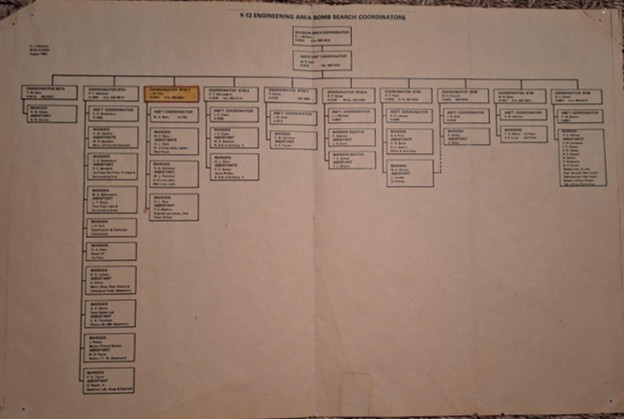
The title of this organization chart is “Y-12 ENGINEERING BOMB SEARCH COORDINATORS.” The highlighted box reads, “I. M. Katz COORDINATOR 9733-1,” where 9733-1 is the building number and my room and phone number are below.
I have written about the Constructal Theory of Adrian Bejan through the review of his book (see Bejan in Panic Reading) Freedom and Evolution: Hierarchy in Nature, Society and Science. He states from a physical basis that, “Inequality is an alternative description of the nonuniform hierarchical distribution of movement on earth. This alternative is common when it refers to two equivalent measures of movement, namely, fuel use and wealth. Inequality has a negative connotation implying lack of justice, empathy, and access to wealth. This implication is in total contradiction with the natural origin of hierarchy, which is freedom of movement. The origin of hierarchy lies in the equal access that freedom provides to the whole, to morph its flow architecture, and to liberate its flows.”
Related
- Hans-Hermann Hoppe, “A Realistic Libertarianism,” LewRockwell.com (Sept. 30, 2014), reprinted in Hoppe, Getting Libertarianism Right (Auburn, Ala.: Mises Institute, 2018); see also “PFP128 | Hans-Hermann Hoppe, Realistic Libertarianism as Right-Libertarianism (PFS 2014)” (libertarianism has to rest on a realistic view of people: inequalities of talent and the hierarchies they produce are natural and not unjust, which is why libertarians belong with the right rather than the egalitarian left)
- Stephan Kinsella, “Classic Hoppe on the Realistic Right vs. the Egalitarian Left,” PFS Blog (June 9, 2026) (libertarians have more in common with the right, which accepts natural human inequality, than with the left, which uses the state to fight it)
- Hans-Hermann Hoppe, “Natural Elites, Intellectuals, and the State,” Mises Daily (July 21, 2006) (every society has natural elites who earn authority voluntarily and once served as judges and peacemakers; the state, and democracy above all, displaced them with politicians and court intellectuals, which explains why the “wrong people” rise to the top)
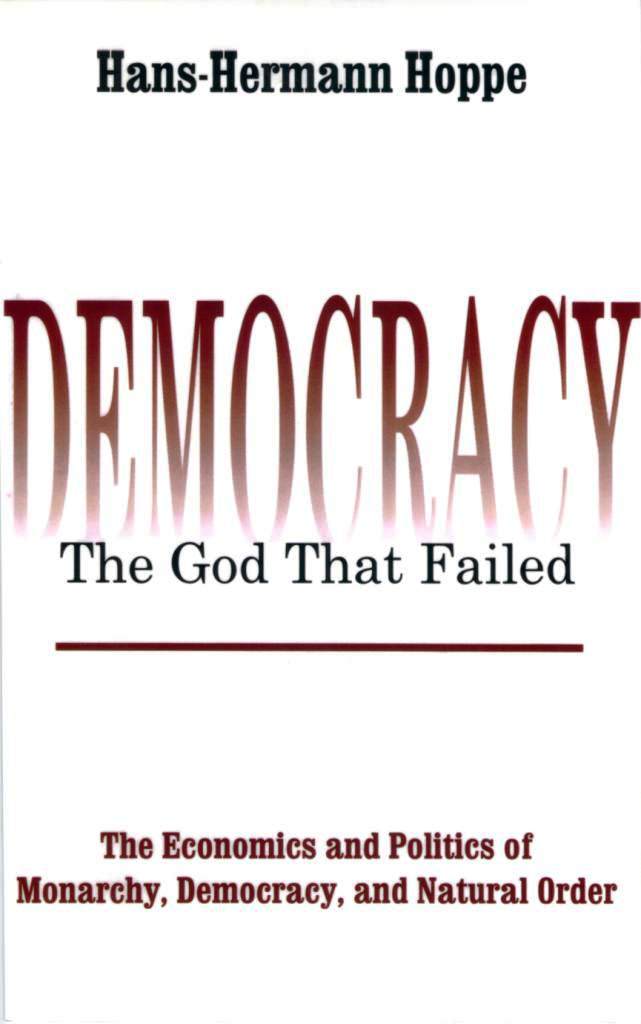
- Hans-Hermann Hoppe, Democracy: The God That Failed (New Brunswick, N.J.: Transaction Publishers, 2001) (democratic rulers are temporary caretakers rather than owners of the state, and open entry into government rewards demagogues: an institutional explanation of the problem Katz borrows from Hayek)
- Hans-Hermann Hoppe, From Aristocracy to Monarchy to Democracy: A Tale of Moral and Economic Folly and Decay (Auburn, Ala.: Mises Institute, 2014) (a short history of how voluntarily recognized natural aristocracies were turned first into monopoly monarchies and then into democracies, each step worse than the one before)
- Hans-Hermann Hoppe, “The Political Economy of Monarchy and Democracy, and the Idea of a Natural Order,” Journal of Libertarian Studies 11, no. 2 (1995) (whether rulers own government privately or merely hold it in trust for the public determines how much they exploit their subjects; this answers Katz’s question of why some oligarchies “care” more than others, and points to a stateless natural order as the real alternative)
- Doug French, “The Trouble with Democracy: Maslow Meets Hoppe,” in Jörg Guido Hülsmann & Stephan Kinsella, eds., Property, Freedom, and Society: Essays in Honor of Hans-Hermann Hoppe (Auburn, Ala.: Mises Institute, 2009), ch. 24 (applies Maslow’s hierarchy of needs: democratic politics draws status-seekers, in contrast to Hoppe’s natural elites)













 Alessandro Fusillo
 Andreas Tögel
 David Dürr
 Doug French
 Fernando Chiocca
 Greg Morin
 Hans-Hermann Hoppe
 Jay Baykal
 Jayant Bhandari
 Jeff Deist
 Jeffrey Barr
 Juan Fernando Carpio
 Ken Yamarashi
 León Isidoro
 Martin Cabrera
 Nick Hoppe
 Oscar Grau
 Peter Wong
 PFS
 scholarium
 Saifedean Ammous
 Sean Gabb
 Sean Ring
 Stephan Kinsella
 Stéphane Geyres
 Thomas Jacob
 Tom DiLorenzo

Follow Us!