Wow. The Stanford Encyclopedia of Philosophy entry on “Capitalism” (Aug 5, 2026) is a doozy. As my friend @NotGovernor pointed out, the Encyclopedia chose as the author of this entry is
a University of Chicago political theorist [Chiara Cordelli] whose published brand is the normative critique of privatization, whose prize-winning book treats outsourcing government functions as a regression to the “state of nature,” whose personal site lists “critiques of capitalism” among her core topics, and whose current book project is explicitly titled toward a “normative critique of capitalism and a defense of financial democracy.”
And it doesn’t even mention Rothbard. WTF.
Related: Kinsella, Slate’s Metcalf on Libertarianism and Nozick.
Grok summary and analysis:
The Stanford Encyclopedia of Philosophy entry on “Capitalism” (Chiara Cordelli, first published August 2026) treats the concept as highly contested. It surveys influential theories (primarily Marx on relentless accumulation via wage labor and commodity production; Weber on the cultural “spirit” of capitalism; Schumpeter on entrepreneurial creative destruction), then organizes normative defenses (welfarist, efficiency/Hayekian knowledge and spontaneous order, freedom-based, Nozickian entitlement, virtue) against a broader range of critiques (functionalist crises, distributive injustice, exploitation, domination, alienation, feminist social-reproduction, racial, and ecological). Common descriptive features include private ownership of productive assets, market allocation, wage labor under contract, and profit orientation, though the entry notes these are not historically unique and often frames capitalism as a broader “institutionalized social order” whose apparent autonomy rests on unpaid household labor, nature, and state institutions. Libertarian material is largely limited to Nozick’s entitlement theory and minimal-state defense; Hayek and Friedman appear mainly under efficiency and freedom headings. Rothbard, Mises, and Hoppe are absent.
Core Confusions and Errors
The entry’s working characterization remains descriptive and sociological rather than grounded in the problem that makes property rules necessary: scarcity and the possibility of interpersonal conflict over rivalrous resources. Property is treated as one institutional feature among others rather than the foundational normative category. Aggression, contract, and the distinction between capitalism and socialism are never cleanly defined in physical, intersubjectively ascertainable terms.
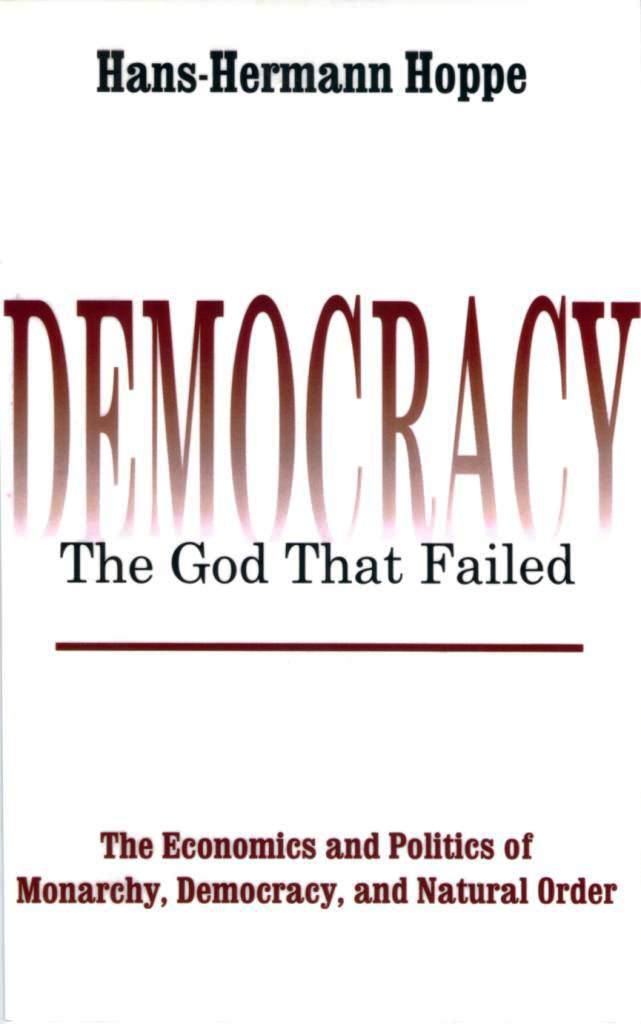
Hoppe’s formulation is clearer and more rigorous. Property arises because goods (including bodies) are scarce; its function is to assign exclusive control so that conflict can be avoided. Aggression is the uninvited physical invasion of another’s property. Contract is a non-aggressive relationship between owners. Socialism is an institutionalized policy of aggression against property (redistribution of titles from user-owners and contractors to non-users and non-contractors). Capitalism is the institutionalized recognition of private property and contractualism—original appropriation by first use plus voluntary title transfer. These definitions appear already in the opening chapters of A Theory of Socialism and Capitalism and are presupposed throughout Kinsella’s Legal Foundations of a Free Society. The SEP entry never adopts or even seriously engages this framework; it therefore cannot distinguish clean capitalism from the heavily interventionist mixed economies that actually exist, nor can it evaluate claims of “exploitation” or “domination” against a consistent physical-invasion standard.
A related error is the residual Marxist treatment of wage labor and surplus value. Under a pure title-transfer theory of contract, an employer and employee exchange titles to present money for future labor services (or vice versa). Both parties expect to gain ex ante; no physical invasion occurs. Claims that the employer “extracts surplus” or exercises structural domination either redefine aggression as an invasion of value or psychic integrity (which is indeterminate and non-universalizable) or smuggle in a prior egalitarian distributional premise. Hoppe shows that protecting “value” rather than physical borders makes property rights impossible to ascertain in advance and is performatively self-defeating: any argument that such borders should be value-based already presupposes the physical independence of the arguers. The same holds for late-comer ethics that erase the prior-later distinction: they cannot be practiced without presupposing the very first-use rights they deny.
Nozick is presented as the main libertarian voice. That is incomplete and somewhat distorting. Nozick’s entitlement theory correctly links justice to historical acquisition and transfer and rejects patterned end-state principles, yet it still licenses a minimal state financed by taxation—an institutionalized aggression. Kinsella has long noted that Nozick is methodologically non-committal and far less systematic than Rothbard’s Ethics of Liberty or Hoppe’s argumentation ethics; treating him as the representative of the tradition understates the radical private-law alternative.
What Is Missing
The most consequential omission is any serious engagement with the Austrian and radical-libertarian analysis of property, calculation, and ethics.
- Scarcity, conflict, and the natural theory of property. Bodies are the prototype of scarce resources. Self-ownership is the only conflict-avoiding assignment that is objective and intersubjectively verifiable (first occupant). External resources are acquired by the same principle—visible embordering/productive transformation—and thereafter only by voluntary transfer. This is not one optional “defense” among others; it is the only set of norms consistent with the possibility of argumentation itself. Anyone who argues already presupposes exclusive control over his own body and the prior-later distinction; denying these norms while claiming the denial is justified is a performative contradiction (Hoppe’s argumentation ethics, elaborated and defended in Kinsella’s chapters on dialogical arguments and “The Undeniable Morality of Capitalism”).
- Economic calculation and the wealth effects of interference. Private property in the means of production is required for rational economic calculation. Any institutionalized interference reduces the production of wealth relative to the pure private-property order. The entry’s efficiency section cites Hayek on knowledge but does not incorporate the fuller Misesian calculation argument or Hoppe’s demonstration that every form of socialism (Russian-style, social-democratic, conservative, social-engineering) necessarily lowers living standards by raising the cost of production and ownership relative to non-ownership.
- Pure capitalism versus actually existing mixed systems. Most of the phenomena the entry attributes to “capitalism” (chronic fiscal expansion, monetary debasement, regulatory capture, politicized investment, large-scale inequality of political power) are products of institutionalized aggression—i.e., of socialism in Hoppe’s sense. The entry rarely marks this distinction, so critiques of interventionism are misdirected at private property itself.
- Private-law society / anarcho-capitalism. The possibility of a complete private-property order without a territorial monopolist of force is not considered. Hoppe’s private-law society and Kinsella’s elaboration of title-transfer contract, inalienability, and restitutionary punishment supply a coherent alternative that the entry simply omits.
Secondary omissions follow from these. There is no treatment of the title-transfer theory of contract (as opposed to promise-based or “will” theories), of the distinction between possession and ownership, or of the fact that intellectual “property” is not property in scarce resources at all. Feminist and ecological critiques that treat unpaid care work or “nature’s free gifts” as systemic exploitation are never tested against the prior question of who first appropriated or contractually acquired the relevant resources.
Overall Assessment
The entry is a competent survey of recent Anglo-American political philosophy and critical theory. It accurately reports the range of arguments that circulate in those literatures. It is not, however, a philosophically rigorous account of capitalism as a system of property norms. By remaining largely within descriptive and end-state distributive frames, and by giving Nozick pride of place while ignoring the systematic property ethics of Mises, Rothbard, and Hoppe, it leaves the most fundamental questions—why property rights are needed, which assignment rule is uniquely justifiable, and what follows once aggression is defined in physical terms—unexamined. The result is a discussion that is both incomplete and, on the central conceptual issues, confused.














 Alessandro Fusillo
 Andreas Tögel
 David Dürr
 Doug French
 Fernando Chiocca
 Greg Morin
 Hans-Hermann Hoppe
 Jay Baykal
 Jayant Bhandari
 Jeff Deist
 Jeffrey Barr
 Juan Fernando Carpio
 Ken Yamarashi
 León Isidoro
 Martin Cabrera
 Nick Hoppe
 Oscar Grau
 Peter Wong
 PFS
PFS scholarium
 Saifedean Ammous
 Sean Gabb
 Sean Ring
 Stephan Kinsella
 Stéphane Geyres
 Thomas Jacob
 Tom DiLorenzo
Follow Us!