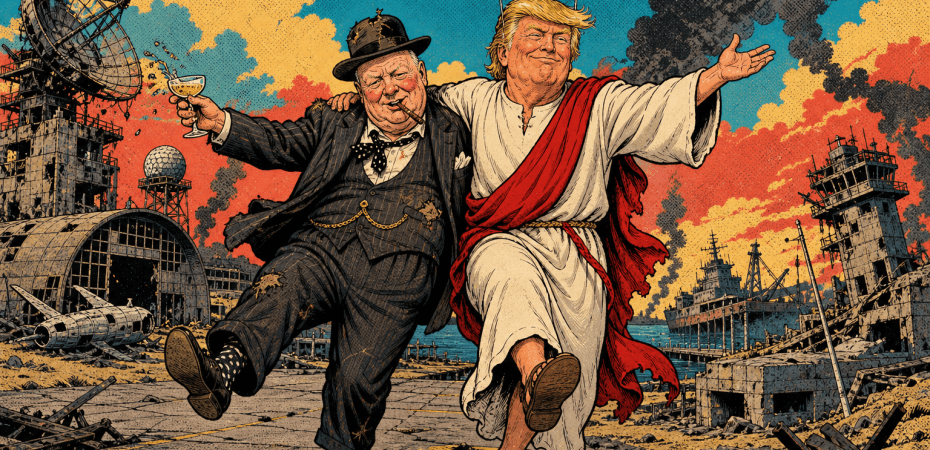
 Len D. Pozeram, “America’s Singapore: The Iran War and Imperial Collapse,” Libertarian Alliance (22 August, 2026)
What happens when an empire built by men of ability falls into the hands of placemen?
Britain supplied the classic answer at Singapore in February 1942. Before the Second World War, Singapore was the great British naval and commercial base at the bottom of the Malay Peninsula. It guarded the sea route between the Indian Ocean and the Pacific. British officials called it the “Gibraltar of the East” and encouraged the world to regard it as an impregnable fortress. Its guns, docks, fuel tanks, warehouses, and reputation were supposed to secure British power across Asia.
Then the Japanese attacked from the direction the British had failed to prepare for. They did not begin by sailing obediently into the largest British coastal guns. They landed farther north in Malaya and drove down the peninsula. Japanese aircraft controlled the sky. Japanese troops moved rapidly through jungle and plantation country that British commanders had treated as nearly impassable. The battleships Prince of Wales and Repulse, sent to demonstrate British naval power without adequate air cover, were sunk by Japanese aircraft in December 1941. By the time the attackers crossed onto Singapore Island, the fortress had been isolated from the military system that was supposed to sustain it. The final surrender came on February 15, 1942. British and Commonwealth forces were short of ammunition, food, and secure water. Lieutenant General Arthur Percival surrendered more than 64,000 troops in Singapore, in addition to the forces already lost during the Malayan campaign. Winston Churchill, the drunken fool in charge at the time, called it the worst disaster and greatest capitulation in British history.
The importance of Singapore was larger than the territory lost. Britain survived and continued fighting the war, but the legend of effortless British supremacy in Asia died in a week. Colonial subjects saw that the imperial master could be defeated. Allies recalculated what British promises were worth. Japan discovered that the reputation of the British Empire was considerably stronger than the forces available to defend it.
That is the comparison with America now. Singapore was not simply a lost battle. It was the moment when a long structural decline became visible to everybody at once.
The British Empire had not been built by fools. There was little moral goodness in much of the project, but there had been strategic intelligence. Earlier generations understood shipping lanes, industrial production, finance, and the political management of distant possessions. They built an imperial system in which naval power rested upon bases, repair yards, merchant shipping, local alliances, and an administrative service able to turn orders issued in London into action thousands of miles away.
By 1942, too many British officials had inherited the map without inheriting the intelligence that created it. They treated Singapore’s reputation as a substitute for preparation. They assumed the Japanese were technically inferior and incapable of rapid operations through Malaya. Commanders prepared to meet the attack anticipated in staff exercises while the enemy fought a different campaign. When evidence contradicted the assumptions, the assumptions were defended.
This is what happens when the builders of an empire are replaced first by caretakers and then by bumbling placemen. The placeman knows the correct language. He understands whom to flatter and which inconvenient report should be buried. What he cannot do is reconsider the system from first principles. He mistakes the continued existence of headquarters, titles, and impressive weapons for proof that the machinery behind them still works.
America has reached its Singapore stage. The United States still possesses enormous destructive power. Britain possessed enormous power in 1942. The question is whether that power can be delivered where it is needed, supplied under attack, repaired after losses, and sustained longer than the enemy can endure.










 Alessandro Fusillo
 Andreas Tögel
 David Dürr
 Doug French
 Fernando Chiocca
 Greg Morin
 Hans-Hermann Hoppe
 Jay Baykal
 Jayant Bhandari
 Jeff Deist
 Jeffrey Barr
 Juan Fernando Carpio
 Ken Yamarashi
 León Isidoro
 Martin Cabrera
 Nick Hoppe
 Oscar Grau
 Peter Wong
 PFS
PFS scholarium
 Saifedean Ammous
 Sean Gabb
 Sean Ring
 Stephan Kinsella
 Stéphane Geyres
 Thomas Jacob
 Tom DiLorenzo
Follow Us!