In Hans Hoppe’s “Mises Institute: Quo Vadis?: Postscript,” he notes:
Moreover, as for low productivity, almost two years ago by now, the MI held a special Human Action Conference, organized by then president Tom DiLorenzo. Funds were raised and special sponsors for each conference speaker solicited. The result of the conference, promised to the donors, sponsors and conference attendees was a book. To this day there has been no book, and even if it should appear in the near future, two years to produce a book with the assistance of plenty of helping hands does not impress.
The piece he is referring to is his “My Discovery of Human Action and of Mises as a Philosopher,” presented at the Human Action Conference, Ludwig von Mises Institute, Auburn, AL, May 16, 2024.
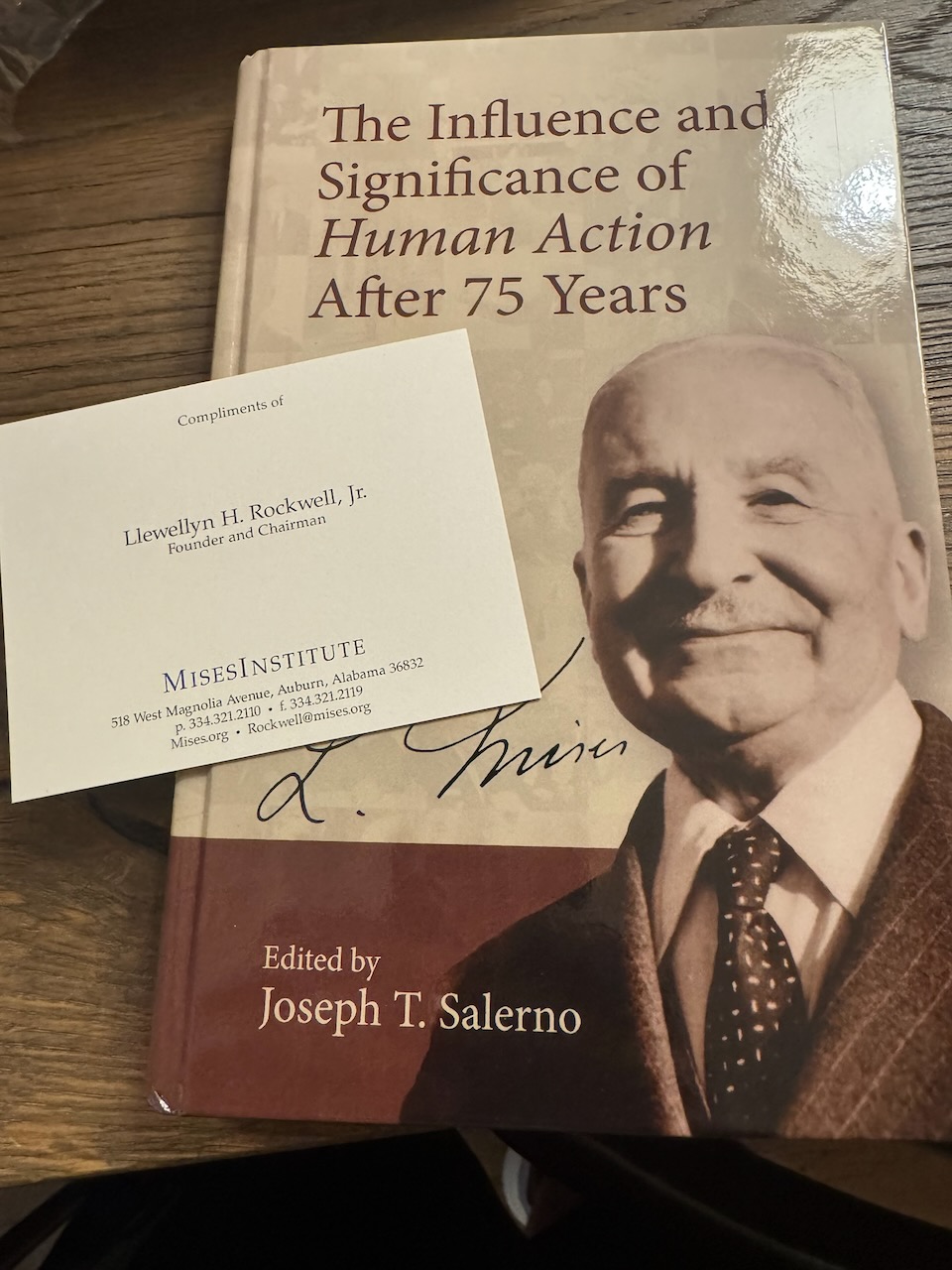
The book Hans referred to is now out; I received a physical copy yesterday. It is The Influence and Significance of Human Action After 75 Years, Joseph T. Salerno, ed. (Auburn, Ala.: Mises Institute, 2025). It does not appear to be on https://mises.org/ or the Mises.com store or, if it’s there, it cannot be found with a normal search, like much other content at the site as I bemoaned in my own recent piece, “My Years with the Mises Institute.”
[Update: now available at on the Mises Store here. The book erroneously states 2025 as the publication date, since it was clearly published in 2026, and the Mises Store link details also specify that it was published 05/04/2026. —SK, 5/12/2026. Update 2: The digital version is now available for download. —, 5/21/2026]

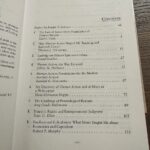
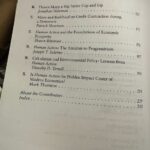

It took them two years to produce this despite all their resources.1 But even so, as I mentioned in a recent tweet, it appears to be somewhat of a rush job since the back cover quotes from the “Foreword,” but the book contains a Preface not a Foreword.2
Also, unfortunately the copyright claims that the book is published under a CC-Creative Commons Attribution-NonCommercial 4.0 International License, or CC-BY-NC. This is a shame as I point out in “My Years with the Mises Institute.”
Now when I ran Libertarian Papers, I had authors sign a Publication Agreement explicitly consenting to our CC-BY licensing policy (since authors retain copyright unless they assign their copyright in writing, and the publisher needs the author’s permission (“license”) to publish it in the first place),3 and the Libertarian Papers submissions page also clearly indicated this so that authors were on notice and also implicitly consented to allow the journal to publish their papers under a CC-BY license:
Copyright: Articles will be published under the Creative Commons Attribution 4.0 License, where possible. By submitting a manuscript to us, you grant a Creative Commons Attribution 4.0 License to the public, unless agreed otherwise in writing. We will also ask authors to sign a (simple and straightforward) Publication Agreement agreeing to publication on these terms.
But I doubt any of the authors in The Influence and Significance of Human Action After 75 Years consented to the publisher using the CC-BY-NC designation. The policy is nowhere in mises.org, as I noted in “My Years with the Mises Institute.”
For example Hoppe’s chapter, “My Discovery of Human Action and of Mises as a Philosopher,” is published CC-BY by Hoppe on his own site (see footer of Hoppe’s site). So it is simply legally incorrect to mislead readers into thinking they may not reproduce Hoppe’s chapter if it is for a “commercial purpose” (whatever that even means; why a pro-capitalist group would be opposed to actions for monetary profit is a mystery).4 This is yet another drawback of switching from the CC-BY policy previously established under Jeff Tucker and Doug French to to the current, more restrictive, policy.
One more note. In Mises Institute: Quo Vadis?: Postscript, Hans also notes:
Quite similarly, one year ago Tom DiLorenzo had organized a conference on Revisionist War History that was to likewise culminate in a following book publication. I had turned in my contribution to this project in December of last year. Until today, almost 6 months later, I still have not even received the proofs of my article. Low productivity again.
Hans is here referring to “On War, Democratic Peace, and Reeducation: The “German Experience” in Reactionary Perspective,” from the Mises Institute’s Revisionist History of War Conference (May 15, 2025—May 17, 2025). Will we see this book? Time will tell.
Related
- The Influence and Significance of Human Action After 75 Years, Joseph T. Salerno, ed. (Auburn, Ala.: Mises Institute, 2026)
- Hans-Hermann Hoppe, “Mises Institute: Quo Vadis?: Postscript,” Property and Freedom Journal (April 17, 2026)
- Hans-Hermann Hoppe, “Mises Institute: Quo Vadis?”, Property and Freedom Journal (March 25, 2026)
- Stephan Kinsella, “My Years with the Mises Institute,” Property and Freedom Journal (May 2, 2026)
- Kinsella, Mises Institute Oral History Project: The Lost Rothbard History (2013) (April 17, 2026)
- Kinsella, Hoppe Removed as Mises Institute Senior Distinguished Fellow (April 1, 2026)
Update: See David Gordon’s review, “After 75 Years, Human Action Is Still the Standard for Understanding Economics,” Friday Philosophy (May 22, 2026):
In a brilliant essay, Hans Hoppe discusses Mises’s claim that human action is “the ultimate given.” He contends that this is true but must be supplemented with the fact that communication takes place in language:
Speaking and writing, and all philosophizing, are done in language. There is no other beginning, and these activities, indeed all communicating in meaningful words, are themselves also actions. So Mises is ultimately right. But it is real actions, and the success or failure of real actions, that precede and provide the ultimate testing ground for all mere talk about actions. Actions, that is, speak louder than words and serve as ground to verify or falsify words. . .there is no infinite regress so far as our knowledge of man is concerned: such is only the case as long as you stay exclusively within the realm of words; but once you recognize how words are tied to objects and get down to the level of real actions, all further questions disappear. You are on unmovable ground. You cannot ask for a justification of action, as this question would be an action itself. (emphasis in original)
This is indeed an intriguing argument, but I confess that I do not understand what is meant by a “justification” of action. If Hoppe means that if someone claimed that action is derived from some more fundamental category, he would entrap himself in a performative contradiction, in that his purported derivation would itself be an action, does this not confuse the activity of deriving with the content of the derivation? And does Mises claim that human action is the ultimate given of knowledge? I had understood him to make only the limited claim that in praxeology, human action is an ultimate given.
Hoppe is just pointing out that action does not need any justification because you cannot not act and that is an irrefutable argument. But then, as I noted previously, Gordon has never accepted Hoppe’s argumentation ethics,5 which does focus on the distinction between action per se and the normative justification of action, which has to take place in an argumentation about action that uses communication and language.6
Re Hülsmann, he writes:
In his discussion of the ways he has sought to make economics “more realistic than even Mises imagined,” Guido Hülsmann challenges Mises’s use of the evenly rotating economy. He thought that, “Only in very few cases was it necessary to build the demonstration [of economic theorems] on the imaginary construct of the ‘evenly rotating economy,’ and he even argued that the use of such constructions was ‘the specific method of economics.’”
Hülsmann proposes to dispense with imaginary constructions:
The purpose of equilibrium analysis is to explain the differences between equilibrium and disequilibrium. This difference does not depend on whether equilibrium ever exists at all. Even if the real world were always in disequilibrium, this would not reduce the necessity and utility of comparing it to a counterfactual world in which it was in equilibrium.
Once more I am not sure that I have grasped the argument, but I take it to be this: A counterfactual world is a possible but non-actual world, but an imaginary construction is not a possible world. Hülsmann is right that Mises’s evenly rotating economy is not a possible world, but I do not see why this point gives him an epistemological advantage over Mises. If by being “realistic,” he intends to be commending a practice but just means “does not use imaginary constructions,” is he not begging the question? And if he means something else, what is it?
I will only add here that I have also pointed out that there is a difference between scenarios that are simplified but realistic (such as a Crusoe economy (only one actor; no society), or a barter society (exchange but no money)) and unrealistic scenarios such as the evenly-rotating economy or a world without scarcity (the Schlaraffenland, i.e. the Garden of Eden or Land of Cockaigne).7
As Hoppe has noted,
Essentially, economic analysis consists of: (1) an understanding of the categories of action and an understanding of the meaning of a change in values, costs, technological knowledge, etc.; (2) a description of a situation in which these categories assume concrete meaning, where definite people are identified as actors with definite objects specified as their means of action, with definite goals identified as values and definite things specified as costs; and (3) a deduction of the consequences that result from the performance of some specified action in this situation, or of the consequences that result for an actor if this situation is changed in a specified way. And this deduction must yield a priori-valid conclusions, provided there is no flaw in the very process of deduction and the situation and the change introduced into it being given, and a priori—valid conclusions about reality if the situation and situation-change, as described, can themselves be identified as real, because then their validity would ultimately go back to the indisputable validity of the categories of action.”8
Thus, in seeking to understand economics, any number of methods may be employed including the contemplation of unrealistic scenarios, such as the ERE or a world without scarcity or a world with knowledge of the future, as long as it is kept in mind that the implications of such reasoning are limited, which is what I believe Hülsmann is getting at.
Real economic analysis as to introduce some contingent assumptions apart from the core basics of praxeology and human action per se. The real world could in fact include an isolated actor, or a world without money; or, indeed, a world with private crime or institutionalized violence of the state (analyzed by Mises in Part Six of Human Action and by Rothbard in ch. 12 of Man, Economy, and State and in most of Power and Market),9 which might introduced in analysis to make the results more applicable to the real world or more interesting.10 But the real world can never involve action without scarcity, limited knowledge of the future, zero time preference, and so on.
- A previous version of this post noted that a tweet indicated that his version had a footnote in the Table of Contents oddly stating that Hoppe had been removed as Mises Institute Senior Distinguished Fellow. This has been revealed to be a hoax. [↩]
- For those confused about the difference, see Parts of a Book: An Essential Guide for Authors; Preface vs Foreword vs Introduction: What’s The Difference?; Prologue, Introduction, Preface, or Foreword: Which Is Right for You?; Distinguishing between a Foreword, a Preface, and an Introduction. [↩]
- See 7 U.S. Code § 201 – Ownership of copyright; 17 U.S. Code § 204 – Execution of transfers of copyright ownership; Copyright & Fair Use: Protect Your Rights As An Author; Copyright office, “What is Copyright?” [↩]
- See the subsection Open Publishing Abandoned in “My Years with the Mises Institute.” [↩]
- Kinsella, “My Years with the Mises Institute,” Property and Freedom Journal (May 2, 2026), text at note 74 et pass. [↩]
- See Kinsella, “Dialogical Arguments for Libertarian Rights,” in Legal Foundations of a Free Society (Houston, Texas: Papinian Press, 2023) [LFFS], the section “Pilon and Gewirth on the Principle of Generic Consistency“; Libertarian Answer Man: On Hoppe and Natural Law. [↩]
- Kinsella, On Property Rights in Superabundant Bananas and Property Rights as Normative Support for Possession, n.5. [↩]
- Hans-Hermann Hoppe, A Theory of Socialism and Capitalism, p. 142. [↩]
- See Ludwig von Mises, Human Action: A Treatise on Economics, Scholar’s ed. (Auburn, Ala: Mises Institute, 1998) and Murray N. Rothbard, Man, Economy, and State, with Power and Market, Scholar’s ed., 2nd ed. (Auburn, Ala.: Mises Institute, 2009), where Mises and Rothbard analyze the implications of a hampered market: that is, some deviation from the natural or normative situation in which property rights exist to support normal descriptive economic possession. See Kinsella, On Property Rights in Superabundant Bananas and Property Rights as Normative Support for Possession. [↩]
- See Kinsella, “A Libertarian Theory of Punishment and Rights,” in LFFS, n.36; Mises: Keep It Interesting. [↩]
Discover more from The Property and Freedom Society
Subscribe to get the latest posts sent to your email.



















 Alessandro Fusillo
 Andreas Tögel
 David Dürr
 Doug French
 Fernando Chiocca
 Greg Morin
 Hans-Hermann Hoppe
 Jay Baykal
 Jayant Bhandari
 Jeff Deist
 Jeffrey Barr
 Juan Fernando Carpio
 Ken Yamarashi
 León Isidoro
 Martin Cabrera
 Nick Hoppe
 Oscar Grau
 Peter Wong
 PFS
PFS scholarium
 Saifedean Ammous
 Sean Gabb
 Sean Ring
 Stephan Kinsella
 Stéphane Geyres
 Thomas Jacob
 Tom DiLorenzo
Footnote is really weird. If they wanted to somehow note his “former” status somewhere, that would make at least a little sense, since they’re putting it out after they let him go. Putting it in a footnote draws undue attention. Saying who fired him is bizarre.
Perhaps it had to do with this comment in Salerno’s Preface:
“As the reader will soon discover, all the essays in this book are profoundly inspired by Mises’s vision of economics. It is not coincidental that their authors are closely associated with the Mises Institute, whose mission since its founding by Lew Rockwell in 1982 has been to promote research and education in Misesian economics. It is a testament to the resounding success of the Mises Institute in pursuing its mission that the scholars who contributed to this volume—who were both teachers and students at its educational events—span four academic generations.”