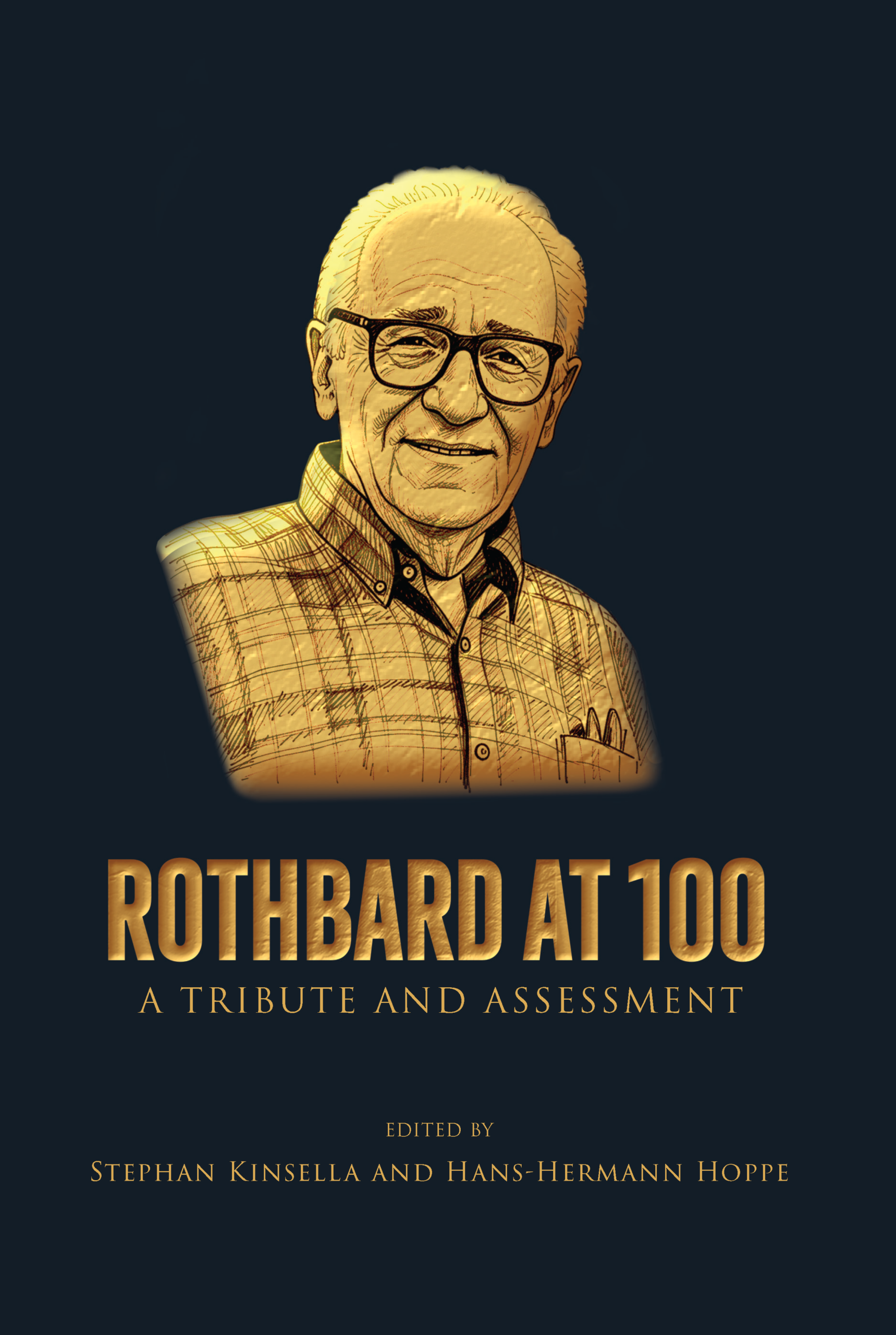
Jean-Philippe Feldman, “Les penseurs du libéralisme – Murray Rothbard et l’anarcho-capitalisme” [The thinkers of liberalism – Murray Rothbard and anarcho-capitalism] (May 8, 2026).
I haven’t read this yet and know nothing about Feldman, but the piece comes recommended here by Yorick de Mombynes:
Excellente synthèse sur la pensée politique de Rothbard, par Jean-Philippe Feldman https://t.co/4cTTIvzK7W
— Yorick de Mombynes (@ydemombynes) May 10, 2026
Mombynes in turn was himself recommended by PFSer Saifedean Ammous here:
Looking forward to joining Professor Hnas-Hermann Hoppe, @NSKinsella, @ydemombynes & other great speakers at the 100 Years with Rothbard conference in Porto on June 27!
Free registration!https://t.co/Oi8ZW86NKN
— Saifedean Ammous (@saifedean) May 10, 2026
And who is himself speaking at 100 Years with Rothbard: Porto, Portugal.

Murray N. Rothbard (1926-1995) was an American economist. A student of Ludwig von Mises and a university professor, he radicalized the Austrian School towards anarcho-capitalism, becoming its leading proponent. Among other works, he published * The Ethics of Freedom * in 1982. His * Austrian Perspective on the History of Economic Thought* was published posthumously in 1995, but it remained unfinished beyond its first two volumes.
Liberty, natural rights and property
As Rothbard writes in his preface, The Ethics of Liberty aims to denounce a systematic theory of liberty. As the title of the first part indicates, liberty is founded on natural law. Chapter 1 deals with natural law and reason. Rothbard bases his philosophy of liberty on a secularized version of John Locke’s Second Treatise of Government . He speaks of a “libertarian natural law tradition” according to which the political order recognizes the “personal rights naturally possessed by each individual,” as stated in Chapter 4, entitled “Natural Law and Natural Rights.” Through reason, humankind can discover this natural order. It is the second part, concerning the “Theory of Liberty,” that sets forth, in a distinctly Lockean manner, the natural rights of humankind, namely, self-ownership and, consequently, ownership of one’s labor.
What, then, is liberty? According to Chapter 7, which deals with “relations between persons,” it is the situation in which “no man is subject to interference by other persons in the control he exercises over his person or his property.” Chapter 9, entitled “Property and Aggression,” lays out the fundamental rule of libertarian society: “No one has the right to commit aggression against the just or legitimate property of another.” In the fourth part of the book, Rothbard addresses “other modern theories of liberty.” According to Chapter 28, on “Hayek and the Concept of Coercion,” Rothbard agrees with his predecessor that liberty is the absence of coercion. But he criticizes him for not properly understanding the concept of coercion—”the aggressive use or threat of physical violence against the person or just property of another”—by including peaceful actions, such as refusing to make a trade. While in Chapter 6 of Part One, devoted to “Robinson Crusoe’s Philosophy of Law,” Rothbard analyzes the situation of a man alone in the face of nature, in the following chapter on “Relations Between Persons,” he argues that the advent of civilization does not signify the abandonment of absolute freedom. Whether in the state of nature or in the society that succeeds it, man remains the owner of his person and of the natural resources he has occupied or transformed. In Part Two, Chapter 15 conceives—as its title suggests—”Human Rights as Property Rights.” If they are not formulated in this way, then Rothbard considers them “vague and contradictory.” In other words, social rights and other social rights are in no way human rights. An incidental remark in Chapter 29 of Part Three confirms this: “true rights require no positive action from anyone and only non-interference.” Finally, Chapter 21, the last chapter of the previous part, examines “animal ‘rights,'” an expression as fashionable as it is meaningless, since natural rights can only concern the human species.
The practical applications of property rights
Although the work is conceived as a systematic theory of liberty, Rothbard reveals in his 1990 afterword to the French edition that its most important aspect lies in the “concrete applications” of property rights. These constitute the core of the second part: Chapter 12 deals with “self-defense,” a right inherent in every individual; Chapter 16 with “information,” according to which every person has the right to become a blackmailer since no one can hold a property right over another’s brain and, consequently, over the information it contains; Chapter 17 with “corruption,” according to which it is the action of the corrupted, not that of the corrupter, that is illegitimate; and Chapter 21 with “every man for himself” situations, which in no way alter the absolutism of property rights. But it is chapter 14, entitled “Children and Rights,” that attracts attention because it contains notable developments on two sensitive subjects: abortion and adoption.
That adults must consent in principle is hardly difficult to accept. But the question arises as to the absolute or relative nature of the principle of freedom. Should a child—and from what age—ontologically benefit from this principle? In the secularized Lockean perspective adopted by Rothbard, a person is the owner of themselves, therefore the owner of their body, and thus free to act as they choose. But what about a child? Still within a Lockean framework, parents hold a trust over their offspring. Etymologically, they are responsible for them until they reach the age of majority, or at least the age of reason. Rothbard adopts Locke’s terminology, considering parents to be the trustees of their children, but he does not draw the same conclusions as the English philosopher. Authority is temporary and revocable at any time, according to the children’s wishes. From birth, a human being is potentially the owner of themselves. Since the parents are obviously the owners of their own property, they have no legal obligation to educate, clothe, or feed their child. They are also free to transfer their trust . Rothbard does not hesitate to speak of a “free market for children.” While this expression may seem provocative, he connects it to the existing situation of a non-free market for children: one where the only option left to parents is to give their offspring to a state-approved agency. This situation not only violates the rights of both parents and children but is also detrimental from a utilitarian perspective—even though Rothbard generally opposes utilitarianism. Indeed, the regulation of the price—set at zero—and the monopolistic nature of the approved agencies inevitably lead to “a severe ‘shortage’ of the good in question,” namely, children. For their part, regardless of age, children have the unilateral right to leave the family home to find other parents or to provide for their own needs. The methods of implementation may vary, but the principles remain the same among other anarcho-capitalist thinkers. For example, in his 1973 work, *Toward a Stateless Society* , David Friedman had already suggested that the age at which children could, as needed, withdraw from parental authority was nine. At that point, children’s rights took precedence over parental authority. The mechanism involved a one-year transitional period during which the child had the option of returning to their family, perhaps with the obligation to visit them several times and reaffirm their choice, while their family had the obligation to provide for them.
Furthermore, if, according to Rothbard, a woman, like any individual, possesses an absolute right over her own body, then she also possesses a right over what is inside her body, including the fetus. Since the fetus is, by definition, not a living person, it has no rights over its own body. It follows that the woman is mistress of her womb. Rothbard concludes unequivocally: “Abortion should be seen not as the ‘murder’ of a living person, but as the removal of an intruder from the mother’s body.”
The nature of the state and anarcho-capitalism
Anarchy generally has a bad reputation. It would be difficult for it to be otherwise, given that it is a disorder resulting from a lack or absence of authority. But anarchy is also the doctrine that excludes any intervention by the State from the lives of individuals, considering it illegitimate. Anarcho-capitalism promotes the disappearance of public power in favor of an order based on respect for property rights, in other words, an order resulting from the self-organization of individuals who possess complete contractual freedom. The absence of state order does not lead to disorder; on the contrary, it is the mechanisms of the market and contracts that spontaneously ensure order. Anarcho-capitalism is therefore diametrically opposed to what Rothbard calls anarcho-communism, which hates property rights even more than the State and excludes freedom from the economic sphere. The freedom of anarcho-capitalism is by no means conceived as the anarchic freedom to do whatever one pleases. While Rothbard describes freedom, both in the state of nature and under civilization, as absolute, it is nonetheless limited by the equivalent rights of others.
In Chapter 4 of Part One of *The Ethics of Liberty *, Rothbard acknowledges the debt that the libertarian natural law tradition owes to Locke, but he does not hesitate to deviate from the English philosopher’s work, given the latter’s contradictions and inconsistencies. It is particularly striking that he bases his anarcho-capitalist doctrine on that of an author who, in his * Second Treatise of Government* , considered the state of nature a state of anarchy since there was no common judge to settle disputes, and who consequently believed that it had become necessary, at a certain point, to establish a state to escape the state of nature. What Rothbard ultimately intends to demonstrate is that the escape from the state of nature is not at all necessary. This is what he explains in Part Three of *The Ethics of Liberty *, whose title is striking: “The State Against Liberty.”
Chapter 22, concerning “the nature of the State,” develops a kind of syllogism: “taxation is theft”; however, the State only exists through taxation; therefore, the State is nothing other than “a vast criminal organization” which, consequently, must disappear. While liberty is conceived as the absence of constraint, the State is nothing but force and violence. Rothbard defines it by two characteristics that are most often linked: the violence of taxation and the monopoly of force. How can this “large-scale plunder” persist? Through two factors: the support of the majority and the alliance with intellectuals. In passing, Rothbard actually answers the classic question of why intellectuals are socialists or statists. It is because they find themselves rewarded more easily and comfortably than if they had to accept a system of voluntary exchange. In the fifth and concluding section, Rothbard echoes the sentiments of Lysander Spooner, whom he quotes extensively: “The state is the eternal enemy of humankind.” In Chapter 24 of the preceding section, concerning the “moral status of relations with the state,” he had been equally scathing: “There is nothing in human nature that makes the state necessary.” Indeed, while society is indispensable, the same cannot be said of the state, “an anti-social factor.” Rothbard dons his economist’s hat once more to highlight the deleterious effects of state existence: public power “parasitizes productive activities”; it “prevents voluntary exchange between people, individual creation, and the division of labor.” Chapter 23, devoted to the “internal contradictions of the state,” allows him to settle the matter of the theory of the limited state, which he describes as a utopia, just like liberalism, as history has shown. While the last part is concerned with “the strategy of freedom”, it gives a foretaste of it by revealing the process that will lead to anarcho-capitalism: each individual being entitled to a right of secession, he will be able to “retain the services of his own protection agency”, so that the State will collapse.
International relations
Anarcho-capitalism implies the absence of a state and, consequently, the absence of international relations. Rothbard makes this point at the very beginning of Chapter 25, which deals with “relations between states.” Yet, he was always keenly interested in foreign policy in general, and in two issues in particular: imperialism and interference.
Anarcho-capitalism holds that every state is by definition imperialist. Rothbard defines imperialism as “an aggression committed against the people of one country by the men of the state of another country who impose foreign domination upon them.” Economically, he underlines the absurdity of John Stuart Mill’s theory, particularly the idea of capital surplus. Not only is a fall in the rate of profit not inevitable, but it is also not tragic, given that, as he explains in the second volume of his 1995 Austrian Perspective on the History of Economic Thought , there is no guarantee that interest rates will be higher abroad than in the home country. More broadly, imperialism is directly contrary to the fundamental axiom of anarcho-capitalism: the rejection of any aggression against a non-aggressor. It is in fact doubly reprehensible—in *The Ethics of Liberty *, the argument essentially echoes that of Frédéric Bastiat on the colonial question. From the perspective of the colonized or the native, of course, but also and above all from the perspective of the Western taxpayer. Rothbard quotes Randolph Bourne’s aphorism: “War is the health of the state.” The taxpayer pays twice: first for the conquest, then for the maintenance of the imperialist bureaucracy. Ultimately, “war militarizes and statizes society.”
Rothbard rejected any right of interference insofar as it disregarded the rights of individuals within the interventionist nation. As early as the 1950s, he had begun to combine an uncompromising defense of capitalism with an isolationist stance. Demonstrating the importance he placed on foreign policy, he devoted a substantial chapter to it in * For a New Freedom: The Libertarian Manifesto* of 1973, the second edition of which appeared in 1978. Pending the dissolution of states, the objective of anarcho-capitalists is to limit the sphere of action of governmental power as much as possible. Thus, with regard to foreign affairs, the goal is to prevent the government from interfering in the affairs of other countries: political isolationism and peaceful coexistence are the anarcho-capitalist counterparts to the policy of domestic laissez-faire. The aim is to prevent each state from extending its violence to its counterparts, so that each tyranny is at least confined to its own borders. Rothbard refutes the so-called 20th-century theory of collective security, according to which, when one state attacks another, there is a moral obligation to form a force to defend the so-called victim state. Interventionist government extends aggression, firstly, because it persecutes the civilians of the other country, and secondly, because it increases fiscal coercion on its own citizens, leaving them at the mercy of reprisals from the so-called aggressor state, and because it can intensify conscription, which is nothing other than the enslavement of its own citizens. In reality, Rothbard explains that the notions of aggression, property rights, or victim have no meaning except at the individual level, making it impossible to define who the aggressor state and who the victim state would be, just as no government can have legitimate claims to any sovereignty within a given territory. He does not hesitate to describe the United States as the most interventionist, belligerent, and imperialist government of the 20th century. He therefore calls for the dismantling of American bases abroad, the cessation of all interference, in short, a complete withdrawal within its borders and the maintenance of a policy of strict isolation or neutrality.
The Ethics of Liberty explicitly reiterates the core ideas Rothbard had presented in a 1963 article. He states frankly that the anarcho-capitalist condemns all wars regardless of their motives, because the condemnation of any state participation in war takes precedence over all other considerations. The anarcho-capitalist policy of peaceful coexistence and non-intervention between states entails the rejection of all foreign aid. In a 1982 article, Rothbard insists that US foreign policy should lead to a withdrawal from the world stage in order to make way for the private realm of free trade, encompassing economic, cultural, and social aspects.













 Alessandro Fusillo
 Andreas Tögel
 David Dürr
 Doug French
 Fernando Chiocca
 Greg Morin
 Hans-Hermann Hoppe
 Jay Baykal
 Jayant Bhandari
 Jeff Deist
 Jeffrey Barr
 Juan Fernando Carpio
 Ken Yamarashi
 León Isidoro
 Martin Cabrera
 Nick Hoppe
 Oscar Grau
 Peter Wong
 PFS
PFS scholarium
 Saifedean Ammous
 Sean Gabb
 Sean Ring
 Stephan Kinsella
 Stéphane Geyres
 Thomas Jacob
 Tom DiLorenzo