Antony P. Müller†, “Should Political Parties be Abolished?”, in A Life in Liberty: Liber Amicorum in Honor of Hans-Hermann Hoppe, Jörg Guido Hülsmann and Stephan Kinsella, eds. (Houston, Texas: Papinian Press, 2024)
28
Should Political Parties be Abolished?
Antony P. Mueller
Antony P. Mueller holds a doctorate in economics from the Friedrich-Alexander-University of Erlangen and Nürnberg (FAU) and teaches currently at the Mises Academy in São Paulo, Brazil.
The ruling model of the liberal democracy is in crisis. In the United States and many European countries, confidence in the political system is in decline. There have been many attempts to explain this disenchantment with politics and the state. Few, however, consider the role of political parties. For the public in general but also for most political theorists, a social order without politics and thus without political parties seems inconceivable. In this article, we investigate the proposition, eloquently put forth in the early 1940s by Simone Weil, that political parties should be banned.
Democracy: Not by the People but by Political Parties
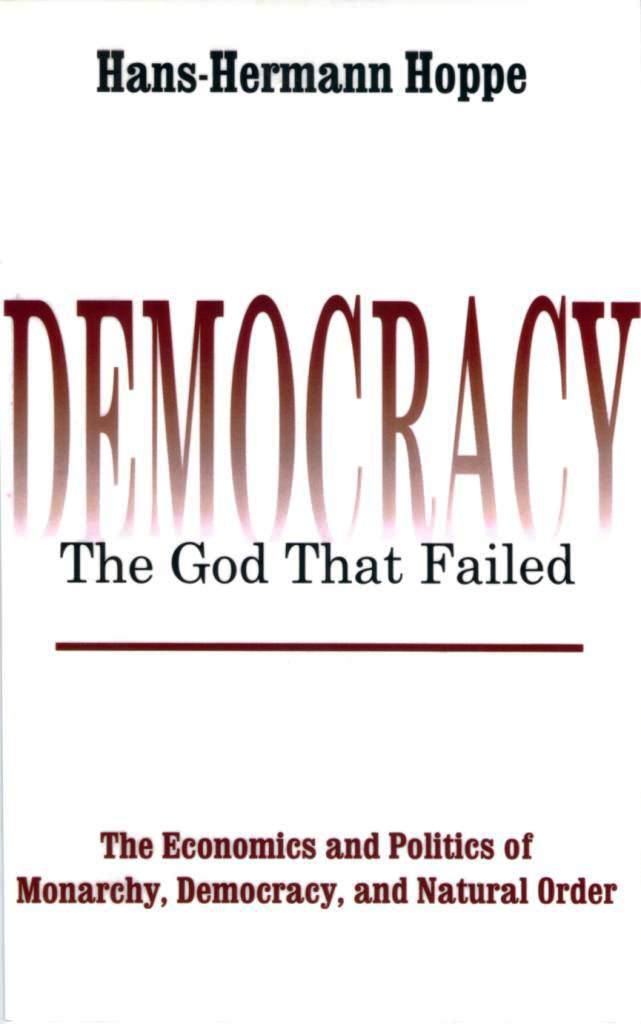
When Hans-Hermann Hoppe published his Democracy: The God That Failed[1] in 2001, some readers may have felt that his claims were exaggerated. Since then, however, the evidence has become overwhelming that democracy is in a deep crisis. Democracies continue to fail. The political system of the West is in crisis.[2]
What nowadays is called “democracy” is not a democracy in the original sense of the concept. There is no rule (kratos) of the people (demos) but dominance of political parties. In his classification of the forms of government,[3] Aristotle would have called the present system an “oligarchy”. Some political theorists speak of a cartelization[4] of the political party system in which parties collude to employ the resources of the state in order to ensure their collective survival.
An amazing fact that comes along with the system of rule by political parties consists in the tendency that bad governing does not lead to the demise of the rulers but to their re-election. Bad governments gain voters because as the economic conditions of the people deteriorate, they tend to call for more government. In urban development, this spiral of impoverishment has been analyzed in detail. The so-called Curley effect,[5] which was studied in the USA to explain why some cities become impoverished but the politicians who cause this get re-elected, applies also to countries. Here, a policy of subsidies maintains unprofitable companies while the productive enterprises face extra tax burdens and tend to leave.
Politicians win elections by utopian promises for their clientele and take measures that lead to economic decline. As a result, those parties spread their voter base and are re-elected that implement bad policies and set another round of impoverishment in motion that de facto fosters their re-election. Even more so: the competing political parties become similar in the pursuit of bad policies. While they promise the best for society, they factually compete for who does it worse for the people.
By combining redistribution and anti-capitalist rhetoric, the top performers in the private sector are induced to migrate—either to foreign countries or at least between the States of the US. As a result, the voter base of the politicians who have caused the impoverishment is growing. In some States or countries, the worst politicians and their respective parties get re-elected again and again. The same politicians who are causing the problems offer themselves as saviors. From the energy to the migration, from the precarious situation in the health system to retirement provision and foreign wars, who caused these problems, if not the same rulers who still hold the scepter in their hands today?
At the same time, the unease with the state and with politics is growing. Disenchantment with state and politics is a topic that has been discussed for a long time but has become increasingly acute in recent years. Not only in the United States do opinion surveys[6] reflect this attitude, showing that trust in public institutions is dramatically declining. This discontent with politics, however, stands in stark contrast to the ongoing politicization of every aspect of life.
The main reason for this dissatisfaction with the political system is primarily the lack of a tie between the rulers and the governed. This system ruled by political parties has moved away from society. Those in power are increasingly perceived as those at the top who ignore the real concerns of the citizens. The party oligarchs are incapable of empathy and are perceived as narrow-minded careerists.
The feeling of general powerlessness paralyzes many citizens. So far, the lack of political participation has only led to a general lack of interest in political affairs, a kind of moroseness. The reaction of many citizens has been to withdraw from politics altogether and no longer participate in the elections.
In Germany, for example, voter turnout in the federal elections for the Bundestag[7] has been declining since the mid-1970s and voter participation is even lower in the elections of the parliaments for the States (Bundesländer).[8] With a share of non-voters of around forty percent, the assemblies resulting from such elections can hardly be called representative of the people.[9] Moreover, if coalitions must be formed for a government to have a parliamentary majority, parties with a low share of the vote set the tone.[10] The party of the Greens has turned out to be the ideologically dominant political factor in the coalition government that was formed in the Federal Republic of Germany in December 2021. Although it does not provide the Chancellor, the Green Party, with a share of less than fifteen percent of the votes at the latest election and before that of mostly a share below ten percent,[11] holds the office of the Vice-Chancellor as well as the Ministry of Foreign Affairs, Economy and Climate Protection, Food and Agriculture, the Ministry of the Environment, the Ministry of Family Affairs and the Office of the Minister for Culture and the Media. The red-green worldview is dominantly present in the public media. The Federal Republic of Germany is thus dominated by a parliamentary group that was democratically elected by less than eight percent of the population. This evolution is frightening because the political parties have become the predominant power group.[12]
In fact, the political parties not only participate in the formation of political will, but because of their concentrated power, they have become a “state within the state.” They serve as vehicles to gain power and benefits for their leading members. In this process, they become more and more authoritarian. To become a candidate, one must first and foremost prove oneself in the political party. It is not the interest in the well-being of the people that counts, but the assertiveness and ingratiation within one’s own party. It is therefore more than natural that a special type of party politician would emerge. That type of person gets chosen whose power instinct is particularly rampant and who is particularly capable if buttering up his comrades with the aim of dominating them. A paradise for cheaters, decent and intelligent people shrink from participating in this game. Those who become party members get seduced and caught up in the maelstrom of the party machinery. Even if they come to the top, they will remain victims.
In modern democratic politics, political parties are the essential part of politics. Anyone who does not belong to a party is practically excluded from the political process. The so-called “political decision-making” has become extremely one-sided. As can be observed, the main issues raised in the party struggle are those that are very far removed from the needs of the people. Decisions will no longer be made in the interest of the country, not even in the interest of their own voters.
If this is so as described, what would it mean to abolish political parties? Would the abolishment of political parties lead to the end of democracy or rather its completion? Who should govern in the absence of political parties? One of the most emphatic statements in favor of the abolishment of political parties comes from a pamphlet by Simone Weil, written in 1943 and published posthumously in 1950. While she does not suggest a solution to the problem of the evils of political parties, her text provides a pungent exposition of the nature of the rule of political parties.
Simone Weil on the Abolition of Political Parties
When Simone Weil[13] wrote her “Notes on the General Abolition of Political Parties,”[14] she was a contemporary witness of the single-party rule in Nazi Germany and Soviet Russia. Nevertheless, the immediate impetus for writing her essay came from her work in the French exile group in London. She was horrified to learn that even in a situation when France was partly under foreign occupation, the partisan strife would not end and the efforts of the members of the “France Libre”[15] group were more focused on the acquisition of power for their specific political party than on the liberation of the French fatherland.
What motivated Weil to write her pamphlet against political parties were not only the horrors of the rule of the National Socialist and Soviet party regime but even more so her shocking insight that totalitarianism arises from political party competition itself. She learned that the tendency towards tyranny is inherent to the struggle of the parties. What happened in the Soviet Union and Nazi Germany is not the exception but lies in the nature of the political party system based on majority voting. All political parties tend to move toward totalitarianism.
Political Parties and Democracy
Parties are at odds with the rule of the people. According to Simone Weil, democracy, understood in its original meaning, does not derive its legitimacy from majority decisions, but that it corresponds to truth and justice. Simone Weil does not reduce democracy to the definition that was later given by Joseph Schumpeter in his Capitalism, Socialism, and Democracy of 1950[16] as an “institutional arrangement for arriving at political decisions in which individuals acquire the power to decide by means of a competitive struggle for the people‘s vote.” (p. 269) but the classical definition of democracy as pronounced by Rousseau.
Jean-Jacques Rousseau (1712–1778) elaborated his fundamental idea of democratic theory in his work on the Social Contract (1762), He justifies popular rule as the expression of the “general will” (volonté générale), which for him is the offspring of reason. Rousseau’s fundamental concept of democracy is derived from the claim that reason can find truth and justice only in so far as it does not allow itself to be corrupted by passions. While there is an infinite variety of errors and injustices, there is only one truth and one justice. Simone Weil interprets Rousseau that because all men unite in what is just and true, while mendacity and crime divide them among themselves without end, reason must be the foundation for democracy to function. For Simone Weil, the central aspect of Rousseau’s theory of democracy is that reason leads to consensus, while passion instigates divergence. In as much, as political parties are driven by and instigate passion, they are detrimental to the true understanding of what democracy is about.[17]
To become a legitimate institution, democracy must meet two conditions. First, the people must be free from any form of collective passions when they express their political will. Second, people need to express their will on the problems of public matters only and must not do it by electing individual persons or groups of individuals, i.e. political parties. Passions distort the general will and turn democracy into a caricature. Political parties gain more power the more uninhibited the collective emotions rage. Thus, with the aim to gain more and more power, political parties fuel passions. Instead of reason, irrationality rules the political process. Simone Weil concludes that these circumstances show that we have never known anything that resembles, even if only faintly, a democracy.
Political parties make their important decisions behind closed doors. If you want to be part of the leadership, you let as little of it as possible get out. Even the press is involved in secrecy. Citizens do not know what is going on behind the scenes. What little he learns, he thinks is a lie, and he‘s probably right. The collective emotional outbursts are widespread because they are systematically and officially ignited by the workings of the parties. Political parties and democracy do not fit together because the absence of passion is fundamental to the formation of the common will in a democracy. Political parties are detrimental to reason as their very existence is based on passion. Therefore, they are alien to democracy.[18]
Evils of Political Parties
According to Weil, the perennial characteristics of political parties are:
- A political party is a machine to generate collective passions.
- A political party is an organization designed to exert collective pressure upon the minds of all its individual members.
- The first objective, and also the ultimate goal, of any political party is its own growth, without limit.
Because of these three characteristics, every party is totalitarian—potentially, and by aspiration.[19]
Political parties are the antithesis of democracy because they operate as a machine for generating collective passions. They are organizations that exert collective pressure on the minds of all their members. The goal of political parties is not to work towards solving public problems but for them, the first goal as well as the final goal of any political party is their own expansion of power.[20]
As Simone Weil explains, the tyrannical nature of political parties emerged in Continental Europe during the French Revolution of 1789. The first party to act in this sense was the Club des Jacobins.[21] Originally a debating club, the Jacobins came to power as a political party in the struggle for power during the Revolution and by this became the first totalitarian party. The Jacobins were the first to practice the principle: “one party in power and all others in prison.” In the course of the party struggles during the revolutionary period, the Jacobins became the bearers of the terror that was soon to engulf the revolution and would finally devour its own children. It is no coincidence at all that totalitarianism and the reign of terror appear at the very beginning of the modern political party system that falsely claims to represent a “democracy.”
Political parties, as a rule, have only vague and unreal ideas about solving public problems. Yet the reality of the practical circumstances of their proper existence makes it inevitable that they themselves become their own purpose. The acquisition of power becomes the prime goal, and from this follows the insatiable hunger of political parties for dominance. With no intellectual content of its own, political parties relentlessly strive for power as an end in itself. If they have gained full power in the interior of a country and can no longer find enough opponents there, they will attack or create presumed external enemies.
The tendency towards totalitarianism is the essential characteristic of a political party. Since the notion of public interest is a fiction, the pursuit of total power becomes an absolute need. The natural affinity between totalitarianism and mendacity finds its home in the political party.
With the rise of political parties in the power struggle of the French Revolution also came the division between “left” and “right.” This distinction has produced havoc in the minds of the people as it limits the political discourse to a difference that is minor than that of both, right and left, to libertarianism. In the United States, this distortion has gone so far that the term “liberalism” was stripped of its original meaning and serves to denote leftism. While both—the left and the right—compete in the struggle for power, both groupings are inherently totalitarian and as such equally opposed to liberty.
Political Propaganda
As organizations that strive for absolute power, political party organizations exert permanent collective pressure on the minds of the people through permeant propaganda. Political parties seek to enslave the mind, a process that begins with their own members and spreads from there to the whole of society. Party members practice three types of lies: they deceive the public; they lie to their own party, and they lie to themselves. Because belonging to a political party “always and in every case compels one to lie, the very existence of political parties is an absolute and unconditional evil.”[22]
Once a party system is established, it becomes virtually impossible to intervene effectively in public affairs without becoming an active member of a party. Yet while one can enter the party competition as an honest person, one cannot remain that way. To make a political career, one has to play the game and submit to the treadmill. Soon the original interests and intentions will disappear from the mind of the newcomer, and party interest and the acquisition of power will prevail. “If the devil were entrusted with the organization of public life, he could not invent a more cunning means.”[23]
Most people join a political party because they have perceived in the activities and propaganda of that party some aspects that seem just and good. But no one who is not already more deeply involved in the political party knows about the party‘s true positions on matters of public life. When he joins the party, the novice knows only some of the positions that have been outwardly presented but does not know that most of them are hidden from the newcomer and the public. Thus, everyone who joins a party sooner or later submits his thinking to the authority of the party. In the course of time, when the party member becomes more closely connected with the inner workings of his party, the novice gradually learns what the party really stands for, and the further he rises, he will accept it without further examination, because this is the way he wants to rise to the top.
Why a Ban on Political Parties?
Simone Weil calls not only for the banning of individual parties but for their general ban. She is convinced that the abolition of the political parties would have a purifying effect even beyond public affairs, where the party spirit has infected everything. Due to the prestige that power generally has in the eyes of the population, thinking in terms of parties has become habitual. The party spirit has been implemented in all matters. Science, too, has submitted to the party spirit.
The negative influence of political parties on public life and the dissemination of their propaganda has shaped the entire mentality of our time. Almost everywhere—often even in the case of purely technical problems—people take sides instead of thinking: for or against. Such a choice replaces the activity of the mind. “This is intellectual leprosy; it originated in the political world and then spread throughout the country, polluting all ways of thinking. This leprosy is killing us if we do not abolish the political parties.”[24]
Weil concludes that the institution of political parties seems to be an almost unalloyed evil. They are inherently bad, and in practice, their effect is harmful to human beings. Just as criminal law prevents the formation of criminal gangs, law should prohibit political parties. For Weil, political parties are criminal in the truest sense of the word. Political parties are the antithesis of democracy. They have their own growth in mind as their first goal and are totalitarian in nature. Thus, not only the quarrel or the discussion is the essence of the political and not what the liberal democratic theorists imagined or what Rousseau meant by his idea of the “common will,” but the party-political division of society into friend and foe is the principle, and in this sense, the respective party doctrine is considered right, good and just in contrast to the enemy whose ideas are wrong, bad, and unjust.
Political parties do not enlighten but kill the sense of truth and justice. “Parties are publicly, officially constituted organizations in such a way as to kill in souls the sense of truth and justice. Collective pressure is exerted on the general public through propaganda. The stated aim of propaganda is to persuade and not to communicate light.”[25]
Party politics leads to politicization, to social division. Sooner or later, it will drift towards civil war. In party democracy there is a willingness to compromise, but only insofar as it serves the interests of the parties and the career of the nomenklatura. Accordingly, these are not permanent or well-negotiated agreements. They are terminated if the interests shift.
The typical career politician is not concerned with the individual but with his own gain of power. Yet in as much as the politician wants to dominate and govern, he is subordinate to his own political party. Being a politician means not to be free. As a member of a political party, the politician must adopt the party‘s creed, must follow the party‘s rules, and must adhere to the party‘s principles. A politician must always be a man of the party. Outside of his political party, he has no power. To the extent that the politician wants to rule and rule, he is himself under the authority of his own political party. Being a politician therefore means not being free. As a member of a political party, the politician must adopt the party‘s credo. He must follow the rules of the party and adhere to its principles. The truth is that his political party owns the politician. People know that the politician is a fraud because while he pretends to make the rules and be the master, he himself is the unfortunate victim.
The prime protagonists of this modern world are the politicians and the political parties. The prime aim of a political party is to gain power. Dominance is the aim of a political party, and the state apparatus serves as its instrument. The larger and more effective the state, the better the state serves as a means of oppression and control and thus for the extension of power of the political party. Political parties strive for power and thus they want a powerful state. “We, the people,” are the victims of this game.
Conclusion
The turn of the 18th to the 19th centuries marks the beginning of the political era. The rapture came with the French Revolution. Yet the death of the old state and the abolition and limitation of the monarchy did not liberate the individual. Rather, the democratic revolutions provoked the birth of politics and the worship of the state. The central factor of this evolution is the emergence of political parties.
Party politics lies at the heart of modern democracy. As such, the political system resembles more an oligarchy than a democracy in the sense of “rule of the people.” In the system called “democracy” nowadays, political parties compete for the votes of the people and the winners of this competition form the law-making body as elected representatives. The same mechanism holds also for presidential elections. Candidates with no support from a political party are practically excluded from participating in the electoral process. That the worst get to the top lies in the mechanics of the system.
References
Brinton, Crane: The Jacobins. An Essay in the New History. Routledge 2011
Bundeswahlleiter: Bundestagswahl 2021.
Crozier, Michael and Samuel P. Huntington: The Crisis of Democracy: Report on the governability of Democracies to the Trilateral Commission. Triangle Papers. 1975.
Fondation Charles de Gaulle: Une formation embryonnaire à l’été 1940.
Glaeser, Edward L. and Andrei Shleifer: The Curley Effect: The Economics of Shaping the Electorate. The Journal of Law, Economics, & Organization, Vol. 21, no. 1
Hoppe, Hans-Hermann: Democracy: The God That Failed. The Ludwig von Mises Institute 2016 [2001]
Jones, Jeffrey M. Confidence in U.S. Institutions Down; Average at New Low. Gallup. July 6, 2022
Katz, Richard S. and Peter Mair: Changing Models of Party Organization and Party Democracy: The Emergence of the Cartel Party. Party Politics. Vol. 1, no. 1.
Newman, W. L.: Aristotle‘s Classification of Forms of Government. The Classical Review, Vol. 6, no. 7 (July, 1892), pp. 289–93
Pew Research Center: Turnout in U.S. has soared in recent elections but by some measures still trails that of many other countries.
Schumpeter, Joseph A.: Capitalism, Socialism, and Democracy. Harper Perennial Modern Classics 2008.
Statista: Stimmenanteile der Grünen bei den Bundestagswahlen von 1980 bis 2021.
Statista: Wahlbeteiligung bei den Bundestagswahlen in Deutschland von 1949 bis 2021.
Statista. Wahlbeteiligung bei den jeweils letzten Landtagswahlen in Deutschland nach Bundesländern (Stand: Oktober 2023)
Weil, Simone: “Notes sur la suppression générale des parties politiques.” Flammarion, 2017
———: “On the Abolition of All Political Parties”. NYRB Classics Reissue Edition, 2014
ENDNOTES
[1] Hans-Hermann Hoppe, Democracy. The God That Failed. The Ludwig von Mises Institute 2016 [2001].
[2] The problem of “non-governability” has been the object of studies since the 1970s. See Michael Crozier and Samuel P. Huntington: The Crisis of Democracy: Report on the governability of Democracies to the Trilateral Commission. Triangle Papers. 1975.
[3] W. L. Newman: Aristotle’s Classification of Forms of Government. The Classical Review Vol. 6, no. 7 (July 1892), pp. 289–93.
[4] Richard S. Katz and Peter Mair: Changing Models of Party Organization and Party Democracy: The Emergence of the Cartel Party. Party Politics. Vol. 1, no. 1.
[5] Edward L. Glaeser and Andrei Shleifer The Curley Effect: The Economics of Shaping the Electorate. The Journal of Law, Economics, & Organization, Vol. 21, no. 1.
[6] Jeffrey M. Jones: Confidence in U.S. Institutions Down; Average at New Low. Gallup July 6, 2022.
[7] Statista: Wahlbeteiligung bei den Bundestagswahlen in Deutschland von 1949 bis 2021.
[8] Statista: Wahlbeteiligung bei den jeweils letzten Landtagswahlen in Deutschland nach Bundesländern (Stand: Oktober 2023)
[9] Turnout in U.S. has soared in recent elections but by some measures still trails that of many other countries. Pew Research Center.
[10] In the Federal election of September 2021, out of a population of 83.2 million inhabitants and 61.1 million eligible voters, 12.2 million people voted for the Social Democratic Party (SPD), 6.4 million for the Green Party and 4.0 million for the Free Democratic Party (FDP). Thus, the coalition that was established by these parties to form the government, represents 36.9% of the electorate and only 18.6% of the population. 81.4 percent of Germany’s population did not vote for any of these parties, and almost two-thirds (63.1 percent) of eligible voters did not vote for them. In this federal election of 2021, 88% of the population did not vote for the Social Democrats and 92% did not vote for the Greens. In total, there were 6,469,081 electoral votes for this grouping. In terms of the population as a whole, this is 7.77 percent. Nevertheless, the Green Party, as the essential coalition partner of the government, largely determines governmental politics and imposes its anti-industrial policy on the whole country. For the data, see here.
[11] Statista: Stimmenanteile der Grünen bei den Bundestagswahlen von 1980 bis 2021.
[12] For this to happen was not provided for in the Constitution (Grundgesetz) of the Federal Republic of Germany, which succinctly states only the “participation” of the political parties in the formation of the political will in Article 21: “The parties participate in the formation of the political will of the people. Its incorporation is free. Their internal order must comply with democratic principles. They must give a public account of the origin and use of their funds, as well as of their assets.”
[13] Born in 1909, Simone Weil graduated in philosophy from the Normale Supérieure in1931. She chose to become temporally a worker a factory worker and engaged in the International Brigades in 1936. She left France for New York with her family in 1942 but then came to London to work for the French Liberation Movement. She died on August 24, 1943. Despite her short life, her work that covers philosophy, politics, and theology, is considered one of the most significant of the 20th century.
[14] “Notes sur la suppression générale des parties politiques.” In English available as “On the Abolition of All Political Parties” NYRB Classics; Reissue edition, 2014.
[15] Fondation Charles de Gaulle: Une formation embryonnaire à l’été 1940.
[16] Joseph A. Schumpeter: Capitalism, Socialism, and Democracy. Harper Perennial Modern Classics 1950.
[17] “La vérité est une. La justice est une. Les erreurs, les injustices sont indéfiniment variables. Ainsi les hommes convergent dans le juste et le vrai, au lieu que le mensonge et le crime les font indéfiniment diverger. L’union étant une force matérielle, on peut espérer trouver là une ressource pour rendre ici-bas la vérité et la justice matériellement plus fortes que le crime et l’erreur.” p. 9. Page numbers refer to the E-book edition of the Notes: Simone Weil: Note sur la suppression générale des partis politiques. Nouvelle Edition. CLIMATS Flamarion 2017.
[18] “Quand il y a passion collective dans un pays, il y a probabilité pour que n’importe quelle volonté particulière soit plus proche de la justice et de la raison que la volonté générale, ou plutôt ce qui en constitue la caricature. La seconde condition est que le peuple ait à exprimer son vouloir à l’égard des problèmes de la vie publique, et non pas à faire seulement un choix de personnes. Encore moins un choix de collectivités irresponsables. Car la volonté générale est sans aucune relation avec un tel choix.” p 11
[19] “Pour apprécier les partis politiques selon le critère de la vérité, de la justice, du bien public, il convient de commencer par en discerner les caractères essentiels. On peut en énumérer trois: Un parti politique est une machine à fabriquer de la passion collective. Un parti politique est une organisation construite de manière à exercer une pression collective sur la pensée de chacun des êtres humains qui en sont membres. La première fin, et, en dernière analyse, l’unique fin de tout parti politique est sa propre croissance, et cela sans aucune limite. Par ce triple caractère, tout parti est totalitaire en germe et en aspiration. S’il ne l’est pas en fait, c’est seulement parce que ceux qui l’entourent ne le sont pas moins que lui. Ces trois caractères sont des vérités de fait évidentes à quiconque s’est approché de la vie des partis.” p. 12
[20] Ainsi la tendance essentielle des partis est totalitaire, non seulement relativement à une nation, mais relativement au globe terrestre. C’est précisément parce que la conception du bien public propre à tel ou tel parti est une fiction, une chose vide, sans réalité, qu’elle impose la recherche de la puissance totale. Toute réalité implique par elle-même une limite. Ce qui n’existe pas du tout n’est jamais limitable. C’est pour cela qu’il y a affinité, alliance entre le totalitarisme et le mensonge.” p. 13
[21] Crane Brinton. The Jacobins. An Essay in the New History. Routledge 2011.
[22] “De ces trois formes de mensonge—au parti, au public, à soi-même—la première est de loin la moins mauvaise. Mais si l’appartenance à un parti contraint toujours, en tout cas, au mensonge, l’existence des partis est absolument, inconditionnellement un mal.” p. 16
[23] “Si on confiait au diable l’organisation de la vie publique, il ne pourrait rien imaginer de plus ingénieux.” p. 18
[24] “C’est là une lèpre qui a pris origine dans les milieux politiques, et s’est étendue, à travers tout le pays, presque à la totalité de la pensée. Il est douteux qu’on puisse remédier à cette lèpre, qui nous tue, sans commencer par la suppression des partis politiques.” p. 23
[25] “Les partis sont des organismes publiquement, officiellement constitués de manière à tuer dans les âmes le sens de la vérité et de la justice. La pression collective est exercée sur le grand public par la propagande. Le but avoué de la propagande est de persuader et non pas de communiquer de la lumière.” p. 14
Discover more from The Property and Freedom Society
Subscribe to get the latest posts sent to your email.
















 Alessandro Fusillo
 Andreas Tögel
 David Dürr
 Doug French
 Fernando Chiocca
 Greg Morin
 Hans-Hermann Hoppe
 Jay Baykal
 Jayant Bhandari
 Jeff Deist
 Jeffrey Barr
 Juan Fernando Carpio
 Ken Yamarashi
 León Isidoro
 Martin Cabrera
 Nick Hoppe
 Oscar Grau
 Peter Wong
 PFS
PFS scholarium
 Saifedean Ammous
 Sean Gabb
 Sean Ring
 Stephan Kinsella
 Stéphane Geyres
 Thomas Jacob
 Tom DiLorenzo