They have no right to whine. If anything, Gordon’s review omitted the real problem with the book: it pretends to be in favor of free speech, freedom of the press, and the First Amendment, even though Objectivists support state censorship of thought, i.e. copyright. Consider: Ayn Rand’s The Fountainhead glorifies IP-terrorism—Roark dynamiting Cortlandt Homes, someone else’s property, because they “stole” his “IP.”2 Well suck it up, Buttercup! I know you hate competition, but too bad.3 As Benjamin Tucker said, if you want to your ideas to yourself, keep them to yourself!4
And consider Rand’s ridiculous claims that:
Patents are the heart and core of property rights.
Intellectual property is the most important field of law.5
I mean, thanks for the compliment about my former vile profession, “Miss” Rand, and it is true that IP law is somewhat specialized and difficult,6 but it’s not “the most important” area of law. It is, however, one of the most evil, damaging, and insidious7 (no offense, David Gordon—see below). I would say it’s not the most important type of law but it is the most important, or one of the most important, to abolish.
And copyright law is unconstitutional to boot. You would think this would matter to these statist Constitution-worshippers.8 Nope. Don’t know, don’t care. Objectivists have no credibility at all and are not liberals; it is obscene that they claim to favor intellectual freedom while supporting patent and copyright law. See, e.g., my previous comments:
Of course house attack dog David Gordon does not call out this major problem with the book; not a surprise, since he thinks the libertarian criticisms of IP are overblown—IP is not a big deal, “it’s not one of the central issues of libertarianism like opposition to war or sound money. It’s just a minor point that’s been blown up.” (( See Stephan Kinsella, “My Years with the Mises Institute,” Property and Freedom Journal (May 2, 2026); David Gordon on IP (Jan. 8, 2025). ))
And Smith herself and no doubt most or all other contributors to this book are no doubt pro-IP. See, e.g., her talk:
Gemini summary:
Tara Smith is a noted scholar of Objectivist philosophy—the philosophy founded by Ayn Rand—which fundamentally supports the existence and protection of intellectual property (IP) rights. While she is a proponent of these rights, her discussion in this video focuses primarily on explaining the controversy surrounding them rather than simply advocating for them.
Her Argument and Analysis
In this video, Smith explains the tension between intellectual property and free speech by highlighting three primary factors that make the issue “murky” for many people:
Abstract vs. Physical Property: Smith notes that people intuitively understand property rights regarding physical goods (e.g., building a lawnmower). However, because intellectual products—like a song, movie, or novel—are abstract, many struggle to view them as “real” property, leading to diminished respect for those rights (0:33-1:07).
Technological Advancement: New technology has made it exponentially easier to copy and distribute others’ work. This ease of access encourages people to “help themselves” to IP, often creating confusion or justification for why they should be allowed to infringe on those rights (1:09-1:19).
The “Free Speech” Defense: A common point of contention occurs when individuals use technology to infringe on copyrights and subsequently argue that they are simply “exercising their speech” by using parts of an artist’s work (1:45-2:00).
Philosophical Context
As an Objectivist scholar, Smith’s broader work is rooted in the belief that individual rights, including property rights, are essential to human survival and flourishing. In the Objectivist view, intellectual property is considered a valid form of property because it is the result of an individual’s productive mental effort, and its protection is a necessary requirement for an objective, moral legal system.
Yes, Rand’s argument is mired in Lockean creationism and the related labor theory of property, the cousin to the labor theory of value of her little buddy Marx. On libertarian/Lockean/IP/Randian “creationism”:
It is nice to see that thought-leaders at the Mises Institute are taking the time to read books written by Objectivists. Dr. Gordon’s review of The First Amendment: Essays on the Imperative of Intellectual Freedom [by Tara Smith, Greg Salmieri et al] prompted me to purchase the book, because his review suggested (shockingly!) that the author(s) advocate(s) for a subjective view of government actions. This would be at odds with the Objectivist view of government.
On reading the book I found that his interpretation of the excerpt [“Let’s assume that the Fourteenth Amendment …”] is incorrect. It is a mischaracterization of the author’s view to say that “For her, the issue is not “what is objectively valid law” but rather what the government enacts as law, so long as the government acts conscientiously”. As shown below, this is an out-of-context interpretation of an argument made by the author on the harm caused by exemptions to laws – which are only valid if they are based on the protection of individual rights. Dr. Gordon’s erroneous interpretation misleads his audience about a much-needed intellectual defense of the First Amendment, our embodiment of the principle of intellectual freedom (which encompasses religious freedom).
The excerpt in question is from Chapter 3 in which Smith makes an insightful case about the harm caused by religious accommodations/exceptions to laws. Citing several examples, she observes that while religious exceptions/accommodations to laws are immensely popular, they are deeply misguided. Her thesis for this chapter is that in a system based on objective laws, such exemptions are unjustified in theory and destructive in practice. She shows that while “religious freedom” is often the battle-cry of those who seek these exceptions, all intellectual and religious freedom is undermined when “exceptions” are left to the subjective whims of government officials.
As she mentions at the beginning of the chapter, a discussion about exemption to laws requires a foundation: an understanding of the basic purpose and authority of a legal system. Smith acknowledges that others may argue whether it is the mission of government to protect rights. But she says that one cannot address the question of “exemptions” without stating ones premises about the role of government. Building on Locke, with additional insights from Rand, Smith includes explicit statements (including citations and footnotes linked to additional scholarship) about the only legitimate role of a government: the protection of individual rights. She recognizes that this role is both prescribed and circumscribed by the nature of individual rights and must be based on objective laws and their uniform execution. She further acknowledges that lawmakers are not infallible and that mistakes in the law (and its execution) can occur – but these must be evaluated on the same standard, the principle of rights-protection.
The excerpt is from a part of the chapter in which the author shows the tension between the First Amendment [incl. religious freedom] and the Fourteenth Amendment [equal protection, anti-discrimination (at least according to current doctrine on Equal Protection)]. It is in this context that she writes the paragraph which is excerpted in Dr. Gordon’s article – the entire sentence is shown here, including parts that were omitted in his excerpt:
“Leaving aside questions about the propriety of the dominant doctrinal reading of the Fourteenth Amendment, let’s assume that the Fourteenth Amendment’s doctrine represents the government’s conscientious best judgment as to what is required to fulfill its responsibility of safeguarding individual rights. If that is so, the government must enforce that judgment as rigorously as it is able in order to accomplish its work. For it to do anything less would damage its ability to fulfill its role and betray its responsibility.” [some portions of the above text was were omitted in the excerpt].
Here the author is making the case for why “exemptions” create conflicts that can only be resolved by non-objective means. “When a government grants wholesale permissions to defy some of its laws for reasons that do not stem from its core function (that is, that in no way enhance its fulfillment of that function), it erects a second sovereign, splinters its standards, and injects arbitrariness into its bloodstream, necessitating legal officials’ use of extraneous considerations for their decisions.”
So, in a system based on objective laws, exemptions/accommodations inject subjectivity into the process,
In the Masterpiece Cakeshop, Ltd. vs. Colorado case, the Court was right to rule in favor of the cakeshop owners. However, the ruling should have been based on the right to the freedom of association. Unlike the rights of religion, speech, press, assembly & petition, “freedom of association” is not explicitly mentioned in the First Amendment. But freedom of association is recognized by the courts as a fundamental right and there is a vast body of case law in support of this position. By basing the ruling narrowly on the Cakeshop owner’s right to the free exercise of religion, the Court leaves open all sorts of other scenarios. For example, a pro-capitalism baker could be compelled to bake a cake that celebrates socialism.
Dr. Gordon’s criticism of Greg Salmieri’s essay [Chapter 6: Free Speech as a Right and a Way of Life] seems like a continuation of the erroneous interpretation of Smith’s essay. At no point in his essay does Salmieri “exalt the state”, or say that he is “so afraid of people exercising individual judgment about the validity of a law that he, in practice, replaces the objective law code with the government’s fiat.” To attribute these ideas to him is intellectually dishonest.
Nor is there any support for government ruling out (or ruling in) a male-only priesthood in the Roman Catholic Church (RCC). A search of the book showed that the only place where the RCC was mentioned is in a criticism of Locke’s limited view on “toleration”. This part of Dr. Gordon’s review is based on imagined extrapolations from a mischaracterization of Smith’s explanation about exemptions. In a legal system is properly circumscribed as described above, there is no role for government in deciding whether or not the RCC can have a gender-restriction on its priests!
The final excerpt is … wrongly transcribed (perhaps leading to ambiguity):
The fundamental reason that Americans are legally entitled to religious freedom. . .is not because the First Amendment says so. If that textual statement were its fundamental platform, we would possess only those rights explicitly mentioned in the Constitution. A right to travel? To marry? To raise children? To pursue the career we choose? The Constitution does not say anything about these. Should we conclude that we do not possess these rights? Hardly. The fact that we do not testifies to our recognition that it is not any list in the Constitution that is the source of our rights (not as their moral source.)
Here is what the book actually says: [including the missing text].
The fundamental reason that Americans are legally entitled to religious freedom is not because the First Amendment says so. If that textual statement were its fundamental platform, we would possess only those rights explicitly mentioned in the Constitution. A right to travel? To marry? To raise children? To pursue the work that you choose? The Constitution does not say anything about those. Should we conclude that we do not possess these rights? Do we conclude that? Hardly. And, the fact that we do not testifies to our recognition that it is not any list in the Constitution that is the source of our rights (not as their moral source.)
Nowhere in this excerpt is the claim that “it is the government’s role to tell you what to do and you must obey.”?
On the topic of “natural law”: Proponents of “natural rights” (e.g. Locke, Rothbard) are correct when they say that rights are NOT privileges that the government grants to its citizens. As Dr. Gordon says, Rand would agree with their conclusion. But she is not a “natural rights” philosopher – she is not on the premise that rights are inherent/intrinsic in man.
Some proponents of natural rights are content with intrinsicist starting points for rights. This view can be summarized, as stated in your article, that “human beings have natural rights”. Locke formulated this intrinsicist approach during the Enlightenment Era. In his 1st and 2nd Treatises, he takes two slightly different (but intrinsicist) approaches w.r.t. the source of rights: they are either a gift from God, or they just inhere in man.
Rand’s views in Ethics begin with observations about living organisms and inanimate entities. We can observe living organisms acting (in accordance with and within the limits of their nature) to stay alive. For a living organism, its “life” is its supreme value and thus the standard by which its other supporting values (e.g. food, water, shelter …) are chosen. Like other living things, there are facts about man’s existence which set the conditions for his survival. Man’s need for values does not simply make them appear. To live, he must use his reasoning mind to conceptually grasp facts about existence, then choose the concepts that he values, and the actions needed to obtain them. Per Rand, A “right” is a moral principle defining and sanctioning a man’s freedom of action in a social context. (from Galt’s speech) “Rights are conditions of existence required by man’s nature for his proper survival.” Like all of his other values, man has to grasp facts about nature (including his own) and conceptualize the conditions under which first survival, and then a flourishing existence is possible for man. For more on this topic, please check out the essays “The Objectivist Ethics”, “Man’s Rights” and to a radio interview titled “The Nature of Rights” by Ayn Rand.
Re: “self-ownership”:
For his starting point in ethics, Rothbard relies on a normative concept which elicits an intuitive appeal: “self-ownership”. It is a form of begging-the-question, since concepts such as “self” and “ownership” are topics that one studies within the field of ethics. Unfortunately Rothbard is hamstrung by the mis-integration that comes from silo-ing man’s values (which, per Mises, are subjective) from his actions. Without the crucial connections (life, values, rights) described above, the notion of self-ownership is simply a floating abstraction. Rothbardians try to defend it by asking rhetorically “if you don’t own myself, then who does? Surely not your neighbor .. or the state”. Or, on the basis of an intuition that a man must (at least) own the space that he occupies!
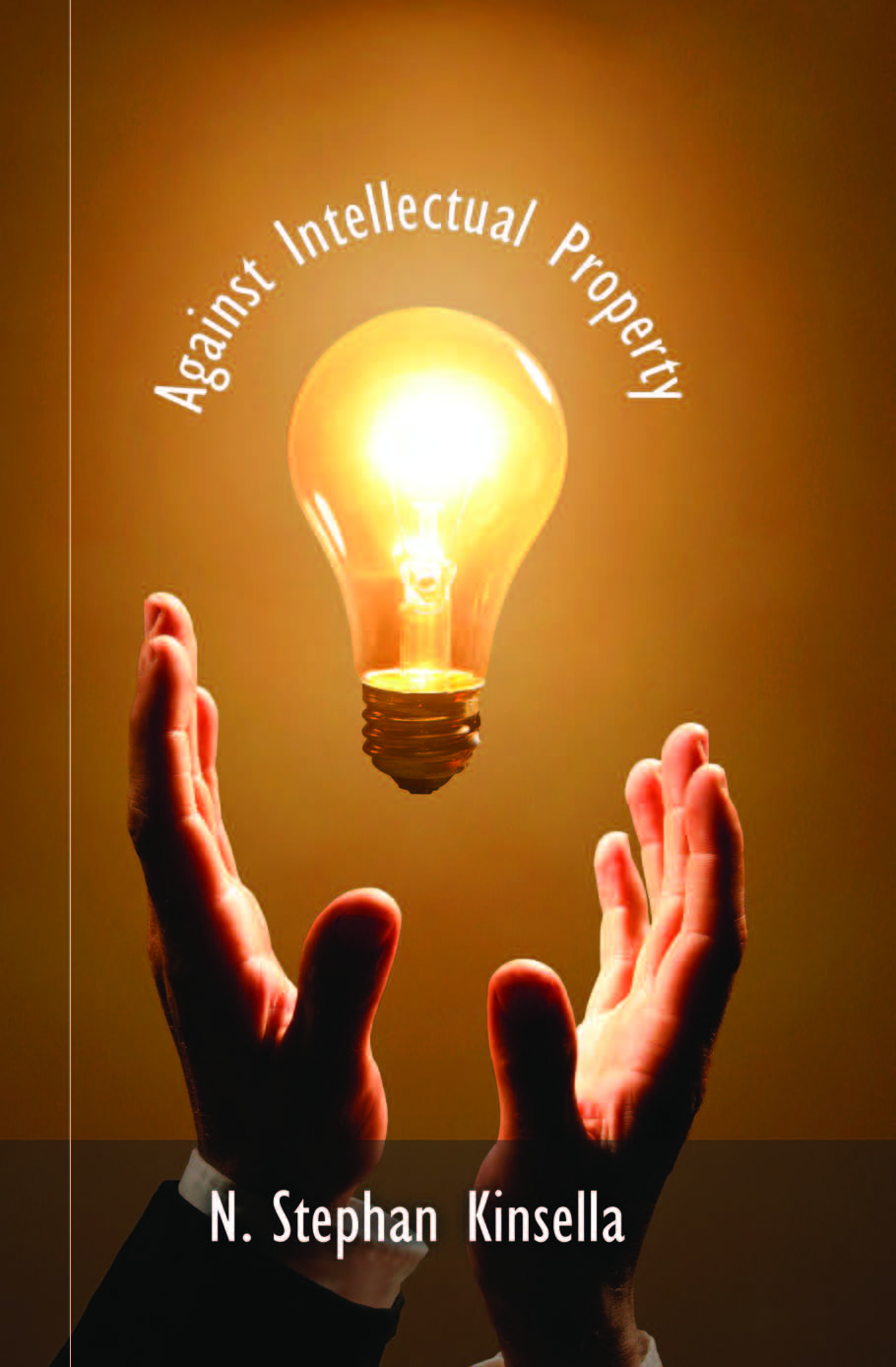
The US Supreme Court has noted that “[t]he specification and claims of a patent . . . constitute one of the most difficult legal instruments to draw with accuracy.” Topliff v Topliff, 145 US 156, 171, 12 S.Ct. 825 (1892). Quoted in Kinsella, Against Intellectual Property. [↩]
As noted here, the 2026 Twentieth Annual Meeting of the Property and Freedom Society was recently held from Thursday, September 17, 2026 to Tuesday, September 22, 2026. Information on the 2027 meeting will be released in early 2027.
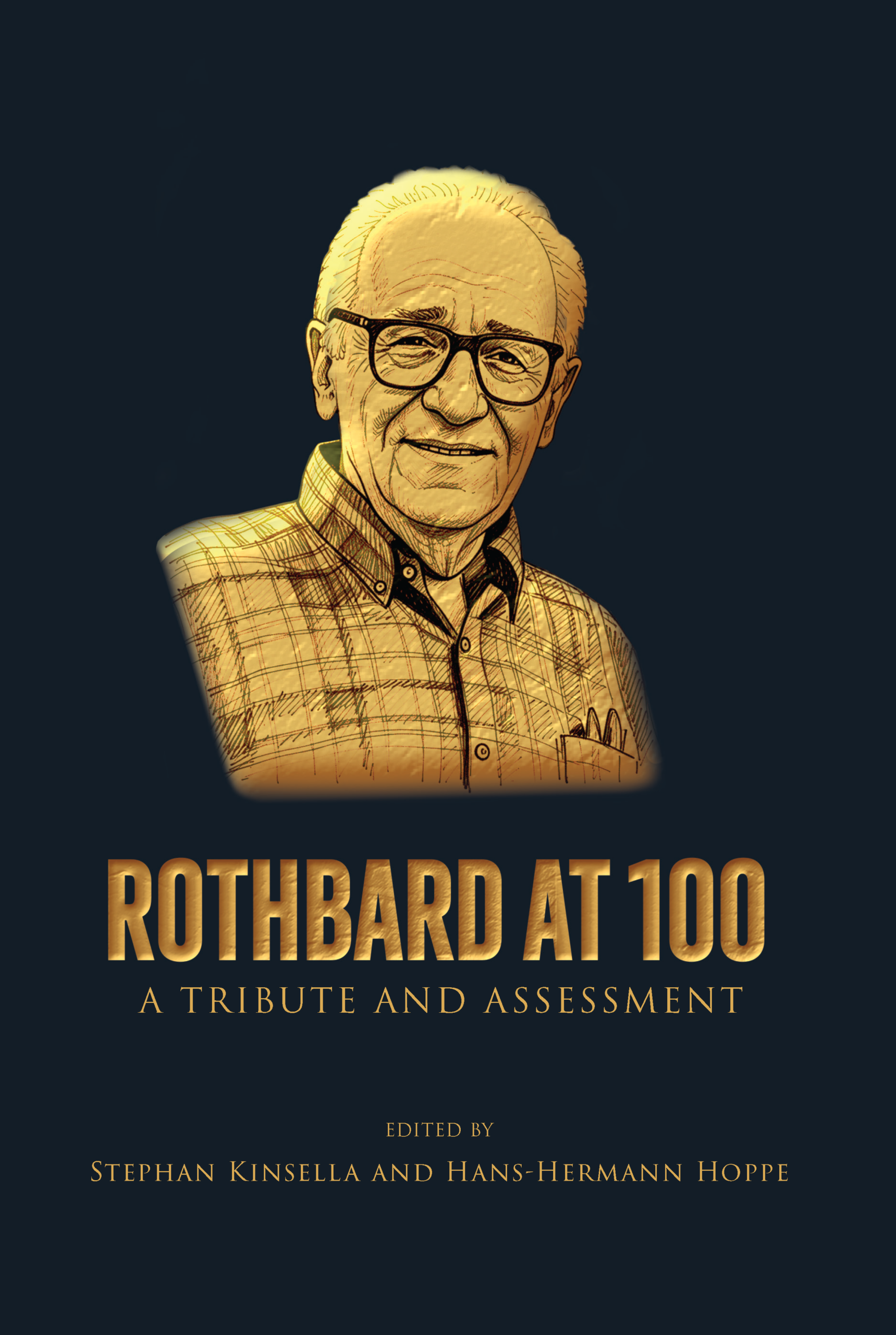
Rothbard at 100 is in production! As you can see, the books are printed in premium hardcover with gold foil stamping, and then they will be covered with a dust jacket. Also available as an audiobook and eBook. Preorder your copy now: https://t.co/iaEh0bk5G0pic.twitter.com/bapPGmhFHb
To donate with BITCOIN please use the address below. If you would like us to credit your payment (for dues, conference fees, etc.) please email Stephan Kinsella ([email protected]) when you make the bitcoin payment.
17M9V6m5X5Da4vNM5wWLjzcHz9qF36FPk6
“Property does not exist because there are laws, but laws exist because there is property.” — FrédéricBastiat
“Because the concept of property, for instance, is so basic that everyone seems to have some immediate understanding of it, most people never think about it carefully and can, as a consequence, produce at best a very vague definition. But starting from imprecisely stated or assumed definitions and building a complex network of thought upon them can lead only to intellectual disaster. For the original imprecisions and loopholes will then pervade and distort everything derived from them. To avoid this, the concept of property must first be clarified.” —Hans-Hermann Hoppe, TSC, ch. 2
The Property and Freedom Society (PFS; Facebook) stands for an uncompromising intellectual radicalism: for justly acquired private property, freedom of contract, freedom of association—which logically implies the right to not associate with, or to discriminate against—anyone in one's personal and business relations—and unconditional free trade. It condemns imperialism and militarism and their fomenters, and champions peace. It rejects positivism, relativism, and egalitarianism in any form, whether of "outcome" or "opportunity," and it has an outspoken distaste for politics and politicians. As such it seeks to avoid any association with the policies and proponents of interventionism, which Ludwig von Mises identified in 1946 as the fatal flaw in the plan of the many earlier and contemporary attempts by intellectuals alarmed by the rising tide of socialism and totalitarianism to found an anti-socialist ideological movement. Mises wrote: "What these frightened intellectuals did not comprehend was that all those measures of government interference with business which they advocated are abortive. ... There is no middle way. Either the consumers are supreme or the government."
(A more complete statement of our Principles can be found here.)






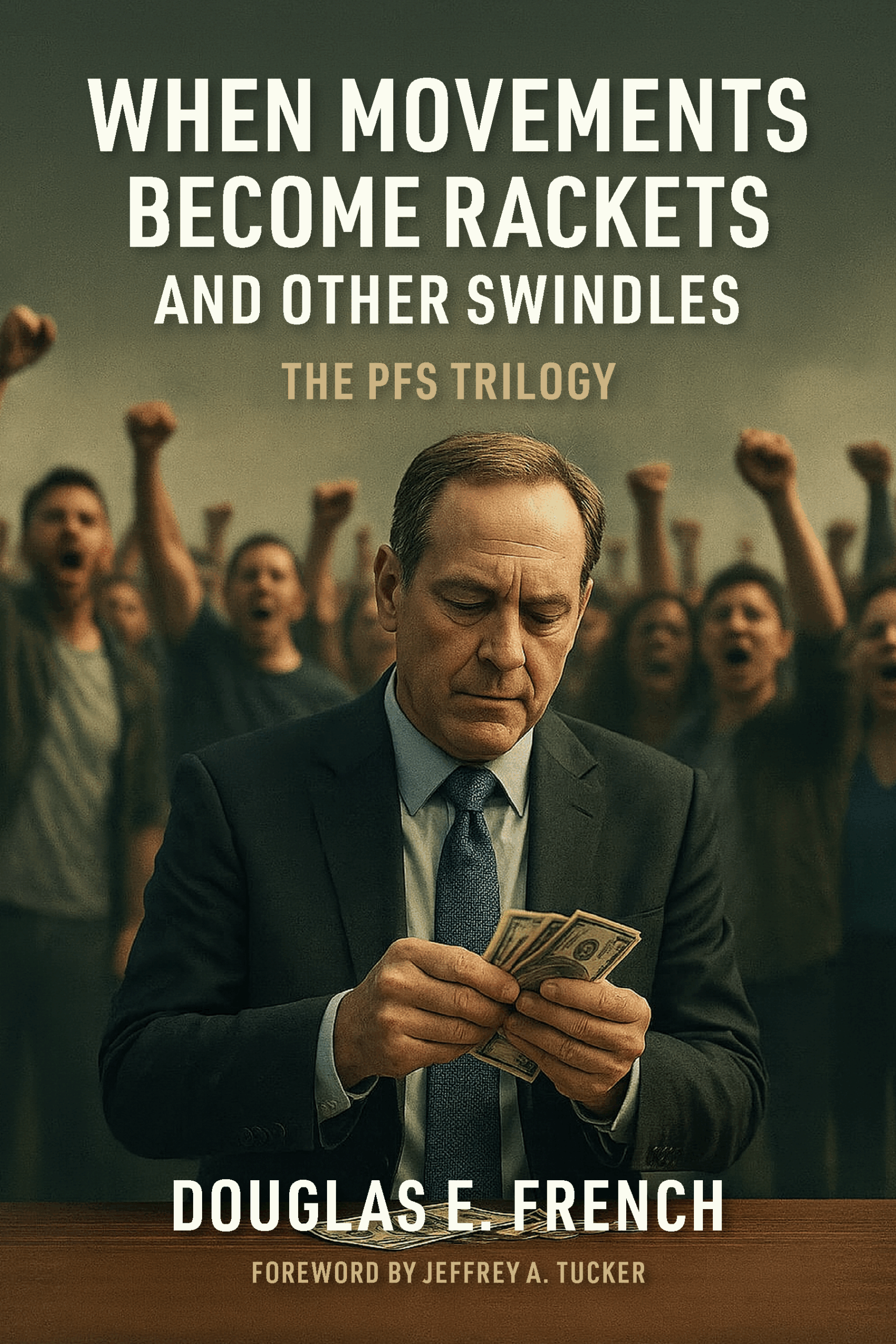


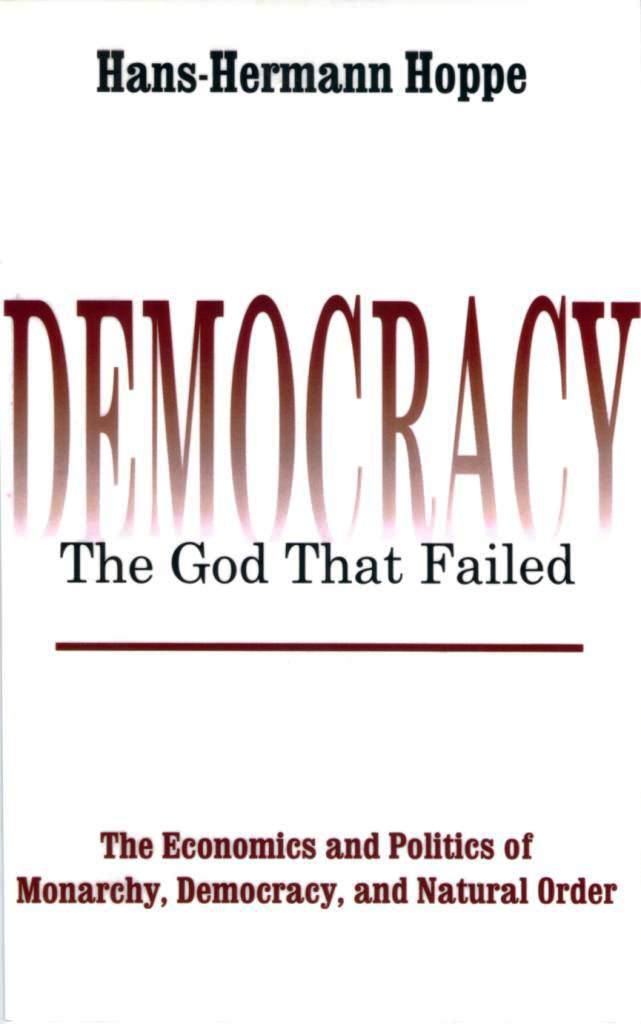


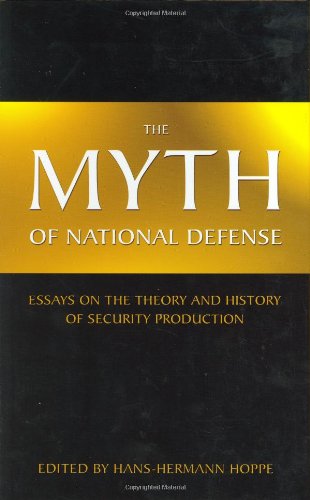

 Alessandro Fusillo
 Andreas Tögel
 David Dürr
 Doug French
 Fernando Chiocca
 Greg Morin
 Hans-Hermann Hoppe
 Jay Baykal
 Jayant Bhandari
 Jeff Deist
 Jeffrey Barr
 Juan Fernando Carpio
 Ken Yamarashi
 León Isidoro
 Martin Cabrera
 Nick Hoppe
 Oscar Grau
 Peter Wong
 PFS
PFS scholarium
 Saifedean Ammous
 Sean Gabb
 Sean Ring
 Stephan Kinsella
 Stéphane Geyres
 Thomas Jacob
 Tom DiLorenzo