[C4SIF cross-post]
Excellent recent column: Adam Haman, “Copyright’s Dirty Secret: It Was Born in the Inquisition,” Haman Nature (Jul 30, 2026).
Related
- Philip Bodeswell, “How To Create A Flying Monkey: Movement: Hint: It’s Not Magic,” The Narcissist State (Aug 19, 2026) (linked in the comments)
- Re the comments on “When monopoly claims reach the body”: See Kinsella, Intellectual Property Rights as Negative Servitudes: “The fact that IP law gives the wielder a negative servitude over the property, and even bodies, of others, shows that IP can also resemble slavery. I pointed this out in Against Intellectual Property (see text at n 94); as does Tom Palmer, “Intellectual Property: A Non-Posnerian Law and Economics Approach,” p. 281; and Palmer, “Are Patents and Copyrights Morally Justified? The Philosophy of Property Rights and Ideal Objects,” pp. 828-29, 831, 862, 864–65; and Roderick Long (Owning Ideas Means Owning People; The Libertarian Case Against Intellectual Property Rights). Palmer notes that William Leggett also “argued that such rights were in reality statutory monopolies that infringed upon the rights of others to the ownership of their own bodies”. Palmer, Are Patents and Copyrights Morally Justified?,” p. 828–29; see also my post William Leggett on Intellectual Property.”
- Kinsella, Rothbard on Mercantilism and State “Patents of Monopoly”
- ——, The Problem with Intellectual Property
- On the incompatibility of faith and copyright, see:
- Faith Seeking Freedom: Libertarian Christian Answers to Tough Questions
- Cody Cook, Open Source Jesus: A Manifesto for a Liberated Church (2015) (pdf, posted with permission)
- Why Creativity Needs Ownership: James Edwards on the Biblical Roots of IP & the Future of Patents
- Tucker, The Magic of Open-Source Publishing
- First Alleged “Copyright” Dispute: 560 AD, Celtic Ireland; Battle Ensues; 3000 people die
***
Adam Haman, “Copyright’s Dirty Secret: It Was Born in the Inquisition,” Haman Nature (Jul 30, 2026)
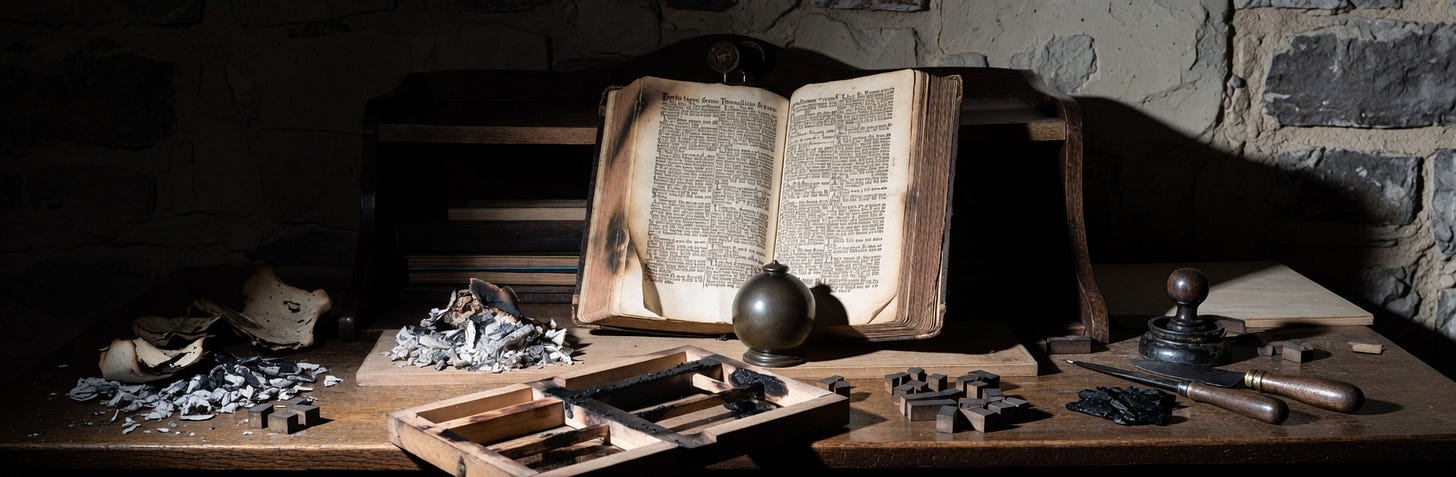
In my journey from political blank slate, to rejecting both Democrats and Republicans, to embracing Randian minarchist libertarianism, and then (six months later, as the joke goes) full anarchism, my biggest stumbling block wasn’t the roads (ha ha) or even the police, courts, or military.
Nope, it was so-called “intellectual property (IP).”
Indoctrinated as I was, I couldn’t see how creativity and productivity could exist without patent and copyright protections. Worse, I thought IP was good and true, just and moral, as Rand (and my college professors) insisted.
Eventually, I came across unassailable moral and legal arguments by Stephan Kinsella, along with devastating empirical evidence by Boldrin and Levine, and I was convinced: statist IP laws are trash too.
What I didn’t realize until very recently (while listening to a great interview of Ada Palmer about Machiavelli on Dwarkesh Patel’s show) was how IP (especially the copyright part of it) has its origins in the Inquisition in Europe.
Weird, right? The system that lets Disney keep Mickey Mouse on lockdown for a century didn’t spring fully formed from some enlightened regard for authors’ natural rights or the needs of the public or the good of the state or anything our modern minds would expect.
Instead, it grew out of church censorship machinery designed to stop heresy from spreading via the printing press.
Imagine what a drastic change Gutenberg’s printing press brought to society. Previously, hand-written manuscripts were rare and precious. Extra copies were a blessing because they lowered the odds of total loss in a fire or flood.
Mechanized printing changed everything. Suddenly texts could be mass-produced cheaply.
Printers started cranking out editions of other people’s work without permission, full of typos, and authors like Machiavelli were left writing frantic letters to friends and patrons: “They printed my book full of errors and there’s nothing I can do about it!”
The Catholic Church’s response, formalized at the Fifth Lateran Council in 1515 with the bull Inter sollicitudines, was classic authoritarianism: control the new technology by requiring prior approval.
No one could print a book without first submitting it to the local bishop and the local inquisitor of heresy for examination and written permission (the imprimatur).
Unauthorized printing meant book-burning, fines, suspension from the trade, and excommunication. Once granted, the record of your approval wasn’t just a “passed the censorship” stamp. It functioned as proof of an exclusive right.
The printer (or party) who went through the process could use the Inquisition’s paperwork to claim a monopoly and sue anyone who printed an unauthorized edition.
In this way, censorship and exclusive printing rights were born as Siamese twins. All books were effectively pre-banned until cleared, and in exchange for jumping through the hoop you got legal exclusivity.
England, watching from outside the Catholic world, liked the dual structure. Queen Mary I’s 1557 charter to the Stationers’ Company handed the London printers’ guild a legal monopoly on printing in exchange for policing the press against heresy and sedition.
Register your title with the Company and you got the exclusive “right to copy.” Licensing by royal or ecclesiastical authorities was required. Star Chamber decrees and the later Licensing of the Press Act of 1662 kept the machine running: license first, monopoly second.
When the licensing system finally lapsed for good in 1695, the Stationers scrambled for more political protection. The result was the Statute of Anne in 1710 — the first modern copyright statute.
It shifted the language toward authors (sort of) and limited terms (14 years, renewable once), but the DNA was still there: state-granted monopoly rooted in an earlier regime of pre-publication control.
That English model is the direct ancestor of copyright here in the US.
So the “just reward for creators” story we all got fed in school is mostly propaganda layered on top of a system invented to stop people from reading the wrong things about the Trinity.
The Inquisition wanted doctrinal purity. Printers wanted protection from competition. The state wanted control. Authors were secondary.
The same pattern shows up later with patents — privileges granted by princes and republics for political or fiscal reasons, not pure natural rights or “the good of the realm” or anything like that.
Once we grasp IP’s origin story, the great Stephan Kinsella’s more principled points land even harder. Property rights in scarce physical resources make sense because conflict over use is inevitable.
Ideas are not scarce in that way. Copying a book or implementing a technique doesn’t deprive the original creator of his copy or his knowledge. The monopoly is pure restriction of peaceful activity, enforced by the state.
Even worse, IP violates the legitimate property rights of other people. Yeah, it’s your ink and paper, but if you draw a picture of the sacred mouse and sell this thing you own, you’re now a criminal!
History shows IP was never primarily about rewarding genius; it was about controlling the flow of information and carving out rents for favored groups.
Creativity flourished for centuries without modern copyright — Shakespeare, Bach, the scientific revolution, and on and on and on. Boldrin and Levine’s data show that stronger IP usually correlates with less innovation in many fields, not more.
The “born in Inquisition” angle just adds the historical insult to the moral and economic injury we are already suffering with IP laws.
Human nature doesn’t require the state to grant temporary monopolies over patterns of information in order to produce art, science, or software. Don’t believe the hype.
Markets, reputation, first-mover advantages, and voluntary contracts handle incentives just fine. The rest is rent-seeking dressed up in high-minded language about “protecting creators.”
Once you see the lineage — from inquisitorial imprimatur to Stationers’ Register to Statute of Anne to today’s copyright maximalism — it’s hard to keep treating IP as some sacred pillar of civilization.
How could it be? Just look around. IP is just another tool the powerful originally used to manage the rest of us, and it still is.
Naturally,
Adam
Discover more from The Property and Freedom Society
Subscribe to get the latest posts sent to your email.












 Alessandro Fusillo
 Andreas Tögel
 David Dürr
 Doug French
 Fernando Chiocca
 Greg Morin
 Hans-Hermann Hoppe
 Jay Baykal
 Jayant Bhandari
 Jeff Deist
 Jeffrey Barr
 Juan Fernando Carpio
 Ken Yamarashi
 León Isidoro
 Martin Cabrera
 Nick Hoppe
 Oscar Grau
 Peter Wong
 PFS
PFS scholarium
 Saifedean Ammous
 Sean Gabb
 Sean Ring
 Stephan Kinsella
 Stéphane Geyres
 Thomas Jacob
 Tom DiLorenzo