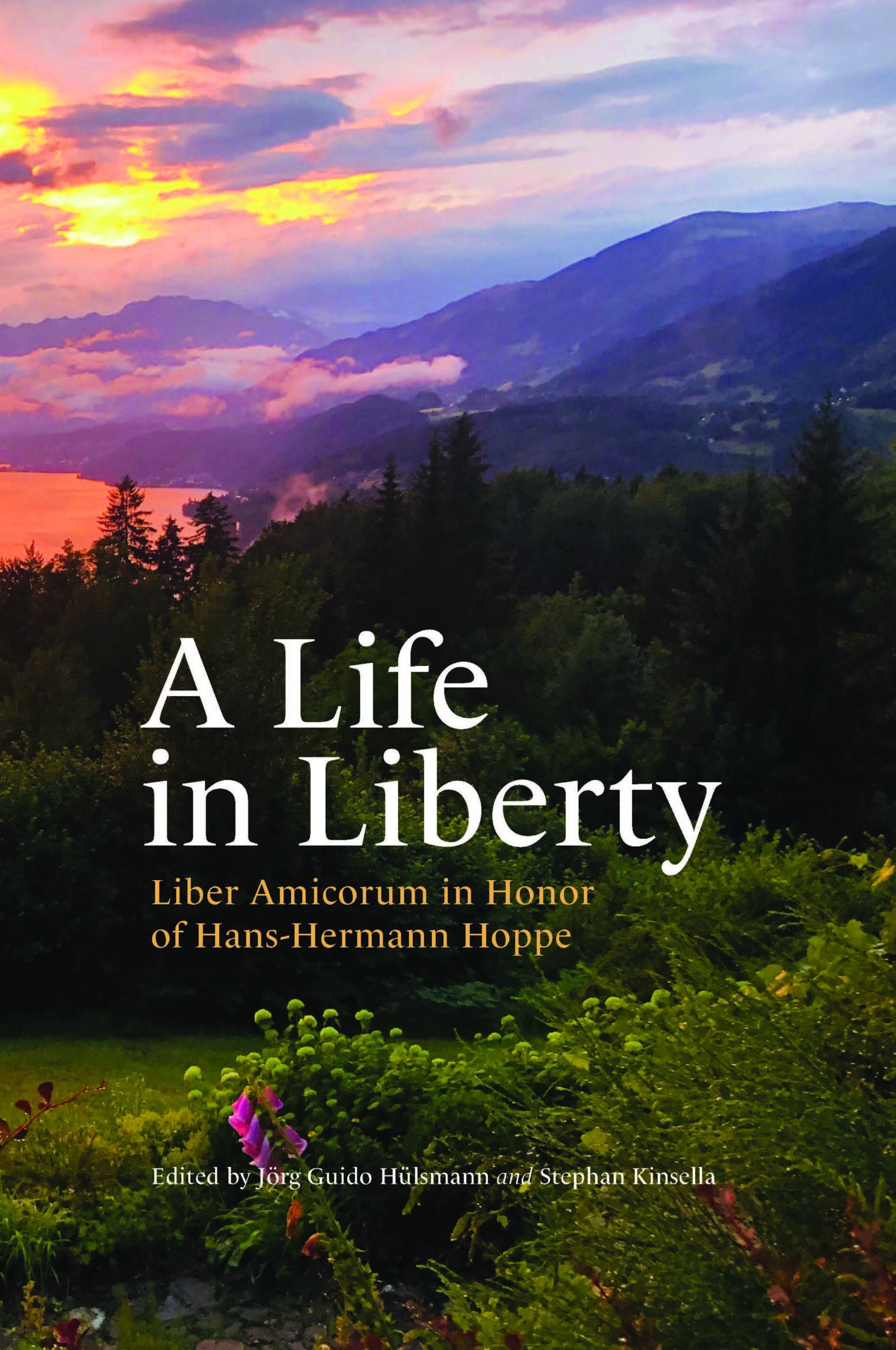
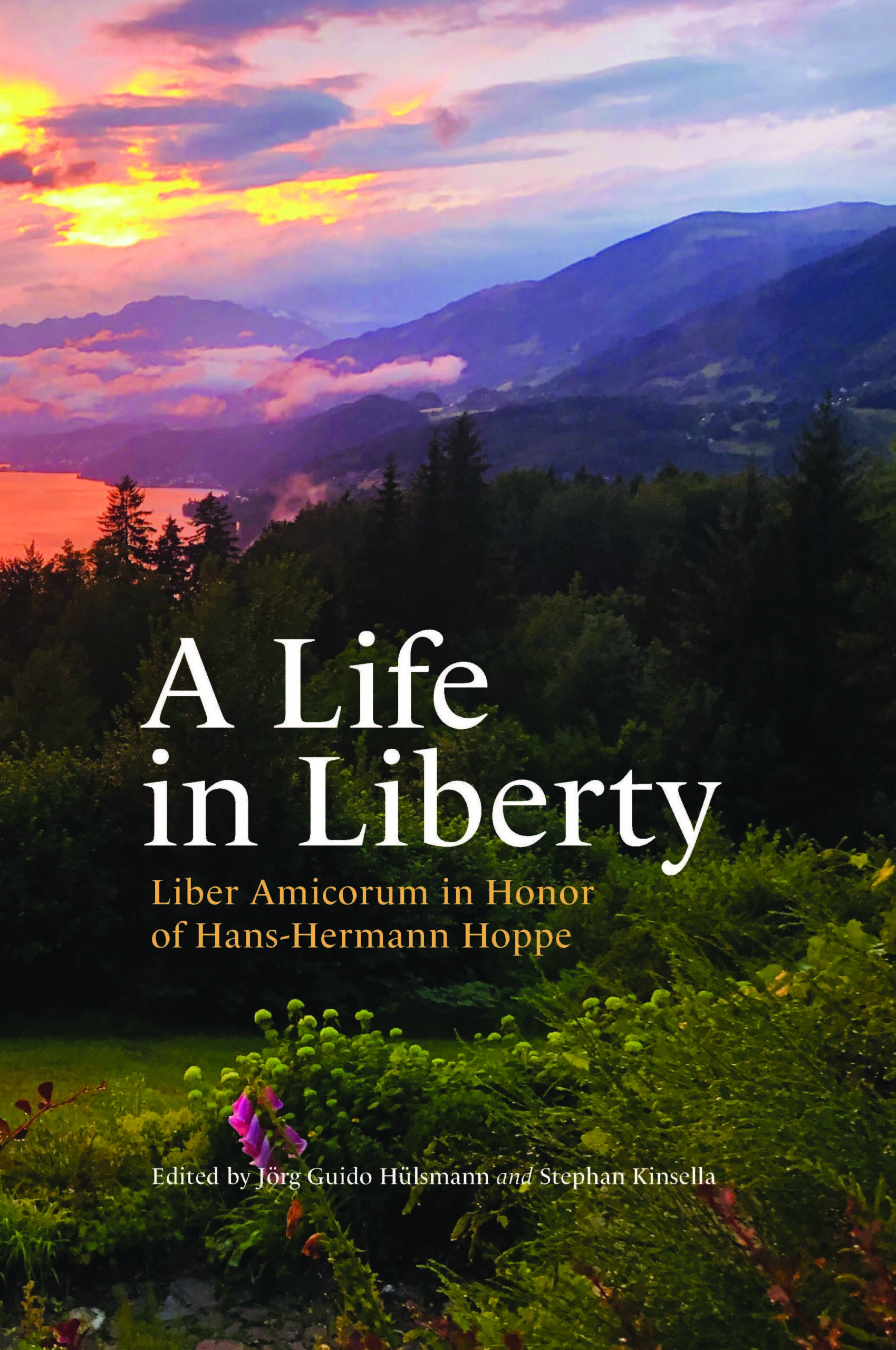
 In 2024, the Property and Freedom Society published A Life in Liberty: Liber Amicorum in Honor of Hans-Hermann Hoppe, Jörg Guido Hülsmann and Stephan Kinsella, eds. (Houston, Texas: Papinian Press, 2024), on the occasion of Professor Hoppe’s 75th birthday on Sept. 2, 2024.
Most of the the pieces were not published in HTML text form as separate articles; we will be posting them in this Bookstream. The Preface was republished in the inaugural post in this Bookstream: A Life in Liberty Bookstream: Preface — Hülsmann and Kinsella. Links to the remaining chapters may be found at the book’s landing page here. Here’s the next entry—
6
Two Weddings and a Foundation
Deanna L. Forbush*
Igrew up in Utah a Libertarian, but didn’t know it. We believed in freedom, capitalism and property rights without realizing there was a name for it. It just seemed axiomatic to me that a person owned their own body, had the right to exclude trespassers, should earn their own way and then keep most of what they obtain by the sweat of their brow, and that the government had a very limited role to play in our lives, to wit, to protect our property rights and that other minor tasks that we expressly invite them to perform. That there was an ideological framework supporting the ideas was a surprise. However, to my delight in 2001 I met and became friends with one of the intellectual giants of libertarianism, Hans-Hermann Hoppe. Now, I had authority to support my innate concept of existence.
Of course, I had the perfect entrée to Professor Hoppe: my husband, Douglas French. Hans sat on Doug’s thesis committee at UNLV years prior. I always say, I’d rather be lucky than good. We met over red wine at a Mises Institute event and, to my good fortune, our lives have been somewhat intertwined ever since. From my days at the Venetian Hotel Casino and Resort and his at UNLV to the present we have shared both the nectar of the Gods and many life-changing discussions.
For example, one night over filet mignon and Chateau Ste. Michelle, I waxed on, not so poetically, about not needing the state to sanction my years-long relationship with Doug. I amused myself by saying we both willingly came home every night without any bureaucrat forcing us to do so. Hans said “don’t be ridiculous, marriage existed long before the state did; marriage has long been the way people demonstrate and express their commitment to one another.” So it is said, so it shall be! Needless to say, within short order, Doug and I hosted Hans and Gülçin’s wedding in Las Vegas, and the Drs. Hoppe gave Doug and I a wedding extravaganza in Bodrum, complete with sea blue hydrangeas, ancient fertility rituals, prosperity henna art, and fireworks. Leave it to say that while I have been enriched by reading his words, absorbing his ideas, and benefited from his laser-focused logic, I’ve been blessed to know him as a friend.
Another fun fact: his brilliance aside, Hans is genuinely funny and quite charming. Something many people don’t know or don’t appreciate. One year, Hans and Gülçin met me and Doug in Vienna to scout the city for the following year’s Mises Institute Supporters’ Summit. In addition to attending the Vienna Opera and other sites Hans-the-expert-tour-guide showed us, we heard him speak in his native German to a crowd of international students. While I’ve been told that the subject of the speech was Austrian economics, the audience often roared with laughter at Hoppe’s wit. I asked him about it later and he said, “ya, ya, I was telling them that you can’t eat German sausage because they are the wurst.”
Hoppe is also magnanimous and kind. In 2015, Hans gave me the great honor of speaking at his Property and Freedom Society conference in Bodrum, Turkey where I spoke of my days jousting with the Culinary Workers Union in Las Vegas. That year, he exposed his benevolent nature.
Hans is also a recognized authority. As a practicing attorney, Hoppe’s insight into property rights has been invaluable. Ironically, my employment practice has led me to represent politically-incorrect employers, such as gentlemen’s cabarets and one of the only legal brothels in the United States, located in Pahrump, Nevada. In a piece published in The Nevada Independent defending prostitution1 I turned to professor Hoppe for an instructive quote to make my point.
The answer to the question of what makes my body “mine” lies in the obvious fact that this is not merely an assertion but that, for everyone to see, this is indeed the case. Why do we say “this is my body”? For this a twofold requirement exists. On the one hand it must be the case that the body called “mine” must indeed (in an intersubjectively ascertainable way) express or “objectify” my will. Proof of this, as far as my body is concerned, is easy enough to demonstrate: When I announce that I will now lift my arm, turn my head, relax in my chair (or whatever else) and these announcements then become true (are fulfilled), then this shows that the body which does this has been indeed appropriated by my will.2
It should be no surprise that Hans’ steady logic and strong belief in a natural justice has resulted in a number of Hoppe’s students becoming lawyers. It makes sense, given that Austrian predecessors to Hoppe, Carl Menger, Ludwig von Mises and Eugen von Bohm-Bawerk were legally trained. Nobel Prize co-winner F.A. Hayek had a legal degree. Austrian economists, like lawyers, concern themselves with real people living real lives with the law untangling real conflicts.
Murray Rothbard, Dr. Hoppe’s great friend and mentor wrote eloquently about the law and property rights:
… tort or criminal law is a set of prohibitions against the invasion of, or aggression against, private property rights; that is, spheres of freedom of action by each individual. But if that is the case, then the implication of the command, “Thou shall not interfere with A’s property right,” is that A’s property right is just and therefore should not be invaded. Legal prohibitions, therefore, far from being in some sense value-free, actually imply a set of theories about justice, in particular the just allocation of property rights and property titles. “Justice” is nothing if not a normative concept.3
I am thrilled to be included among the contributors to the Hoppe Liber Amicorum which honors a man who is not only great in his field but an enormous inspiration and valued friend.
Endnotes
*Deanna Forbush is an attorney with Fox Rothschild. She lives with her husband, Doug French, in Las Vegas.
- Deanna Forbush, “When It Comes to Prostitution, Let Freedom be the Last Word,” The Nevada Independent (Feb. 3, 2023). [↩]
- Informal translation from Hans-Hermann Hoppe, Eigentum, Anarchie und Staat (Manuscriptum Verlag, 2005, pp. 98–100; originally published in 1985), quoted in Stephan Kinsella, “How We Come to Own Ourselves,” in Legal Foundations of a Free Society (Houston, Texas: Papinian Press, 2023), text at n.17. [↩]
- Murray N. Rothbard, Economic Controversies (Auburn, Ala.: Mises Institute, 2011; https://mises.org/library/economic-controversies), p. 369. [↩]
Discover more from The Property and Freedom Society
Subscribe to get the latest posts sent to your email.














 Alessandro Fusillo
 Andreas Tögel
 David Dürr
 Doug French
 Fernando Chiocca
 Greg Morin
 Hans-Hermann Hoppe
 Jay Baykal
 Jayant Bhandari
 Jeff Deist
 Jeffrey Barr
 Juan Fernando Carpio
 Ken Yamarashi
 León Isidoro
 Martin Cabrera
 Nick Hoppe
 Oscar Grau
 Peter Wong
 PFS
PFS scholarium
 Saifedean Ammous
 Sean Gabb
 Sean Ring
 Stephan Kinsella
 Stéphane Geyres
 Thomas Jacob
 Tom DiLorenzo