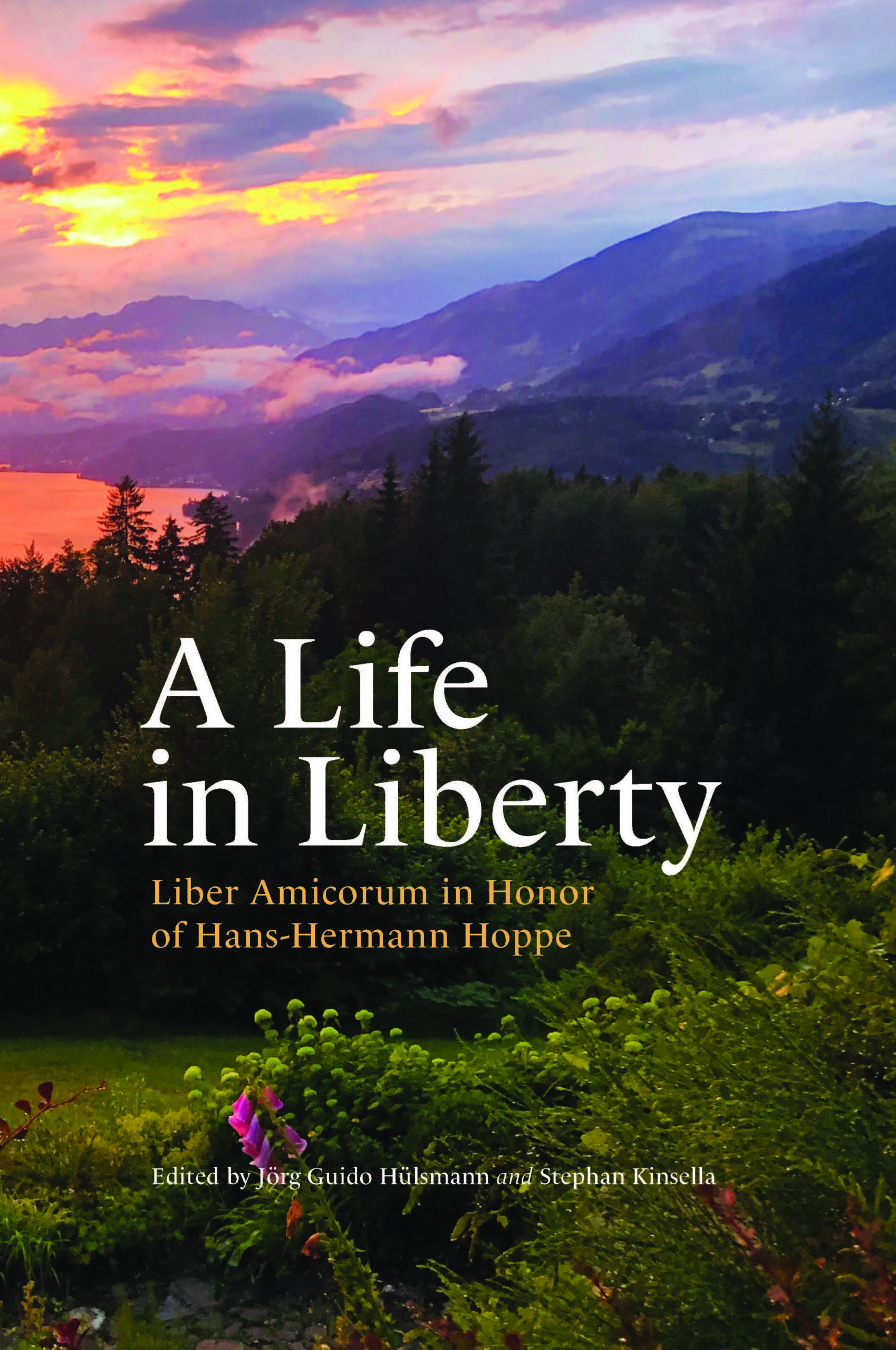
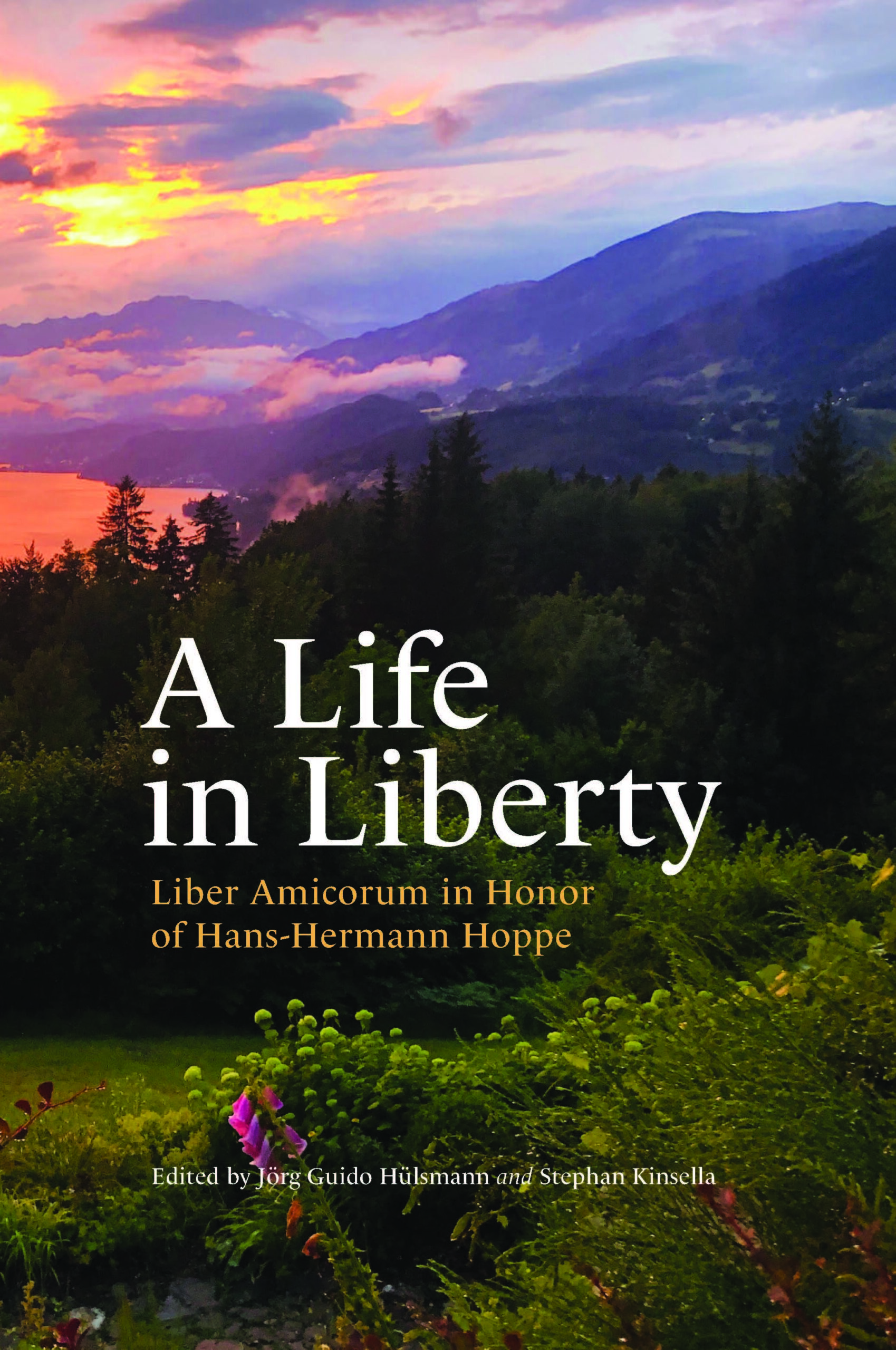
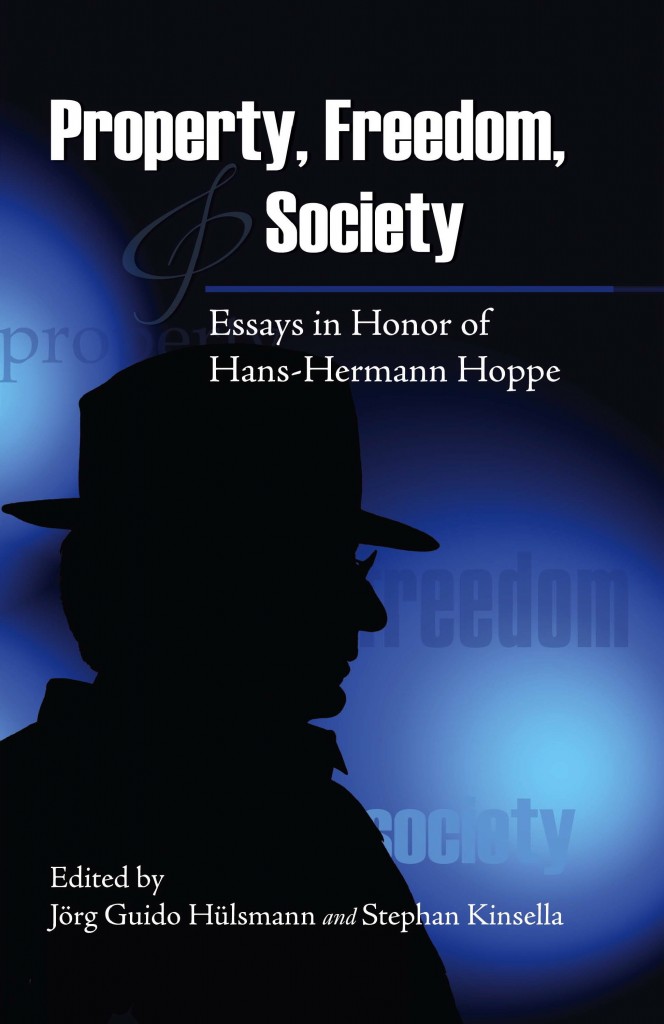
 In 2024, the Property and Freedom Society published A Life in Liberty: Liber Amicorum in Honor of Hans-Hermann Hoppe, Jörg Guido Hülsmann and Stephan Kinsella, eds. (Houston, Texas: Papinian Press, 2024), on the occasion of Professor Hoppe’s 75th birthday on Sept. 2, 2024.
Most of the the pieces were not published in HTML text form as separate articles; we will be posting them in this Bookstream. The Preface was republished in the inaugural post in this Bookstream: A Life in Liberty Bookstream: Preface — Hülsmann and Kinsella. Links to the remaining chapters may be found at the book’s landing page here. Here’s the next entry—. See also:
- Hans-Hermann Hoppe Victory Blog
- Kinsella and Tucker, “The Ordeal of Hoppe,” The Free Market, Volume 25, Number 4 (April 2005)
7
The Triumph of Hans-Hermann Hoppe
Jeffrey M. Herbener*
Colleagues and friends of Hans-Hermann Hoppe remember his victory over the thought police at UNLV. His ordeal kept grinding on from early March 2004 until late February 2005. Even though it ended in “a moment of great personal triumph,” for Hans, he expressed concern at the time about the “chilling effect on less established academics” his case may foster and “about the level of self-censorship in academia.”1
His lament that “if I made one mistake, it was that I was too cooperative and waited too long to go on the offensive” was true only in the sense of his personal interaction with his antagonists during the ordeal.2 Only a few months after his tribulation began, Hans was on the offensive in the battle of ideas. In June of 2004, he conducted a weeklong series of lectures at the Mises Institute. The lectures, transcribed and collected in Economy, Society, and History demonstrate how far he had departed from the sterile path of the economics profession which is bent on formulating models with an increasingly narrow focus to give one-off explanations of each specific case.3 Far from following this trend into irrelevance, Hans was broadening his vision and generalizing his analysis. From the firm foundation of private property, he was building out from economics to provide a Grand Narrative of the history of human society.
Hans realized that fulfilling the potential of such a project required a new independent intellectual institution. In August 2005, he organized the Property and Freedom Society, which held its first meeting in May 2006.
Six months later, on November 4, Hans delivered the Mises Memorial Lecture at the Austrian Student Scholars Conference. Sticht Lecture Hall on the campus of Grove City College, which seats around 200, was packed. Except for the 20 students presenting their research at the conference, the audience was a general student body. The main interest of most students in attendance was to earn extra credit in their introductory economics courses. It’s safe to say that the vast majority had neither read the work nor even heard the name of Hans Hoppe before that night, let alone knew of his courageous stand against the thought police. Yet, their reaction to Hans’s lecture was unprecedented.
There have been 40 keynote lectures in the 20 annual renditions of the ASSC. The conference has been blessed to host many leading Misesian economists delivering outstanding lectures on important topics. Speakers have employed varying degrees of rhetorical and technological engagement with the audiences. The response of students over the years has ranged from polite applause to warm appreciation. Hans’s talk was vintage Hoppe. He stood behind the podium speaking in his logically rigorous manner for 55 minutes on the topic, “The Private Law Society.” He made no attempt to ingratiate himself to the audience with the usual rhetorical and technological devices. Yet at the close of his remarks, Sticht Lecture Hall erupted in a sustained standing ovation. Neither the economics faculty nor the conference participants promoted this response by being the first to jump to their feet. The response was spontaneous.
Several reasons might be offered for such a response. Hans’s delivery can be mesmerizing; his logic overwhelming; his lucid thinking felicitously expressed; his fearlessness in speaking the truth. Hans himself remarked on the latter, “I had recognized and accepted no intellectual taboo whatsoever, and, whether because or despite of this, I had enjoyed great popularity among my students.”4
There was, however, another more important reason for the exuberance of the audience that night. The content of Hans’s talk resonated with GCC students because it connected for them two beliefs which they held. First, the reality of human nature, which as Christians they accepted and therefore, understood from their personal experiences in life. And second, their sense of justice which they learned and therefore, accepted from the teaching of scripture. The response of GCC students to Hans’s lecture was a manifestation of the foundation on which genuine human flourishing rests.
Since 2006, Hans has continued to broaden his scope of analysis in a quest for a Grand Narrative of human history. In this, he has gone beyond his mentor’s system of liberty grounded in natural law by placing Rothbard’s system within the broader moral system of the Bible.
Colleagues and friends of Hans are eager to see the ultimate triumph, both professionally and personally, he achieves at the end of his new path.
Endnotes
*Jeffrey M. Herbener ([email protected]) is professor of economics and chairman of the economics department at Grove City College. He is a Senior Fellow of the Ludwig von Mises Institute Institute and associate editor of The Quarterly Journal of Austrian Economics.
- Hans-Hermann Hoppe, “My Battle with the Thought Police,” Mises.org (April 12, 2005). [↩]
- Ibid. [↩]
- Hans-Hermann Hoppe, Economy, Society, and History (Auburn, Ala.: Mises Institute, 2021; www.hanshoppe.com/esh). [↩]
- Ibid., p. xv. [↩]
Discover more from The Property and Freedom Society
Subscribe to get the latest posts sent to your email.










 Alessandro Fusillo
 Andreas Tögel
 David Dürr
 Doug French
 Fernando Chiocca
 Greg Morin
 Hans-Hermann Hoppe
 Jay Baykal
 Jayant Bhandari
 Jeff Deist
 Jeffrey Barr
 Juan Fernando Carpio
 Ken Yamarashi
 León Isidoro
 Martin Cabrera
 Nick Hoppe
 Oscar Grau
 Peter Wong
 PFS
 scholarium
 Saifedean Ammous
 Sean Gabb
 Sean Ring
 Stephan Kinsella
 Stéphane Geyres
 Thomas Jacob
 Tom DiLorenzo
