Snowdrift, “Jensen Huang Should Not Have Come Back Like This,” Ludwig von Mises Substack (Nov. 24, 2026), translated from the Chinese original (Nov. 24, 2026).
A Chinese Austrian writing as Snowdrift welcomes Jensen Huang’s reinstatement as NVIDIA’s CEO but objects to how it came about: Huang was pushed out under political pressure and brought back less than two weeks later, only after the board “received input from senior levels of the United States government.”1 Snowdrift’s point is that once a firm must clear its sales, its open-source work, and even its CEO with Washington, its ownership is private in name only—a de facto nationalization, what Snowdrift calls the Nazi playbook and Mises called the Zwangswirtschaft of Hitler’s Reich. (See also Snowdrift’s earlier “The Jensen Huang Affair” and Lao Gu’s take on Huang’s ouster, in the Related list.)
Jensen Huang Should Not Have Come Back Like This
Snowdrift • Ludwig von Mises Substack • Nov. 24, 2026
Written by Snowdrift in Shaanxi Province, China at 12:06 p.m. on 24 November 2026
I am in favour of Jensen Huang’s reinstatement.
For one thing, sacking the founder and driving soul of your own company is a recklessly bold move. [Note: Formally, Huang was not sacked; he resigned on Nov. 12, 2026, amid the affair and espionage allegations. —Ed.] The function of an entrepreneur is categorically different from that of a professional manager. A professional manager is a hired hand, an executor of corporate strategy, drawing a wage that is the discounted value of his marginal productivity. The entrepreneur, by contrast, is the architect of that strategy, the brain of the firm, the one who dictates the direction in which resources are allocated — and the one who stakes his entire fortune and skin on the outcome, the ultimate bearer of operational risk and of profit and loss.
Entrepreneurial judgment is an art, and art is intensely personal. It depends, almost entirely, on the particular temperament and intelligence of the individual. Certain resources achieve their highest efficiency and maximum profit only under the idiosyncratic stewardship of a given entrepreneur; swap him out, and the very same resources may amount to nothing.
Which is precisely why the market punished NVIDIA the moment Huang was shown the door. Investors marked the company down, sharp and immediate, because they could not see a NVIDIA without him.
Some will say this is a governance issue — that a company ought not to be hostage to one man, that it should run the same whoever is in the chair. It sounds sensible. It is, in fact, a category mistake: the fallacy of treating “the company” as a real entity rather than as a convenient abstraction. Every collective is made up of persons, and persons are not interchangeable. If it truly made no difference who ran the place, why would recruitment ever specify requirements? Why would we distinguish genius from mediocrity at all?
Why did Caesar cross the Rubicon? Because he was Caesar. Put someone else in his sandals and the river might never have been crossed, and history would have turned differently.
Now, to be fair: had this been the company’s own free decision, it would fall squarely within the domain of property rights, and the shareholders would have borne the consequences. Outsiders would have had nothing to say.
The trouble is that this was not that. It was the visible product of political manoeuvring — Democrats, the so-called China hawks, the Silicon Valley factions hostile to open source, the incumbent giants eager to entrench their monopoly rents — closing ranks in the name of “national security”, and aiming, through Huang, at Trump and the MAGA Republicans. That has nothing whatsoever to do with commerce.
None of which is to excuse the affair itself. Wrong is wrong. Nor is it any defence that “the big boys all do it and nobody gets hauled over the coals”. Other people’s wrongdoing is not a licence for your own. If the shareholders genuinely hold that the moral failing is intolerable and are willing to pay the economic price for it, then removing him was entirely their prerogative. What is contemptible is doing it through morality — weaponising ethics for political ends, and wrapping the whole thing in the flag.
On the other hand, Huang’s return serves the shareholders. The market has already answered: the stock shot up the moment it was known.
Had this been a purely private matter, NVIDIA’s shareholders would never have removed him, because Huang delivers them the largest return. The overwhelming majority of consumers buying AI chips could not care less whether the CEO has a blemished private life; they care whether the silicon does the job. He was removed because of “national security”, espionage innuendo, and pressure from political operators.
The one, core, final mission of an entrepreneur is to pursue maximum profit for his investors by the most advantageous means available. Profit maximisation is the optimal allocation of resources; it is the maximal satisfaction of consumer demand. Where else would profit come from? Windfall gains are proof that certain resources were previously under-capitalised or over-discounted, and that the entrepreneur spotted the disequilibrium, bid for the factors, and recomposed them into a scarcer, better use. At the same time, fat margins are the consumer vote: demand was so urgent that buyers competed the price up. Profit, in other words, is the residue of entrepreneurial foresight.
We do not rail against failed entrepreneurs. They have already paid, in losses, for their misjudgement — that is the market’s proper sanction. If anyone is to be blamed, it is not the profitable firm but the loss-making one. It failed to serve consumer demand, consumers withheld their money-votes, and scarce resources were squandered. That is where losses come from.
An entrepreneur owes no duty to “national security” or “social responsibility” — both phrases are conceptual smuggler’s traps. There is no such thing as national security; there is only the security of this or that politician and this or that interest group. There is no abstract social responsibility either; serving consumers well is the largest and best social responsibility there is.
Once “national security” and “social responsibility” are legislated, the entrepreneur is already producing inside a cage of prior restraint, self-castrating to avoid a larger regulatory risk — and that act is itself a negation of the entrepreneurial function. Run the counterfactual: absent the intervention, human action would simply not have taken this shape.
The moment you bolt national-security and social-responsibility obligations onto a firm, you set aside the investor-profit mandate and substitute the objectives of government and of the literati and the commentariat. Production is no longer steered by consumer demand but by the need to burn capital satisfying regulators and public opinion. In effect, the firm builds what the state and the commentariat tell it to build. That is enough to destroy the free-enterprise order at the root.
That is why I support Huang’s return — because it serves shareholders and consumers, and because he should not have been politically hunted. One side of a political fight may even be “right”, but it is not right for the sake of rightness; it is right for someone’s interest, and that kind of rightness is unreliable. More often still, both sides are wrong, or the wrong machinery happens to deliver a right outcome — and that still does not make it legitimate.
What I object to is the manner of the return. This is a political restoration, not a commercial or market one. Politics has overridden commerce, overridden shareholder entitlement, overridden consumer demand.
Both the exit a dozen or so days ago and the rapid re-emergence are artefacts of the same machine. It is stomach-turning. We do not know how much dirty dealing changed hands in between, or how many Nancy Pelosi-style “stock wizards” were manufactured through inside information. That is almost beside the point. The point is this: what wrong could an entrepreneur possibly do by wanting to sell his goods to his largest customer? What wrong is it to want open source, and to be hammered as unpatriotic and insecure for it? To want to ship, and to need Washington’s permission? To be required, even, to hand a cut of the proceeds to the US government? What capitalist, what market economy, is this?
That is nationalisation. Push the logic to its limit: if you do not obey, we make sure you cannot operate; if you cooperate, the state can take the firm and simply let you sit in the CEO’s chair. Shareholders move aside. Consumers move aside.
Few people realise this is the Nazi playbook — title stays nominally private, but usage is dictated from above. Fewer still grasp that the true test of a market economy is the integrity of private property rights. It is not only when the state confiscates everything that planning begins; it begins the moment the bundle of rights is truncated and the owner must ask permission how to use his own.
And “nationalisation”, in this sense, arrives the instant a firm must take orders from Washington — whom to sell to, whom to hire, whom to fire — and thread its way through a thicket of legislation. At that point it is already a state enterprise.
Consider what follows. After this episode, will Huang dare push hard to sell chips into China again? Will he dare keep pursuing his open-source ecology? The Democrats have already threatened a full congressional investigation into Huang and Trump the moment they retake the House [Note: Democrats won the House in the Nov. 3, 2026 midterms and take control when the new Congress is sworn in on Jan. 3, 2027. —Ed.] — and that is not bluster, it is a standing account ready to be settled. Under that sword of Damocles, will NVIDIA’s operations not have to clear every move with the state? And what is such a firm, if not a state firm?
Remember the pattern. The brightest mind, the most innovative company, once targeted by the regulator, is shackled and slowly bleeds out its inventive capacity. The strongest firm, once captured by regulation and handed a monopoly rent, grows complacent, drifts away from real consumer demand, and rusts. The ablest investor or engineer, faced with rule-by-fiat and counter-fiat and the ever-imminent reckoning, watches his time-preference spike — he starts consuming capital instead of building it, and slides into mediocrity and poverty.
NVIDIA was a good company. This kind of handling will talk it into the ground.
Politics is the enemy of the economy.
***
Related
- Snowdrift, “The Jensen Huang Affair,” Ludwig von Mises Substack (Nov. 12, 2026)
- “Lao Gu on Who Jensen Huang Has Really Pissed Off,” PFS Blog (Nov. 20, 2026)
- “Lao Gu: Proof Without Purpose,” PFS Blog (Nov. 23, 2026)
- “Lao Gu: Asset Disclosure for Officials—Where’s the Problem?,” PFS Blog (Nov. 20, 2026)
- “Lao Gu on China’s $1 Trillion Trade Surplus,” PFS Blog (Nov. 16, 2026)
- Stephan Kinsella, “Lao Gu on Rubio, the ICC, and World Government: ‘Don’t Quote Law to Men Who Carry Swords’,” PFS Blog (Nov. 16, 2026)
- Stephan Kinsella, “Lao Gu: Why You Should Never Introduce an Inheritance Tax,” PFS Blog (Nov. 13, 2026)
- Stephan Kinsella, “Lehto on the 44-Acre Shakedown; or, In What Sense Do You ‘Own’ Land You Can’t Build On?,” PFS Blog (Nov. 16, 2026)
- Peter Wong, “Why Indians Are Conquering Silicon Valley’s CEO Suites While Chinese Elites Build Empires and Principalities Instead,” PFS Blog (June 26, 2026)
- Hans-Hermann Hoppe, “On the American Ideology and its Proponents and Beneficiaries,” Property and Freedom Journal (Aug. 23, 2026)
- Connor O’Keeffe, “The Real Problem with Trump’s Intel Deal,” Mises Wire (Aug. 27, 2025)
- Ludwig von Mises, “Middle-of-the-Road Policy Leads to Socialism” (address before the University Club of New York, Apr. 18, 1950)
- Murray N. Rothbard, Wall Street, Banks, and American Foreign Policy (Auburn, Ala.: Mises Institute, 2011)
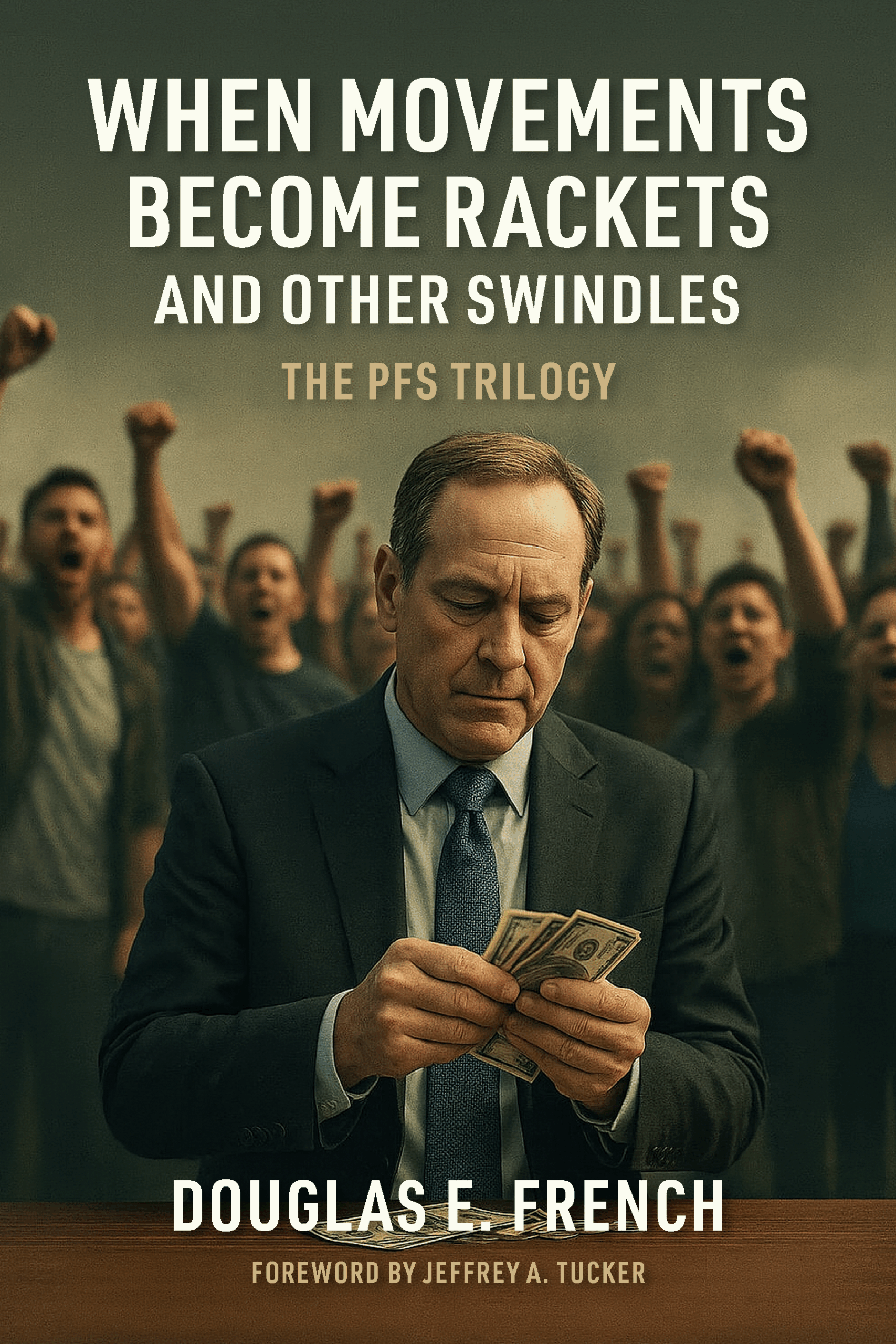
- Douglas E. French, “Teaching the Unteachable: The Teaching Entrepreneurship Racket,” in When Movements Become Rackets and Other Swindles: The PFS Trilogy, ed. Stephan Kinsella (Houston: Papinian Press and Property and Freedom Society, 2025), ch. 3 (originally published as “Entrepreneurship Can’t Be Taught in a College Classroom,” Mises Wire (June 21, 2025))
- Cf. Gordon Miller, “We Can’t ‘Teach’ Entrepreneurship, But We Can Inspire Future Entrepreneurs,” Mises Wire (Oct. 21, 2025) (reply to French)
- On Huang’s Nov. 12, 2026 resignation, see NVIDIA, “NVIDIA Announces CEO Transition” (press release, Nov. 12, 2026); on his return, see NVIDIA, “NVIDIA Board Reinstates Jensen Huang as President, CEO and Board Director” (press release, Nov. 23, 2026); Andy Hirschfeld, “Nvidia Board Reinstates Jensen Huang as CEO,” Al Jazeera (Nov. 23, 2026) (reporting that Trump told CNBC he was “represented in the board meeting”). See also “Lao Gu on Who Jensen Huang Has Really Pissed Off,” PFS Blog (Nov. 20, 2026), n.1. [↩]








 Alessandro Fusillo
 Andreas Tögel
 David Dürr
 Doug French
 Fernando Chiocca
 Greg Morin
 Hans-Hermann Hoppe
 Jay Baykal
 Jayant Bhandari
 Jeff Deist
 Jeffrey Barr
 Juan Fernando Carpio
 Ken Yamarashi
 León Isidoro
 Martin Cabrera
 Nick Hoppe
 Oscar Grau
 Peter Wong
 PFS
 scholarium
 Saifedean Ammous
 Sean Gabb
 Sean Ring
 Stephan Kinsella
 Stéphane Geyres
 Thomas Jacob
 Tom DiLorenzo

Follow Us!