 Guest post by Cristiano Chiocca
“A government which robs Peter to pay Paul, can always count on the support of Paul.” – George Bernard Shaw
Following the 2026 election, the Left has won once again, and the Right is raising accusations of a coup, fraud, and manipulation. This pattern has repeated itself for decades in Brazil—one of the few countries to adopt an electronic voting system.
As someone who, as a matter of principle, remains inherently skeptical of the State and its institutions, I find myself disagreeing with my friends on the Right on this occasion. Without delving into the technical minutiae of the system, I rely on a few logical arguments: for instance, why would the Left choose to rig only the majoritarian elections—while leaving the legislative contests untouched—rather than securing a more favorable Congress? Furthermore, who is to say that the age-old practice of ballot-stuffing or paper-ballot fraud wouldn’t occur—as we have seen in recent examples in the United States? In short, I generally support the use of electronic voting machines; no one has managed to convince me that a paper-based system would be any less prone to fraud.
That said, I believe the Brazilian Right is missing the mark—or rather, looking in the wrong place. There is, in fact, a much clearer and more evident form of electoral subversion in Brazil, but it has nothing to do with the electronic voting machines. This scheme has left traceable fingerprints, making it easy to identify those who carried it out.
This electoral subversion in Brazil was conceived at USP (the University of São Paulo) by Ruth Cardoso. Before becoming First Lady, she was an academic in the Department of Social Sciences at the Faculty of Philosophy, Letters, and Human Sciences. There, she co-founded CEBRAP (the Brazilian Center for Analysis and Planning) alongside other leftist intellectuals—such as Florestan Fernandes and her husband, Fernando Henrique Cardoso (who would go on to serve two terms as President of the Republic, from 1994 to 2002)—with financial backing from the Ford Foundation. While the traditional Left relied solely on labor unions as a political instrument, Ruth realized that within the favelas, there existed a far more dynamic form of social mobilization and aggregation—one that had not been co-opted by the Left or the State. In 1995, she created the Comunidade Solidária (Solidary Community) program, through which the State assumed a guiding and controlling role, channeling various spontaneous, community-driven initiatives into the purview of government ministries.
For Ruth and her circle of intellectuals, the idea that the poorest could bypass both the State and the Left—transforming their own lives through their own initiatives—was unthinkable. Consequently, various activities—such as entrepreneurship, literacy training, and vocational development—were parceled out among different government ministries.
Ruth was astute enough to recognize that the poor were, in fact, human beings—a realization that often proved difficult for intellectuals on the academic Left—and she understood that they were capable of making their own choices with their own money. She therefore shifted the focus from the distribution of basic food baskets to direct cash transfers.
However, like many intellectuals on the Left, her trust in the people had its limits; she tied the financial aid to specific activities she wanted the poor to undertake. “I will give you money, provided you keep your child in school,” or “I will give you money, provided you use it to buy specific food for your children, or cooking gas,” and so on.
Naturally, with these programs managed by a myriad of different ministries, the associated costs and bureaucracy ballooned, leading to significant inefficiency and corruption. This prompted Ruth to create the CadÚnico (Unified Registry) in 2001—a centralized system that consolidated all such programs, allowing the State to map every family deemed “vulnerable” and distribute benefits via a single magnetic card.
By this time, her husband’s final presidential term was drawing to a close, and a new administration was set to take office following Lula’s electoral victory. The fellow intellectuals who supported Lula—still operating with outdated ideas—attempted to launch “Fome Zero” (Zero Hunger), a program that reverted to the old model of distributing food and vouchers. However, they encountered the same problems Ruth Cardoso had faced, ultimately adopting the very solutions she had already devised. They rebranded the CadÚnico as Bolsa Família, packaging it in an aesthetic more palatable to the intelligentsia.
Naturally, intellectuals based in major academic hubs across Europe and the United States praised Ruth Cardoso, recognizing her as the architect of a cash-transfer model that became a global benchmark.
They understood that this embodied the aspirations of so-called “moderate” Marxists—also known as social democrats—who had long sought to implement egalitarianism through democratic means.
In Brazil, however, the credit went to Lula and the Workers’ Party (PT)—a party, ironically, rooted in an older, labor-union-based model of leftist organization. And this “credit” could only be repaid in one way: through votes, ensuring their continued hold on power.
This insidious and subtle form of income transfer is seemingly harmless and goes unopposed—after all, who could be against charity? Yet, someone must always foot the bill; a segment of society that consumes without producing forces another segment to produce without consuming. The labor of those who produce buys fewer and fewer goods as the consumption of those who do not produce continues to rise. To keep the non-productive consumer voting, the government must increase handouts, further compressing the income of those who work.
On one hand, Ruth’s enchanted dream (and, for that matter, the vision of Marx and his deranged intellectual cohort) creates an ever-growing disincentive to work; on the other, it fosters an increasingly voracious class of dependents.
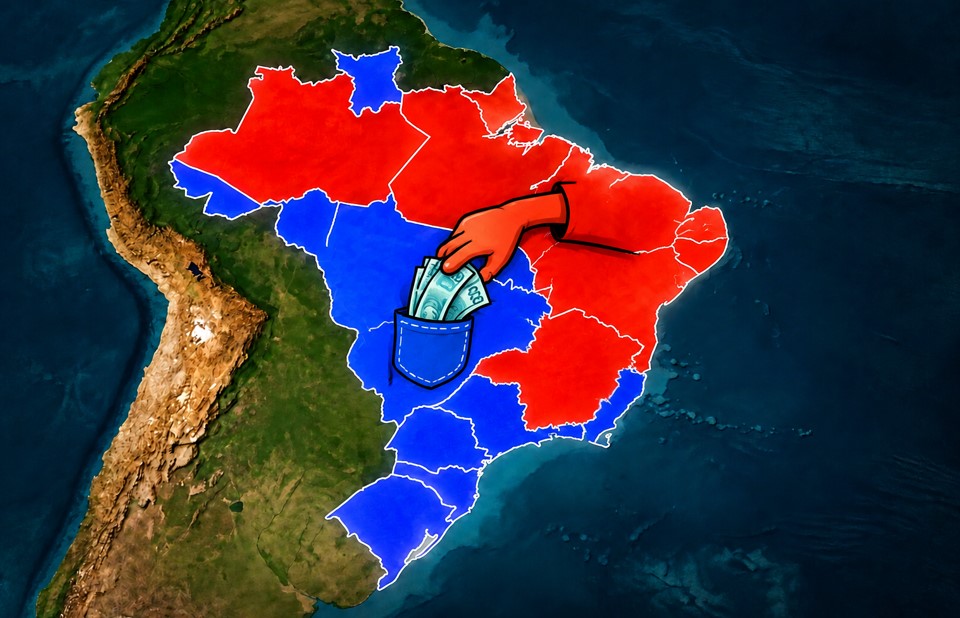
This has never been clearer than in Brazil’s electoral map: in the “red” areas, the dependents reside, while in the “blue” areas, the workers live—they vote in diametrically opposite ways, yet the dependents always win. Workers and producers have no way to compete, nor can they organize politically on equal footing with those who depend on the state.
It is clear that neither Ruth Cardoso nor the successive left-wing governments concerned themselves with a fundamental tenet of governance—one which, in fairness, no bureaucracy anywhere in the world ever bothers to uphold. This principle dictates that no recipient of government handouts should be permitted to vote, as doing so would effectively allow them to cast a ballot regarding the portion of others’ income that is being transferred to them (a rule that should likewise apply to the entire bureaucratic apparatus of the civil service, subsidized business owners, and so on).
Brazilian politics has become a flawed system—two sides of the same coin—where the Right and the Left compete over who can offer the largest increases to the Bolsa Família welfare program. Even during the administration of Jair Bolsonaro (2018–2022)—which occurred during a brief interlude in the sequence of left-wing governments—a substantial increase in the value of these benefits was implemented; yet, even then, it failed to secure the votes of the recipients. Election campaigns have devolved into a contest of threats, with each side warning that its opponent will reduce or eliminate these benefits, forcing the other side to defend itself by promising to maintain or even increase them. Those who receive these benefits have consistently refused to switch sides, preferring the certainty of what they have over the uncertainty of an alternative.
As the epigraph I chose for this text suggests, a left-wing government will always rely on the support of those who depend upon it—and there is no political path to change this until the productive sector has been completely suffocated.
Governments do not collapse without first breaking the very society that sustains them.
***
Related
- Lula’s historic fourth-term win (after losing the first round) and Flávio Bolsonaro’s refusal to concede / call for annulment over the late extension of voting hours:
https://www.reuters.com/world/americas/brazil-heads-polls-runoff-between-leftist-lula-bolsonaro-jr-2026-10-25/ - Lula won in 93 of the 100 municipalities most dependent on Bolsa Família (72% of valid votes in that group):
https://ndmais.com.br/politica/bolsa-familia-lula-vence-93-das-100-cidades-mais-dependentes/ - Pre-election polling showing a sharp split: Lula at ~68–69% among Bolsa Família beneficiary households vs. trailing among non-beneficiaries:
https://veja.abril.com.br/brasil/a-diferenca-na-intencao-de-voto-em-flavio-e-lula-entre-quem-recebe-e-nao-recebe-bolsa-familia-segundo-a-pesquisa-btg-nexus/ - Analysis of Lula’s strength in high-dependency / high-Bolsa Família municipalities (and interaction with evangelical share):
https://oglobo.globo.com/politica/eleicoes-2026/noticia/2026/10/27/bolsa-familia-conecta-lula-a-evangelicos-e-petista-avanca-nas-cidades-dependentes-do-auxilio-com-mais-fieis.ghtml















 Alessandro Fusillo
 Andreas Tögel
 David Dürr
 Doug French
 Fernando Chiocca
 Greg Morin
 Hans-Hermann Hoppe
 Jay Baykal
 Jayant Bhandari
 Jeff Deist
 Jeffrey Barr
 Juan Fernando Carpio
 Ken Yamarashi
 León Isidoro
 Martin Cabrera
 Nick Hoppe
 Oscar Grau
 Peter Wong
 PFS
 scholarium
 Saifedean Ammous
 Sean Gabb
 Sean Ring
 Stephan Kinsella
 Stéphane Geyres
 Thomas Jacob
 Tom DiLorenzo

Follow Us!