George F. Smith argues that small-government conservatives and libertarians lack a consistent political principle, since nearly every political camp concedes the State some role. Except for the Austrian School, economists claim the market is rife with hazards that only a coercive monopoly can fix. Yet interventionism fails on the evidence, and, as Kolko and Rothbard showed, it was always about special privilege rather than justice. A free market could supply education, defense, roads, and sound money without compulsion; it is already the real “government” running most of our daily lives. So don’t settle for limiting the State. Eliminate it.
From George F. Smith, “Don’t Settle for ‘Limited’ Government,” LewRockwell.com (May 16, 2026):
“A man is no less a slave because he is allowed to choose a new master once in a term of years.” — Lysander Spooner
“The sole invariable characteristic of the State is the economic exploitation of one class by another.” — Albert Jay Nock
“The State, by its very nature, must violate the generally accepted moral laws to which most people adhere.” — Murray Rothbard
There are people who fight for smaller government and call themselves conservatives or libertarians. They write, speak, join clubs, talk with friends and neighbors or otherwise promote their convictions about the dangers inherent in too-large a state. It’s hard for any freedom-lover not to sympathize with them to an extent, until you consider their lack of political principle.
Any given libertarian or conservative would almost certainly oppose what is called the Deep State, which a friend described thusly:The “Deep State” refers to entrenched networks within government institutions — intelligence agencies, military leadership, bureaucracy, regulatory bodies, contractors, financial interests, and allied private organizations — that possess continuity, influence, and institutional self-interest beyond election cycles, and which can shape or resist policy regardless of the wishes of elected leaders.
The Deep State is the overripe version of the National Security State under which we did not choose to live because it makes the military sovereign. Small government people would almost certainly say it’s the chief cause of havoc in the world for overthrowing democratically-elected governments and creating military crises.
Beyond that, it’s hard to identify a political position that unites or separates them. Some libertarians such as David Stockman support the Federal Reserve as originally conceived, while blasting it in its current form, and there are conservatives such as Pat Buchanan who regard FDR’s Good War as unnecessary.
Is there any agreement among all political spokespeople, from extreme left to extreme right?
Yes, quite obviously there is. They all see a role for the state in civilized human affairs.
And there is one other position that unites them, closely aligned with the first: Their distrust of the free market.
With the exception of the Austrian School, economists of every stripe claim trade is rife with hazards that only the imposition of a violent monopoly can resolve. Free markets, in other words, are in need of the state’s “guns and badges” to prevent or break-up other monopolies, support compulsory schooling, create and support medical, banking, and other cartels, provide monetary policymakers who, by trashing the purchasing power of the dollar, will prevent crises such as the ones in the 1930s and 2007–2008, criminalize going to work or leaving one’s home during a crisis, while providing exemptions for state-approved (“essential”) businesses, and anything else that will keep the market working in the manner it prefers.
Without turning to theory, evidence alone fails to vindicate interventionism. For details of interventionism’s more recent failures, see the Independent Institute’s Reset Report or Downsizing the Federal Government, though neither site is a champion of unhampered (laissez-faire) markets. For a consistent free market perspective, see the Mises Institute’s vast collection of interventionism critiques from an Austrian economics viewpoint.
Related
- Hans-Hermann Hoppe, “On the Impossibility of Limited Government and the Prospects for a Second American Revolution,” Mises Daily (June 28, 2008) — the Constitution’s grant of taxing and legislative power made limited government impossible; the way out is bottom-up secession, with competing private insurers providing protection and justice.
- Idem, “State or Private Law Society,” HansHoppe.com (May 9, 2011) — the state as territorial monopolist of ultimate decision-making, versus the alternative of a private law society.
- Idem, “The Private Production of Defense,” Journal of Libertarian Studies 14, no. 1 (Winter 1998–99) — why security, the supposed paradigm “public good,” is better supplied by competing insurers than by a monopolist state.
- Idem, “Anarcho-Capitalism: An Annotated Bibliography,” LewRockwell.com (Dec. 31, 2001) — Hoppe’s guide to the essential anarcho-capitalist literature.
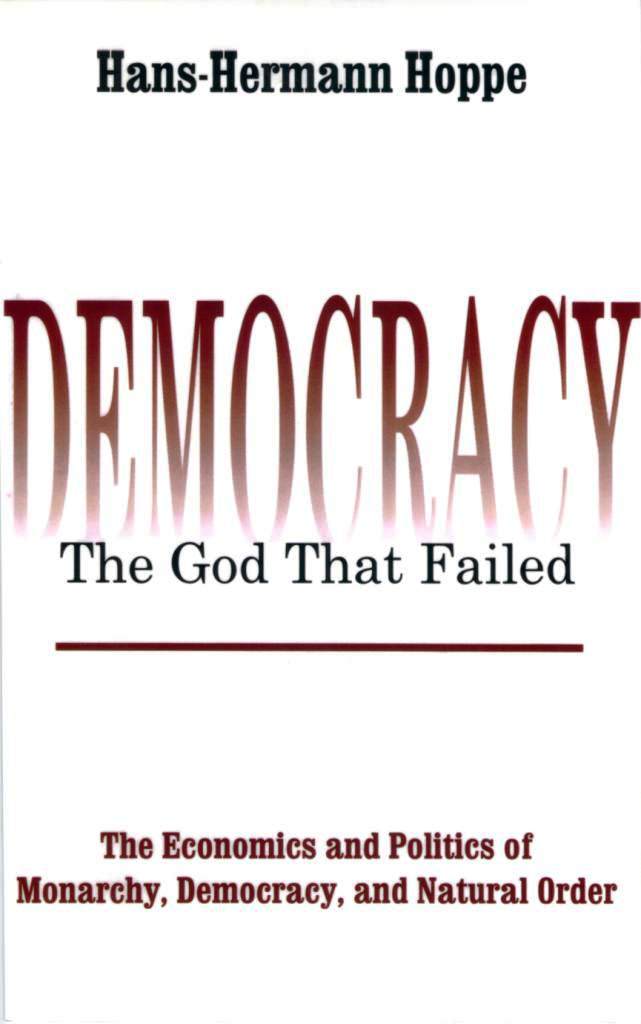
- Idem, Democracy: The God That Failed (New Brunswick, N.J.: Transaction
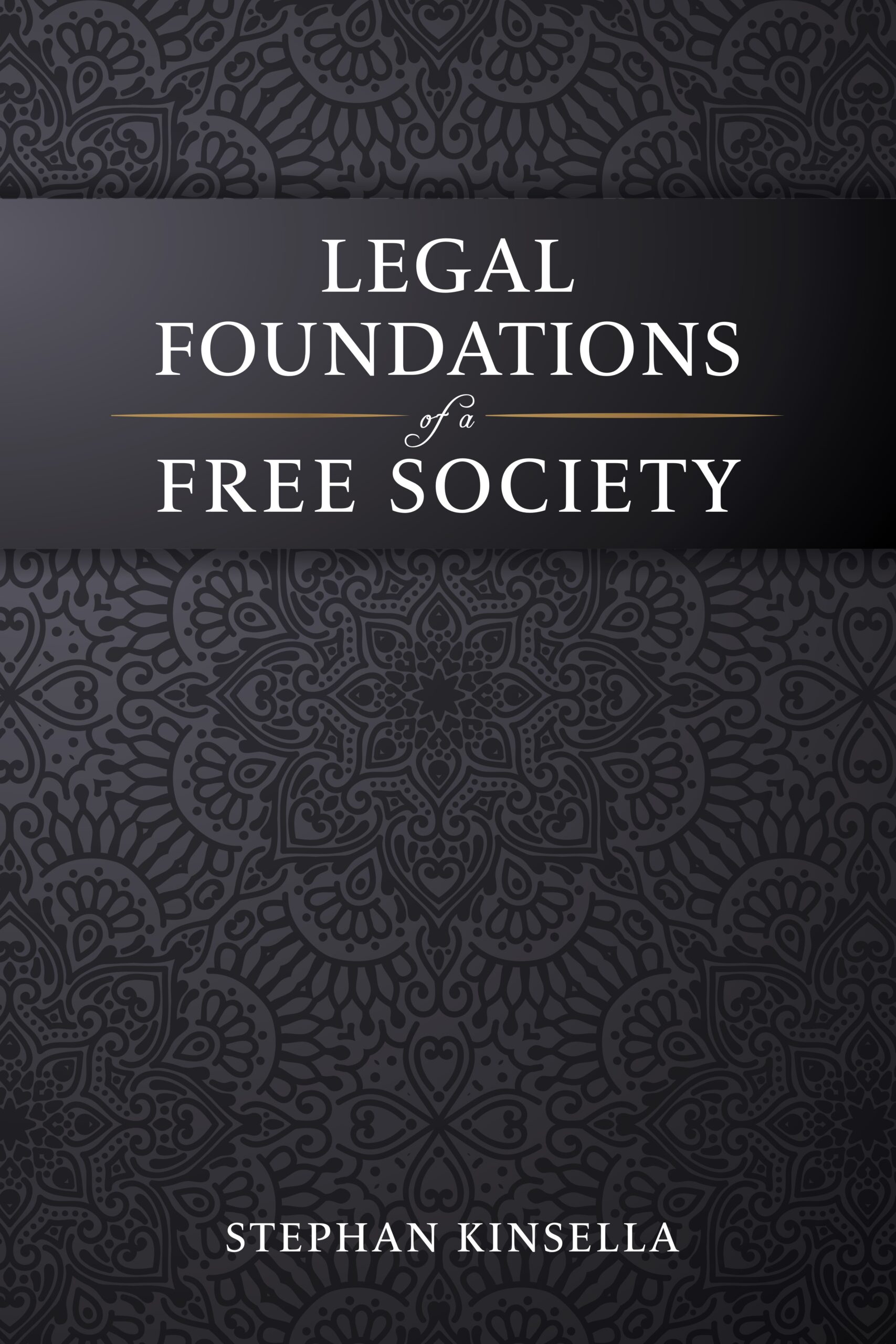
- Stephan Kinsella, “What It Means To Be an Anarcho-Capitalist,” LewRockwell.com (Jan. 20, 2004), reprinted as ch. 3 of Legal Foundations of a Free Society (Houston: Papinian Press, 2023) — anarchism is an ethical stance, not a prediction: if you oppose aggression, you oppose the state, which necessarily aggresses through taxation and by outlawing competing defense agencies.
- Idem, “The Nature of the State and Why Libertarians Hate It,” StephanKinsella.com (May 3, 2010) — the state as institutionalized aggression, drawing on Oppenheimer’s “political means,” Nock, Rothbard, and Hoppe; quibbles over the word “government” are merely semantic.
- Idem, “Why Should the Government Be Limited?,” Mises Blog (Sept. 28, 2011) — once you grant that the state is a legitimate service provider, there is no principled reason for it to limit its taxation; “limited government” is unrealistic.
- Idem, “The Irrelevance of the Impossibility of Anarcho-Libertarianism,” Mises Blog (Aug. 20, 2009) — calling anarchy “impossible” is a normative confusion, like saying crime is acceptable because it will never be eliminated.
- Idem, “Attention Minarchists: Mind Your Manners (2008),” StephanKinsella.com (Aug. 2, 2026) — minarchists, who tolerate some state aggression, are quasi-libertarians and should stop scolding anarchists as unrealistic.
- Idem, “Then and Now: From Randian Minarchist to Austro-Anarcho-Libertarian,” StephanKinsella.com (Feb. 6, 2010) — my own path from trying to justify minarchy in 1989 to anarchism soon after.
- Idem, “Michael Malice’s The Anarchist Handbook: Supplemental Readings,” StephanKinsella.com (May 20, 2021) — a reading list of anarcho-libertarian classics to accompany Malice’s anthology.














 Alessandro Fusillo
 Andreas Tögel
 David Dürr
 Doug French
 Fernando Chiocca
 Greg Morin
 Hans-Hermann Hoppe
 Jay Baykal
 Jayant Bhandari
 Jeff Deist
 Jeffrey Barr
 Juan Fernando Carpio
 Ken Yamarashi
 León Isidoro
 Martin Cabrera
 Nick Hoppe
 Oscar Grau
 Peter Wong
 PFS
 scholarium
 Saifedean Ammous
 Sean Gabb
 Sean Ring
 Stephan Kinsella
 Stéphane Geyres
 Thomas Jacob
 Tom DiLorenzo

Follow Us!